
Custom Cleaning Brush
SS316 Furnace Roller Brush
SS316 furnace roller brush for high-temperature industrial cleaning. 200 mm diameter, 1600 mm face, SS316 wire bristles, quick-change coupling.
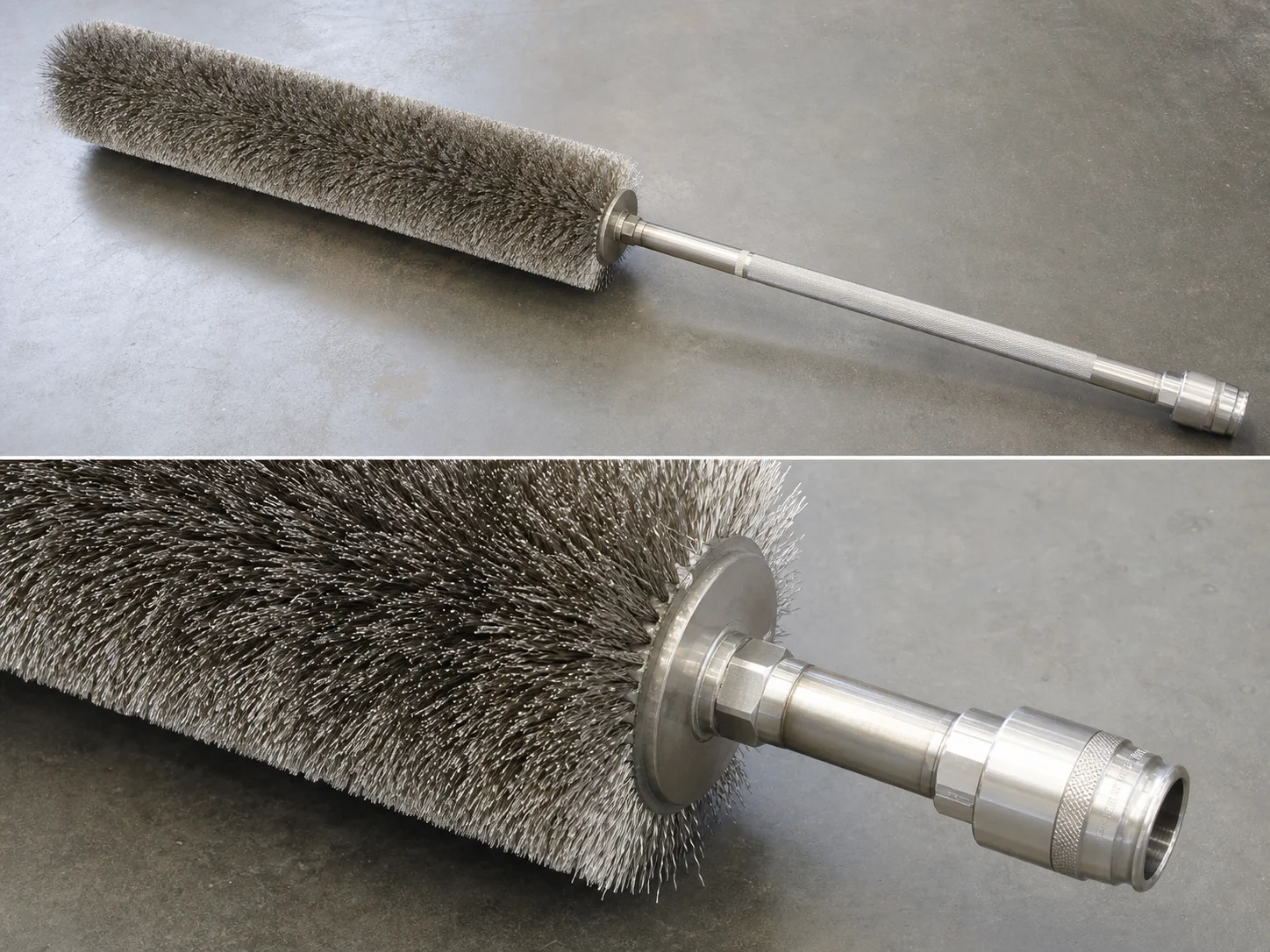
Large-format brush
100 pcs
Minimum order
Built one at a time on a core or channel: full-width rollers, sweeper brooms and long strip.
Production lead time, once the specification is confirmed
- Up to 100 pcsWithin 20 days
- 101–1,000 pcsWithin 30 days
- Over 1,000 pcsConfirmed with your quotation
Peak season can extend these times; the shipping date is confirmed in writing with your quotation. Sampling and shipping are quoted separately.
A motor-driven cylindrical roller brush built with SS316 wire bristles for continuous cleaning of furnace rollers, hearth rollers, and product surfaces in high-temperature industrial lines. It removes oxide scale, dust, and process residue without damaging the base roller surface and installs quickly with a quick-change coupling to minimize line downtime.
What can this brush do for you?
Withstand continuous furnace operating temperatures
SS316 wire retains useful mechanical stiffness and corrosion resistance at elevated temperatures where carbon steel wire would anneal, oxidize rapidly, or lose brushing pressure. This means the roller keeps a consistent cleaning contact across long production runs instead of going soft after the first heat cycle.
Remove oxide scale without cutting into the roller surface
The wire diameter and fill density are selected to break loose light-to-medium oxide scale, furnace dust, and loosely bonded residue while leaving the base metal of the furnace roller intact. For lines where roller surface finish directly affects product quality, this controlled contact prevents the gouging and scratching that a stiffer carbon steel or knotted wire brush would cause.
Survive acidic and humid furnace atmospheres
SS316’s molybdenum content gives it better resistance to chloride-bearing moisture and weak acidic fumes than SS304 or plain steel. In furnace zones where condensation forms during cool-down or where combustion byproducts create a mildly corrosive environment, the brush does not rust between runs or shed corroded wire fragments onto the product line.
Change out quickly with a quick-change coupling
The roller mounts to the drive shaft through a quick-change coupling, so operators can replace a worn brush, switch to a different wire diameter, or clear a jam without unbolting a multi-part shaft assembly. On a continuous furnace line, this keeps cleaning maintenance to minutes instead of a scheduled shutdown event.
Provide uniform cleaning pressure across the full roller face
The cylindrical construction with evenly spaced wire fill distributes contact force along the entire brush face. This matters most on wide furnace rollers: a hand brush or segmented tool cleans only a narrow band at a time, while this roller cleans the full working width in a single rotation, producing a more uniform surface condition.
What is a SS316 Furnace Roller Brush?
A SS316 Furnace Roller Brush is a rotating cylindrical cleaning tool that installs directly onto a furnace line, conveyor, or roller maintenance station. Instead of a handle, the brush has a central shaft that couples to the drive motor. As the brush rotates, SS316 wire bristles sweep across the surface of a furnace roller, hearth roller, or the underside of a moving product to dislodge oxide scale, dust, and other loose residues that accumulate during heating cycles.
The brush is not a hand tool. It is an inline or offline cleaning component designed for continuous rotation at a controlled speed. In most installations it is positioned to contact the furnace roller while the roller is still turning, or it is mounted in a dedicated roller cleaning station that rotates the roller against the brush. Because the brush itself is driven, the operator does not apply manual pressure; the brush rotation speed and the engagement depth between brush and roller control the cleaning force.
The SS316 wire bristles are the primary working element. The wire diameter, trim length, and fill density determine how aggressively the brush cleans and how much heat it can tolerate before the bristles lose their spring. The central core is also made from AISI 316 stainless steel so that the entire rotating assembly remains corrosion-resistant, including the shaft area that sits close to the furnace heat or process fumes.
This is a tool for maintaining furnace rollers and the product surfaces that pass over them. It removes the light, friable oxide layer and loose contamination that builds up between furnace runs. It is not a replacement for shot blasting, chemical descaling, or grinding when the roller has developed a thick, hard, tightly bonded scale layer larger than a few hundred microns. In those situations the brush can be used as a finishing step after heavier mechanical removal, but it will not strip heavy mill scale on its own.
Technical Specifications
The following table lists the standard configuration for this roller brush. All dimensions and wire parameters can be adjusted for a specific furnace line.
| Parameter | Standard Configuration |
|---|---|
| Brush outer diameter | 200 mm |
| Brush face length | 1600 mm |
| Brush shape | Round (cylindrical) |
| Bristle / wire material | SS316 stainless steel wire |
| Core / body material | AISI 316 stainless steel |
| Wire diameter | 0.2 – 0.5 mm (selected for the residue type and roller surface finish) |
| Trim length | 20 – 45 mm (set to control stiffness and heat retention) |
| Fill density | Standard or high density, depending on cleaning demand |
| Mounting / connection | Quick-change coupling on one or both shaft ends |
| Shaft end style | Keyed, splined, or custom quick-change adapter |
| Maximum continuous operating temperature | Up to 400°C (752°F) for short cycles; derate for prolonged exposure above 300°C |
| Rotational speed | Typically 100 – 800 RPM depending on line speed and roller size |
| Balancing | Dynamically balanced for operation up to the rated speed |
| Brush type | Custom Roller and Conveyor Brushes |
| How it is driven | Machine-driven, mounted in the equipment |
| Cleaning target | roller hearth furnace, continuous annealing and normalizing line, and glass tempering and ceramic kiln roller conveyor cleaning |
| Surface or part | roller, conveyors, glass, metal, ceramic, plates, tubes, and profiles |
| Residue or debris | dust, oxide, scale, oxide scale, process residue, particles, powder, and rust |
The standard brush length and diameter shown above can be changed to match the furnace roller width, the available mounting space, and the required contact arc. Quick-change coupling designs are configured to fit the customer’s existing drive shaft or roller journal.
Where does this brush work best?
- Roller hearth furnaces in steel, stainless steel, and specialty alloy heat treating, where oxide and dust from the product build up on the hearth rollers and transfer back onto the strip or plates.
- Continuous annealing and normalizing lines that run strip, wire, or tube through a furnace on driven rollers; the brush cleans the rollers offline during scheduled maintenance to restore surface finish.
- Galvanizing and coating lines where the entry or exit rollers pick up zinc dust, oxide, or dross particles that must be removed before they mark the coated surface.
- Glass tempering and ceramic kiln roller conveyors where roller surfaces collect fine particles, glass chips, or glaze dust that cause product defects.
- Powder metal sintering and brazing furnace lines where loose metallic powder and binder residue adhere to the conveyor rollers and must be swept off without contaminating the next batch.
- Any high-temperature conveyor system where rollers are exposed to heat, combustion byproducts, or process dust and where a corrosion-resistant wire brush is needed to prevent rust contamination on the product.
How do I choose the right one?
Choose this brush configuration by matching the brush to the roller, the residue, and the operating environment. The following decision points will help you specify a roller brush that cleans without damaging the line.
Start with the roller dimensions
Measure the width, diameter, and surface profile of the furnace rollers you need to clean. The brush face length should cover the full contact width of the roller, or slightly exceed it, so that the entire cleaning surface is swept in one pass. A brush face that is shorter than the roller will leave uncleaned bands. A brush outer diameter that is too small relative to the roller will require a higher rotational speed or deeper engagement to achieve the same surface contact, which increases wire wear.
Select the wire diameter for the residue and surface finish
Thinner wire (0.2 – 0.3 mm) removes light dust and loose oxide with a softer brushing action. It is the better choice when the roller surface is polished, coated, or sensitive to scratching. Thicker wire (0.4 – 0.5 mm) applies more pressure per bristle and removes heavier scale or more tightly bonded residue, but it also wears the roller surface faster. If the roller will be reground later, a more aggressive wire may be acceptable; if the roller must stay smooth, stay with thinner wire.
Match the core and shaft to the mounting
Check the existing drive coupling on your furnace line. The brush shaft ends must interface with that coupling without adapters, excessive runout, or axial play. Quick-change couplings are faster to swap but require the matching coupling half on the drive side. If the line uses a keyed or splined shaft, the brush shaft must be machined to that exact profile.
Consider the temperature and atmosphere
SS316 wire loses some stiffness above 300°C, so prolonged exposure at high temperature reduces brushing effectiveness. For continuous cleaning inside the furnace hot zone, specify a higher fill density, a shorter trim length, or a larger wire diameter to compensate for the stiffness loss. For intermittent cleaning during cool-down, the standard configuration is usually adequate. If the furnace atmosphere contains strong acids, chlorides, or sulfides, SS316 may be sufficient; for extreme corrosion, a higher alloy or coated wire may be required.
When to choose a different brush or cleaning method
Use a nylon, PBT, or natural fiber roller brush if the roller surface cannot tolerate any metallic contact or if the residue is soft, sticky, or oil-based. Use an abrasive roller or grinding wheel if the roller has heavy, hard, or welded-on scale that a wire brush cannot break. Use chemical descaling or shot blasting for complete scale removal before the roller returns to service. This SS316 wire roller brush is intended for regular maintenance cleaning of light-to-medium oxide and dust, not for rebuilding damaged roller surfaces.
Can I customize this brush?
Furnace roller brushes are rarely one-size-fits-all. We can adjust the brush to your roller dimensions, your residue, and your existing drive interface. To configure a custom brush, provide the roller width and diameter, the residue type and thickness, the operating temperature, the line speed or desired brush RPM, and a drawing or photo of the current mounting arrangement.
We can change:
- Brush geometry — outer diameter, face length, end chamfers, spiral or straight wire fill pattern, and multi-diameter profiles if the roller has a crowned or stepped surface.
- Wire fill — wire diameter, trim length, fill density, wire direction, and mixed wire configurations (e.g., stiffer wire at the edges where scale accumulates).
- Core and shaft — SS304, SS316L, or higher alloy core; solid or hollow core to reduce rotating mass; custom shaft length, keyway, spline, or quick-change adapter.
- Quick-change coupling — matching half-coupling, torque rating, axial retention, and safety locking mechanism.
- Special requirements — dynamic balancing to specific RPM, anti-spark bronze or copper alloy wire inserts for explosive atmospheres, or wire replacement modules that allow the core to be reused.
- Project support — material certificates for the SS316 wire and core, hardness and corrosion test reports, drawing approval, and third-party inspection for critical furnace installations.
How do you tell when a SS316 furnace roller brush is worn out?
How do I know if the brush is engaging the roller with the right force?
After installation, run the brush at the specified speed and observe the contact area. The brush should deflect the wire tips slightly against the roller without flattening the fill completely. If the wire tips barely touch, the engagement depth is too small and scale will remain. If the wire lays flat against the core, the engagement depth is too large and both the brush and the roller will wear prematurely. Adjust the brush position until the wire tips are visibly working but still spring back after each rotation.
What is the maximum temperature this brush can handle continuously?
SS316 wire starts to lose significant stiffness above about 300°C (572°F). For continuous operation inside a furnace hot zone, keep the brush below that temperature or derate the cleaning expectation. For short cleaning passes during cool-down, the brush can tolerate spikes up to 400°C (752°F) without permanent deformation. For sustained temperatures above 400°C, a different wire alloy or a non-metallic brush may be required.
How can I tell when the brush needs to be replaced?
Check the brush after every 40 – 80 hours of use, depending on the line. Look for reduced wire length of more than 30% from the original trim, permanently bent or splayed wires that no longer spring back, or visible breakage of individual wires. Also check the core and shaft for cracks, corrosion under the wire fill, or runout beyond the balancing specification. Replace the brush when the cleaning quality drops or when the wire fill no longer covers the roller uniformly.
Will this brush remove heavy furnace scale or only light dust?
This brush is designed for light-to-medium oxide scale, furnace dust, and loose contamination that builds up between runs. It will not remove thick, hard, tightly bonded mill scale or fused deposits. If the roller has a heavy scale layer, use mechanical grinding, shot blasting, or chemical descaling first, then use this brush as a final surface conditioning step.
Can I run this brush on a chrome-plated or ceramic-coated furnace roller?
Yes, but you must reduce the wire diameter and engagement depth. Chrome plating and ceramic coatings are harder than the base steel but can still be scratched by contact with thicker steel wire. Use 0.2 mm or thinner wire, reduce the engagement depth by 50% compared to an uncoated steel roller, and test on a scrap roller or a short section before putting the brush into full production.
What should I check before installing the brush on the line?
Verify that the brush shaft coupling matches the drive coupling exactly, that the rotational direction matches the wire lay, and that the brush is dynamically balanced for the intended RPM. Inspect the brush for loose or protruding wires, and make sure the mounting guard is in place to contain any broken wires. Run the brush briefly without load to confirm smooth rotation and no vibration before engaging the roller.
Guides that go deeper on this
Abrasive Nylon Grit and Filament Selection
Read this guideGuideBrush Roller Conveyor Mistakes with Dry Dust
Read this guideGuideBrush Speed, Engagement, and Heat
Read this guideGuideConveyor Belt Cleaning Brush Design
Read this guideGuideFloor Scrubber Brush Selection: Disc Brush vs Roller Brush
Read this guideCustom Manufacturing RFQ
Describe Your Application
For an accurate quotation, please provide the main dimensions, material preference, working surface, residue, quantity, and a drawing or photo.
Drawing or photo optional — it speeds things up, it does not gate the enquiry.
Custom Brush RFQ
Send Your Brush Project
Upload a drawing, product photo, or sample photo and provide the core dimensions and cleaning conditions.
“We need a brush to remove wet residue from a stainless steel conveyor, about 800mm wide. The current brush wears quickly. We can send photos.”
“We sell drinkware and need a cleaning brush to include with the product. Quantity around 5,000 pieces.”