
What Is a Cement Conveyor Cleaning Brush?
A cement conveyor cleaning brush is an industrial brush assembly designed to contact the belt surface—especially the edges—and dislodge accumulated dust, fines, or sticky residues. In cement plants, these brushes are typically mounted on return idlers, pulleys, or dedicated brush holders. They can be rotary brushes driven by the belt or stationary scraper-style brushes. The primary goal is not polishing or deep cleaning but preventing material carryback that leads to belt mistracking, excessive roller wear, and housekeeping issues.
Why Belt Edge Contamination Matters in Cement Plants
Belt edge contamination is a progressive problem. As fines accumulate along the belt edges, the belt’s tracking shifts, causing uneven wear on the belt and idlers. Spilled material piles under the conveyor and must be removed manually or with secondary cleanup systems. In wet or humid areas, accumulated dust can harden into concrete-like deposits that are difficult to remove. By placing a correctly specified cleaning brush at the right location, you can:
- Reduce unplanned downtime from belt misalignment.
- Lower cleanup labor and water consumption.
- Extend belt and idler life by minimizing abrasive edge contact.
- Improve safety by eliminating spillage slip hazards.
Common Brush Types and Material Options for Cement Conveyor Cleaning
Not every conveyor brush works well in a cement environment. High heat, abrasive dust, moisture, and occasional chemical exposure narrow the acceptable materials. The table below compares the most common brush material and construction options used for belt edge cleaning in cement plants.
| Brush Material | Stiffness | Best for Residue Type | Mounting Style | Temperature Limit | Notes |
|---|---|---|---|---|---|
| Nylon (solid or abrasive-filled) | Medium to stiff | Dry, non-sticky dust; moderate buildup | Strip brush with metal channel; rotary brush with shaft | Up to 210°F (99°C) | Good wear resistance; can embed silicon carbide grit for extra abrasion. |
| Polypropylene | Soft to medium | Light dust; wet but non-abrasive residue | Strip brush; often used in food-grade or chemical-exposed areas, but limited in cement heavy-duty | Up to 180°F (82°C) | Chemical-resistant; not ideal for high-abrasion cement clinker. |
| Wire (carbon steel or stainless) | Very stiff | Hardened or sticky buildup; high temperature | Rotary brush with metal core; tube brush style | Up to 300°F (149°C) for carbon steel; higher for stainless | Aggressive; can damage belt if misapplied. Use only on durable rubber belts. |
| Horsehair or Tampico | Soft to medium | Fine dust; polishing or light wiping | Strip brush with wood or plastic back | Up to 170°F (77°C) | Not aggressive enough for cement edge buildup; more suited for clean-side secondary cleaning. |
| Abrasive Nylon Web | Medium-high | Caked-on residue; moderate temperature | Rotary brush or flap-style wheel | Similar to nylon | Good compromise between cleaning power and belt wear. |
In addition to filament material, pay attention to the brush core and mounting. Metal cores (steel, stainless) offer durability in high-temperature or high-torque applications, while plastic or composite cores reduce weight and corrosion risk in wet conditions. Mounting options include threaded-end studs for rotary brushes, bolt-on strip brushes with metal channels, and clamp-on assemblies that attach to conveyor stringers without welding.
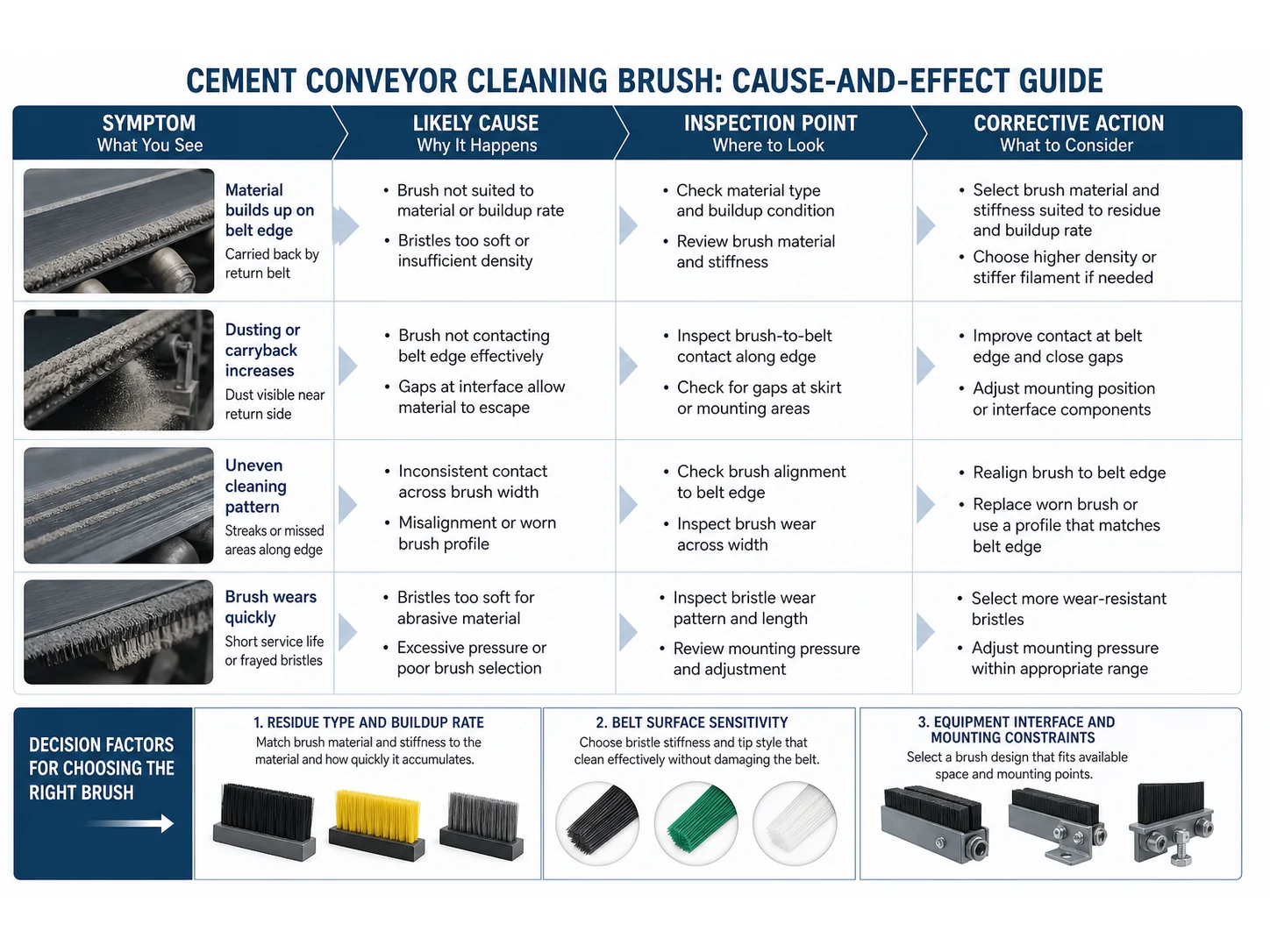
How to Choose the Right Cement Conveyor Cleaning Brush: Decision Factors
Before contacting a supplier, walk through these selection factors. They will help you describe your application clearly and reduce the chance of mis-specified brushes that wear too fast, damage the belt, or fail to clean effectively.
1. Residue Type and Buildup Rate
Is the contamination dry dust, sticky slurry, or hardened concrete-like crust? Dry dust can often be managed with a medium-stiff nylon brush, while hardened buildup may require an abrasive-filled brush or even a wire brush. Consider how fast the buildup occurs between cleaning cycles; a high-buildup area may need a more aggressive brush material or a larger brush diameter to maintain contact as the bristles wear.
2. Belt Surface Sensitivity
Cement conveyor belts range from heavy-duty rubber with thick covers to fabric belts used in lighter transfers. Wire brushes are effective but can scuff or cut thin covers. If the belt is expensive or prone to cover damage, start with an abrasive nylon brush and increase aggressiveness only if needed. Always test on a small section first when changing brush types.
3. Equipment Interface and Mounting Constraints
Measure the available space around the belt edge. A rotary brush needs room for a shaft, bearings, and possibly a motor if driven. A stationary strip brush needs a sturdy mounting bracket that can handle vibration. Check the conveyor stringer design—some plants use pre-drilled brackets; others require clamp-on mounts. The brush length, trim length (bristle length), and overall diameter must fit into the existing opening without interfering with belt movement or structure.
4. Wet or Chemical Exposure
In cement plants, water sprays are common for dust suppression. If the brush operates in a wet environment, choose materials that resist moisture absorption and degradation. Nylon absorbs water and can soften or swell; polypropylene is better in constant wetness, but may lack abrasion resistance. Stainless steel wire resists corrosion, while carbon steel wire will rust quickly. Consider sealed bearings for rotary brushes in wet conditions.
5. Hygiene and Safety Expectations
While not typically a food-grade environment, cement plants handling blended cements with additives or operating in closed buildings may have cleanliness standards. Brushes should not shed bristles that can contaminate the product stream. Nylon and polypropylene filaments are less likely to break off than wire, but still need routine inspection. If metal contamination is a concern (e.g., before a magnetic separator), avoid wire brushes entirely.
6. Maintenance Frequency and Brush Life
How often can your team access the brush for inspection and replacement? In a high-production cement plant, minimizing maintenance stops is critical. A brush with a larger diameter and higher fill density will last longer but may cost more upfront. Adjustable mountings let you reposition the brush as it wears, extending service life. Ask potential suppliers for wear-rate data under similar conditions, or plan for a trial period.
7. Custom Size Requirements
Standard catalog brushes may not fit your conveyor. Custom brush length, diameter, and core design are common in cement applications. When ordering custom brushes, provide the exact belt width, edge clearance, and preferred mounting points. A dimensioned sketch, even a simple one, reduces miscommunication. Many manufacturers accept rough drawings and will create a technical drawing for approval before production.
Common Mistakes When Selecting a Cement Conveyor Cleaning Brush
- Choosing by cost drivers alone: A low-cost brush that wears out in two weeks costs more in labor and downtime than a slightly more expensive brush lasting six months.
- Ignoring mounting compatibility: A brush that does not fit the existing bracket leads to unsafe field modifications or delays.
- Using the wrong stiffness for the buildup: A brush too soft will not clean; a brush too stiff can damage the belt or overload the drive.
- Overlooking edge seal interference: Some belts have edge seals or tracking guides. The brush must be positioned to avoid catching on these features.
- Failing to test before large-scale rollout: Start with one conveyor, monitor results for a week, and adjust bristle material or mounting angle before expanding.
- Assuming all rotary brushes are equal: Rotary brush diameter, RPM (if driven), bristle trim length, and pattern density all affect performance. Provide full operating conditions to the supplier.
When a Standard Cement Conveyor Cleaning Brush Is the Wrong Choice
A cleaning brush is one component of a belt cleaning system. In some situations, a brush alone will not solve the problem:
- If the belt carries hot clinker above 300°F (149°C) continuously, even stainless wire brushes may lose temper or degrade, and a heat-resistant scraper or water-cooled cleaning system may be required.
- If sticky, hygroscopic materials (e.g., raw mix with high moisture) form thick cake layers, a brush may smear rather than remove. A combination of pre-cleaner scrapers and secondary brushes often works better.
- When the belt edge is already fraying or cracking, a brush can worsen damage by catching loose strands. Replace the belt or trim the edge first.
- If you need to meet strict dust emission regulations, a brush alone may not contain all dislodged dust. Pair it with a local dust collection or containment shroud.
In complex cases, ask the supplier for a drawing review or a sample test on your actual belt. Providing belt speed, material temperature, moisture content, and current edge condition will help the supplier recommend whether a brush, scraper, or combined system fits best. Never accept a guess: insist on application-specific engineering support.
Final Takeaway
Selecting a cement conveyor cleaning brush is not about finding the lowest-cost or most aggressive option. It is about matching brush material, stiffness, mounting, and size to the specific edge contamination conditions in your plant. Start by defining the residue type, belt sensitivity, and operating environment. Compare material options using a practical table like the one above, then test with a single unit before committing to a full rollout. This approach reduces belt wear, cuts maintenance costs, and keeps your conveyor lines running cleaner longer.
Frequently Asked Questions
What is the difference between a strip brush and a rotary brush for cement conveyor cleaning?
A strip brush is stationary, typically mounted in a metal channel along the belt edge, and cleans by friction as the belt moves past. A rotary brush turns against the belt, either driven by the belt itself or by an external motor, offering more aggressive cleaning action. Strip brushes are simpler and cheaper; rotary brushes are better for stubborn or fast-accumulating buildup.
How do I know if I need a nylon brush or a wire brush for my cement conveyor?
Use a nylon brush for general dry dust and moderate buildup on standard rubber belts. Switch to a wire brush only if the nylon fails to remove hardened deposits and you have confirmed the belt cover can tolerate the harsher contact. Always test on a small section first to check for belt damage.
Can I use the same brush for the belt edge and the belt surface?
Not necessarily. Edge brushes are often shorter and positioned differently than surface cleaners. A brush designed for the belt edge may need a different trim length, stiffness, and mounting angle to effectively reach the edge without interfering with belt tracking. Consult the brush manufacturer for the right configuration.
How often should I replace a cement conveyor cleaning brush?
Replacement frequency depends on brush material, belt speed, residue abrasiveness, and contact pressure. In a high-production cement plant, a well-specified nylon edge brush might last 3–6 months, while a wire brush may last longer but could require tension adjustments. Inspect brushes weekly at first and establish a replacement schedule based on wear measurements, not just time.
What is the best mounting position for a belt edge cleaning brush?
The ideal mounting position is on the return run just after the head pulley, where the belt is flat and tension is consistent. For rotary brushes, align the brush so it contacts the belt edge squarely, with slight pressure. For strip brushes, secure them against the belt edge with uniform gap. Ensure the brush does not interfere with idlers or belt tracking guides, and allow for adjustment as the bristles wear.
Technical References
- OSHA — Machine Guarding
- OSHA — Control of Hazardous Energy
- OSHA — Combustible Dust
- EPA — Particulate Matter Basics
- OSHA — Respirable Crystalline Silica
Which bristle material fits this job — Nylon PA, Rubber or Abrasive Nylon?
| Material | Continuous temperature (°C) | Peak temperature (°C) | Water absorption | Hardness |
|---|---|---|---|---|
| Nylon PA | 93 | 121 | 0.3–9% by PA grade and conditioning | Medium to firm; filament diameter and trim length control bending force. |
| Rubber | 100 | 130 | very low | Specified by compound and Shore hardness; published TPE families can span roughly 50–80 Shore A, but that is a product-family example rather than a universal rubber range. |
| Abrasive Nylon | 120 | 150 | 0.1–1.0% | Abrasive filament; stiffness and cutting level is controlled by PA base, grit type, grit size, filament diameter and trim height. |
| AISI 304 Stainless Steel Wire | 400 | 500 | 0% | Rockwell B 70–95 depending on temper and cold work |
| Polypropylene PP | 80–100 | 120–140 | ≤0.03% | Shore D 65–75 |
Figures as published by Brushtec / DuPont; Perlon; Alleima. Confirm the exact grade against the supplier datasheet before ordering.
What should replace Roller and Conveyor Brushes for cement conveyor cleaning brush?
- Roller and Conveyor Brushes — Roller and conveyor brushes hold cylindrical line contact across a working width, including helix-wound builds where the filament path is set to move loosened material toward one side; a strip brush holds the same line without rotating, so it seals or wipes but cannot carry residue along the width.
- Nylon PA — Compare Nylon PA with PP, PBT, PET. Change material when wet stiffness, temperature, chemical resistance, conductivity, particle shedding, or surface marking becomes the limiting factor.
- Rubber — Compare Rubber with Silicone elastomer, TPE, PVC profile, PVA sponge. Change material when wet stiffness, temperature, chemical resistance, conductivity, particle shedding, or surface marking becomes the limiting factor.
- Abrasive Nylon — Compare Abrasive Nylon with PP, PBT, PET. Change material when wet stiffness, temperature, chemical resistance, conductivity, particle shedding, or surface marking becomes the limiting factor.