
What Is a Mining Conveyor Belt Brush?
A mining conveyor belt brush is a motor-driven or passive roller brush that contacts the belt surface after the head pulley or inside the return run. It dislodges stubborn wet residue that scrapers alone cannot remove. Brushes use filaments (nylon, polyester, polypropylene, or wire) mounted on a core, rotated against the belt at a set interference or pressure. They are common in coal, copper, gold, phosphate, and aggregate operations where moisture turns carryback into a paste.
How Wet Material Carryback Challenges Brush Selection
Wet carryback is not simply “dirt on a belt.” It is often abrasive, chemically aggressive, and highly adhesive. Standard brush filaments may mat, wear too quickly, or embed grit that then scratches the belt. Water spray can soften some filament materials, while acidic or caustic process water can chemically degrade them. Temperature swings, freezing, and high-pressure washdowns add further stress. A brush that works perfectly on dry silica dust can fail within days on damp copper concentrate.
Common Types of Mining Conveyor Belt Brushes
While hundreds of custom designs exist, most mining brushes fall into a few categories:
- Rotary spiral brush – filament wound in a continuous spiral around a core; provides good cleaning with a sweeping action that moves material to one side.
- Strip brush in a holder – straight, replaceable brush strips clamped into a metal or plastic holder; easy to adjust and maintain.
- Full-face roller brush – densely filled bristles across the entire roller width; uniform contact, often used with internal water spray for wet cleaning.
- Combination brush-scraper – a secondary arm that holds both a polyurethane scraper blade and a brush segment; bridges the gap between scraping and finishing.
Comparing Brush Options for Wet Carryback
Use the table below to match brush characteristics to your wet carryback challenge. These are typical starting points, not exact specifications.
| Brush Type | Best For | Typical Filament Material | Typical Diameter | Stiffness / Hardness | Mounting Style | Maintenance Consideration |
|---|---|---|---|---|---|---|
| Rotary Spiral | Sticky clay, ore concentrate | Nylon 6.6 or polypropylene | 200–300 mm | Medium to firm | Flange or pillow block bearings | Spiral may wear unevenly; check end wear |
| Strip Brush in Holder | Moderate moisture, fine grain | Polypropylene or polyester | Strip height 50–100 mm | Soft to medium | T-slot or bolt-on channel | Easy to replace strips individually |
| Full-face Roller | High moisture, wide belts | Nylon or abrasive nylon | 300–500 mm | Medium to aggressive | Pillow block, driven or free-rolling | Cleans uniformly; may require more power |
| Combination Brush-Scraper | Heavy paste, sticky filter cake | Polyurethane blade + nylon brush | Varies | Scraper: firm; Brush: medium | Tensioned arm assembly | Two contact points to monitor |
Filament material choice is key: nylon handles wear and water well but can absorb moisture and swell; polypropylene is hydrophobic and chemical-resistant but less stiff; polyester offers a balance and resists rot; abrasive-impregnated nylon (e.g., silicon carbide) adds grit for stubborn buildup but increases belt wear risk.
How to Choose a Brush for Wet Material Conveyor Belts
Base your decision on real operating conditions, not catalog ratings:
- Residue type – fine clay needs a different filament stiffness than coarse, chunky slurry. Test with a sample brush if possible.
- Belt surface sensitivity – thin, mechanically spliced, or soft rubber belts can be damaged by aggressive filament; choose softer bristles and lighter interference.
- Equipment interface – check available mounting space, shaft size, and whether you need a driven brush or can use belt friction. Driven brushes often clean better but add maintenance.
- Wet or chemical exposure – use polypropylene or stainless steel core in corrosive environments; avoid absorbent filaments like natural fibers.
- Hygiene / washdown expectations – food‑grade or zero‑contamination mining (e.g., lithium) may require sealed bearings and antimicrobial filaments.
- Maintenance frequency – strip brushes allow quick single‑strip replacement; full‑face rollers often require full replacement. Balance uptime goals with brush cost.
- Custom size requirements – off‑the‑shelf brushes may not fit older conveyors; a supplier drawing review is essential to get core length, diameter, and mounting right the first time.
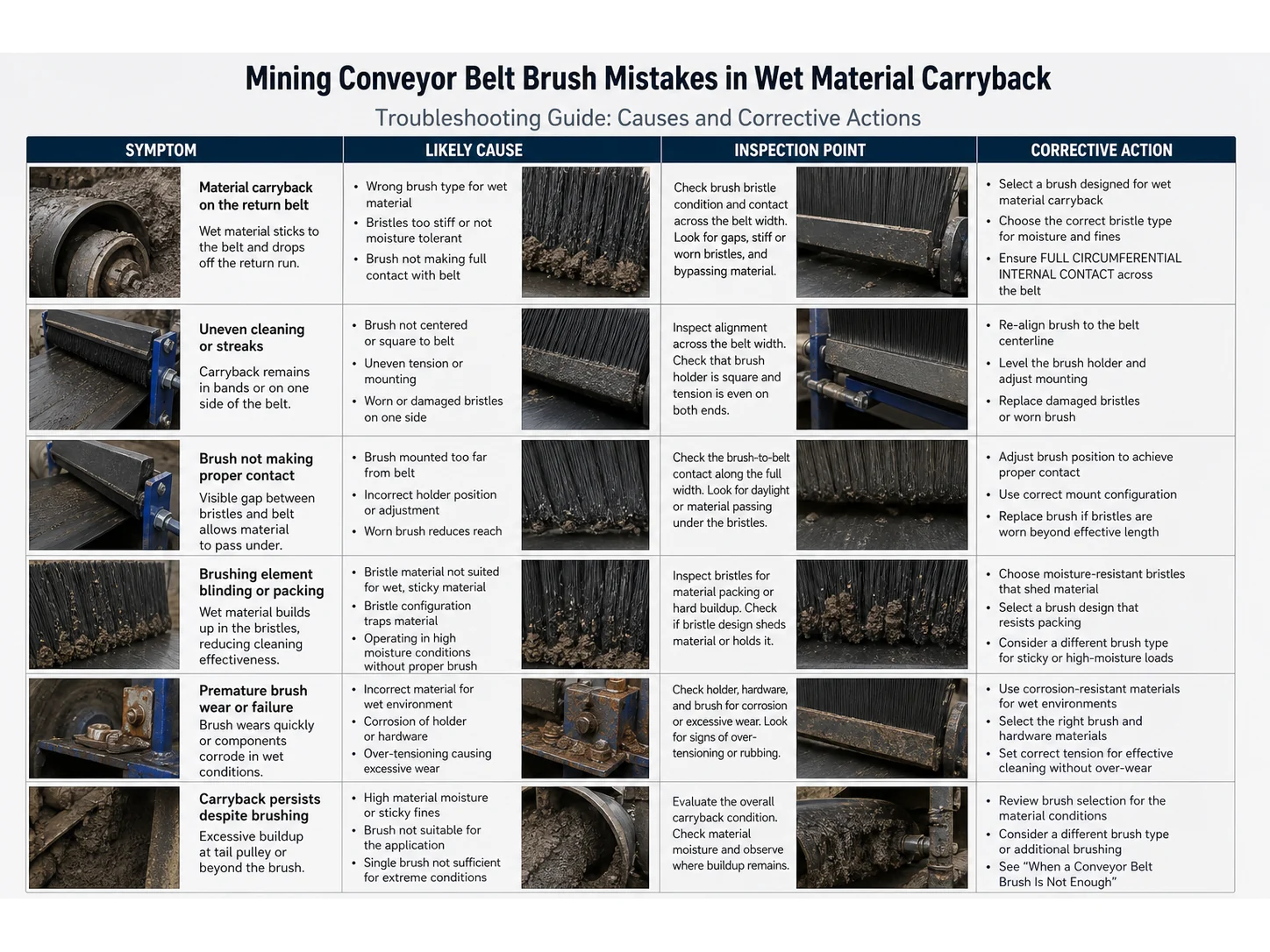
Common Mistakes When Selecting or Using a Mining Conveyor Belt Brush
Avoid these frequent missteps:
- Choosing filament by cost drivers, not by wet abrasion resistance. lowest-cost nylon filaments can wear out in weeks; a small cost difference avoids unscheduled downtime.
- Ignoring core material in wet environments. Plain steel cores rust and freeze bearings. Request stainless steel, galvanized, or polymer cores for wet service.
- Mounting without adjusting interference. A brush that barely touches the belt does nothing; too much pressure accelerates wear and overloads the motor. Set interference to manufacturer’s recommendation and check after 24 hours of run-in.
- Using a brush where a scraper is needed first. Brushes clean fines and thin films; heavy, wet sludge requires a primary polyurethane or carbide scraper ahead of the brush.
- Forgetting about belt direction and spiral hand. A spiral brush can push material toward bearings and wreck seals. Confirm rotation and hand direction before ordering.
- Skipping the sample test. Wet carryback behavior is unpredictable. Ask for a sample brush section and run it on your belt for at least one shift before committing to a full order.
When a Conveyor Belt Brush Is the Wrong Choice
A brush alone cannot solve every wet carryback problem. You likely need a belt cleaning system — not just a brush — when:
- The carryback is thick, heavy mud that clogs brush filaments immediately.
- Belt speed exceeds the brush’s effective cleaning range (typically above 3–4 m/s for standard driven brushes).
- The belt has deep mechanical splices or gouges that catch and tear filaments.
- Freeze‑thaw cycles cause carryback to turn into rock‑hard ice on the belt.
- Regulatory or environmental discharge limits require zero spillage (add a secondary scraper, belt wash box, and recovery system).
In these cases, combine a belt brush with a primary scraper, water spray bars, and possibly an engineered belt wash station. Always review the complete cleaning layout with an applications engineer.
Final Takeaway
Getting the right mining conveyor belt brush for wet carryback means matching filament material and stiffness to the residue, selecting a corrosion‑resistant core, dialing in interference, and planning for easy maintenance. Avoid the common mistakes of buying on cost drivers, ignoring environmental factors, and skipping the sample test. When carryback is extreme, a brush is part of a system — not the whole answer.
Frequently Asked Questions
What is the difference between a conveyor belt brush and a belt scraper?
A scraper uses a rigid or tensioned blade (polyurethane or carbide) to shear off bulk material, while a brush uses flexible filaments to clean fine, sticky residue. Brushes are better for final cleaning after a scraper.
Can I use the same brush for dry and wet carryback?
Not always. Wet carryback often demands harder, more chemical‑resistant filaments and a corrosion‑proof core. Dry dust may allow softer, economical materials. Assess moisture exposure before standardizing.
How do I measure for a custom mining conveyor belt brush?
Provide belt width, the available mounting space (distance from belt to chute wall), shaft center height, and belt speed. A drawing or photo of the existing mounting points helps the supplier ensure correct fit.
How often should I adjust or replace a conveyor belt brush?
Check interference weekly during the first month, then monthly. Replace filaments when they wear down to half their original length or when cleaning performance drops noticeably. Strip brushes may allow partial replacement.
What filament material is best for acidic water carryback?
Polypropylene is generally best because it resists most acids and absorbs almost no water. Nylon can work with mild acids but may swell. Always confirm chemical compatibility with the filament manufacturer.
Does a brush require its own drive motor?
A driven brush (with a small motor) gives more consistent cleaning and works at belt speeds below 1 m/s where passive rollers slip. A free‑rolling brush relies on belt contact and is simpler but less effective on wet, slippery belts.
Can a brush damage my conveyor belt?
Yes, if filament is too stiff, interference is excessive, or filament material is abrasive (e.g., silicon carbide‑impregnated). Always start with a lighter interference and monitor belt cover wear.
What’s the most overlooked factor when ordering a brush?
Core material. Many operators assume carbon steel is acceptable, but in wet mining environments, steel cores can corrode quickly, seize bearings, and cause unplanned downtime. Specify stainless steel or polymer cores from the start.
Technical References
- OSHA — Machine Guarding
- OSHA — Control of Hazardous Energy
- OSHA — Combustible Dust
- EPA — Particulate Matter Basics
- British Plastics Federation — Thermoplastics
Which bristle material fits this job — Nylon PA, AISI 304 Stainless Steel Wire or Abrasive Nylon?
| Material | Continuous temperature (°C) | Peak temperature (°C) | Water absorption | Hardness |
|---|---|---|---|---|
| Nylon PA | 93 | 121 | 0.3–9% by PA grade and conditioning | Medium to firm; filament diameter and trim length control bending force. |
| AISI 304 Stainless Steel Wire | 400 | 500 | 0% | Rockwell B 70–95 depending on temper and cold work |
| Abrasive Nylon | 120 | 150 | 0.1–1.0% | Abrasive filament; stiffness and cutting level is controlled by PA base, grit type, grit size, filament diameter and trim height. |
| Rubber | 100 | 130 | very low | Specified by compound and Shore hardness; published TPE families can span roughly 50–80 Shore A, but that is a product-family example rather than a universal rubber range. |
| Silicon Carbide Abrasive Nylon | 80–120 | 140–170 | 0.3–2.0% | Carrier Shore D 70–85; SiC Mohs Hardness Approximately 9.2 |
Figures as published by Brushtec / DuPont; Alleima; Perlon. Confirm the exact grade against the supplier datasheet before ordering.
What should replace Roller and Conveyor Brushes for conveyor belt?
- Roller and Conveyor Brushes — Roller and conveyor brushes hold cylindrical line contact across a working width, including helix-wound builds where the filament path is set to move loosened material toward one side; a strip brush holds the same line without rotating, so it seals or wipes but cannot carry residue along the width.
- Nylon PA — Compare Nylon PA with PP, PBT, PET. Change material when wet stiffness, temperature, chemical resistance, conductivity, particle shedding, or surface marking becomes the limiting factor.
- AISI 304 Stainless Steel Wire — Use AISI 316 stainless steel wire for chloride, marine, dairy, beverage, chemical washdown, or higher pitting-resistance requirements. Use carbon steel for dry aggressive cutting and brass or abrasive nylon for lower marking risk.
- Abrasive Nylon — Compare Abrasive Nylon with PP, PBT, PET. Change material when wet stiffness, temperature, chemical resistance, conductivity, particle shedding, or surface marking becomes the limiting factor.