
Custom Cleaning Brush
Mining Conveyor Belt Brush
Custom heavy-duty conveyor belt brush for mining. Removes sticky carryback, dust, and fines from belts. Customizable width, diameter, fill material.
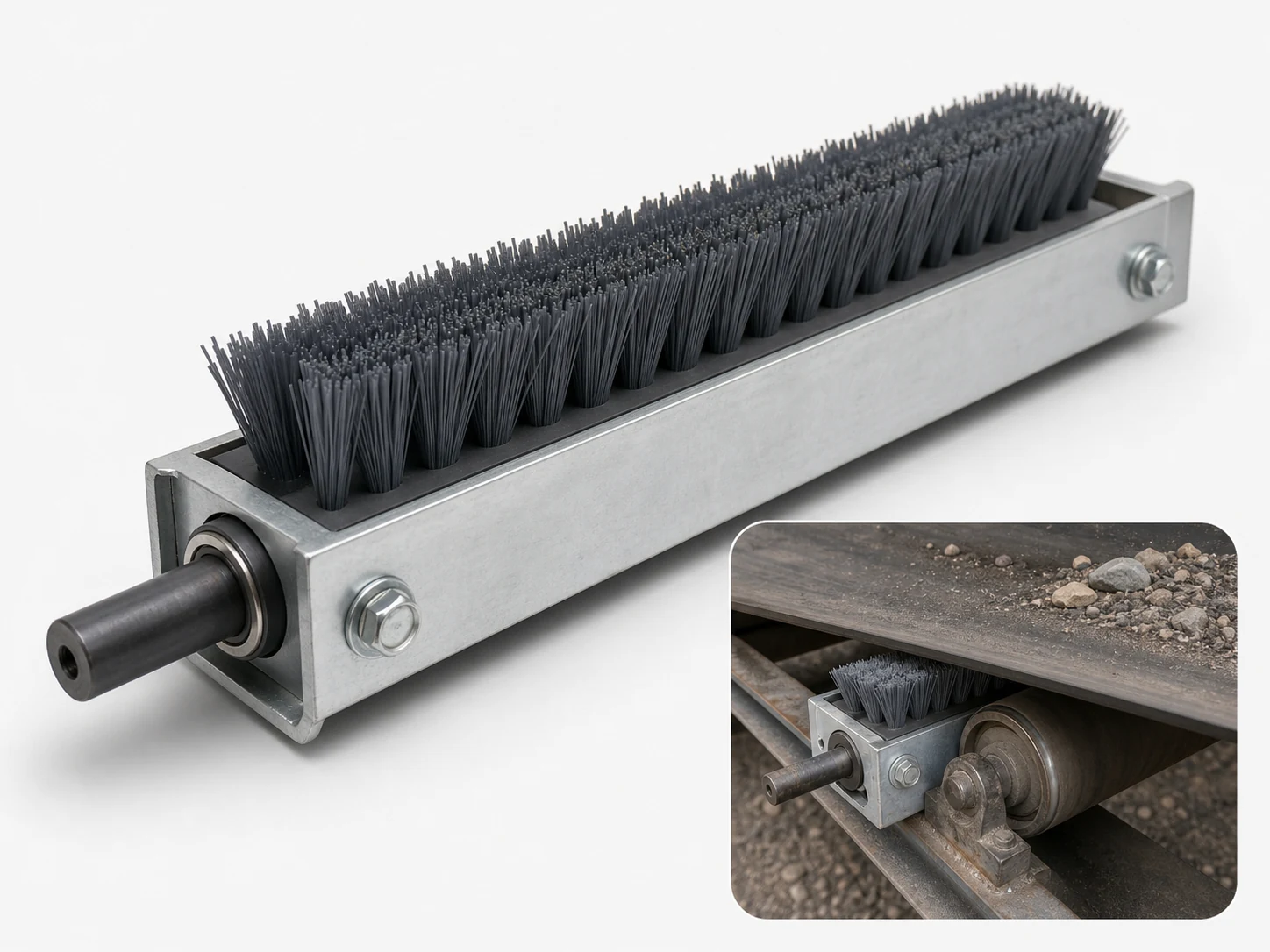
Large-format brush
100 pcs
Minimum order
Built one at a time on a core or channel: full-width rollers, sweeper brooms and long strip.
Production lead time, once the specification is confirmed
- Up to 100 pcsWithin 20 days
- 101–1,000 pcsWithin 30 days
- Over 1,000 pcsConfirmed with your quotation
Peak season can extend these times; the shipping date is confirmed in writing with your quotation. Sampling and shipping are quoted separately.
A heavy-duty rotary conveyor belt brush engineered for mining environments, designed to continuously remove sticky carryback, dust, and fine material from the belt surface to reduce spillage, belt tracking issues, and premature component wear.
What can this brush do for you?
Continuous Removal of Sticky Carryback
The brush rotates against the belt surface, dislodging fines and sticky material that scraper blades often smear. This reduces material buildup on return idlers, pulleys, and the belt itself, lowering spillage and cleanup labor.
Handles Abrasive and Wet Mining Conditions
Fill material options include silicon carbide abrasive nylon for hardened deposits, polypropylene for wet, chemically aggressive slurries, and standard nylon for general duty. The brush is engineered for the dust, moisture, and heavy vibration typical of mining conveyors.
Reduces Belt Tracking Problems and Component Wear
By removing carryback before it reaches return rollers and pulleys, the brush prevents material from causing belt misalignment, premature roller failure, and uneven belt wear. This extends the life of the entire conveyor system.
Adjustable Contact for Different Belt Loads
The brush can be positioned with a radial engagement of 2–10 mm and edge overlap of 5–15 mm per side, allowing you to fine-tune cleaning pressure without excessive filament wear or belt abrasion.
Long Service Life with Replaceable Fill
The brush core and shaft are reusable. When the filaments eventually wear down, the fill can be replaced on-site or the entire brush can be reconditioned at a lower cost than purchasing a complete new unit, reducing total operating cost.
What is a Mining Conveyor Belt Brush?
A mining conveyor belt brush is a cylindrical rotary cleaning tool mounted on a shaft and positioned against the return side of a conveyor belt, usually just after the head pulley. It uses densely packed synthetic filaments to mechanically scrape and flick off material that sticks to the belt surface as the belt travels. Unlike scraper blades, which use a fixed edge, the brush contacts the belt with thousands of flexible filament tips, providing a compliant cleaning action that follows belt irregularities and splices without gouging the belt cover.
The brush can be free-running, rotating due to belt contact, or motor-driven for higher cleaning force on slow or heavily loaded belts. The shaft is supported by pillow block bearings on a frame that allows for precise radial adjustment relative to the belt surface. In mining applications, the brush is typically installed in an inverted position under the return belt or at the head pulley discharge point where carryback is highest.
The brush is not designed to remove large, thick layers of compacted material or large rocks stuck to the belt. For heavy deposits, a primary scraper should be used first, with the brush as a secondary or finishing cleaner. It excels at removing fine particles, dust, and thin sticky films that cause buildup over time.
Technical Specifications
| Parameter | Value / Options |
|---|---|
| Working width | 100–3000 mm, matched to belt width with edge overlap |
| Brush diameter | 60–500 mm, selected based on mounting space and required contact arc |
| Core diameter | 25–250 mm, determined by shaft size and fill length |
| Shaft diameter | 12–100 mm, sized for torque and shaft length |
| Trim length | 15–100 mm, defines filament length and flexibility |
| Fill materials | Silicon carbide abrasive nylon, polypropylene PP, nylon PA |
| Filament diameter | 0.3–1.5 mm, finer for dust, coarser for aggressive cleaning |
| Fill density | Configurable; typically 10–40 holes per square inch |
| Contact setting | 2–10 mm radial engagement; 5–15 mm edge overlap per side |
| Rotation | Free-running or motor-driven; direction relative to belt can be specified |
| Belt speed suitability | Standard up to 5 m/s; higher speeds with balanced core and reinforced filament retention |
| Mounting configuration | Pillow block bearings with adjustable frame; end plates for direct shaft mounting |
| Core material | Steel, stainless steel, or aluminum (selected for environment) |
| Operating environment | Designed for mining dust, moisture, and moderate chemical exposure; material grade selected for temperature and chemical resistance |
| Brush type | Custom Roller and Conveyor Brushes |
| How it is driven | Machine-driven, mounted in the equipment |
| Cleaning target | head pulley, return strand, and transfer point dust suppression by removing residual cleaning |
| Surface or part | belts, conveyors, frames, edges, transfer points, and plates |
| Residue or debris | dust, fines, sticky carryback, slurry, and fine particles |
| Mounting / connection | Free-running or motor-driven; direction relative to belt can be specified; Pillow block bearings with adjustable frame; end plates for direct shaft mounting |
Where does this brush work best?
- Head pulley cleaning on belt conveyors in coal mines, iron ore mines, copper concentrators, and aggregate operations, where sticky fines adhere to the belt after discharge.
- Return strand cleaning on overland and in-plant conveyors to stop carryback from accumulating on return idlers and causing belt wander.
- Transfer point dust suppression by removing residual fines before the belt re-enters the loading zone.
- Wet process conveyors in mineral processing plants, where polypropylene fill withstands moisture, weak acids, and slurry contact.
- Reclaim tunnels, stockyard conveyors, and ship-loading belts handling materials like bauxite, phosphate, and potash.
How do I choose the right one?
Start with belt width and speed. Measure the belt width first. The brush working width should cover the belt surface plus a 5–15 mm overlap on each side to prevent edge buildup. Belt speed determines whether a free-running brush will provide sufficient agitation; for speeds below 2 m/s or for heavy carryback, a motor-driven brush is recommended.
Next, evaluate the material being removed. What is sticking to the belt? Light dust and dry fines respond well to standard nylon. Hard, abrasive, or compacted carryback needs silicon carbide abrasive nylon. Wet, sticky mud or clay benefits from polypropylene because it sheds moisture and resists chemical attack. The table below summarizes material selection.
| Fill Material | Best For | Limitations |
|---|---|---|
| Silicon carbide abrasive nylon | Hardened, abrasive carryback; scale and crust | May be too aggressive for very soft belt covers; higher filament cost |
| Polypropylene PP | Wet, sticky, or chemically aggressive materials | Lower temperature resistance; less abrasive than silicon carbide |
| Nylon PA | General purpose, dry fines, moderate carryback | Absorbs moisture in continuous wet service; may soften |
Check the mounting space. You need enough clearance between the belt and surrounding structure to fit the brush diameter and the adjustment frame. The brush should be positioned where the belt is stable, usually on the return side just past the head pulley or before the first return idler. A larger diameter gives longer filament life and more contact arc, but requires more space.
Decide on rotation and drive. A free-running brush uses belt friction and requires less infrastructure, but cleaning effectiveness depends on belt speed and contact pressure. A motor-driven brush rotates opposite to the belt travel to fling material away and works well on slow or heavily loaded belts. Specify the drive option based on your conveyor’s operating duty.
Consider when not to use a brush. If the carryback is thick, hard, or includes large lumps, install a primary scraper blade before the brush. The brush then acts as a secondary cleaner. For very fine dust where water is acceptable, a spray bar may be more effective, but in dry mining environments the brush avoids adding moisture to the process.
Can I customize this brush?
Yes. Every mining conveyor is different, and we build the brush to match your belt and operating conditions. Provide the belt width, belt speed, material characteristics, available mounting dimensions, and photos or drawings of the installation point. We will then specify the appropriate working width, diameter, fill material, and drive configuration.
- Working width and brush diameter: matched to belt width, speed, and available space.
- Core and shaft: diameter, material (steel, stainless, aluminum), shaft end machining (keyways, flats, threads), and length.
- Fill material and geometry: silicon carbide abrasive nylon, polypropylene, or nylon; filament diameter from 0.3 to 1.5 mm; fill density; trim length.
- Mounting and frame: pillow block bearings, adjustable slide base, fixed end plates, or custom brackets to fit existing structure.
- Drive options: free-running, belt-driven pulley, chain sprocket, or direct-coupled gearmotor. Rotation direction specified.
- Color and marking: custom colors, filament color coding for different fill types, laser marking or stamped identification on core or end plates.
- Packaging: bulk crating, palletized, individually wrapped, or project-specific labeling.
If your project requires material certifications, inspection reports, third-party testing, or documentation support, our engineering team can assist with those requirements during the customization process.
Which filament lasts longest on a mining conveyor belt brush?
How do I know when to replace the brush filaments?
Inspect the brush monthly or after every 500 operating hours, whichever comes first. Measure the trim length at several points across the width. When the shortest filaments are reduced by 50% or the brush no longer contacts the belt unless the gap is closed beyond the recommended 2–10 mm, it is time to replace the fill or the entire brush. Also look for flattened, melted, or brittle filaments.
What is the correct contact pressure for the brush?
Contact pressure is controlled by the radial engagement, not by spring force. Set the brush so the filament tips penetrate 2–10 mm into the belt surface at the center of the contact arc. Too little engagement leaves a film; too much causes excessive filament wear and can overheat the belt. After initial setting, run the conveyor for one hour and inspect the brush pattern on the belt—it should be even and not show signs of smearing or burning.
Can the brush be used on a reversible conveyor belt?
Yes, but the brush must be positioned symmetrically over the belt and the rotation direction must be specified for bidirectional use. If the brush is motor-driven, a reversing drive or a mechanical clutch may be needed. Free-running brushes work in either direction but may lose cleaning effectiveness when the belt reverses because the contact geometry changes.
What maintenance does the brush require?
Weekly: check for material wrapped around the shaft or core, and ensure the brush rotates freely. Monthly: verify bearing lubrication and torque the mounting bolts. Quarterly: measure filament wear profile and check shaft runout. If the brush becomes loaded with sticky material, clean it with water or compressed air during scheduled downtime, but avoid using solvents that could damage the fill material.
Is the brush suitable for underground mining with potentially explosive atmospheres?
We can supply brush configurations with static-dissipative filament and core materials, and we can provide documentation to support your hazardous area assessment. However, the brush itself is a mechanical device and does not carry an intrinsic safety rating. Your site safety team should evaluate the installation location and any electrical drive components against applicable regulations.
Guides that go deeper on this
How to Choose Mining Conveyor Belt Brush
Read this guideGuideMining Conveyor Belt Brush Mistakes in Wet Carryback
Read this guideGuideMining Conveyor Belt Brush: Material and Size for Belt Edges
Read this guideGuideMining Conveyor Belt Brush: What Holds Up in Dry Dust?
Read this guideGuideMining Conveyor Brush vs Standard: Continuous Lines
Read this guideGuideConveyor Belt Cleaning Brush Design
Read this guideGuideConveyor Brush Pressure: Residue Removal Without Belt Damage
Read this guideCustom Manufacturing RFQ
Describe Your Application
Please include the main sizes, application, residue, preferred material, interface, quantity, and any drawing or sample available.
Drawing or photo optional — it speeds things up, it does not gate the enquiry.
Custom Brush RFQ
Send Your Brush Project
Upload a drawing, product photo, or sample photo and provide the core dimensions and cleaning conditions.
“We need a brush to remove wet residue from a stainless steel conveyor, about 800mm wide. The current brush wears quickly. We can send photos.”
“We sell drinkware and need a cleaning brush to include with the product. Quantity around 5,000 pieces.”