
Custom Cleaning Brush
Cleaning Brush Food Processing Conveyor Belt
Shaft-mounted conveyor belt cleaning brush for powder, crumb, oil, and sticky carryback. PBT, PP, or nylon fill; 100–3000 mm widths; washdown rated.
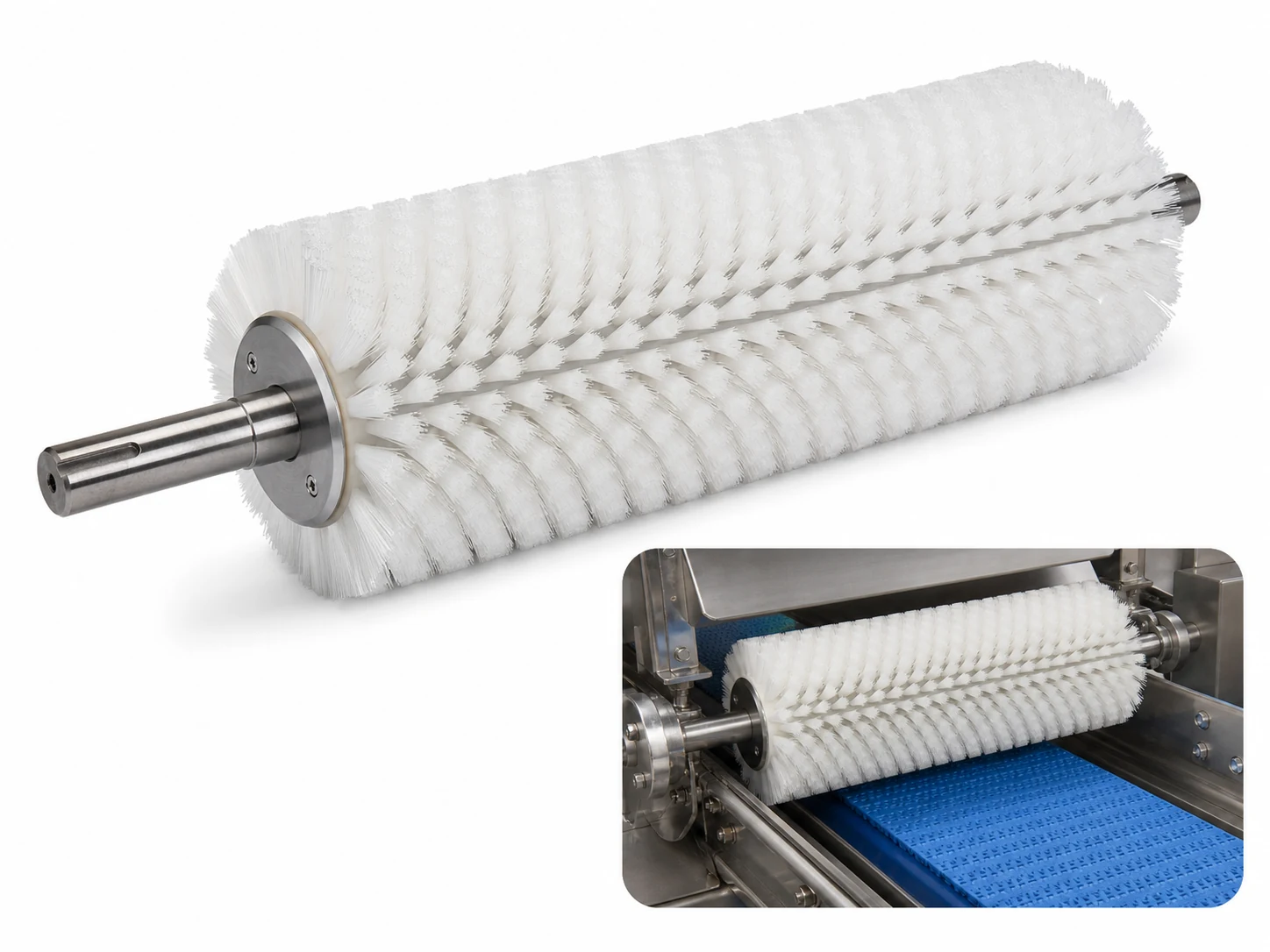
Large-format brush
100 pcs
Minimum order
Built one at a time on a core or channel: full-width rollers, sweeper brooms and long strip.
Production lead time, once the specification is confirmed
- Up to 100 pcsWithin 20 days
- 101–1,000 pcsWithin 30 days
- Over 1,000 pcsConfirmed with your quotation
Peak season can extend these times; the shipping date is confirmed in writing with your quotation. Sampling and shipping are quoted separately.
A shaft-mounted rotary cleaning brush for food processing conveyor belts that removes powder, crumbs, fiber, film fragments, and sticky carryback from the belt return path, drive rollers, and adjacent support components. Full-width trim, adjustable radial engagement, and washdown-tolerant materials keep the cleaning zone open and drainable.
What can this brush do for you?
Full-width contact with edge overlap
The brush face is built to the actual belt width plus 5–15 mm of overlap per side. Powder and crumbs that ride near the belt edge never get a chance to accumulate on idler bearings or support rollers, because there is no uncleaned margin.
Adjustable radial engagement
A 2–10 mm interference between the trim ends and the belt face lets you tune contact pressure for the residue load. As the fill wears, the mount position can be re-set or advanced so cleaning force stays consistent instead of falling off gradually.
Fill stiffness matched to the residue
PBT, polypropylene, and nylon fill options cover light dry fines, wet starch and sugar films, and greasy carryback without using a rigid blade edge. The bristle ends follow belt splices and surface texture, so the belt is cleaned without gouging the material.
Open, drainable construction for washdown
Fill strips and core geometry leave open drainage paths that let rinse water and detergent pass through rather than pool behind the brush. Stainless steel core and shaft options hold up to regular hot-water washing in 20–85°C washdown environments.
Low-headroom return-side mounting
Brush diameters from 60 mm and shaft options to fit existing pillow blocks let the brush install under the belt where blade scrapers and air knives often cannot reach. Configure it as contact-driven or externally driven to match the available space and belt speed.
What is a Cleaning Brush Food Processing Conveyor Belt?
A Cleaning Brush Food Processing Conveyor Belt is a cylindrical rotary brush installed beneath or against a moving food processing conveyor belt, typically on the return side where the empty belt passes after the discharge point. The fill contacts the underside of the belt, loosens transferred material, and carries it away from the belt surface into a catch pan or collection area.
The brush may rotate by contact with the belt or through an external drive. Flexible trim does the contact work instead of a solid scraper edge, so the tool follows belt splices, modular joints, and textured surfaces. It is used as part of a cleaning sequence: the brush removes solid and sticky debris, and the line’s washdown and sanitation steps complete the process.
This is not a sanitizer and it is not a heavy scraper. It is designed for removal of fines, film, crumbs, fibers, and transfer residues that would otherwise build up on the belt, rollers, and machine frame.
Technical Specifications
Working width, brush diameter, core, shaft, trim, and fill are specified for each conveyor. Typical project values and options are shown below.
| Parameter | Value / Options |
|---|---|
| Working width | 100–3000 mm; sized to belt width plus 5–15 mm edge overlap per side |
| Brush diameter (OD) | 60–300 mm |
| Core diameter | 25–250 mm |
| Shaft diameter | 12–100 mm; 304 or 316 stainless steel where washdown is required |
| Trim length | 15–100 mm |
| Radial engagement | 2–10 mm into the belt face; adjustable for wear compensation |
| Fill materials | PBT, polypropylene (PP), or nylon (PA), selected for residue and washdown chemical exposure |
| Fill arrangement | Full-face strip, spiral wound, or segmented blocks to suit belt profiles |
| Mounting | Pillow block, flange bearing, stub shaft, or driven end configuration |
| Washdown | 20–85°C water or detergent cleaning; open, drainable construction |
| Brush type | Custom Roller and Conveyor Brushes |
| How it is driven | Machine-driven, mounted in the equipment |
| Cleaning target | dry snack, wet protein and ready-meal line, and modular plastic or fabric belt cleaning |
| Surface or part | belts, roller, frames, conveyors, joints, edges, transfer points, and pans |
| Residue or debris | crumbs, powder, fiber, starch, sugar, chocolate, film fragments, and sticky carryback |
| Mounting / connection | Pillow block, flange bearing, stub shaft, or driven end configuration |
Where does this brush work best?
- Dry snack, bakery, and confectionery lines where crumbs, sugar, starch, and chocolate film transfer to the return side of the belt.
- Wet protein and ready-meal lines where fat, protein residue, batter, or sauce carryback would otherwise contaminate rollers and frame.
- Washdown lines with hot-water or detergent cleaning between production windows, especially when stainless cores and shafts are specified.
- Modular plastic or fabric belts that would be scarred by a metal scraper blade and need flexible contact across splices and joints.
- Transfer points and outfeed areas where label fragments, film slivers, or powder dust travel on the belt surface and need continuous removal.
How do I choose the right one?
Start with the belt width and the space available under the return run.
Measure the belt width and the distance between the return belt and the frame. The brush working width should cover the full belt width plus 5–15 mm per side. The available height dictates the maximum brush diameter: enough clearance must remain for the trim to flex without bottoming against the frame, and for debris to drop into a pan. If the gap is tight, a smaller-diameter core and longer trim can preserve contact width without increasing overall OD.
Then match the fill to the residue and environment.
| Condition | Fill selection |
|---|---|
| Light dry powder, crumbs, and fiber at ambient temperatures | PP or PBT |
| Wet lines with hot detergent or frequent hose-down | PBT |
| Oily or greasy carryback | PA nylon |
| Sticky sugar, chocolate, or starch film requiring firmer contact | PBT with higher fill density and shorter trim |
For dry fine particles, a contact-rotated brush is often enough. When residue is sticky or the belt speed is high, specify an externally driven brush that rotates at a higher surface speed than the belt; this lifts sticky material instead of simply pressing it back in.
A brush is not the right first choice for thick, hardened, or caramelized layers that require a blade scraper or steam to break; use those methods first and position the brush after them for final surface cleaning. If the belt has tall cleats, sidewalls, or deep profiles, a standard full-face trim may catch and tear; choose a segmented or profiled fill instead. For belts with very narrow gaps under the return side, consider a smaller disc or strip brush arrangement.
Can I customize this brush?
Every dimension and fill parameter is project-configurable. To define the brush, send the belt width, belt thickness, belt material, belt speed, mounting space under and around the return run, residue type, washdown chemicals and temperatures, and whether the brush must be idling or driven. A drawing or photo of the return side helps reduce fit errors.
- Working width and brush OD – sized to cover the belt plus edge overlap within the available clearance
- Fill material and stiffness – PBT, PP, or nylon; filament diameter, fill density, crimp, and trim length
- Fill layout – full-face, spiral, segmented, or profiled to clear cleats and sidewalls
- Core and shaft – stainless steel, polymer core, keyed or plain shaft ends, end disc configurations
- Mounting interface – pillow block, flange, take-up bracket, quick-release, or driven shaft extension
- Drive configuration – contact-rotated, chain/sprocket, or direct coupled to match line speed
- Identification – color-coded fill, engraved or printed end discs, or project-specific labels
- Packaging – bulk, individually protected, or line-set boxing
If your project needs material declarations, food-contact documentation, inspection support, or third-party testing, we can include those requirements in the project specification.
When is a cleaning brush food processing conveyor belt worn out rather than just dirty?
How can I tell whether the brush is engaging the belt correctly?
Set the radial engagement to 2–10 mm and watch the contact line. The trim tips should bend but not lay flat against the belt. If powered, compare drive current before and after setting. If the brush rotates freely with no visible flex, engagement is too light; if the trim is fully flattened or the motor load spikes, it is too deep.
What should I remove or check around the brush before washdown?
Clear the catch pan and remove built-up residue from behind the fill strips. Check that any exposed bearings are suitable for washdown, and confirm the brush is not left sitting in standing water after rinsing. For belts with scrapers or air knives ahead of the brush, verify those devices are still set so the brush is doing final cleaning rather than bulk removal.
When should I replace the fill instead of adjusting the mount?
When trim length has shortened noticeably, bristle ends show permanent set, or you can no longer maintain 2 mm radial engagement at the original mounting position, replace the fill strip or brush. Visible gaps in the contact line and residue returning to the support rollers are also replacement signals.
Will the brush damage belt splices or modular belt joints?
Flexible fill follows splices and joints when stiffness and engagement are set correctly. Excessively stiff fill, deep engagement, or a worn trim that exposes the core can abrade the belt. Re-check the contact setting after installing a new fill and after any mount adjustment.
Does the brush replace sanitation or chemical cleaning?
No. The brush removes physical debris and sticky carryback before sanitation; it does not sanitize the belt or replace the required washdown, foam, rinse, and sanitizing steps for food processing lines.
What should I do if the belt has cleats, sidewalls, or raised profiles?
Use a segmented, spiral, or profiled fill so the raised features pass between or over the fill strips without catching. A continuous full-face trim across tall profiles will bend, break, or tear. If you are not sure, send a photo and dimensions of the belt profile with your inquiry.
Guides that go deeper on this
Abrasive Nylon Grit and Filament Selection
Read this guideGuideBrush Speed, Engagement, and Heat
Read this guideGuideConveyor Belt Cleaning Brush Design
Read this guideGuideConveyor Brush Pressure: Residue Removal Without Belt Damage
Read this guideGuideFood Conveyor Brushes: Bakery, Dairy and Meat Processing
Read this guideCustom Manufacturing RFQ
Describe Your Application
To quote this brush accurately, send the size, material, cleaning target, residue, quantity, and any available drawing or sample photo.
Drawing or photo optional — it speeds things up, it does not gate the enquiry.
Custom Brush RFQ
Send Your Brush Project
Upload a drawing, product photo, or sample photo and provide the core dimensions and cleaning conditions.
“We need a brush to remove wet residue from a stainless steel conveyor, about 800mm wide. The current brush wears quickly. We can send photos.”
“We sell drinkware and need a cleaning brush to include with the product. Quantity around 5,000 pieces.”