
Custom Cleaning Brush
Rubber Conveyor Belt Brush
Rubber conveyor belt brush for continuous belt cleaning. Sweeps powder, crumbs, fibers, labels, film fragments and sticky carryback.
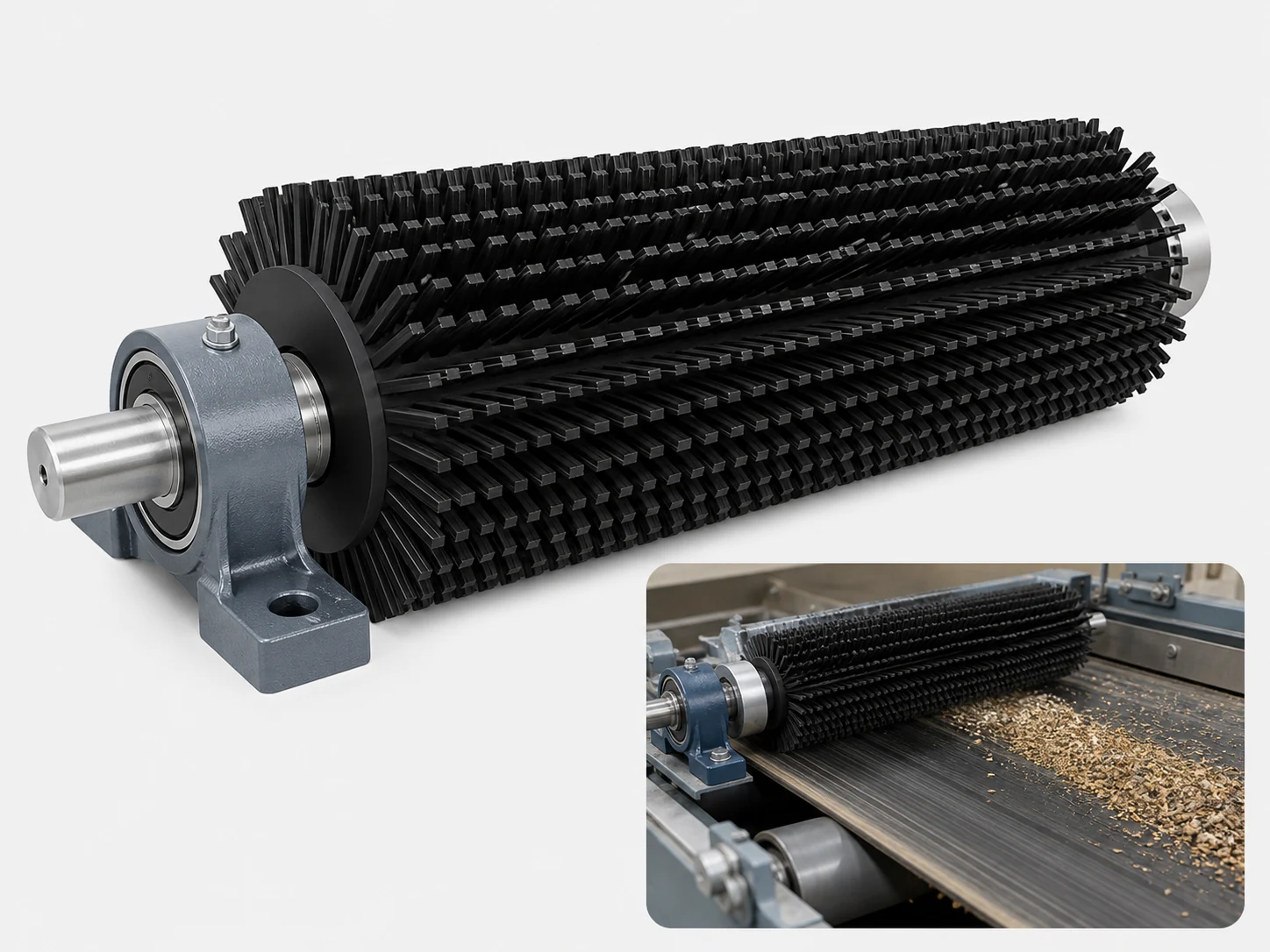
Large-format brush
100 pcs
Minimum order
Built one at a time on a core or channel: full-width rollers, sweeper brooms and long strip.
Production lead time, once the specification is confirmed
- Up to 100 pcsWithin 20 days
- 101–1,000 pcsWithin 30 days
- Over 1,000 pcsConfirmed with your quotation
Peak season can extend these times; the shipping date is confirmed in writing with your quotation. Sampling and shipping are quoted separately.
A rubber-backed conveyor belt brush that mounts across the belt width to continuously sweep powder, crumbs, fibers, chips, labels, film fragments, and sticky carryback off the belt surface before it builds up on rollers, pulleys, and frames. The flexible rubber base follows belt undulations and splices while polypropylene or nylon filaments provide the cleaning contact.
What can this brush do for you?
Maintains full-width contact on moving belts
The rubber base extrusion seats the fill in a straight line and lets the brush conform to minor belt sag, camber, and surface wave without losing contact in the middle. A brush that only touches the belt edges leaves the center to carry residue; this design presses the filament tips across the entire working width from the first day until the fill is worn to replacement length.
Sweeps fine and sticky debris without gouging the belt
Polypropylene and nylon filament tips bend under load instead of scraping. That removes fine powder, crumbs, fibers, label fragments, and soft sticky carryback while leaving the belt cover intact. The rubber base adds a second layer of protection: it absorbs sudden contact, so the brush does not chatter when it meets a splice or a hard spot in the belt.
Runs quietly through splice and frame vibration
The rubber body damps the high-frequency vibration that makes rigid metal-backed brushes hammer against the belt. This keeps the brush seated, reduces noise in the plant, and extends the life of both the belt cover and the mounting brackets.
Replaces worn wiper blades without changing the frame
The brush is produced with flat-back, channel, and clamp mounting profiles that fit the same transverse rails and brackets used for conventional conveyor belt cleaners. You can swap a worn wiper blade for a full-width brush strip or add the brush behind an existing precleaner as a secondary sweep.
Allows controlled contact pressure and edge overlap
Contact is adjusted by setting the radial engagement, typically 2–10 mm, and by extending the working width 5–15 mm past each belt edge. Because the setting is defined at installation, the brush removes residue consistently without overloading the conveyor drive or wearing the fill in a few shifts.
What is a Rubber Conveyor Belt Brush?
A Rubber Conveyor Belt Brush is a transverse-mounted sweeping brush built around a rubber base extrusion and a continuous row of synthetic filaments. It is installed above or below the belt at a point where material has already started to cling or fall: behind the head pulley, on the return run, at transfer points, or across a web path. As the belt moves, the filament tips sweep the surface and loosen the film, crumbs, powder, or sticky layer that would otherwise travel back under the conveyor.
The rubber base is what makes this brush different from a plain metal-backed strip brush. It flexes enough to follow normal belt movement, yet holds the fill in a stable, evenly spaced row. The rubber also acts as a resilient mounting element: when the belt passes a splice, seam, or minor irregularity, the base compresses slightly instead of transmitting the impact into the frame. The result is a brush that can stay engaged with the belt without being rigid enough to cause wear or chatter.
This is a sweeping tool, not a scraper. A rubber conveyor belt brush is intended for fine, loose, soft, or sticky material that a hard scraper would either miss or smear across the belt. It works best as a continuous contact cleaner on dry or lightly damp belts. For heavy crusted deposits, hard scale, or material frozen to the belt, a precleaner or scraper should normally run ahead of the brush, with the brush used as the finishing contact.
Technical Specifications
| Parameter | Value / Options |
|---|---|
| Working width | 100–3000 mm, segmented for longer belts and shipping convenience |
| Trim length | 15–100 mm, selected by residue thickness and available clearance |
| Fill material | Polypropylene (PP), Nylon PA6, or Nylon PA6.6 for dry or wet service |
| Base material | Natural rubber, SBR, or EPDM extrusion, chosen for oil, chemical, and temperature exposure |
| Brush diameter | 60–300 mm for cylindrical / roller configurations |
| Core diameter | 25–150 mm on cylinder or roller builds |
| Shaft diameter | 12–100 mm for driven or idler roller versions |
| Contact setting | 2–10 mm radial engagement; 5–15 mm edge overlap per side |
| Mounting | Flat back, channel, clamp, or custom transverse bracket interface |
| Operating temperature | -20°C to +80°C with standard rubber compounds; EPDM extends the upper range |
| Belt speed | Typically up to 2–3 m/s, depending on fill density and engagement |
| Brush type | Custom Roller and Conveyor Brushes |
| How it is driven | Machine-driven, mounted in the equipment |
| Cleaning target | food processing conveyor, packaging line, and board production cleaning |
| Surface or part | belts, conveyors, roller, frames, transfer points, machine guides, channel, and rails |
| Residue or debris | crumbs, powder, sticky carryback, fiber, labels, film fragments, chips, and dust |
| Mounting / connection | Flat back, channel, clamp, or custom transverse bracket interface |
All values can be adjusted to the conveyor frame, belt width, residue type, and installation clearance. The brush can be supplied as a straight transverse strip or as a rotating cylinder where the application calls for driven contact.
Where does this brush work best?
- Food processing conveyors that carry flour, crumbs, sugar, seasoning, or sticky product film on flat or troughed belts, where carryback collects under the return rollers.
- Packaging lines where labels, film fragments, tape pieces, and carton dust drift onto belts and transfer points and need continuous removal.
- Wood, panel, and board production where sawdust, chips, and fibers cling to belt surfaces and machine guides.
- Agriculture and grain handling where fine dust, chaff, and fibrous material build up on conveyor belts and rollers.
- Recycling and sorting lines where film, labels, paper scraps, and light sticky material wrap around pulleys if not swept off.
- General material handling where sticky carryback from minerals, powders, or processed product causes premature roller and bearing failure.
How do I choose the right one?
Measure the belt and mounting clearance first. The brush working width must cover the full contact surface of the belt plus the specified edge overlap. Check the transverse rail position and available height above the belt; trim length is selected so the filaments reach the belt without bottoming against the support channel. A brush that is too long or too wide will interfere with the frame, while one that is too short leaves an uncleaned center strip.
Match the filament to the residue and operating environment. Polypropylene is the standard choice for wet or chemically exposed lines because it does not absorb water and resists many cleaning agents. Nylon PA6 or PA6.6 is stiffer and more abrasion-resistant, which suits dry, fibrous, or slightly abrasive carryback. If the belt carries hot product, oil, or aggressive washdown chemicals, specify the exact conditions so the correct nylon grade or a project-specific fill can be selected.
Set contact pressure, not just contact. Radial engagement of 2–10 mm controls how far the filament tips bend into the belt. Too little engagement leaves residue in the texture of the belt cover. Too much engagement increases drag, accelerates filament tip wear, and can overheat the drive if multiple brushes are installed. Start at the low end of the range, inspect the belt after one shift, and increase only as needed.
Consider the rubber compound for the environment. Standard natural/SBR rubber works for normal indoor service. EPDM holds up better outdoors and in higher-temperature or washdown areas. If frequent oil contact is expected, specify an oil-resistant compound rather than relying on standard rubber.
Decide between a stationary strip and a driven roller. A stationary rubber-backed strip is the lowest-maintenance choice for most return-run and transfer-point cleaning. A cylindrical roller brush with a shaft is used where the belt surface needs a more aggressive sweeping action, where the brush must be driven, or where the installation rotates the brush for even filament wear.
Use the right cleaning combination. If the belt carries baked-on, crusted, or hard material, install a scraper or precleaner ahead of this brush. The rubber conveyor belt brush is the finishing sweep for loose and sticky residue, not the primary removal tool for heavy buildup. If the residue contains metal particles, use magnetic separation rather than relying on brush contact.
Can I customize this brush?
Rubber conveyor belt brushes are built to the conveyor rather than picked off the shelf. For a custom configuration, provide the belt width, belt surface material, operating speed, residue type, washdown or chemical exposure, temperature, available mounting clearance, and a drawing or photo of the installation point.
- Working width and segmentation — continuous strips from 100 mm up to 3000 mm, or multiple shorter sections with end gaps for long conveyors and easier handling.
- Rubber base profile — flat back, channel, clamp-in, or a custom extrusion shape that matches the existing mounting rail.
- Filament material and density — PP, PA6, or PA6.6 in fine, medium, or high fill density, depending on the residue and belt texture.
- Trim length and face angle — straight, angled, or beveled filament face so the brush suits the direction of belt travel and available height.
- Cylinder option — core diameter, shaft diameter, bearing interfaces, and overall diameter when a driven or idler roller brush is required.
- Color and identification — custom base or filament color for zone marking, replacement tracking, or safety visibility.
- Packaging — bulk lengths, individually wrapped segments, or project-specific packing for multi-site delivery.
We can also support your project with material documentation, inspection plans, and third-party testing where the application or customer specification requires it.
When is a rubber conveyor belt brush worn out rather than just dirty?
How do I know when the brush fill needs to be replaced?
Measure the remaining trim length at several points across the working width and compare it with the original specification. When the tips are worn short enough that the brush no longer makes the specified 2–10 mm engagement across the full belt, or when visible gaps appear in the filament face, replace the worn section. Uneven wear on one side usually means the edge overlap or mounting height is not set correctly.
Can the brush be installed on the return run and at the head pulley at the same time?
Yes. Many conveyors run one brush after the head pulley to catch material immediately after discharge and a second brush on the return run to remove what remains. Each brush is set independently, and both use the same mounting profile, so the installation becomes a repeatable frame detail.
What happens when the brush meets a mechanical belt splice or fastener?
The rubber base flexes enough to pass over normal mechanical splices and fastener heads without lifting the whole brush off the belt. However, the splice height must not exceed the set engagement. If a splice is unusually high or damaged, set the brush downstream of the splice path or reduce engagement so the splice does not strike the backing channel.
Does the brush replace a belt scraper?
No. A rubber conveyor belt brush sweeps fine, loose, and sticky residue from the belt surface. A scraper removes thicker or compacted layers by direct blade contact. On belts with both types of carryback, the scraper runs first and the brush follows as the finishing cleaner. The two tools are complementary, not interchangeable.
How do I verify that the brush is actually cleaning the belt?
Run the conveyor at normal speed for one complete belt revolution, then wipe the belt surface behind the brush with a clean white cloth or gloved hand. If the cloth comes away visibly loaded with the same residue, increase engagement slightly or check that the filament face still has full width contact. Also inspect the return rollers and pulleys after a shift: if carryback is still accumulating under the roller line, the contact setting or filament material likely needs adjustment.
Can this brush handle wet washdown or frequent chemical cleaning?
Yes, when the correct materials are specified at the time of ordering. Polypropylene fill and an EPDM or oil-resistant rubber base resist moisture and many washdown chemicals better than standard natural rubber and nylon in permanently wet service. Give us the cleaning chemical, concentration, and wash frequency so the base and fill are selected for the actual environment.
Guides that go deeper on this
How to Choose Rubber Conveyor Belt Brush
Read this guideGuideAbrasive Nylon Grit and Filament Selection
Read this guideGuideBrush Speed, Engagement, and Heat
Read this guideGuideConveyor Belt Cleaning Brush Design
Read this guideGuideConveyor Brush Pressure: Residue Removal Without Belt Damage
Read this guideCustom Manufacturing RFQ
Describe Your Application
To quote this brush accurately, send the size, material, cleaning target, residue, quantity, and any available drawing or sample photo.
Drawing or photo optional — it speeds things up, it does not gate the enquiry.
Custom Brush RFQ
Send Your Brush Project
Upload a drawing, product photo, or sample photo and provide the core dimensions and cleaning conditions.
“We need a brush to remove wet residue from a stainless steel conveyor, about 800mm wide. The current brush wears quickly. We can send photos.”
“We sell drinkware and need a cleaning brush to include with the product. Quantity around 5,000 pieces.”