
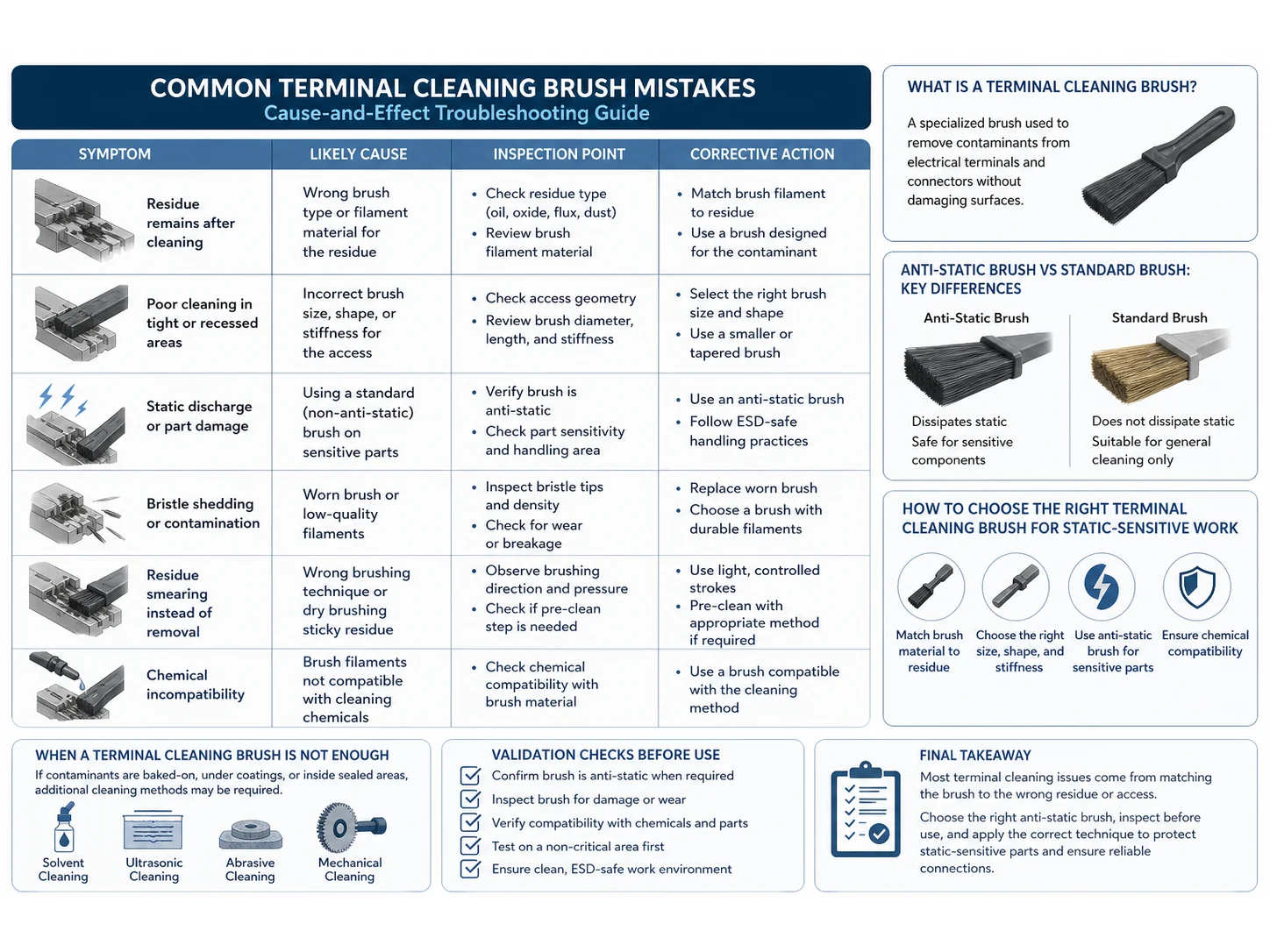
What Is a Terminal Cleaning Brush?
A terminal cleaning brush is a small, precision brush engineered to clean the contact surfaces of electrical terminals without altering their geometry or plating. It typically features fine, low-abrasion bristles mounted in a handle or shank that may be manual or machine-compatible. In electronics, these brushes are used to maintain signal integrity, prevent intermittent connections, and extend the service life of mating connectors.
Why Static-Sensitive Parts Require Special Attention
Static-sensitive components—like MOSFETs, CMOS ICs, laser diodes, and precision resistors—can be permanently damaged by voltages as low as 30 volts, while a human body can generate thousands of volts. A terminal cleaning brush that is not ESD-safe can act as a charge generator or an insulator, building up static and discharging it directly into the part. For critical applications, only brushes with proven static-dissipative or conductive properties should be considered.
Anti-Static Brush vs Standard Terminal Brush: Key Differences
| Feature | Standard Terminal Brush | Anti-Static Terminal Brush |
|---|---|---|
| Bristle Material | Nylon, polyester, animal hair | Conductive carbon-filled nylon, stainless steel fiber, or natural conductive fibers |
| Surface Resistivity | Typically > 10¹² Ω/sq (insulative) | 10³–10⁹ Ω/sq (dissipative or conductive) |
| Static Generation | High risk of tribocharging | Low charge generation; often self-dissipating |
| Handle / Ferrule | Often metal or standard plastic | Static-dissipative plastic or coated metal, with grounding option |
| Application Safety | Unsuitable near exposed ESD-sensitive devices | Safe for use on static-sensitive parts when used with ESD workstations |
| Typical Cost | Lower | Moderately higher, but prevents expensive component loss |
How to Choose the Right Terminal Cleaning Brush for Static-Sensitive Work
Selecting the correct brush requires evaluating application-specific factors, not just picking a generic “anti-static” label. Consider these decision points:
- Residue Type – Light dust vs. flux residue vs. light oxidation. Stiffness and bristle shape must match the contaminant without scratching plating.
- Surface Sensitivity – Gold-plated, tin-plated, or bare copper contacts have different hardness. Brush stiffness and tip geometry must prevent metal removal.
- Equipment Interface – The brush must fit into the terminal gap or connector housing. Diameter, trim length, and overall profile are critical.
- Wet or Chemical Exposure – If used with cleaning solvents, the brush handle, ferrule, and bristle bonding must resist swelling, softening, or shedding.
- Hygiene Expectations – In cleanroom or class 100/1000 environments, the brush must be low-linting and possibly autoclavable.
- Maintenance Frequency – High-volume production may require durable bristles that withstand hundreds of cycles without deformation.
- Custom Size Requirements – Off-the-shelf brushes often fall short for miniature or high-density connectors. Custom brush engineering with a technical drawing review may be necessary.
Common Mistakes and How to Avoid Them
Even experienced technicians make errors that risk component damage or process inefficiency. Here are the most frequent pitfalls:
- Using a brush that is not ESD-safe – Standard nylon brushes can generate enough static to destroy a sensitive IC. Always specify surface resistivity ≤ 10⁹ Ω and verify the brush is labeled anti-static or static-dissipative.
- Ignoring bristle stiffness – Overly stiff bristles can scratch thin gold plating, exposing underlying nickel or copper and leading to corrosion. Match bristle hardness to the contact material; extra-soft brushes are often needed for delicate pads.
- Wrong diameter or tip shape – A brush that barely fits can bend pins or leave bristles behind. Use a brush with a diameter slightly smaller than the terminal opening and a tip profile that matches the surface (e.g., flat, pointed, or chisel).
- Using metal-core brushes near energized or static-sensitive parts – Metal ferrules or core wires can cause short circuits if they touch adjacent pins, or they can create a conductive path for ESD. Choose brushes with plastic handles and no exposed metal.
- Skipping solvent compatibility checks – Some cleaning solvents degrade brush adhesives or bristle materials, causing bristle loss or contamination. Always test a sample brush with your chosen solvent before full-scale use.
- Neglecting brush maintenance – A dirty brush can redeposit contaminants. Clean brushes regularly with isopropyl alcohol or a dedicated ESD-safe brush cleaner, and replace them when bristles show permanent deformation.
- Assuming one brush fits all terminals – Different connector families (e.g., D-sub, USB, terminal blocks) require different brush shapes. Stock a small range of sizes rather than forcing a single brush into every application.
When a Terminal Cleaning Brush Is the Wrong Choice
A terminal cleaning brush is ideal for routine maintenance and light contamination removal, but it has limits. If terminals show heavy corrosion, burnt arc damage, or hardened flux that resists mechanical brushing, consider alternative methods such as:
- Contact cleaning solutions with chemical deoxidizers and a subsequent rinse.
- Ultrasonic cleaning for small, detachable components.
- Fiberglass eraser pens for spot treatment.
- Precision scraping tools for hardened debris, followed by a brush for final cleaning.
For custom or high-value connectors, request a supplier drawing review or sample test before committing to a brush-based cleaning process. The wrong tool can cause more damage than the contamination itself.
Final Takeaway
The key to avoiding terminal cleaning brush mistakes around static-sensitive parts is to prioritize ESD safety and application fit. Start with a verified static-dissipative brush, match the bristle stiffness and diameter to your specific terminals, and always test with your actual cleaning chemistry. A small upfront investment in the right brush prevents expensive rework and field failures.
Frequently Asked Questions
Can I use a regular brush if I ground it with a wrist strap?
Grounding the operator helps, but an insulative brush can still generate a localized static field high enough to damage parts. Grounding does not make a standard brush ESD-safe; only a brush made with conductive or static-dissipative materials can reliably prevent charge buildup.
What bristle material is safest for gold-plated terminals?
For gold-over-nickel plating, extra-soft conductive nylon or goat hair brushes are often recommended because they gently remove contamination without cutting through the thin gold layer. Avoid hard natural bristles or abrasive-filled plastics.
How often should I replace a terminal cleaning brush?
Replace a brush when bristles become permanently bent, flagged, or contaminated beyond cleaning. In high-usage environments, this may be every few hundred cycles; in a low-volume repair bench, brushes can last months with proper care.
How do I clean the brush itself?
Rinse the bristles with isopropyl alcohol or a compatible solvent, gently agitate, and blot dry with a lint-free wipe. Do not use aggressive solvents that might dissolve the handle or ferrule. Allow to air-dry completely before use near electronics.
Is a conductive or dissipative brush better for work on live circuits?
Never use any brush on live circuits unless it is explicitly rated and insulated for energized work. For passive ESD control, static-dissipative (10⁶–10⁹ Ω) brushes are preferred because they bleed charge slowly, avoiding a sudden discharge. Conductive brushes (<10⁶ Ω) can act as a spark gap if grounded incorrectly.
What diameter brush should I choose for standard D-sub connectors?
For female D-sub sockets, a brush with a diameter of about 1.5–2.5 mm and a rounded tip is common. Always measure your actual pin diameter and hole depth, and select a brush that leaves a small clearance to avoid bending.
Can I use the same brush for both wet and dry cleaning?
Yes, if the brush materials are solvent-resistant and the bristle retention method is secure. However, be mindful that solvent usage can soften some adhesives over time. Dedicate separate brushes for wet and dry if contamination cross-migration is a concern.
Technical References
Which bristle material fits this job — Nylon PA, AISI 304 Stainless Steel Wire or Conductive Nylon?
| Material | Continuous temperature (°C) | Peak temperature (°C) | Water absorption | Hardness |
|---|---|---|---|---|
| Nylon PA | 93 | 121 | 0.3–9% by PA grade and conditioning | Medium to firm; filament diameter and trim length control bending force. |
| AISI 304 Stainless Steel Wire | 400 | 500 | 0% | Rockwell B 70–95 depending on temper and cold work |
| Conductive Nylon | 80–110 | 130–160 | 0.5–2.5% | Shore D 75–88 |
| Goat Hair | 50–70 | 90–110 | 12–20% | — |
| Brass Wire | 150–200 | 250–300 | 0% | Rockwell B 40–90 |
Figures as published by Brushtec / DuPont; Alleima. Confirm the exact grade against the supplier datasheet before ordering.
What should replace Handheld Detail Brushes for terminal cleaning brush?
- Handheld Detail Brushes — Handheld detail brushes cover general precision cleaning; auto-detailing brushes impose tighter controls for painted, polished, leather, display, and trim surfaces.
- Nylon PA — Compare Nylon PA with PP, PBT, PET. Change material when wet stiffness, temperature, chemical resistance, conductivity, particle shedding, or surface marking becomes the limiting factor.
- AISI 304 Stainless Steel Wire — Use AISI 316 stainless steel wire for chloride, marine, dairy, beverage, chemical washdown, or higher pitting-resistance requirements. Use carbon steel for dry aggressive cutting and brass or abrasive nylon for lower marking risk.
- Conductive Nylon — Compare Conductive Nylon with Anti-static filament, carbon fiber, stainless conductive filament, standard PA6. Change material when wet stiffness, temperature, chemical resistance, conductivity, particle shedding, or surface marking becomes the limiting factor.