
Custom Cleaning Brush
Terminal Cleaning Brush
Brass wire terminal cleaning brush for battery posts, cable clamps, connectors and bus bars. Removes oxide and corrosion without ferrous contamination.
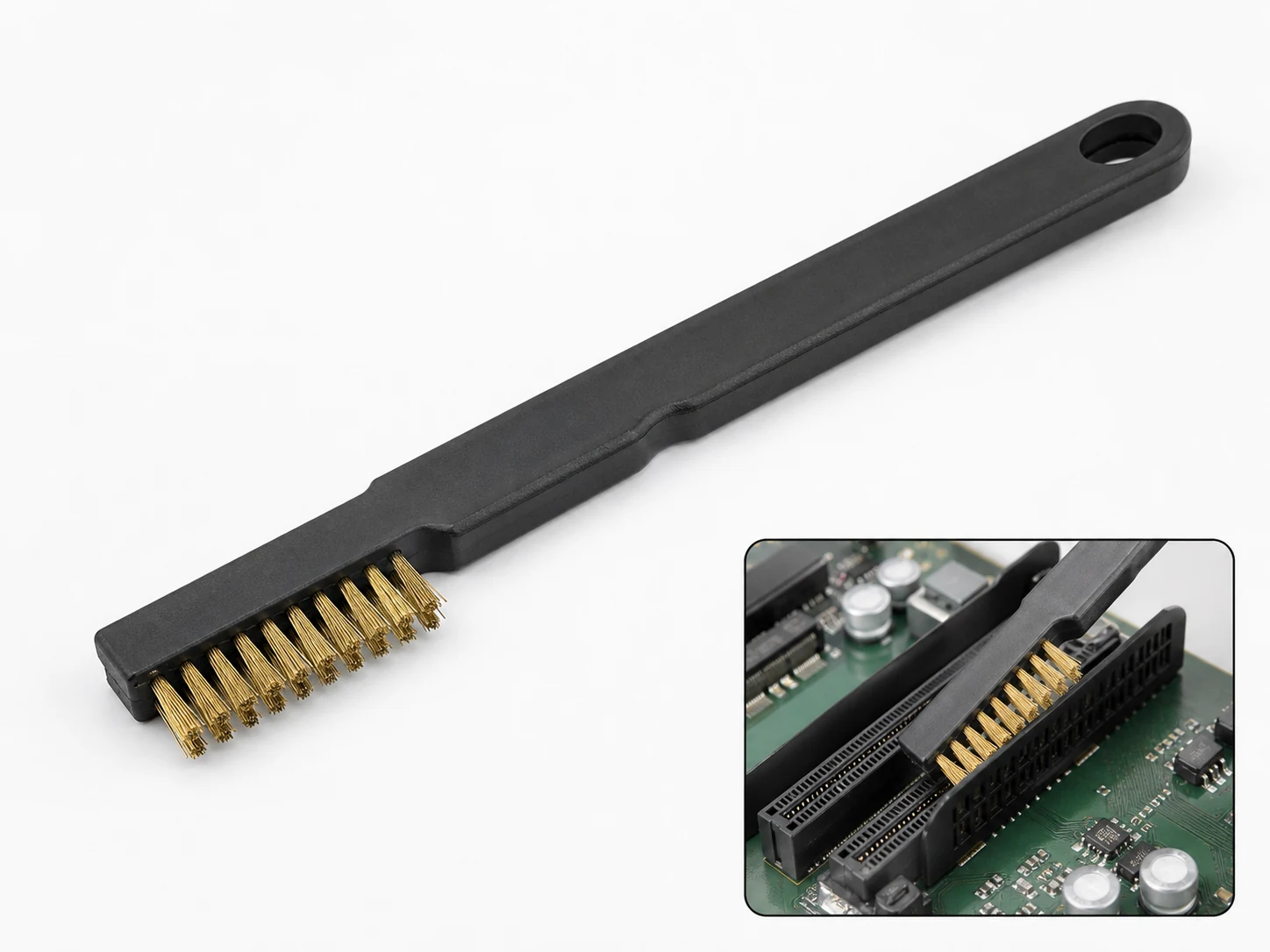
Small brush
500 pcs
Minimum order
Held in one hand: tube, bottle, detail and swab brushes — including long-handled ones with a small head.
Production lead time, once the specification is confirmed
- Up to 500 pcsWithin 7 days
- 501–50,000 pcsWithin 14 days
- Over 50,000 pcsWithin 21 days
Peak season can extend these times; the shipping date is confirmed in writing with your quotation. Sampling and shipping are quoted separately.
A hand-held brass wire terminal cleaning brush for removing oxidation, corrosion and carbon deposits from battery posts, cable clamps, connector pins and terminal contact surfaces. The brass fill cuts through surface oxide without embedding ferrous particles or scratching soft copper and brass contact metals.
What can this brush do for you?
Removes Oxide and Corrosion Without Cutting Into Soft Contact Metal
Brass wire is harder than the sulfation and oxide layer that builds on battery terminals, but softer than the copper, brass and lead underneath. The brush scrapes away the non-conductive surface film while preserving the terminal material that still has to carry current.
One Tool Cleans Both the Post and the Clamp
The dual head combines an internal brush for the inside of a cable clamp with an external brush that wraps around the battery post. You can restore both mating faces in the same stroke cycle instead of switching between two separate brushes.
No Ferrous Particles Left Behind to Cause Shorts
Steel wire sheds tiny magnetic fragments that can lodge between terminals or inside a connector. Brass fill is non-magnetic and leaves larger, visible, low-risk particles that are easy to blow or wipe away, which matters when the cleaned part goes back into a live electrical system.
Controlled Access in Tight Terminal Boxes
With an overall length from 80 to 200 mm and a short bristle trim, the brush works inside recessed battery trays, terminal strip rows and bus bar stacks where a full-size wire brush cannot be positioned. The hand-guided stroke lets the operator clean only the contact area.
Stable Fill That Keeps Its Shape Through Repeated Use
The wire set is crimped or locked into the ferrule so the bristle density stays even. Instead of splaying after the first few posts, the head continues to present enough working tips to remove corrosion with every pass.
What is a Terminal Cleaning Brush?
A Terminal Cleaning Brush is a hand-guided wire brush designed specifically to restore clean, low-resistance contact surfaces on electrical terminal hardware. The dense brass wire fill breaks through surface oxidation, sulfation, corrosion, dried flux and carbon deposits that increase contact resistance or cause hot spots.
During use, the operator strokes the wire tips across the post, clamp, lug or connector face, usually dry or with a light application of contact cleaner. The stiff wire removes the oxide film mechanically; it does not dissolve grease or chemically strip the surface. The brush is part of a maintenance sequence: disconnect, brush, remove loosened debris, inspect, reconnect and re-torque.
This is not a paint-removal brush, a welding-prep brush or a tool for cleaning engine castings. The geometry and fill are built around small conductive surfaces that need a clean metal-to-metal interface.
Technical Specifications
The table below shows the standard production envelope. All dimensions can be matched to the terminal hardware you service.
| Parameter | Value / Options |
|---|---|
| Brush form | Dual internal/external wire-brush head for male posts and female clamps |
| Fill material | Brass wire (standard); phosphor bronze, stainless steel or nickel silver on project request |
| Wire diameter | 0.10–0.30 mm, selected for corrosion level and contact sensitivity |
| Overall length | 80–200 mm |
| Outer brush diameter | 15–40 mm, matched to clamp opening |
| Inner brush diameter | 10–25 mm, matched to post diameter |
| Bristle trim length | 8–15 mm from the ferrule face |
| Ferrule / stem | Brass or nickel-plated steel, crimped or rolled to lock the wire set |
| Handle | Hardwood, polypropylene or ESD-safe polymer, with knurled grip or hanging hole option |
| Operating environment | Dry or solvent-assisted use on copper, brass, bronze, lead and plated terminal surfaces |
| Brush type | Custom Handheld Detail Brushes |
| How it is driven | Hand-guided |
| Cleaning target | battery post and cable clamp, terminal block and bus bar, and connector pin and socket cleaning |
| Surface or part | terminals, connectors, cable, pins, metal, panels, bars, and bores |
| Residue or debris | corrosion, oxide, carbon deposit, particles, flux, flux residue, oxide film, and leaves |
| Mounting / connection | Shaft-Mounted / Flange |
Where does this brush work best?
- Battery posts and cable clamps on automotive, commercial, marine and industrial batteries where sulfation and corrosion build up between maintenance cycles.
- Terminal blocks and bus bars in panels and switchgear where oxidation from humidity or thermal cycling raises contact resistance.
- Connector pins and sockets during harness rework, test-fixture maintenance or connector verification, when oxide or flux residue must be removed before mating.
- Grounding points and lugs where surface corrosion compromises the bonding path and needs mechanical removal before re-tightening.
- Relay and contactor contact faces that need light oxide removal before contact resistance testing or recommissioning.
How do I choose the right one?
Start with the two mating surfaces. Measure the post outside diameter and the clamp inside diameter. The internal brush must enter the clamp without bottoming out, and the external brush must wrap around the post with enough contact pressure to scrub. A dual head is the practical choice when both surfaces corrode; a single-face or pencil-style head is better when only one side is accessible.
Then match the fill to the surface metal. Brass wire is the default for copper, brass, lead and most battery terminal alloys. It removes the oxide layer without deep material removal. For terminal surfaces with thin tin, gold or silver plating, a metal wire brush can cut through the plating; choose a finer wire gauge, reduce contact pressure, or move to a non-abrasive bristle brush. Stainless steel wire works faster on heavy scale and hard steel terminals, but it leaves ferrous particles and can scratch soft metals, so it is not the first choice for fine electrical connections.
Select wire diameter to the corrosion level. A 0.10–0.15 mm wire provides slower, lighter cleaning for fine contacts and thin plating. A 0.25–0.30 mm wire is better for heavy sulfation, deep oxide or larger battery post surfaces.
Choose overall length and handle for the working space. Recessed terminal compartments usually call for an 80–120 mm tool; open engine bays or large battery banks can use a 180–200 mm version. An ESD-safe or non-slip handle is preferable when the brush is used near populated circuit boards or in controlled assembly areas.
Consider the operating environment. Brass is non-magnetic and does not spark like steel, but the ferrule and handle still need to hold up to the solvents, wash-down chemicals or temperatures in your process. Specify those conditions so the complete tool is built for the job.
Choose a different tool when the terminal is heavily pitted, deeply cracked or plated beyond repair. Brushing cannot replace missing metal or restore a worn plating. Large flat bus surfaces and heavy mill-scale removal are usually better handled by a power wire brush or abrasive pad. Optical faces, gold-plated signal contacts and other precision surfaces should never be cleaned with a wire brush.
Can I customize this brush?
Terminal hardware varies by vehicle family, connector series and panel layout, so the brush is configured around your actual part dimensions. Provide the post diameter, clamp bore or connector part number, the surface material, the type and thickness of corrosion, the cleaning environment, and the preferred handle or overall length. A sample terminal or drawing speeds up the match.
We can adjust:
- Head geometry – dual internal/external, single-side, pencil, angled or multi-diameter form to reach specific posts and clamp bores
- Fill material and gauge – brass, phosphor bronze, stainless steel or nickel silver in 0.10–0.30 mm wire
- Wire density and trim – denser fill for heavier corrosion, shorter trim for more aggressive contact, longer trim for conformability
- Ferrule and stem – brass, nickel-plated steel, non-magnetic stem option, crimped or rolled lock
- Handle – hardwood, polypropylene, ESD-safe polymer, knurled grip, hanging hole, color coding or molded identification mark
- Packaging – bulk, individual sleeve, kit with contact cleaner wipe, or project-specific labeling
If your project requires material declarations, incoming inspection criteria or third-party testing, we can support those requirements during development and production planning.
How long does a terminal cleaning brush last, and how is it cleaned between runs?
Will brushing damage the plating on my battery terminals?
On unplated lead, copper or brass, brass wire removes the oxide layer with minimal base-metal loss. On terminals with thin tin, gold or silver plating, metal wire can thin or scratch the plating. Use the finest wire gauge that still removes the deposit, reduce stroke pressure, and inspect the surface after the first pass. If plating is already worn through, re-coat or replace the terminal.
How can I tell when the brush has worn out?
Check the wire set for flattened, splayed or missing bristles and make sure the ferrule is still tight. If a test stroke on a corroded test piece no longer exposes bright metal, or if loose wire segments come out during brushing, the brush is finished. A worn brush generates more pressure and less cleaning.
Should I use the brush dry or with a cleaner?
Dry brushing works for sulfation and light oxide. For heavy corrosion or dried flux, a small amount of contact cleaner or warm water helps release debris from the wire tips, but wipe the loosened material away before reconnecting. Do not soak the handle or ferrule connection, and make sure the terminal area is dry before the electrical connection is restored.
Can this brush be used around battery gas or fuel vapor?
Brass wire is non-magnetic and less likely to spark than steel, but any hand tool can produce a glancing spark if struck against a hard surface. Always disconnect and isolate the circuit, ventilate the area, and follow site rules for confined spaces or potentially explosive atmospheres before brushing battery terminals.
Will brass particles left on the terminal affect the connection?
Small brass dust can settle in recesses and under clamp surfaces. After brushing, blow the area with clean compressed air or wipe with a lint-free cloth and inspect against good light. Brass particles are conductive and should not be left inside a connector housing or between mating faces.
Is this brush suitable for optical end faces or precision signal contacts?
No. A wire brush is far too aggressive for polished optical surfaces, thin gold plating or fine-pitch signal contacts. Use lint-free swabs, specialty cleaning sticks or non-abrasive applicators for those parts. The terminal brush is meant for robust electrical contact surfaces only.
Guides that go deeper on this
Custom Manufacturing RFQ
Describe Your Application
To prepare the correct quotation, provide the dimensions, cleaning task, residue, material, mounting details, quantity, and a drawing or photo.
Drawing or photo optional — it speeds things up, it does not gate the enquiry.
Custom Brush RFQ
Send Your Brush Project
Upload a drawing, product photo, or sample photo and provide the core dimensions and cleaning conditions.
“We need a brush to remove wet residue from a stainless steel conveyor, about 800mm wide. The current brush wears quickly. We can send photos.”
“We sell drinkware and need a cleaning brush to include with the product. Quantity around 5,000 pieces.”