
What Is a Connector Cleaning Brush?
A connector cleaning brush is a precision cleaning tool designed for electronic and electro-mechanical interfaces. Its bristles are made from inherently static-dissipative or conductive materials—such as conductive carbon fibers, anti-static nylon, or natural goat hair treated for ESD control—and its handle is often conductive or grounded. The core job is to clean pins, sockets, edge connectors, and backplane contacts without leaving insulating residue, generating a static field, or damaging thin gold or nickel plating.
Common Types of Connector Cleaning Brushes
Brush designs vary by connector geometry and cleaning protocol. Most fall into one of five practical groups.
- Pencil-style brushes: Retractable or fixed tip with a small round ferrule, often holding a few hundred micro-fine conductive fibers. Ideal for D-sub, USB, and board-to-board connectors.
- Swab-type (disposable) brushes: ESD-safe foam or lint-free fabric over a small stick. Used once per cleaning cycle to prevent cross-contamination in cleanrooms or during field repairs.
- Gun-barrel cleaning brushes: Short, stiff brushes that twist into barrel-style power or RF connectors. Often made with brass or stainless steel core and anti-static bristles.
- Channel/pin-rack brushes: Flat or wedge-shaped heads that clean multiple pins in a row. Common in backplane and DIN 41612 connectors.
- Tray-mounted brush blocks: Used in automated or semi-automated cleaning stations where consistent contact pressure and angle are required.
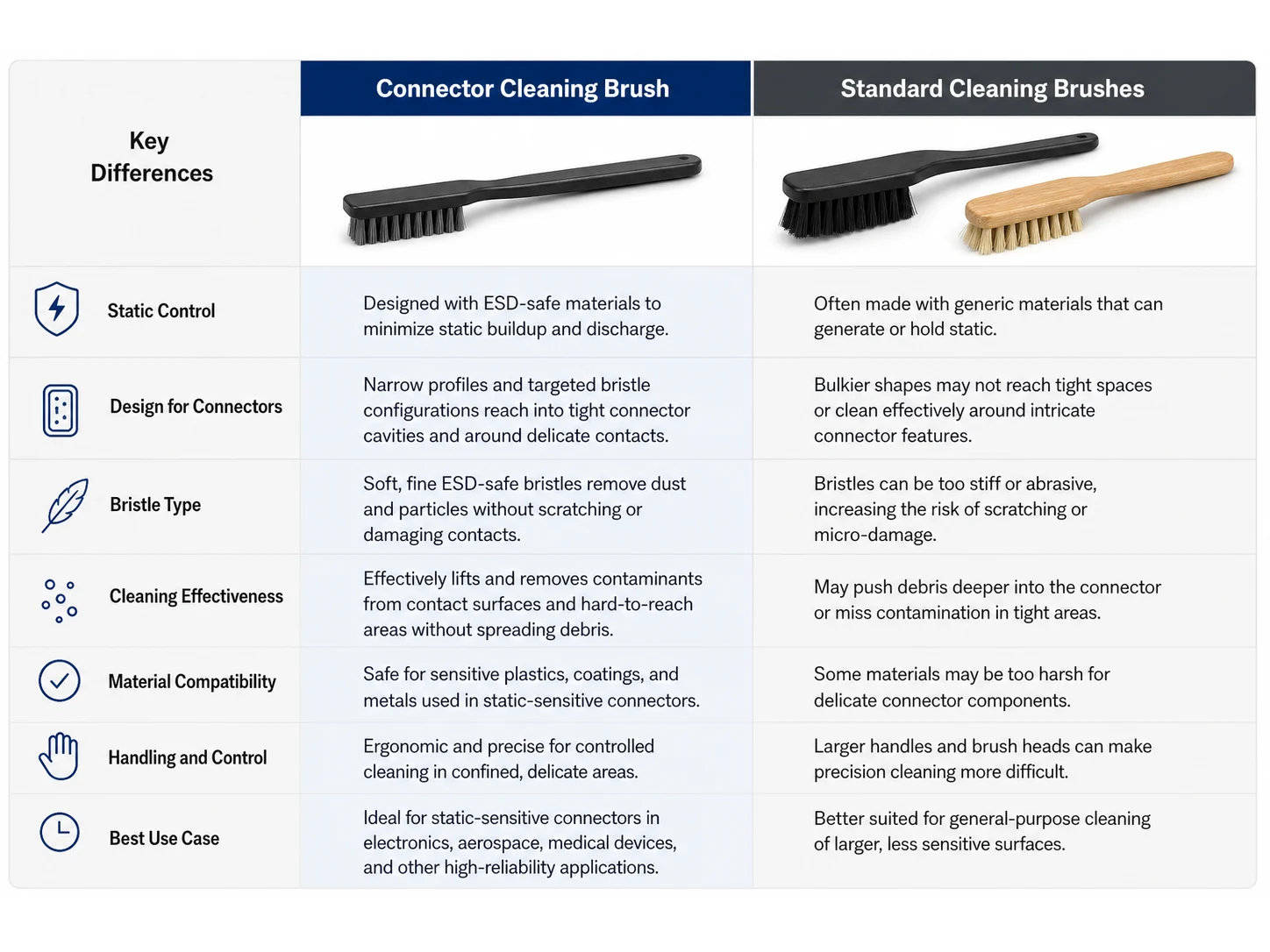
Connector Cleaning Brush vs. Standard Cleaning Brushes: Key Differences
| Feature | Connector Cleaning Brush | Standard Cleaning Brush |
|---|---|---|
| Bristle Material | Conductive carbon fiber, anti-static nylon, treated horsehair, ESD-safe foam | Natural or nylon bristles, steel wool, brass wire, untreated polyester |
| ESD Safety | Static-dissipative (surface resistivity typically 10⁴–10¹¹ Ω) | Insulative or static-generating; common risk of ESD up to several kV |
| Stiffness | Soft to medium; engineered not to scratch gold or nickel flash | Variable; often too aggressive for thin platings |
| Typical Diameter | 0.5–5 mm brush tip; matches common pin/socket sizes | Usually >5 mm; not designed for miniature connector cavities |
| Chemical Compatibility | Selected materials withstand IPA, acetone, contact cleaners, and aqueous solutions | Many handles and bristles degrade with strong solvents |
| Handle/Core | Conductive polypropylene, stainless steel, or static-safe plastic; often with ground path | Wood, aluminum, or off-the-shelf plastic with no ESD path |
| Cleanroom / High-Purity | Often available in Class 100–10,000 compatible options | Not designed for particle control |
How to Choose the Right Brush for Static-Sensitive Parts
Start with the actual cleaning challenge, not the brush catalog. Match the brush to the connector, the environment, and the residue.
- Residue type: Dry dust and fiber lint can be lifted with soft conductive fibers. Tacky flux, oils, or oxidation often require a slightly stiffer brush used with a cleaning solvent. Metal whiskers or corrosion call for abrasive-free cleaning and possibly a sample test.
- Surface sensitivity: Gold-plated contacts (0.5 μm or less) need the softest brush that still lifts debris. Hard nickel or stainless steel shells tolerate firmer bristles. Always verify bristle hardness on a scrap connector first.
- Equipment interface: Narrow female sockets need a brush with a small diameter core (1–3 mm). Edge connectors and card guides demand a flat brush profile. Barrel connectors need a twisted-wire brush that fills the ID without scratching the dielectric.
- Wet or chemical exposure: If you use isopropyl alcohol, contact cleaner, or aqueous flux removers, confirm that the brush head adhesive, handle, and bristle material are resistant. ESD-safe foam swabs are often preferred for single-use chemical cleaning.
- Hygiene expectations: In cleanroom or optical connector environments, every brush must be lint-free and contamination-controlled. Disposable swab brushes or cleanroom-laundered reusable brushes are standard.
- Maintenance frequency: High-volume production lines benefit from durable, rechargeable/replaceable brush tips. Field technicians often prefer retractable, pocket-safe brushes that stay clean when not in use.
- Custom size requirements: When off-the-shelf diameters don’t match the connector pitch, custom brush drawing review is needed. Provide the supplier with pin spacing, cavity depth, and minimum bend radius.
Common Mistakes When Cleaning Static-Sensitive Connectors
- Using a standard wire brush: Even a small brass brush can generate thousands of volts of static and scratch delicate gold contacts.
- Ignoring solvent compatibility: Nylon bristles can swell or dissolve in acetone; wood handles absorb IPA and swell. Match the brush to the chemical.
- Applying too much force: Excessive pressure can bend pins, peel plating, or force debris deeper. Let the bristles do the work.
- Reusing contaminated brushes: A brush used on corroded terminals will carry damaging particles to the next connector. Dedicate brushes by contamination class or switch to single-use swabs.
- Skipping magnification inspection: After cleaning, always inspect under 10–30× magnification to ensure no bristle fragments or residue remain.
When a Connector Cleaning Brush Is the Wrong Choice
A connector cleaning brush solves surface-level contamination but has practical limits.
- Heavy oxidation or corrosion: Thick oxide layers, white rust, or green corrosion require chemical deoxidizers, ultrasonic cleaning, or mechanical burnishing tools first. The brush then removes loose debris.
- Deep multi-pin connectors: In high-density mil-spec circular connectors (e.g., 100+ pins in a shell), a brush alone may not reach the bottom of each socket. Foam swabs or vacuum-assisted cleaning are often needed.
- High-pressure or automated wash: Brushes cannot replace pressurized spray cleaning or fully automated robotic cleaning cells when throughput and repeatability are critical.
- Insulation displacement connectors (IDC): Brushes can disturb preloaded contacts. Stick to lint-free wipes and controlled chemical spray.
If you see continued contact resistance drift or field failures after brushing, a supplier drawing review and a sample cleaning trial are the next logical steps.
Final Takeaway
Choose a connector cleaning brush—not a standard brush—anytime you are working with static-sensitive parts. Match the bristle material, tip diameter, and stiffness to the connector geometry, the type of residue, and the chemical environment. Standard brushes have their place for general shop cleaning, but on delicate electronic interfaces the few extra cents spent on an ESD-safe tool prevent costly rework, intermittent failures, and field returns.
Frequently Asked Questions
Can I test my brush for static safety?
Yes. Use a surface resistivity meter or static field meter. Place the brush on a charged plate analyzer or simply brush a known insulator while measuring voltage. A safe connector cleaning brush should dissipate static quickly (typically meeting ANSI/ESD S20.20 surfaces resistivity limits).
What bristle material is best for gold-plated pins?
Conductive carbon fiber or very soft anti-static nylon. Both are gentler than natural hair and leave minimal residue. Avoid any abrasive bristle that can scratch gold flash.
How often should I replace a connector cleaning brush?
It depends on contamination load. In cleanroom use, a brush may last hundreds of cycles. In heavy-flux or outdoor connector cleaning, replace it when bristles become matted, discolored, or fail a tacky-roll cleanliness test. Disposable swabs should be used once and discarded.
Can I use isopropyl alcohol with any connector cleaning brush?
Most ESD-safe brushes tolerate IPA, but verify with the manufacturer. Some handle adhesives or low-cost anti-static coatings may soften. Foam swabs with urethane foam are generally excellent with IPA.
What diameter brush do I need for a USB-C or Lightning connector?
A brush tip diameter of 2–3 mm works well. The bristle length should be slightly longer than the connector cavity depth to reach the back of the pins without bottoming out the ferrule.
Are there connector cleaning brushes approved for cleanroom use?
Yes. Many suppliers offer Class 100–10,000 cleanroom-laundered or certified brushes. These use low-particulate, low-ionic materials. Request a copy of the cleanroom processing certificate when ordering.
Will a connector cleaning brush remove solder flux from a PCB connector?
A brush alone rarely removes hardened flux. Apply a flux remover first, let it dwell, then gently agitate with the brush. For no-clean fluxes that are difficult to dissolve, heat and more aggressive solvents may be needed before brushing.
Technical References
Which bristle material fits this job — Nylon PA, AISI 304 Stainless Steel Wire or Carbon Fiber?
| Material | Continuous temperature (°C) | Peak temperature (°C) | Water absorption | Hardness |
|---|---|---|---|---|
| Nylon PA | 93 | 121 | 0.3–9% by PA grade and conditioning | Medium to firm; filament diameter and trim length control bending force. |
| AISI 304 Stainless Steel Wire | 400 | 500 | 0% | Rockwell B 70–95 depending on temper and cold work |
| Carbon Fiber | 200–350 | 400–500 | ≤0.10% | — |
| Brass Wire | 150–200 | 250–300 | 0% | Rockwell B 40–90 |
| Horsehair | 60–80 | 100–120 | 8–15% | — |
Figures as published by Brushtec / DuPont; Alleima. Confirm the exact grade against the supplier datasheet before ordering.
What should replace Handheld Detail Brushes for connector cleaning brush?
- Handheld Detail Brushes — Handheld detail brushes cover general precision cleaning; auto-detailing brushes impose tighter controls for painted, polished, leather, display, and trim surfaces.
- Nylon PA — Compare Nylon PA with PP, PBT, PET. Change material when wet stiffness, temperature, chemical resistance, conductivity, particle shedding, or surface marking becomes the limiting factor.
- AISI 304 Stainless Steel Wire — Use AISI 316 stainless steel wire for chloride, marine, dairy, beverage, chemical washdown, or higher pitting-resistance requirements. Use carbon steel for dry aggressive cutting and brass or abrasive nylon for lower marking risk.
- Carbon Fiber — Compare Carbon Fiber with Conductive nylon, anti-static filament, stainless micro-wire, standard nylon. Change material when wet stiffness, temperature, chemical resistance, conductivity, particle shedding, or surface marking becomes the limiting factor.