
What Is a PCB Brush?
A PCB brush is a hand tool designed to clean printed circuit boards and other static-sensitive electronic assemblies without generating harmful electrostatic charges. These brushes typically feature conductive or static-dissipative bristles—often made from materials like carbon-filled nylon, horsehair blended with conductive fibers, or stainless steel for specific applications—and handles that are either conductive or treated to safely channel static charges to ground. The primary function of a PCB brush is to remove dry contaminants such as dust, fiber particles, and dried flux, though some variants can be used with mild solvents. By preventing ESD, PCB brushes help avoid component degradation, logic errors, and catastrophic failures in sensitive devices.
How Standard Cleaning Brushes Differ from PCB Brushes
Standard cleaning brushes—such as generic nylon brushes, natural-hair paint brushes, or wire brushes—are not designed for static control. When rubbed against a surface, these materials can generate high levels of static electricity, which may discharge into sensitive components. Additionally, standard brushes may have metal ferrules, wooden handles, or untreated plastics that can hold a charge or introduce new contaminants. While they work well for general cleaning in non-ESD environments, their use on static-sensitive electronics poses a serious risk.
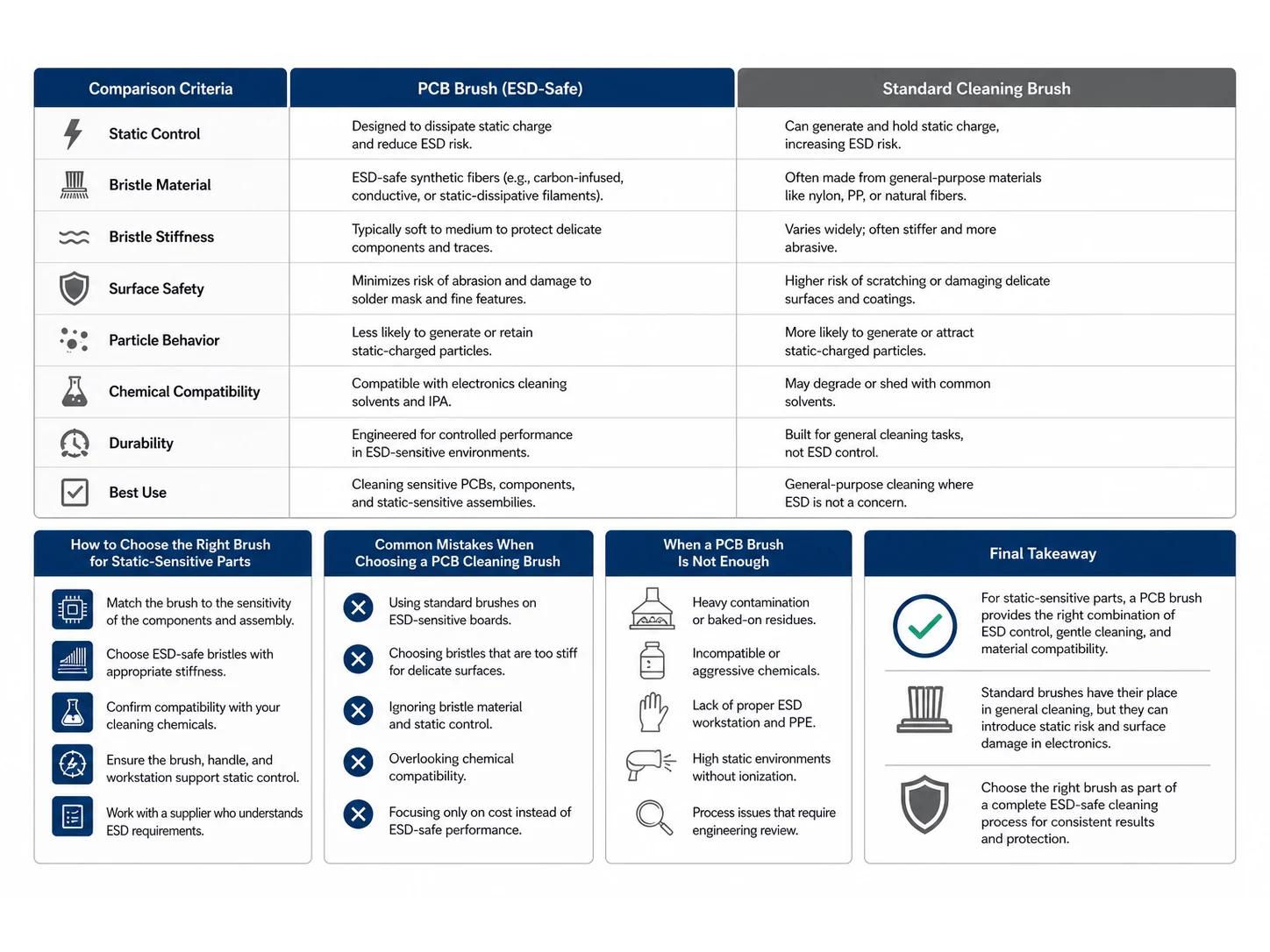
PCB Brush vs Standard Brush: Comparison Table
| Feature | PCB Brush | Standard Cleaning Brush |
|---|---|---|
| Static Charge Generation | Dissipates or conducts static; typically rated < 109 ohms surface resistance | Often generates thousands of volts via tribocharging |
| Bristle Material | Carbon-filled nylon, conductive horsehair, soft metal alloys, or dissipative filaments | Nylon, polyester, natural hair, brass, steel, or Tampico |
| Handle & Ferrule | Conductive plastic, static-dissipative rubber, or wood with grounding provisions | Wood, plastic, or metal with no static control |
| Suitable for Static-Sensitive Parts | Yes—certified for ESD-safe areas when handled correctly | No—risk of immediate or latent ESD damage |
| Typical Stiffness Range | Soft to medium-firm to avoid scratching; measured by fiber diameter and trim length | Varies widely; often too aggressive for PCB traces or coatings |
| Chemical Resistance | Often compatible with isopropyl alcohol and mild flux removers | Depends on material; some may dissolve or corrode |
| Cost (Relative) | Moderate to higher due to materials and ESD-safe design | Low to moderate |
| Common Applications | PCB rework, bench-top assembly cleaning, conformal coating prep, computer maintenance | Janitorial tasks, heavy machinery, painting, non-sensitive equipment |
How to Choose the Right Brush for Static-Sensitive Parts
Selecting the correct PCB brush involves more than just looking for “anti-static” on the label. Consider the following factors:
- Contaminant type: Dry dust may only require a soft conductive fiber brush, while flux residue often needs a stiffer bristle and possibly a solvent-safe brush.
- Surface sensitivity: Delicate PCB traces, conformal coatings, or bare dies demand a brush with gentle, compliant fibers to avoid scratching.
- Equipment interface: Some brushes are designed to be mounted on automated cleaning systems or robotic arms; check shank diameter, ferrule style, and overall length.
- Wet or chemical exposure: If using isopropyl alcohol or cleaning solvents, ensure the brush handle and bristle bonding adhesive are compatible to prevent degradation.
- Hygiene expectations: In cleanrooms or medical electronics, select brushes that can be cleaned and dried frequently without shedding or losing static-dissipative properties.
- Maintenance frequency: High-volume production may require brushes that withstand frequent use and periodic washing; disposable brushes might be acceptable for low-volume rework.
- Custom size requirements: For unique component geometries, a standardized brush may not fit. In such cases, consider working with a supplier to define custom trim length, bristle diameter, and handle shape.
- Grounding assurance: The brush must provide a reliable path to ground, either through a conductive handle and wrist strap or via an ESD-safe workbench connection.
Common Mistakes When Choosing a PCB Cleaning Brush
Even experienced technicians can overlook critical details when selecting a PCB brush. Avoid these frequent errors:
- Assuming all “anti-static” brushes are the same: Some brushes are only anti-static on the bristles but have insulating handles that can hold a charge. Verify surface resistance specifications for the complete tool.
- Using wire brushes on PCBs: Metal bristles can scratch traces, remove solder mask, and cause shorts. Only use soft metal alloys in specifically approved ESD-safe designs.
- Choosing by cost drivers alone: Inexpensive “ESD-safe” brushes may lose their static-dissipative properties after minimal use or washing. Invest in brushes from reputable suppliers that provide resistivity data.
- Ignoring chemical mixing: A brush that works great for dry cleaning might deteriorate when exposed to flux removers. Always check chemical compatibility charts.
- Neglecting grounding: A dissipative brush still needs a path to ground. If the operator is not grounded, static can still build on the brush and discharge into the board.
- Using a single brush for everything: Mixing cleaning agents or using a brush that previously cleaned leaded components on modern RoHS boards can cause cross-contamination and degrade reliability.
When a PCB Brush Is the Wrong Choice
A PCB brush is excellent for localized manual cleaning, but it has limits:
- Heavy contamination: Thick flux deposits, conformal coating removal, or baked-on debris may require chemical cleaning tanks, ultrasonic baths, or vapor degreasers instead of manual brushing.
- Full-board cleaning: For whole-board cleaning before conformal coating, an automated spray or immersion system is faster and more consistent than a hand brush.
- Static control at component level: If ESD-sensitive components are unassembled, a brush alone cannot Help confirm safety—use ionizers and ESD packaging as part of a complete program.
- Non-static-sensitive applications: For cleaning chassis, connector housings, or mechanical parts that are far from electronics, a standard brush may be more economical and perfectly suitable.
- If in doubt, request a sample or data sheet: When specifying brushes for a new production line, always test a sample on actual assemblies and review the supplier’s electrical conductivity and decay test results.
Final Takeaway
For any task involving static-sensitive parts—from PCB rework to computer and server maintenance—a genuine PCB brush (anti-static brush) is the usually safer choice. Standard brushes, though cheaper and widely available, introduce an unacceptable risk of electrostatic discharge. Evaluate your specific cleaning challenge based on contaminant type, surface delicacy, solvent use, and grounding needs to select the right brush. And remember: even the best brush won’t prevent ESD if you neglect operator grounding and consistent ESD-safe work practices.
Frequently Asked Questions
Can I use a standard anti-static brush for cleaning a computer?
Yes, an anti-static brush designed for electronics (often labeled as an “anti static brush for cleaning computer” or “anti static brush computer”) is essentially a type of PCB brush. It will safely remove dust from motherboards, expansion cards, and power supplies without risking static damage. However, ensure the brush is rated for ESD-safe environments and that you are properly grounded.
What bristle stiffness is safe for PCB cleaning?
Most PCB cleaning tasks require soft to medium stiffness. Brushes with overly stiff bristles can scratch solder mask, damage delicate traces, or dislodge small surface-mount components. Look for brushes with fiber diameters around 0.05–0.15 mm and a trim length that provides enough give. When in doubt, start with the softest option and move up only if cleaning effectiveness is insufficient.
How do I test if my brush is truly static-dissipative?
Use a surface resistance meter (megohmmeter) following ESD Association standards (e.g., ANSI/ESD STM11.11). A truly static-dissipative brush typically exhibits a surface resistance between 104 and 109 ohms. Many suppliers provide a certificate of compliance or test results. If the resistance is too high (> 1011 ohms), the brush is insulating and unsafe for ESD-sensitive work.
Can I wash a PCB brush with isopropyl alcohol?
Yes, many PCB brushes tolerate isopropyl alcohol (IPA) and other mild solvents used in electronics cleaning. However, repeated soaking can cause bristle fallout or handle deterioration over time. Check the manufacturer’s compatibility guide: the handle material and bonding adhesive must be solvent-resistant. After cleaning, allow the brush to dry completely before use to prevent liquid from bridging contacts.
What is the difference between conductive and dissipative brushes?
Conductive brushes (surface resistance < 104 ohms) allow static charges to flow quickly to ground, which can be risky if they contact a live circuit. Dissipative brushes (104–109 ohms) slow the flow, reducing spark risk while still safely removing charge. For most bench-top PCB cleaning, a dissipative brush is recommended. Conductive brushes are more common in applications where fast charge bleed-off is essential, such as near sensitive optical sensors.
Are there any ESD-safe brushes for records or film negatives?
While there are specialized “anti static brush for vinyl records” or “anti static brush for film negatives,” these are not the same as PCB brushes. They often use extremely soft carbon fiber or goat hair and are not designed for industrial cleaning. Using a stiff PCB brush on a vinyl record could scratch the grooves. For non-electronic static-sensitive items, choose purpose-made audio/photo anti-static brushes.
Do I need a different brush for wet vs dry cleaning?
Not necessarily, but you must verify solvent compatibility. Some brushes designed only for dry use may have adhesives or handle materials that degrade when exposed to solvents. If your process involves frequent wet cleaning, look for a brush with a stainless steel ferrule, chemically resistant bristles, and a handle sealed against moisture.
Technical References
Which bristle material fits this job — Nylon PA, AISI 304 Stainless Steel Wire or Horsehair?
| Material | Continuous temperature (°C) | Peak temperature (°C) | Water absorption | Hardness |
|---|---|---|---|---|
| Nylon PA | 93 | 121 | 0.3–9% by PA grade and conditioning | Medium to firm; filament diameter and trim length control bending force. |
| AISI 304 Stainless Steel Wire | 400 | 500 | 0% | Rockwell B 70–95 depending on temper and cold work |
| Horsehair | 60–80 | 100–120 | 8–15% | — |
| Carbon Fiber | 200–350 | 400–500 | ≤0.10% | — |
| Conductive Nylon | 80–110 | 130–160 | 0.5–2.5% | Shore D 75–88 |
Figures as published by Brushtec / DuPont; Alleima. Confirm the exact grade against the supplier datasheet before ordering.
What should replace Handheld Detail Brushes for pcb?
- Handheld Detail Brushes — Handheld detail brushes cover general precision cleaning; auto-detailing brushes impose tighter controls for painted, polished, leather, display, and trim surfaces.
- Nylon PA — Compare Nylon PA with PP, PBT, PET. Change material when wet stiffness, temperature, chemical resistance, conductivity, particle shedding, or surface marking becomes the limiting factor.
- AISI 304 Stainless Steel Wire — Use AISI 316 stainless steel wire for chloride, marine, dairy, beverage, chemical washdown, or higher pitting-resistance requirements. Use carbon steel for dry aggressive cutting and brass or abrasive nylon for lower marking risk.
- Horsehair — Compare Horsehair with Boar bristle, goat hair, microfiber. Change material when wet stiffness, temperature, chemical resistance, conductivity, particle shedding, or surface marking becomes the limiting factor.