
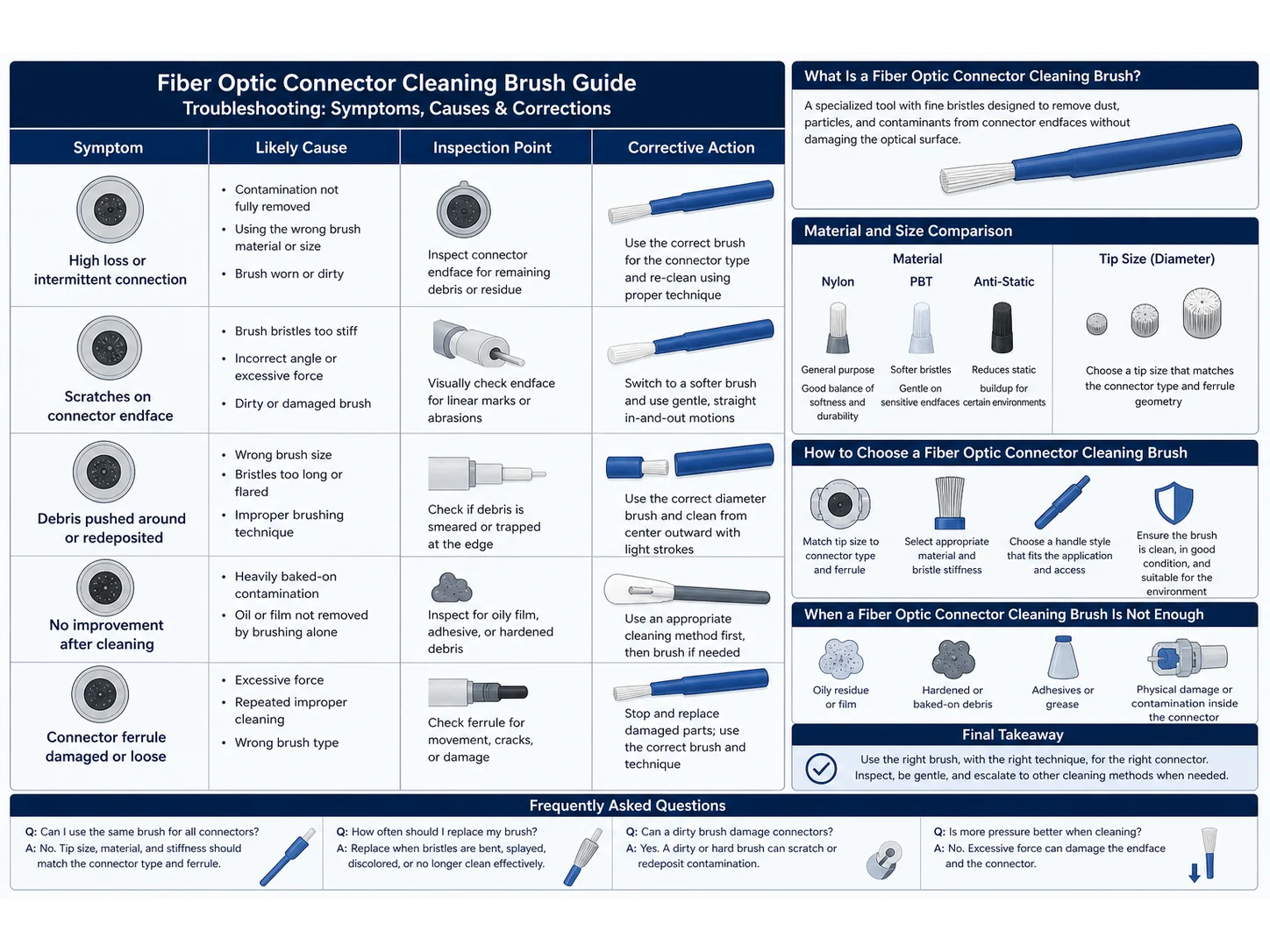
What Is a Fiber Optic Connector Cleaning Brush?
A fiber optic connector cleaning brush is a small, non‑abrasive tool used to manually clean the end‑face of optical fiber connectors and the inside of bulkhead adapters. Unlike general‑purpose brushes, these brushes use ultra‑soft, lint‑free bristles or foam swabs to remove contaminants without scratching the polished ceramic or composite ferrule. They are a critical part of inspection and cleaning workflows that maintain low insertion loss and high return loss in single‑mode and multimode fiber links.
Common Types and Options
Choosing a cleaning brush starts with understanding the main varieties available for connector contacts. Most options differ by material, diameter, tip stiffness, and handle design.
- Bristle material: Urethane foam, microfiber, static‑dissipative microfiber, PVA (polyvinyl acetal), or specialty polymer blends. Foam and microfiber are most common for dry cleaning, while PVA may be used with wet solvents.
- Tip diameter: Matched to connector ferrule size—typically 1.25 mm (LC/MU) or 2.5 mm (SC/FC/ST/E2000). Other custom diameters exist for specialty connectors.
- Tip stiffness: Softer tips are safer for delicate APC (angled physical contact) end‑faces; firmer tips may be needed for cleaning inside alignment sleeves or removing heavier contamination.
- Handle/Core: Options include short pen‑style sticks, long reach probes for cleaning inside bulkheads without removing the connector, and adapter‑mounted brushes that click into alignment sleeves.
- Single‑use vs. reusable: Many high‑purity foam swabs are single‑use to prevent re‑contamination. Some microfiber brushes can be cleaned and reused a limited number of times.
Material and Size Comparison
| Characteristic | Urethane Foam Swab | Microfiber Brush Tip | Static‑Dissipative Tip |
|---|---|---|---|
| Best for | Dry cleaning of end‑face dust | Wet or dry, tougher residues | ESD‑sensitive active equipment |
| Risk of scratching | Very low | Low to moderate | Very low |
| Lint generation | Minimal | Low | Minimal |
| Typical diameters | 1.25 mm, 2.5 mm | 1.25 mm, 2.5 mm, custom | 1.25 mm, 2.5 mm |
| Common handle style | Stick, pen, probe | Stick, probe | Stick, probe |
| Reusability | Single‑use recommended | Limited reuse with care | Single‑use recommended |
How to Choose a Fiber Optic Connector Cleaning Brush
Selecting the right brush depends on the specific cleaning challenge, not just the connector type. Evaluate these factors:
- Residue type: Dry dust and fiber particles are best removed with a clean, dry foam swab. Oily films or flux residues often require a solvent-compatible brush, such as a PVA or microfiber tip, used with reagent-grade isopropyl alcohol (IPA) according to manufacturer guidance.
- Surface sensitivity: APC connectors have an angled end-face and are more easily scratched by abrasive contaminants. In these cases, choose an extra‑soft foam tip with a smooth, consistent surface. UPC connectors are more forgiving but still demand non‑abrasive materials.
- Equipment interface: If the connector is behind a panel or inside a bulkhead adapter, a long‑reach probe brush allows cleaning without removing the adapter. For tough‑to‑access ports, a brush with a flexible tip or a swab designed for the specific adapter make and model can help.
- Wet or chemical exposure: If the cleaning process involves isopropyl alcohol or other approved solvents, verify that the brush material is compatible. Some foams degrade or swell in alcohol; PVA and certain microfiber materials are engineered for wet cleaning.
- Maintenance frequency and hygiene: High‑volume production lines or central offices where connectors are mated and unmated daily benefit from single‑use brushes that Help confirm fresh, lint‑free cleaning every time. For lower‑frequency field work, reusable brushes may be acceptable if properly stored between uses.
- Custom size requirements: While 1.25 mm and 2.5 mm are standard, some legacy, military, or specialty connectors require a custom diameter. In these cases, a supplier drawing review is necessary to match the brush tip to the ferrule and alignment sleeve dimensions without guesswork.
Common Mistakes When Using Cleaning Brushes
Even the best brush will fail if used incorrectly. Avoid these field‑proven mistakes:
- Using the wrong diameter: A 2.5 mm swab forced into a 1.25 mm sleeve can damage the brush, leave debris, or fail to contact the end‑face. Always confirm connector type before choosing size.
- Skipping inspection after cleaning: The only way to know if the connector is clean is to inspect it with a fiber optic microscope (IEC 61300‑3‑35 compliant). Never rely on visual appearance alone.
- Re‑dipping a used brush in solvent: This contaminates the cleaning fluid. Use fresh solvent for each cleaning step, and never return a used brush to a clean solvent container.
- Using consumer‑grade swabs or pipe cleaners: Office cotton swabs shed lint and may contain adhesives that leave behind residue. Only use brushes rated for fiber optic cleaning.
- Applying too much pressure: Excessive force can grind contaminants into the glass, permanently scratching the end‑face. Light, rotating motion is sufficient.
- Ignoring ESD safety: In active equipment with exposed lasers, a static discharge can damage optics. Use static‑dissipative brushes where spec sheets or site rules require ESD control.
When a Fiber Optic Connector Cleaning Brush Is the Wrong Choice
A cleaning brush solves one part of the contamination problem, but it has boundaries. A brush is not enough when:
- The connector end‑face shows pitting, deep scratches, or epoxy bleed. These are physical defects, not dirt, and the connector must be re‑terminated or replaced.
- Contamination is inside the ferrule bore or on the bare fiber stub after cleaving. Brushes designed for connector end‑faces cannot clean inside the ferrule or connector body.
- The bulkhead adapter itself is heavily contaminated or damaged. In this case, a specialized adapter cleaning tool or replacement adapter is required.
- Automated high‑volume polishing lines need consistent, validated cleaning. A manual brush may be insufficient; automated cleaning stations or ultrasonic cleaning may be the better choice.
- Inspection shows that the cleaning process is leaving a smear or residue that a standard brush cannot remove. This may require a different brush material, a solvent change, or a process review with the supplier’s application engineer.
When these boundaries appear, a supplier drawing review or a sample test can help verify whether a custom brush geometry, material, or additional cleaning tool is required for the specific connector series and operating environment.
Final Takeaway
A fiber optic connector cleaning brush is a small, low‑cost tool with a big impact on network performance. Match the material and diameter to the connector type, adapt the tip stiffness to the cleaning method (dry or wet), and always follow with an inspection. The right brush reduces rework, extends connector life, and prevents costly signal degradation—but it must be paired with proper technique and the understanding that no single tool solves every cleaning challenge.
Frequently Asked Questions
What material is best for a fiber optic connector cleaning brush?
For most dry cleaning tasks, a lint‑free urethane foam swab is the best starting point. It is gentle, economical, and widely available in standard diameters. Microfiber tips are preferred when a solvent like isopropyl alcohol is used or when slightly more scrubbing action is needed. For ESD‑sensitive environments, choose a brush labelled static‑dissipative or ESD‑safe.
Can I use isopropyl alcohol with any cleaning brush?
Not necessarily. Some foam materials can degrade or swell when exposed to alcohol. Check the brush manufacturer’s specification for solvent compatibility. PVA brushes and certain microfiber tips are commonly rated for use with IPA, but always confirm that the solvent grade and application method align with the connector supplier’s cleaning recommendations.
How often should I replace a cleaning brush?
Single‑use foam swabs should be disposed of after one cleaning. Reusable microfiber brushes can be used until they show signs of contamination buildup, linting, or loss of tip shape. A good rule is to replace a reusable brush whenever an inspection microscope shows that the brush itself is leaving particles behind.
What size brush fits an LC connector?
LC connectors use a 1.25 mm ferrule. Look for a brush tip or swab specifically labelled as 1.25 mm. Some bulkhead cleaning brushes also include a guide tube sized for LC/SC duplex adapters; verify that the tip reaches the connector end‑face without rubbing the adapter walls excessively.
Is a cleaning brush sufficient for APC connectors?
Yes, but extra care is needed. APC ferrules have an angled end‑face, so the brush tip must be soft enough to conform to the angle without gouging. A soft foam swab used with a light rotating motion and followed by inspection is the standard approach. Never use stiff bristle brushes on APC end‑faces.
Why is inspection so important after brushing?
Brushing dislodges contaminants, but it can also smear oils or push debris to the edge of the ferrule. Only a fiber inspection scope can verify that the end‑face meets the cleanliness criteria defined in IEC 61300‑3‑35. Skipping this step risks installing a “clean‑looking” but still dirty connector that will fail acceptance testing.
Can a cleaning brush also clean the inside of a bulkhead adapter?
Yes, but you need the right tool. Many manufacturers offer cleaning sticks or probes with a long handle and a tip designed to clean inside the alignment sleeve without removing the adapter. These are often called “bulkhead cleaning brushes” and should be used with a straight push‑twist‑pull motion to avoid bending the alignment sleeve.
Technical References
- EOS/ESD Association — ESD Fundamentals
- EOS/ESD Association — Principles of ESD Control
- NIST — Metric SI
Which bristle material fits this job — Microfiber, Cotton Yarn or PVA Sponge?
| Material | Continuous temperature (°C) | Peak temperature (°C) | Water absorption | Hardness |
|---|---|---|---|---|
| Microfiber | 80–120 | 140–170 | 0.2–1.0%Material Itself ; Structure Can Absorb 3–7 Times Its Own Weight | — |
| Cotton Yarn | 80–100 | 130–150 | 7–12% | — |
| PVA Sponge | 60 | 90 | — | Soft absorbent contact material; hardness/compression is controlled by foam or sponge density. |
| Nylon PA | 93 | 121 | 0.3–9% by PA grade and conditioning | Medium to firm; filament diameter and trim length control bending force. |
| Horsehair | 60–80 | 100–120 | 8–15% | — |
Figures as published by Brushtec / DuPont. Confirm the exact grade against the supplier datasheet before ordering.
What should replace Handheld Detail Brushes for fiber optic connector cleaning brush?
- Handheld Detail Brushes — Handheld detail brushes cover general precision cleaning; auto-detailing brushes impose tighter controls for painted, polished, leather, display, and trim surfaces.
- Microfiber — Compare Microfiber with Cotton yarn, wool, felt, soft PBT filament. Change material when wet stiffness, temperature, chemical resistance, conductivity, particle shedding, or surface marking becomes the limiting factor.
- Cotton Yarn — Compare Cotton Yarn with Microfiber, wool, felt, PVA sponge. Change material when wet stiffness, temperature, chemical resistance, conductivity, particle shedding, or surface marking becomes the limiting factor.
- PVA Sponge — Compare PVA Sponge with PU sponge, PP sponge, microfiber. Change material when wet stiffness, temperature, chemical resistance, conductivity, particle shedding, or surface marking becomes the limiting factor.