
What Is a Juicer Cleaning Brush?
Whether a juicer cleaning brush beats a standard cleaning brush in a home kit should be judged by the actual job conditions, not by the product name alone. Start with residue type, contact surface, cleanability, drying, storage, and cross-contamination risk. The right brush reaches the area, removes the target soil or finish defect, and avoids creating a second problem such as scratching, shedding, jamming, static risk, or contamination.
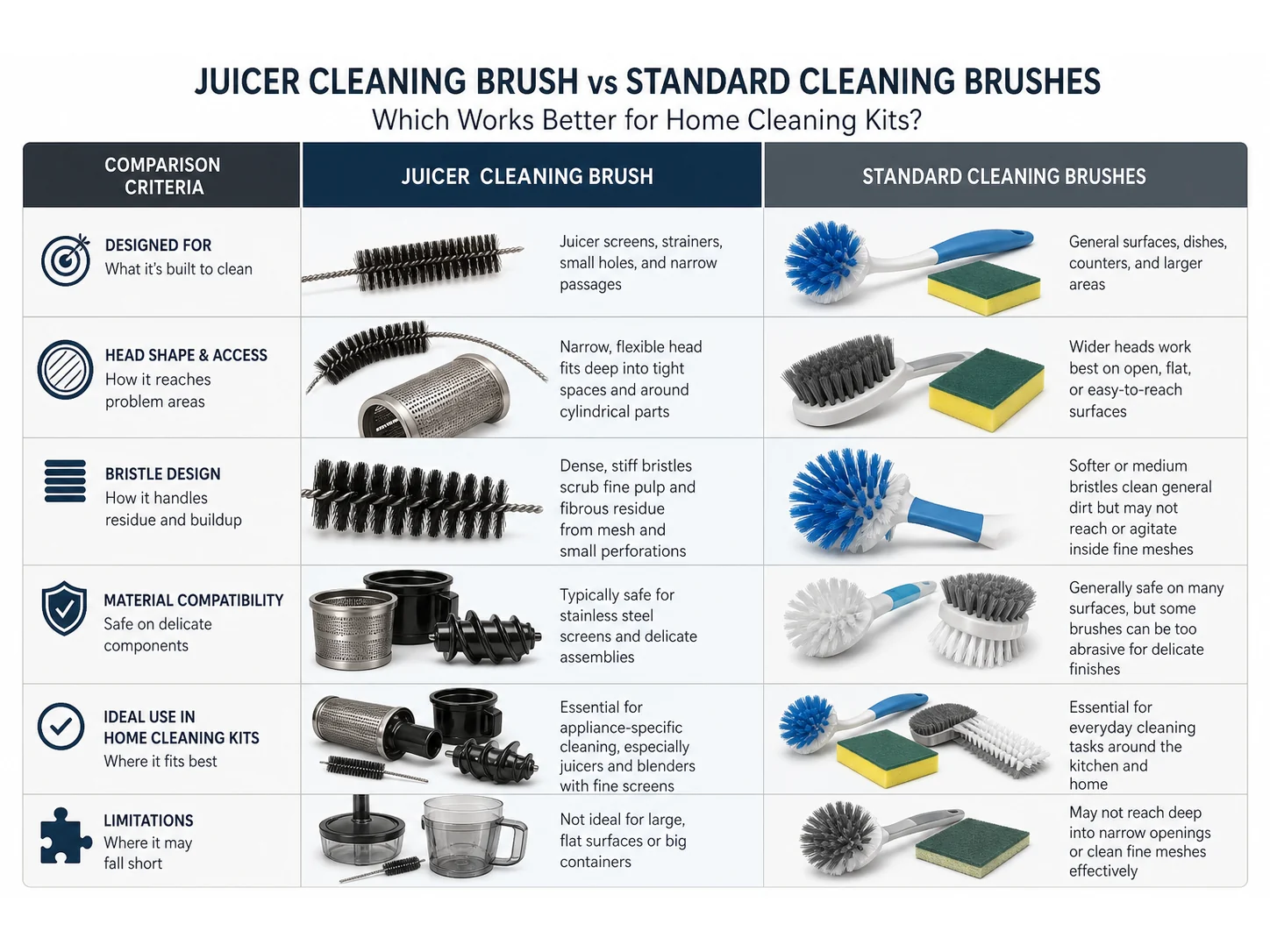
A juicer cleaning brush is a small, handheld brush built to dislodge pulp, fiber, and sticky residue from the tight, mechanical areas of a juicer. The typical design features a long, thin handle, a tapered head, and bristles that are firm enough to scrub but gentle enough to avoid scratching plastic parts or fine mesh screens. Some models include a secondary scraper tip or a smaller end bristle for nooks and ports. Unlike a generic bottle brush, the dimensions and bristle layout are tuned to match common juicer geometries.
Common Types of Cleaning Brushes in Home Kits
Home cleaning kits can include several brush types, each with a different primary job. Understanding their designs helps you see where a juicer brush fits or overlaps:
- Bottle brush: Long handle, cylindrical bristle head, good for wide necks and straight-walled containers.
- Dish brush: Short handle, wide head, better for plates and open surfaces.
- Vegetable brush: Rounded head designed for produce skin, often with stiff bristles.
- Pipe cleaner / tube brush: Flexible wire core with short, dense bristles; used for narrow tubes and straws.
- Grout / detail brush: Small, stiff-bristled brush for tight corners and grooves.
A juicer cleaning brush blends features from a bottle brush and a detail brush but with a focused purpose that none of these standard types perfectly addresses.
Juicer Cleaning Brush vs Standard Brushes: Head-to-Head Comparison
| Factor | Juicer Cleaning Brush | Standard Bottle Brush | Standard Detail Brush |
|---|---|---|---|
| Head length/diameter | Usually 1.5–2.5 in. (4–6 cm) bristle area, tapered | 2–4 in. (5–10 cm) bristle area, often cylindrical | Under 1 in. (2.5 cm) bristle area |
| Bristle stiffness | Medium-soft; safe for plastic mesh | Soft to medium; varies widely | Stiff to very stiff |
| Handle length & style | Long (6–8 in.), straight plastic or wire | Long, often plastic handle | Short stubby handle or finger grip |
| Reach inside narrow tubes | Excellent, designed for feed chutes | Good for straight, wide tubes | Poor to none |
| Ability to scrub fine mesh | Excellent, distributed pressure | Fair; large head may miss spots | Poor, risk of tearing or bending |
| Residue removal ease | Very good for wet, fibrous pulp | Fair for dried-on residue | Good for thick, stuck-on grime |
| Risk of scratching/damage | Low (when bristles are intact) | Low to moderate | High on soft surfaces |
How to Choose the Right Brush for Your Home Cleaning Kit
Your choice depends on what you are cleaning, how often, and what risks you need to avoid. Use the following decision factors:
- Residue type: If you frequently deal with sticky, fibrous pulp (from celery, kale, ginger), a juicer cleaning brush can save time. For loose tea or coffee grounds, a standard bottle brush may suffice.
- Surface sensitivity: Plastic juicer parts and fine mesh screens scratch easily. A stiff brush or abrasive pad will do more harm than good. A dedicated juicer brush minimizes that risk.
- Equipment interface: Juicer chutes and screens have specific shapes. A tapered, narrow head reaches corners that a cylindrical bottle brush cannot.
- Wet or chemical exposure: Some juicer brushes use nylon bristles and stainless steel cores, which resist corrosion from citric acid or detergents. Standard brushes with painted steel wire can rust quickly.
- Hygiene expectations: If you juice raw produce, trapped residue can harbor bacteria. A dedicated brush, cleaned and dried between uses, helps maintain a higher sanitation standard.
- Maintenance frequency: Daily juicers will see a noticeable benefit from the right tool. If you juice once a week, a careful bottle brush with a good detergent may do the job.
- Custom size requirements: Off-the-shelf juicer brushes fit most centrifugal and masticating juicers. For odd-sized manual juice presses, you may need a narrower tube brush or a custom-trimmed detail brush.
Common Mistakes When Choosing a Cleaning Brush
- Assuming all bottle brushes work the same: A low-cost, wide-bristle bottle brush might not even fit the juicer’s feed chute, let alone clean the screen.
- Using a wire brush or scouring pad: Metal bristles or abrasive pads will damage plastic parts and mesh screens beyond repair.
- Ignoring bristle material: Natural bristles (like tampico) can hold moisture and grow mold. Nylon or silicone brushes are easier to sanitize.
- Overlooking handle attachment: A handle that twists off or breaks under pressure leaves a piece stuck inside the juicer. Look for one-piece molded designs or secure stainless steel cores.
- Using the same brush for multiple tasks without disinfection: Cross-contamination between raw juice residues and other kitchen areas is a common food-safety slip.
When a Juicer Cleaning Brush Is the Wrong Choice
A juicer cleaning brush does a great job with routine pulp and juice residue, but it has clear boundaries:
- Baked-on or carbonized buildup: If juice residue has been burned onto a heating plate or old parts, chemical soaking or a specialized non-abrasive scrubber is needed; brushing alone won’t cut it.
- Blocked internal channels: Masticating juicers sometimes clog with fibrous chunks that a brush can’t push out. A disassembly tool or pressure flush is required.
- Mold or biofilm inside tubing: Brushes may miss invisible biological layers. A periodic soak in a food-safe sanitizer is essential.
- Commercial or high-volume settings: A manual brush is too slow. CIP (clean-in-place) systems or ultrasonic baths are the correct solution.
- Custom non-standard parts: If your juicer has a proprietary narrow tube or unusual screen angle, an off-the-shelf juicer brush might not fit perfectly. In such cases, you may need to source a custom brush or request a technical drawing review from a supplier.
Final Takeaway
For a home cleaning kit dedicated to regular juicer maintenance, a juicer cleaning brush outperforms a generic bottle brush or detail brush. It strikes the right balance of reach, bristle stiffness, and surface protection. If your cleaning tasks are more varied, a high-quality bottle brush may cover most needs, but you’ll likely spend more time and risk damaging fine mesh parts. Invest in a purpose-built juicer brush if you juice often or value convenience; stick with a careful standard brush if you juicer infrequently and have a soft touch.
Frequently Asked Questions
Can’t I just use a pipe cleaner for my juicer screen?
Pipe cleaners are sometimes too stiff and can bend or tear fine mesh screens. Their thin core also applies concentrated pressure, which risks puncturing soft plastic parts. A juicer cleaning brush distributes force more evenly.
What bristle material is safest for juicer parts?
Nylon or food-grade silicone bristles are preferred. They resist bacterial growth, clean easily, and won’t scratch plastic or stainless steel mesh. Avoid brass, steel, and natural fibers that absorb moisture.
How often should I replace my juicer cleaning brush?
Replace the brush when bristles start to flatten, splay, or shed. Typical home use might require replacement every 3–6 months. A worn brush cleans poorly and may trap bacteria in misshapen bristles.
Is a silicone bottle brush better than a traditional bristle brush for juicing equipment?
Silicone brushes are gentler on surfaces and don’t hold odor, but they can lack the scrubbing power needed for fibrous pulp. A medium-stiff nylon brush is usually more effective for juicer residue.
What’s the best way to clean a juicer brush itself?
Rinse under hot water immediately after use, shake out excess moisture, and hang to air-dry. Occasionally soak it in a diluted vinegar or food-safe sanitizer solution to remove hidden buildup.
Can a long-handle grill brush work as a juicer brush?
No. Grill brushes typically have metal bristles or extremely stiff plastic that will damage juicer parts. Stick to brushes labeled food-safe and designed for delicate surfaces.
Do all juicers need a special brush, or do some come with one?
Many juicer manufacturers include a basic cleaning brush in the box. These are usually well-suited to that specific model. If you lose it or need a replacement, a third-party juicer cleaning brush often matches the geometry closely.
How do I choose a brush size for a narrow masticating juicer?
Measure the feed chute and screen opening. Look for a brush with a bristle diameter slightly larger than the narrowest opening so it fills the space without forcing. A brush too small won’t make full contact; too large can get stuck.
Technical References
Which bristle material fits this job — Nylon PA, Silicone or AISI 304 Stainless Steel Wire?
| Material | Continuous temperature (°C) | Peak temperature (°C) | Water absorption | Hardness |
|---|---|---|---|---|
| Nylon PA | 93 | 121 | 0.3–9% by PA grade and conditioning | Medium to firm; filament diameter and trim length control bending force. |
| Silicone | 200–250 | 280–300 | 0.1–1.0% | Shore A 20–80 |
| AISI 304 Stainless Steel Wire | 400 | 500 | 0% | Rockwell B 70–95 depending on temper and cold work |
| PBT | 120–140 | 160–180 | 0.05–0.20% | Shore D 80–90 |
| Polypropylene PP | 80–100 | 120–140 | ≤0.03% | Shore D 65–75 |
Figures as published by Brushtec / DuPont; Alleima; Perlon. Confirm the exact grade against the supplier datasheet before ordering.
What should replace Handheld Detail Brushes for juicer cleaning brush?
- Handheld Detail Brushes — Handheld detail brushes cover general precision cleaning; auto-detailing brushes impose tighter controls for painted, polished, leather, display, and trim surfaces.
- Nylon PA — Compare Nylon PA with PP, PBT, PET. Change material when wet stiffness, temperature, chemical resistance, conductivity, particle shedding, or surface marking becomes the limiting factor.
- Silicone — Compare Silicone with PP, TPE, Nylon. Change material when wet stiffness, temperature, chemical resistance, conductivity, particle shedding, or surface marking becomes the limiting factor.
- AISI 304 Stainless Steel Wire — Use AISI 316 stainless steel wire for chloride, marine, dairy, beverage, chemical washdown, or higher pitting-resistance requirements. Use carbon steel for dry aggressive cutting and brass or abrasive nylon for lower marking risk.