
What Is a Pastry Tip Cleaning Brush?
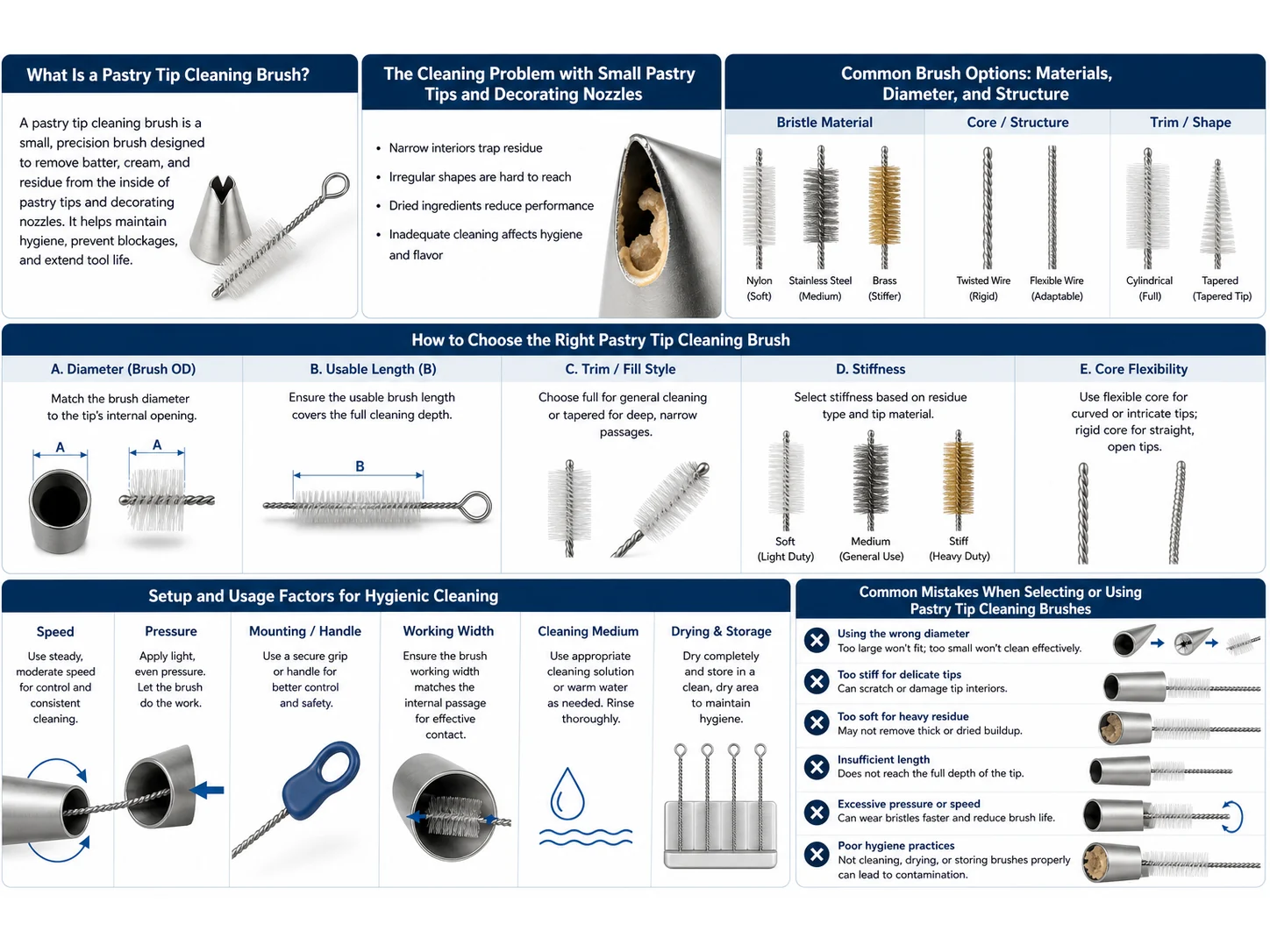
A pastry tip cleaning brush is a residue-removal tool engineered to reach the tapered, angled, and often intricate internal surfaces of pastry piping tips used in bakeries and food processing lines. It typically features a slim profile—often 2 mm to 20 mm in diameter—with bristles anchored along a central wire core. The brush is purpose-built for daily or shift-based cleaning to maintain food safety and tip performance.
The Cleaning Problem with Small Pastry Tips and Decorating Nozzles
Pastry tips come in dozens of shapes: round, star, leaf, petal, basketweave, and specialty. Their internal passages narrow to 1 mm or less in some designs, while threads and seams trap buttercream, royal icing, chocolate, or batter. Moisture from rinsing can accelerate microbial growth if residues remain. Manual cleaning with cloths, pipe cleaners, or generic brushes often misses these internal surfaces, leaving a hygiene risk and potentially affecting the next batch through flavor transfer or tip clogging.
Common Brush Options: Materials, Diameter, and Structure
Not all small brushes are suitable for pastry tip cleaning. The table below compares typical designs relevant to food-production environments.
| Brush Type | Typical Diameter | Bristle Material | Core/Wire | Flexibility | Best For | Food-Contact Note |
|---|---|---|---|---|---|---|
| Twisted-wire brush (nylon) | 2–12 mm | Nylon (soft or medium) | Galvanized or stainless steel wire | Moderate; bends and holds shape | General piping tips, light sugars | Nylon approved for incidental food contact; confirm core material |
| Twisted-wire brush (brass) | 3–10 mm | Brass wire | Steel wire | Moderate | Hardened sugar/dough on stainless steel tips | Brass may impart color if worn; avoid on delicate platings |
| Twisted-wire brush (stainless steel) | 3–15 mm | Stainless steel wire | Stainless steel wire | Stiff | Heavy residue, rust-free environments | Aggressive; can scratch soft metals or plating; verify grade for washdown |
| Pipe cleaner style brush | 1.5–8 mm | Cotton or microfibre with nylon core | Flexible wire (often aluminum or stainless) | Very flexible | Delicate curved or offset tips | Natural fibers may retain moisture; single-use or frequent replacement |
| Micro-brush / interdental style | 0.6–2 mm | Nylon fibres, fine wire | Thin wire stem | Very flexible, fragile | Ultra-fine nozzles, injection tips | Often disposable; check material compatibility |
Most pastry tip cleaning brush sets contain multiple diameters—commonly 3–5 sizes—to match a range of tip openings. A set gives the flexibility to clean different nozzle families without switching tools constantly.
How to Choose the Right Pastry Tip Cleaning Brush
Instead of picking by cost drivers or brand, base your selection on these operational factors:
- Tip Inner Diameter: Measure the smallest internal opening. Choose a brush whose working diameter is 0.5–1.5 mm smaller than that opening to allow thorough cleaning without jamming.
- Wire Core Flexibility: Straight-through tips work with moderate flexibility. Curved or offset tips need a highly flexible core that can follow the internal path without buckling.
- Bristle Softness: Soft nylon or natural fibre for plated brass or aluminum tips to avoid scratching. Medium nylon or soft brass for stainless steel with light deposits. Hard wire only for tough, carbonized residues on robust stainless nozzles—and only after testing on a sample.
- Residue Type: Fat-based buttercream or chocolate may respond to moderate bristles with a suitable detergent; hardened sugar or baked-on dough often requires a more aggressive brush or pre-soak.
- Washdown Method: If brushes go through a warewasher or are soaked in sanitizer, the core and handle materials must tolerate chemicals and heat. Galvanized steel can corrode; stainless or sealed plastic cores hold up better.
- Documentation for Food-Contact Use: Request supplier documentation that shows bristle and core materials meet relevant food-contact regulations (e.g., FDA 21 CFR, EU 1935/2004, or 3-A Sanitary Standards where applicable). This is not a certification claim—it is a verification step before use in production.
Setup and Usage Factors for Hygienic Cleaning
Even the best brush underperforms if misused. Integrate these practices into your sanitation routine:
- Pre-rinse: Flush tips immediately after use to prevent residue from hardening.
- Brushing technique: Insert the brush from the tip’s base toward the opening with a slight twisting motion. Work the entire internal surface, including thread areas.
- Brush maintenance: After cleaning tips, inspect the brush for trapped debris. Rinse, sanitize, and hang to dry. Avoid wooden handles; choose plastic or stainless steel with a hanging hole.
- Color coding: In allergen-sensitive environments, use colored brushes dedicated to specific product lines to prevent cross-contact.
- Replacement schedule: Replace brushes when bristles become matted, bent, or start shedding. A daily visual check is advised.
Common Mistakes When Selecting or Using Pastry Tip Cleaning Brushes
Avoid these pitfalls that can shorten tip life or compromise hygiene:
- Choosing a brush that is too large. Oversized brushes jam inside tips, bending bristles or damaging delicate edges.
- Using overly stiff bristles on plated tips. Hard wire can scratch chrome or nickel plating, creating corrosion sites and crevices for bacterial growth.
- Ignoring core material. A carbon steel wire core that rusts will contaminate tips and cleaning solutions. Stainless steel cores prevent that.
- Skipping material documentation. Using a brush not intended for food surfaces risks chemical leaching or bristle fragments in product.
- Using the same brush for all residues. Cross-contamination between allergen-containing and non-allergen products, or between sweet and savory, can occur without proper sanitation between uses.
- Assuming one brush fits all tip shapes. Specialty curved tips need a flexible brush; a stiff straight brush misses the critical surfaces.
When a Pastry Tip Cleaning Brush Is the Wrong Choice
A pastry tip cleaning brush solves a specific cleaning problem, but it has limits. You may need an alternative or supplement if:
- Heavy carbonized build-up: Baked-on sugar deposits that resist manual brushing may require soaking in a food-grade solvent or ultrasonic cleaning.
- Micro nozzles under 1 mm: Standard twisted-wire brushes may be too thick. A disposable micro-brush or specialized interdental brush might be required.
- High-volume cleaning (hundreds of tips per shift): Manual brushing becomes a bottleneck. Consider automated brush systems, multi-brush racks, or CIP-style spray systems for frequent cleaning.
- Complex multi-part nozzles: Some decorating nozzles disassemble; if residue traps in unsealed joints, disassembly is necessary—brushing alone cannot reach inside.
- Recurring contamination or brush wear: If shedding bristles appear in product or if brushes fail quickly, sample testing with the actual residue and operating conditions—or a supplier engineering review—may be needed to find a better match.
Final Takeaway
Selecting a pastry tip cleaning brush comes down to matching diameter, core flexibility, and bristle material to the internal geometry and residue type of your tips—while ensuring the brush materials are documented for food-contact use. Start by measuring your smallest tip opening, then acquire a set that covers your range. Test with real residues, inspect daily, and replace brushes before they become a contamination risk. That pragmatic approach keeps tips clean, production safe, and inspectors confident.
Frequently Asked Questions
How do I measure the right brush diameter for my pastry tip?
Use calipers to measure the narrowest internal diameter of the tip. Subtract 0.5–1.5 mm to get a brush diameter that provides clearance while still making full wall contact. If your tip set varies widely, a brush set with multiple sizes is the safest approach.
Can I use a standard hardware store wire brush for pastry tips?
Generally no. Hardware brushes often use carbon steel wire that rusts, shed bristles aggressively, and lack material documentation for food contact. Food-grade brushes are designed with appropriate materials, smoother surfaces, and often offer compliance declarations—essential for a production environment.
What bristle material is safest for stainless steel pastry tips?
Medium nylon or soft brass bristles usually clean effectively without scratching. Hard stainless steel bristles can gall or create micro-scratches that harbor bacteria, so reserve them only for heavy-duty bare stainless tips where fine scratches pose no risk of trapping contaminants.
How often should I replace my pastry tip cleaning brush?
Inspect daily. Replace when bristles become bent, matted, or start shedding. A worn brush is a hygiene risk and less efficient. In high-volume production, a weekly replacement schedule—or sooner if visual inspection shows wear—is common.
Are there brushes that can clean multiple tips at once?
Yes, some systems use a rack holding multiple brushes aligned with tip holders, allowing several tips to be cleaned simultaneously. For manual work, having a brush set with several sizes at the workstation is the most practical solution.
Can I sanitize my cleaning brush with bleach or high heat?
Check the brush materials. Nylon bristles and polypropylene handles usually tolerate dilute sanitizers and temperatures up to 80°C, but metal cores (especially galvanized steel) may corrode with strong chemicals or prolonged moisture. Always follow the supplier’s material tolerance guidance.
Is a twisted-wire brush better than a pipe cleaner style for pastry tips?
It depends. Twisted-wire brushes are more durable and aggressive, suited for straight tips with stubborn residue. Pipe cleaner styles are gentler and highly flexible, making them ideal for curved or delicate tips—but they may wear out faster and need more frequent replacement.
What if residue hardens inside a curved pastry tip and a brush won’t reach it?
Soak the tip in warm water and a food-grade detergent first to soften the deposit. Then use the most flexible brush you have, working slowly from both ends if possible. For extreme cases, an ultrasonic bath may be needed to break up the residue without mechanical force.
Technical References
- FDA — Food Code
- eCFR — 21 CFR 177.1500 Nylon Resins
- eCFR — 21 CFR Part 117 Human Food CGMP and Preventive Controls
- NIST — Metric SI
Which bristle material fits this job — AISI 304 Stainless Steel Wire, Nylon PA or Carbon Steel Wire?
| Material | Continuous temperature (°C) | Peak temperature (°C) | Water absorption | Hardness |
|---|---|---|---|---|
| AISI 304 Stainless Steel Wire | 400 | 500 | 0% | Rockwell B 70–95 depending on temper and cold work |
| Nylon PA | 93 | 121 | 0.3–9% by PA grade and conditioning | Medium to firm; filament diameter and trim length control bending force. |
| Carbon Steel Wire | 200–300 | 350–450 | 0% | Rockwell C 40–60 |
| Brass Wire | 150–200 | 250–300 | 0% | Rockwell B 40–90 |
| AISI 316 Stainless Steel Wire | 400 | 500 | 0% | Rockwell B 70–95 depending on temper and cold work |
Figures as published by Alleima; Brushtec / DuPont. Confirm the exact grade against the supplier datasheet before ordering.
What should replace Handheld Detail Brushes for pastry tip cleaning brush?
- Handheld Detail Brushes — Handheld detail brushes cover general precision cleaning; auto-detailing brushes impose tighter controls for painted, polished, leather, display, and trim surfaces.
- AISI 304 Stainless Steel Wire — Use AISI 316 stainless steel wire for chloride, marine, dairy, beverage, chemical washdown, or higher pitting-resistance requirements. Use carbon steel for dry aggressive cutting and brass or abrasive nylon for lower marking risk.
- Nylon PA — Compare Nylon PA with PP, PBT, PET. Change material when wet stiffness, temperature, chemical resistance, conductivity, particle shedding, or surface marking becomes the limiting factor.
- Carbon Steel Wire — Compare Carbon Steel Wire with Carbon steel wire, brass wire, abrasive nylon. Change material when wet stiffness, temperature, chemical resistance, conductivity, particle shedding, or surface marking becomes the limiting factor.