
Custom Cleaning Brush
Pastry Tip Cleaning Brush
Custom pastry tip cleaning brush for piping tips and nozzles. Double-ended, 3-12 mm diameters, nylon/PBT or stainless wire. Built to fit your tip set.
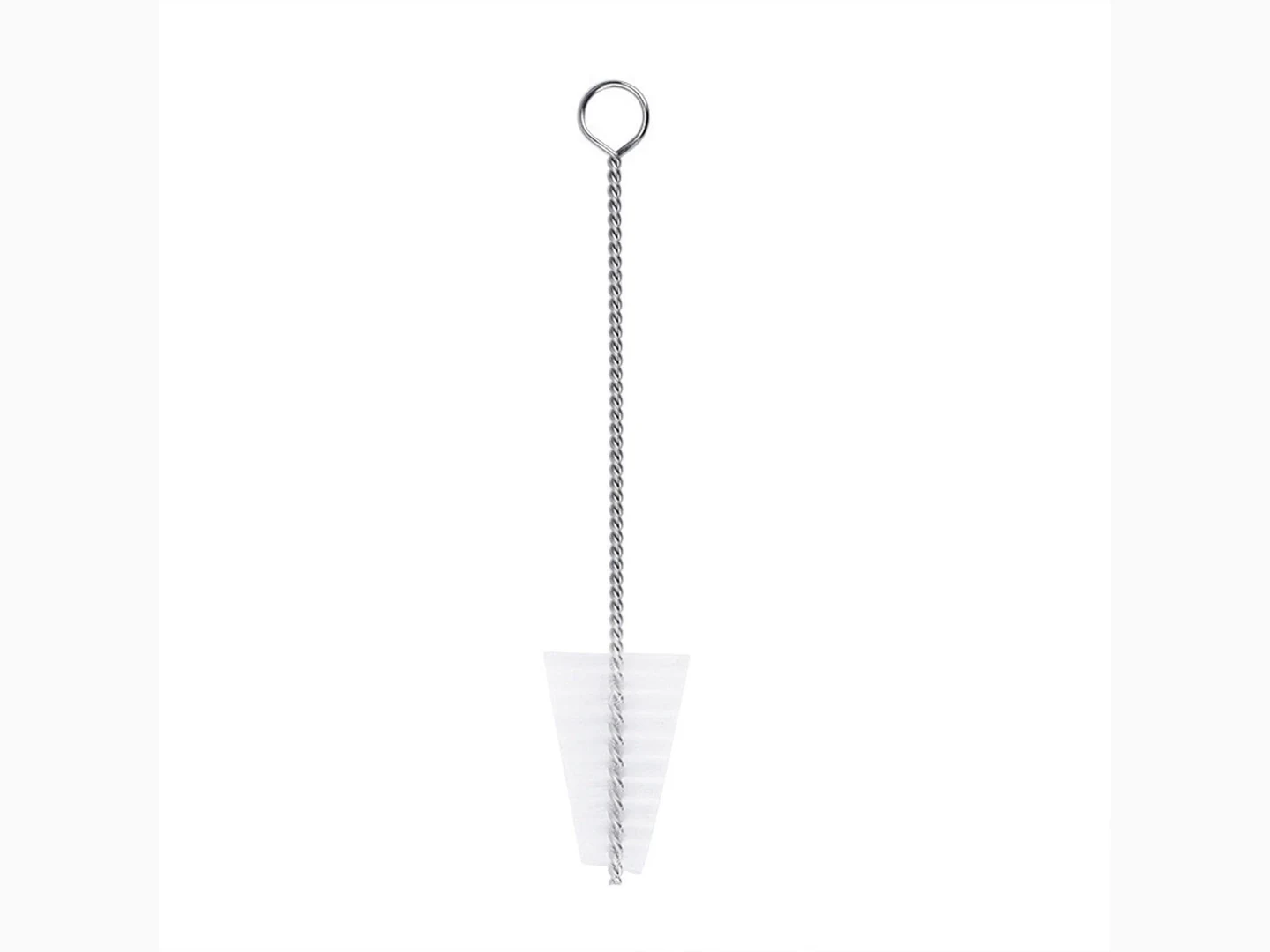
Small brush
500 pcs
Minimum order
Held in one hand: tube, bottle, detail and swab brushes — including long-handled ones with a small head.
Production lead time, once the specification is confirmed
- Up to 500 pcsWithin 7 days
- 501–50,000 pcsWithin 14 days
- Over 50,000 pcsWithin 21 days
Peak season can extend these times; the shipping date is confirmed in writing with your quotation. Sampling and shipping are quoted separately.
A small-diameter, double-ended cleaning tool for pastry tips and narrow piping nozzles. The straight brush end sweeps cylindrical bores and couplers, while the pointed end reaches the folded flutes and seams inside star, petal, and leaf tips where dried icing collects.
What can this brush do for you?
Two distinct working ends for open bores and closed flutes
The straight brush end scrubs the smooth circular bore of round tips, couplers, and large French tubes, while the pointed end digs through folded star points, petal creases, and leaf tip seams. Instead of switching between a toothpick and a generic brush, one tool covers both areas of the same tip.
Fine filaments matched to small nozzle openings
Filaments from 0.08 mm to 0.25 mm and brush diameters from 3 mm to 12 mm let the brush enter tips too small for kitchen brushes and bottle-style cleaners. Bristles pack into the cavity without folding back or leaving the tip throat untouched.
Material options that respect the tip surface
Nylon PA and PBT filaments remove buttercream, ganache, and soft icing without scratching plastic, coated, or polished metal tips. For hardened, baked-on sugar residue on stainless steel nozzles, a fine stainless steel wire fill provides a stiffer scrub while a lower interference setting keeps force under control.
Set configurations that reduce color-change downtime
Because tips come in many small bore sizes, we can supply a matched set from 3 mm to 12 mm so decorators always have the correct fit for the tip in hand. A set eliminates the habit of forcing one oversized brush through a smaller tip, which bends stems and flattens bristles.
Reusable tool that simplifies shift-end sanitation
Unlike disposable swabs or improvised toothpicks, this brush is built for repeated insertion, rotation, and rinsing across a production shift. The twisted wire core holds bristles in place, and the narrow stem dries quickly between tip changes.
What is a Pastry Tip Cleaning Brush?
A pastry tip cleaning brush is a hand-held tool built around a fine stainless steel stem, usually between 0.5 mm and 1.5 mm, with a short bristle section at one end and a formed point at the other. The bristle section is created by twisting filaments between two stainless steel wires, which locks them in place for repeated insertion and rotation.
In use, the straight brush end is inserted into the tip barrel and pulled back while rotating, sweeping residual frosting, dough, or icing off the walls. The pointed end addresses closed tip designs—star, drop flower, leaf, petal, and Russian piping tips—by pressing through their narrow openings to release dried material packed inside folds and creases.
This is a dry-use or damp-wipe tool for light to medium residue. Hard, caramelized deposits usually need a warm water or detergent soak before brushing. The stainless steel wire version is only for uncoated metal tips.
Technical Specifications
We can adjust the dimensions, stem, filaments, and point geometry to match your piping tip inventory.
| Parameter | Value / Options |
|---|---|
| Brush diameter | 3–12 mm, selected to tip bore ID |
| Working length | 20–80 mm |
| Overall length | 120–200 mm, including stem and point |
| Stem diameter | 0.5–1.5 mm |
| Stem material | Twisted stainless steel wire, 304 or 316 SS |
| Filament diameter | 0.08–0.25 mm |
| Fill material | Nylon PA, PBT, or stainless steel wire |
| Head configuration | Double-ended: straight brush end + pointed pick end |
| Point material | Stainless steel or molded polymer, per application |
| Set size | 1–20 brush diameters per project |
| Interference recommendation | Near-size contact for wiping; 5–20% oversize for polymer scrubbing; lower interference for wire fills |
| Use conditions | Warm water/detergent rinse; presoak hardened residues; air dry after use |
| Brush type | Custom Handheld Detail Brushes |
| How it is driven | Hand-guided |
| Cleaning target | professional bakery and patisserie production line, central kitchen and commissary operation, and food-processing plant cleaning |
| Surface or part | nozzles, bores, seams, tanks, tubes, filling nozzles, metal, and narrow openings |
| Residue or debris | icing, sugar, dough, chocolate, and cream |
| Mounting / connection | Threaded Removable / Fixed |
Where does this brush work best?
- Professional bakery and patisserie production lines where decorators clean round, French star, drop flower, petal, leaf, and specialty piping tips between colors and after shift.
- Central kitchens and commissary operations that run depositors, filling nozzles, and portioning tubes with buttercream, meringue, ganache, and royal icing.
- Food-processing plants with small-bore product-zone nozzles and extruder tips handling dough, cream, chocolate, or sugar paste.
- Restaurants, hotels, and catering kitchens that need rapid flip of decorating stations without waiting for a soak tank.
- Private-label kitchen-tool suppliers building consumer pastry kits with size-matched cleaning brushes.
How do I choose the right one?
Start with the tip, not the brush category. Measure the smallest inside diameter of the tip and note whether it has closed folds or a straight bore.
- Round, open tips and couplers: Match the brush diameter to the bore. Near-size contact works for wiping loose buttercream and sludge. Choose 5–20% oversize in nylon or PBT when you need a mild scrub. For stainless steel wire, stay at or near the bore diameter to avoid excessive force.
- Closed star, petal, and leaf tips: The straight brush should fit the main barrel, while the pointed end must penetrate the narrow fold openings. Make sure the working length can reach the tip bottom without the stem bending.
- Plastic, coated, or aluminum tips: Use nylon PA or PBT. Do not choose a wire fill; it will scratch or scrape the surface.
- Stainless steel tips with hardened sugar: A fine wire fill is the stronger choice, but presoak first. Wire does not replace chemical or thermal softening.
- Set selection: If your tip inventory spans several sizes, request a set covering the full 3–12 mm range. Most standard decorating sets have 6–10 common tip diameters; custom sets can include one brush per diameter to prevent cross-use.
Also confirm the cleaning environment: wash temperature, detergent, sanitizer, whether tips are rinsed after brushing or sent through a dishwasher. That determines stem material and filament grade. If you work with very deep or angled internal bores beyond 80 mm, a longer-neck nozzle brush or an ultrasonic bath may be required. Use an ultrasonic bath or soaking tank when dried residue fills folded seams and cannot be reached safely. Use a longer-handled nozzle brush for very deep nozzles, and use a disposable swab when cross-contamination between allergen or color batches is the main concern.
Can I customize this brush?
Pastry tip cleaning brushes are customized by diameter, working length, point shape, and set make-up, because no two tip inventories are identical. If you can send a sample tip, a CAD drawing, or a simple list of tip IDs and bore diameters, we can recommend a matching brush matrix.
- Brush geometry: Diameters from 3–12 mm, working lengths 20–80 mm, overall lengths 120–200 mm, and custom point shapes: sharp, blunt, angled, or narrow scraper tip.
- Stem: 0.5–1.5 mm stainless steel core, straight or slightly flexible, 304 or 316 SS.
- Fills: Nylon PA, PBT, or fine stainless steel wire in 0.08–0.25 mm filament diameters, with color coding for diameter or area.
- Handles: No handle, molded polymer grip, hanging loop, or branded grip section.
- Sets and packaging: 1–20+ brush diameters per set, bulk, individual bags, retail cards, peg hooks, or custom kit packaging.
- Marking and labeling: Pad printing, laser marking, or molded identification on the handle/stem, plus private-label packaging.
For food-industry projects, we can support material documentation, food-contact declarations, third-party inspection, and project-specific test reports as part of the customization scope.
Which size and filament should a pastry tip cleaning brush be built with?
Will the stainless steel wire version scratch plastic pastry tips?
Yes. A wire fill is intended for uncoated stainless steel tips with hardened residue. For plastic, coated, or aluminum tips, specify nylon PA or PBT filaments. If you are not sure which tip material you will receive, use the polymer option or test on a scrap tip first.
How do I check that the brush is the right diameter for my tip?
Insert the brush into the tip opening with light pressure. It should enter without forcing, rotate freely, and still contact the interior walls. If the bristles fold completely over or the stem flexes hard at the entrance, the diameter is too large. If you feel almost no wall contact, move up to the next diameter or add 5–20% oversize with a polymer fill.
Can the pointed end replace an ultrasonic cleaning step?
No. The point removes dried material you can physically reach inside folds and creases, but it cannot clean blind internal corners or dissolve caramelized sugar. Heavily baked-on residue should be presoaked in warm water or run through an ultrasonic bath before final brushing.
How should the brush be maintained between uses?
Rinse under warm water, wipe with a mild detergent if needed, and dry the stem and bristles before storage. Check the twisted wire core for bends, the point for dulling, and the bristle rows for loose or missing filaments. Replace any brush with bristle loss so it cannot shed into food product.
Is one brush enough for a full decorating set?
Usually not. A single diameter cannot serve both a #2 writing tip and a large French star without either jamming or leaving residue. A matched set of 6–12 diameters costs less in time and tip wear than forcing one size across the whole set. We can build a set based on the exact tip IDs you use.
What if my tips have an internal angle or curved bore?
A straight double-ended brush follows only the bore axis. If the interior has a sharp bend or very deep shoulder, a straight brush may not reach the full surface. Send us the tip drawing or sample, and we can evaluate whether a longer working length, a slightly flexible stem, or a different nozzle brush configuration is the better fit.
Guides that go deeper on this
Custom Manufacturing RFQ
Describe Your Application
Please include the main sizes, application, residue, preferred material, interface, quantity, and any drawing or sample available.
Drawing or photo optional — it speeds things up, it does not gate the enquiry.
Custom Brush RFQ
Send Your Brush Project
Upload a drawing, product photo, or sample photo and provide the core dimensions and cleaning conditions.
“We need a brush to remove wet residue from a stainless steel conveyor, about 800mm wide. The current brush wears quickly. We can send photos.”
“We sell drinkware and need a cleaning brush to include with the product. Quantity around 5,000 pieces.”