
Custom Cleaning Brush
Pastry Tip Cleaning Brush Set
Multi-diameter pastry tip cleaning brush set removes dried icing, dough, sugar and fat from piping tips, couplers and fine nozzles.
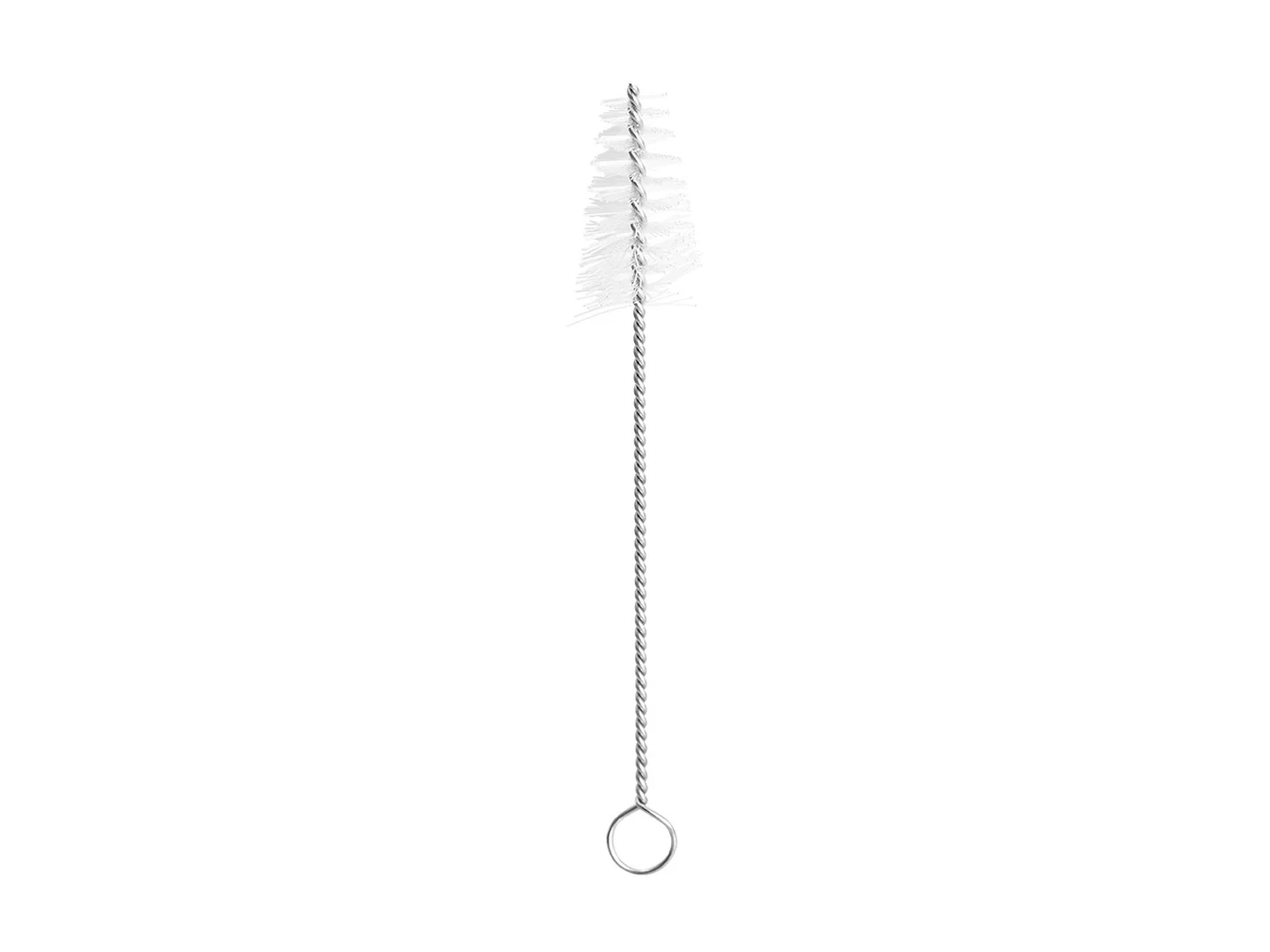
Small brush
500 pcs
Minimum order
Held in one hand: tube, bottle, detail and swab brushes — including long-handled ones with a small head.
Production lead time, once the specification is confirmed
- Up to 500 pcsWithin 7 days
- 501–50,000 pcsWithin 14 days
- Over 50,000 pcsWithin 21 days
Peak season can extend these times; the shipping date is confirmed in writing with your quotation. Sampling and shipping are quoted separately.
A multi-diameter set of narrow tube brushes built to clear dried icing, batter, sugar, melted chocolate, and fat from the interior bores and seams of pastry tips, couplers, and fine piping nozzles. Each brush uses a flexible twisted-wire stem with fine filaments sized to reach the tip shoulders and narrow outlets where cloths and wide brushes cannot make contact.
What can this brush do for you?
Diameter options that actually contact the bore wall
Piping tips range from fine writing tubes under 4 mm to wide open-star and Russian piping tips above 10 mm. The set includes a progressive range of brush diameters, normally from 3 mm to 12 mm, so you can pick a brush that fills the interior instead of one that only skims it. A brush that matches the bore with light interference lifts residue film off the wall; one that is too small misses the layer and leaves a thin smear behind.
Flexible stem passes through narrow necks and curved tapers
Each brush is built on a twisted-wire stem that bends without collapsing on the way into tight tip openings. The stem follows the internal taper from the base to the outlet, so cleaning motion can reach the joint where the tip threads onto the coupler and the small interior shoulder that traps dried icing.
Two fill materials for soft residue and hardened buildup
Fine Nylon PA or PBT filaments remove soft buttercream, royal icing, wet dough, oil films, and most daily residue without scratching polished or plated pastry tips. Stainless steel wire brushes in the set address hardened sugar, caramelized syrup, and baked-on fat that has dried in the tip overnight. Both fill types are captured in the twisted wire core, so bristles stay in place during push-pull and rotating strokes.
One set cleans round, star, leaf, closed, and specialty tips
Because the set spans multiple diameters, it covers plain round tubes, open and closed star tips, French tips, leaf and petal tips, drop flower tubes, and Russian piping nozzles. The narrower brushes handle small openings and fine writing tips; the larger diameters clean wide pastry tubes, couplers, and the base cavity behind the opening.
Quick rinse-out and fast drying after use
The open center construction and thin wire core do not trap water or food particles. After removing the residue, the brush rinses clean under warm water and air-dries quickly, reducing the chance of odor or cross-contamination when the set is reused across flavor or color batches.
What is a Pastry Tip Cleaning Brush Set?
A pastry tip cleaning brush set is a group of small-diameter tube brushes with twisted-wire stems and fine filament fill, proportioned to clean the internal passages of pastry tips and small piping components. Unlike a single pipe cleaner or a generic bottle brush, the set gives you a size for the narrow outlet, the body, and the coupler opening, because no one diameter cleans every tip in a decorating kit.
In use, the operator selects a brush slightly larger than the internal bore or equal to it, inserts the stem through the wide base or narrow outlet as access allows, and uses short push-pull plus rotation strokes to free dried batters, sugar-based icing, chocolate, and fats. The twisted wire core provides the stiffness to transmit pressure to the working end while remaining flexible enough to follow tapers and bends.
The set is a manual detail-cleaning tool, not a replacement for the full wash step. It removes attached food residue so subsequent soaking, rinsing, and sanitizing can work on a clean surface. It is especially useful for tips that have internal threads, seams, or closed-star cutouts where a flat brush or cloth cannot enter.
Technical Specifications
| Parameter | Value / Options |
|---|---|
| Set composition | 5–8 brushes covering a progressive diameter range, typically 3, 4, 5, 6, 8, 10, and 12 mm; set size and diameter steps can be changed per project |
| Brush diameter | 3–12 mm; custom smaller or larger diameters on request |
| Working length (bristle section) | 20–80 mm, matched to tip depth; shorter for small writing tips, longer for closed-star and tube tips |
| Overall length | 150–250 mm for standard hand sets; extended 250–450 mm versions available for piping machine nozzles and hard-to-reach fittings |
| Stem type | Twisted wire core, galvanized carbon steel or 316 stainless steel; stainless preferred for frequent wet washing and food-zone use |
| Stem diameter | 0.5–1.5 mm, selected to pass through the narrowest tip opening without jamming |
| Filament material | Nylon PA6.6, PBT, or 316 stainless steel wire |
| Filament diameter | 0.08–0.25 mm for Nylon/PBT; 0.10–0.20 mm for stainless steel wire |
| Bristle profile | Single-spiral or double-spiral fill; double-spiral gives denser contact for contoured interior surfaces |
| Stem end / handle | Straight tail, loop end, color-coded vinyl cap, or uncoated end, depending on set configuration |
| Operating environment | Manual cleaning, wet or dry; compatible with warm water, dish detergent, and rinse/sanitizing steps; material grade selected to suit washdown chemicals and frequency |
| Brush type | Custom Tube & Pipe Bore Brushes |
| How it is driven | Hand-guided |
| Cleaning target | commercial and high-volume pastry kitchen, bakery production and depositing line, and food-service maintenance and sanitation station cleaning |
| Surface or part | bores, tubes, nozzles, thread, shoulders, seams, necks, and internal passages |
| Residue or debris | icing, batter, sugar, chocolate, fat, oil, syrup, and dough |
| Mounting / connection | Threaded Removable / Fixed |
These are practical cleaning dimensions. The specification should be confirmed against the actual pastry tip range, because star, closed-star, French, and Russian tips vary in internal bore even when the outside dimensions look similar.
Where does this brush work best?
- Commercial and high-volume pastry kitchens where dozens of piping tips are used daily in cake decorating, meringue work, chocolate decoration, and plated desserts. Brushes remove dried royal icing, buttercream, ganache, and sugar films from sharp internal corners and threads.
- Bakery production and depositing lines where piping nozzles, filling tubes, aeration tips, and couplers collect batter, dough particles, sugar syrup, oil, and baked residue between batches. The set includes longer-stem options for cleaning nozzles while still mounted or positioned in hard-to-reach areas.
- Test kitchens, product development labs, and food-equipment cleaning teams working with small food-contact parts that require visual verification after wash. A correctly sized brush makes it possible to confirm the bore is free of residue before sanitizing.
- Food-service maintenance and sanitation stations where pastry tips, nozzles, small valves, and filling attachments are manually washed. The set complements soaking and spray-rinse processes by breaking up adhered deposits before the rinse step.
How do I choose the right one?
Selection starts with the pastry tip bore, not the number of brushes. Follow these steps to build or specify a set that will actually clean the tips in your kitchen.
Measure the narrowest opening and the main bore
Record the internal diameter of each tip at its narrowest point and the main cavity diameter. For Nylon or PBT brushes, choose a diameter approximately 5–20% larger than the main bore so the flexible filaments press against the wall during rotation. Stainless steel wire brushes should be selected near the bore size or with only light interference, because wire does not flex as much and too much oversize will jam or gouge.
If the tip has a narrow neck with a wider body, the stem diameter becomes the limiting factor. The stem plus compressed brush diameter must pass the narrow neck, while the filament diameter still carries the working contact into the wider area.
Match fill material to the residue and the tip surface
Use Nylon or PBT brushes for soft icing, batters, oil films, and daily cleaning on polished, plated, coated, or plastic pastry tips. Use the stainless steel wire brushes in the set only on solid stainless or heavy nickel-plated tips with hardened sugar, caramelized syrup, or baked-on fat. Wire brushes are not appropriate for thin plating, anodized aluminum, disposable plastic tips, or coated decorative accessories.
If the residue is heavy baked-on carbon or mineralized hard water scale, fine wire may not be aggressive enough; a dedicated industrial wire brush or chemical pre-soak should replace or precede the brush step.
Check working length against tip depth and blind areas
The bristle section must reach the deepest part of the tip, including the base cavity and the interior shoulder behind the opening. A short brush that does not reach the threads leaves residue where contamination starts. A working length that is too long wastes bristle contact and makes the brush harder to control inside shallow tips.
Consider the stem end and operator control
A straight tail with vinyl cap is easiest to grip for sink-side cleaning. A loop end allows hanging the brush near the wash station and reduces the chance of dropping it into a drain. Longer overall lengths help when cleaning piping machine nozzles that stay mounted or are difficult to reach, while short stem lengths improve control for fine hand work.
When this set is not the right tool
Choose another brush or method when the internal passage is smaller than about 3 mm, because the standard minimum brush diameter cannot make effective wall contact in smaller channels. In that case, use a fine pipe cleaner, micro swab, or single-use applicator. For production-scale cleaning of hundreds of identical tips per shift, ultrasonic cleaning or automated wash systems may be more consistent than manual brushing alone; this set works well as the spot-cleaning and verification step in that process.
Can I customize this brush?
Pastry tip cleaning brush sets are built around the diameter range and residue profile of your specific tips. We will need the internal bore range, narrowest opening, tip types, residue conditions, wash chemicals, and wet/dry use frequency, plus your preferred handle style and package format. A drawing, catalog reference, or sample tip set helps match the working lengths accurately.
- Set composition — number of brushes, diameter steps, inclusion of both Nylon/PBT and stainless wire brushes in one kit, or single-material sets
- Brush diameter and working length — built to a specific tip assortment, such as 3/4/5 mm for writing and fine star tips plus 8/10/12 mm for large open tubes
- Stem material — galvanized carbon steel or 304/316 stainless steel, with stem diameter adjusted to the smallest neck
- Filament material and fill density — Nylon PA6.6, PBT, stainless steel wire; single-spiral for light residue or double-spiral for denser scrubbing contact
- Stem end and handle — straight tail, loop, color-coded vinyl cap by diameter, printed size marking, or laser-marked identification
- Packaging and private label — bulk packs for kitchen use, individual printed cards or boxes for retail, custom brand artwork, or grouped kits by tip type
If your food-safety or quality program requires material declarations, inspection reports, or third-party testing support for the intended food-contact use, we can assist during the customization project.
Which filament survives the cleaning and still lasts on a pastry tip cleaning brush set?
How do I know which brush diameter to use on a given pastry tip?
Measure the internal bore first. For Nylon or PBT brushes, choose a diameter about 5–20% larger than the bore so the filaments contact the wall. For stainless steel wire brushes, choose a diameter near the bore size. If the brush jams or folds over during insertion, drop down one size. If it slides through with no wall contact, go up.
Can I use the stainless steel wire brushes on all my pastry tips?
No. Use wire brushes only on solid stainless or heavy nickel-plated tips. Thin plating, coated metal, anodized aluminum, and plastic tips should be cleaned only with Nylon or PBT brushes. When in doubt, test on an inconspicuous area or stay with the softer fill.
What is the best way to clean dried royal icing that has hardened in a small star tip?
Soak the tip in warm water or a detergent solution first to soften the residue. Then select a brush with light interference, insert it from the base, and use rotation with short push-pull strokes. If the icing remains hard after soaking, use a stainless steel wire brush only if the tip is solid stainless or heavy nickel-plated metal.
How can I verify the tip is actually clean after brushing?
Run a clean white cloth or thin swab through the bore after brushing and inspect the cutout edges and base threads under good light. Any colored residue, film, or odor means the brush missed an area. Adjust the brush diameter, working length, or add a pre-soak step before assuming the tip is clean.
How should the brush set be maintained between uses?
Rinse each brush under warm water with mild detergent after each cleaning session and inspect the filaments for embedded particles. Straighten bent stems by hand. Hang the brushes to air-dry. Replace any brush with matted or missing bristles, permanent kinks, or rust on the core.
Can this set replace soaking or sanitizing?
No. Brushing removes attached residue, but it does not replace chemical soaking for hardened material or sanitizing as required by your food-safety plan. Use the set as one step in the full sequence: pre-rinse, soak if needed, brush, rinse, and then sanitize.
Guides that go deeper on this
We have not written a guide specific to this one yet. The material that covers selection, filament, dimensions, maintenance and sourcing is collected in the technical resources library.
Custom Manufacturing RFQ
Describe Your Application
Send the key measurements, cleaning requirement, residue, material direction, mounting method, quantity, and drawing or photo.
Drawing or photo optional — it speeds things up, it does not gate the enquiry.
Custom Brush RFQ
Send Your Brush Project
Upload a drawing, product photo, or sample photo and provide the core dimensions and cleaning conditions.
“We need a brush to remove wet residue from a stainless steel conveyor, about 800mm wide. The current brush wears quickly. We can send photos.”
“We sell drinkware and need a cleaning brush to include with the product. Quantity around 5,000 pieces.”