
Custom Cleaning Brush
Fan Tip Tube Brush
Custom fan tip tube brushes for cleaning bores, ports, counterbores and seats. Nylon, PBT, PP filaments, galvanized or stainless stems.
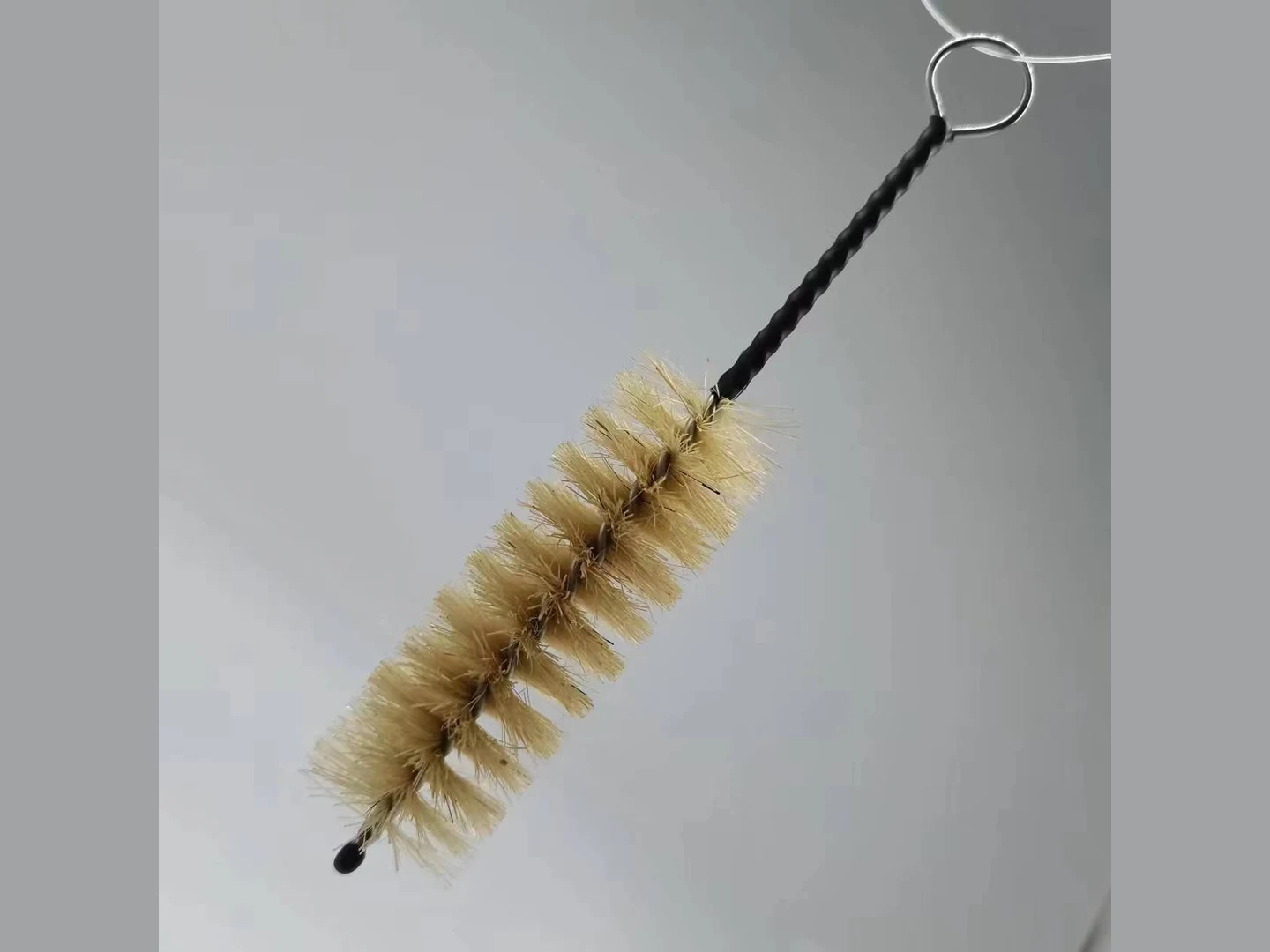
Small brush
500 pcs
Minimum order
Held in one hand: tube, bottle, detail and swab brushes — including long-handled ones with a small head.
Production lead time, once the specification is confirmed
- Up to 500 pcsWithin 7 days
- 501–50,000 pcsWithin 14 days
- Over 50,000 pcsWithin 21 days
Peak season can extend these times; the shipping date is confirmed in writing with your quotation. Sampling and shipping are quoted separately.
A fan tip tube brush combines a standard twisted-wire tube cleaning section with a flared filament fan at the working end, so one stroke covers the narrow bore and the wider counterbore, port opening, taper seat, or tube-end face beyond it. It is built to lift machining chips, coolant, oil, powder, and light process deposits from internal passages and their end features without scoring the machined surface.
What can this brush do for you?
Cleans the bore and its end feature in one pass
The straight filament section scrubs the through hole or main bore, while the flared end fan contacts and sweeps the larger diameter at the bottom of a blind hole or the port mouth. Instead of running a bore brush and then a second end brush, the same push, pull, and rotate cycle completes both contact areas.
Follows steps, shoulders, and taper seats instead of skipping them
Fan filaments deflect as they pass the transition from the small bore into a counterbore, then spring back toward their relaxed spread. The flexible ends reach into the corner where the bore wall meets the bottom face or seat, an area straight trim brushes tend to leave as a dead ring.
Removes process residue without gouging soft or plated bores
Nylon, PBT, and polypropylene filaments have limited cutting action compared with wire or abrasive fill. They carry away chips, oil, coolant, and light oxidation while leaving aluminum, brass, copper, and coated bore surfaces intact under normal hand or low-speed power use.
Works as a hand brush or mounted to a driven stem
Loop, ring, threaded, and plain-tail configurations support pull-through cleaning by hand or mounting in a low-speed drill or spindle for repetitive bore prep. The twisted wire stem holds the filament setting under rotation while the fan end keeps contact at the open end of the passage.
What is a Fan Tip Tube Brush?
A fan tip tube brush is a cylindrical twisted-wire tube brush with a secondary filament group at the working end that is spread outward into a fan or conical shape. The straight brush section handles the bore ID; the fan handles the larger open geometry beyond the bore: a counterbore, port face, flared tube end, O-ring pocket, valve seat pocket, or tube sheet opening.
The fan is formed by setting longer or angled filament at the end of the brush section. The wire stem still works as the backbone of the brush, so the tool can be pushed and rotated through a passage like a standard tube brush. When the fan reaches a wider cavity, its filaments return to their spread angle and sweep the face or seat; when it is pulled back through the narrow bore, the filaments fold backward and move with the stem.
This is not a heavy stock-removal tool. The filament is intended for wiping, displacing, and mild scrubbing of loose and lightly adhered deposits. If the passage has no wider end feature, the fan adds little and the brush is better configured as a plain tube brush. Used in the right geometry, a fan tip removes a second operation and ensures the bore entry or seat is cleaned at the same time as the tube wall.
Technical Specifications
The ranges below cover standard production. Each brush is sized around the narrowest bore ID, the end feature to be contacted, and the operating method.
| Parameter | Standard Range / Options |
|---|---|
| Brush section length | 25–127 mm (1–5 in) |
| Shank brush diameter | 3.2–50.8 mm (0.125–2.0 in) |
| Fan tip spread diameter | 5–76 mm (0.2–3.0 in); typically 20–60% larger than the shank brush diameter |
| Fan tip length | 10–40 mm (0.4–1.6 in) |
| Overall length | 152–406 mm (6–16 in), cut to reach requirement |
| Filament material | Nylon (PA6, PA6.6) primary; PBT and PP available |
| Filament diameter | 0.08–0.25 mm (0.003–0.010 in) |
| Stem wire | Galvanized steel, 304 stainless steel, 316 stainless steel, or coated steel |
| Stem style | Single stem, double stem, loop, ring, threaded, flexible extension |
| Contact setting | Near-size for wiping; 5–20% oversize for flexible polymer scrubbing; lower interference with wire fill |
| Brush type | Custom Tube & Pipe Bore Brushes |
| How it is driven | Hand-guided |
| Cleaning target | hydraulic and pneumatic manifold, machined tube and pipe end, and valve and fitting body cleaning |
| Surface or part | tubes, bores, passages, ports, tapers, sheets, valves, and internal passages |
| Residue or debris | chips, powder, coolant, oil, carbon, rust, scale, and process deposits |
| Mounting / connection | Threaded Removable / Fixed |
Working temperatures, chemical exposure, and required fill stiffness are tied to the filament and stem selections in your order profile.
Where does this brush work best?
- Hydraulic and pneumatic manifolds – cross-drilled ports, counterbores, SAE/ISO port entrances, O-ring grooves, and taper seats that accumulate chips and cutting fluid during machining.
- Machined tube and pipe ends – cleaning the ID, lead-in chamfer, and end face after drilling, reaming, or cutoff.
- Valve and fitting bodies – seat pockets, internal threads, and port mouths where a straight brush stops short of the open face.
- Small engine and fuel system ports – injector bores, carburetor passages, and throttle-body openings where carbon and fuel film must be removed from a wider mouth at the passage end.
- Heat exchanger and boiler tube entries – tube sheet openings and tube ID entry zones that collect scale, rust particles, and cleaning residue.
- Laboratory and processing tubing – nylon or PP variants for wiping powder, product film, and rinse residue from tubing with flanged or flared ends.
How do I choose the right one?
Measure the narrowest passage and the end feature first
The shank brush diameter must pass the smallest bore with enough filament contact to clean, and the fan tip spread must match the larger end diameter or seat. If the fan has to travel through the bore before reaching the end feature, its relaxed spread must be small enough to fold through the bore without permanent set. If there is no wider opening, the fan does not function and a standard tube brush is the better configuration.
Match the filament to the residue and surface
Nylon is the default for general oils, coolant, chips, and light deposits on machined bores. PBT resists hydrocarbons and holds stiffness better in warmer or fuel-related applications. PP suits water-based or alkaline wash environments with lower temperature requirements. Finer filaments (0.08–0.12 mm) wipe and polish; heavier filaments (0.20–0.25 mm) provide firmer scrubbing without moving into abrasive territory.
Pick the stem by how the brush will be driven
Single-stem construction is the standard for hand use and simple pull-through. Double-stem fills the bore more densely and gives a stiffer cleaning section. Loop and ring ends make manual pulling easier; a threaded or plain ground tail allows mounting in a drill, fixture, or low-speed machine spindle. Use a flexible extension only when the passage curves, and keep power speed low to prevent the fan from throwing outward and overheating.
Use the right interference, not the maximum
An on-size brush cleans by wiping and conforming to the bore. A 5–20% oversize condition with polymer filaments increases contact pressure for light scrubbing. More than that with soft filaments creates folding and uneven wear, not better cleaning. Wire fills need lower interference and different speed control because they cut the base material instead of flexing.
When a fan tip tube brush is the wrong choice
If the deposit is hard rust, burned carbon, baked scale, or polymerized residue, use a wire or abrasive-filled tube brush or a mechanical reaming tool. If the passage is under about 3 mm (0.12 in) ID and must follow tight curves, a plain flexible tube brush, wire brush, or precision swab is more practical. If the brush is for contamination-sensitive single-use cleaning, a disposable applicator may serve better.
Can I customize this brush?
Yes. Fan tip tube brushes are normally made to the bore drawing rather than stocked as finished parts. To configure the brush, provide the minimum bore ID, bore depth, end feature diameter and depth, the transition angle or step, the residue to be removed, process fluid and temperature, whether the brush is hand or power driven, and the required stem end or handle.
Common variables we adjust:
- Fan tip geometry – spread diameter, fan angle, filament length, filament density, single or layered fan, and fan position along the stem.
- Brush section – shank diameter, brush length, total reach, and end trim profile.
- Filament – nylon, PBT, or PP; filament diameter; straight or crimped fill; stiffness grade; color coding.
- Stem – galvanized or stainless wire, wire gauge, single or double stem, threaded end (metric or inch), loop, ring, flexible extension, or plain tail for tool mounting.
- Handle and interface – bare tail, loop, ring, T-handle, hex or round shank, and quick-change options.
- Packaging and marking – bulk pack, individual poly bag, box, label, laser marking, or custom color for identification.
If your purchasing specification requires project-specific material documentation, inspection reports, or third-party testing support, we can assist with that as part of the customization program.
Which size and filament should a fan tip tube brush be built with?
How can I tell whether the fan tip actually reaches the end feature?
Mark the stem at the bore entry before insertion. After the brush bottoms out, compare the mark with the known bore depth and check whether the fan has entered the counterbore or seat. On critical parts, inspect by borescope or light after brushing. If the fan tip stops short, shorten the brush section or move the fan closer to the working end.
Can this brush be run under power?
Yes, with a threaded or ground tail. Keep polymer filament brushes at low speed, typically 500–1,500 RPM depending on diameter; higher speeds flare the fan outward, reduce contact control, and may heat-set or melt the filament tips. Hand rotation or a slow pulled-through stroke is preferred when surface finish is critical.
Will the fan fold when it travels through a smaller bore?
It folds backward whenever the bore ID is smaller than the relaxed fan diameter. The fan reopens when it enters the wider cavity at the end, which is exactly how the brush reaches the end feature. If the entire passage is the same diameter, the fan remains folded and adds no useful contact, so a standard tube brush is the cleaner choice.
What should I inspect before the brush goes back into service?
Check the fan for permanently bent or matted filaments, missing filament ends, and a spread angle that no longer returns. Check the twisted stem for kinks, loosened winding near the brush section, or corrosion at the loop or thread. A fan that stays folded or a shank section worn below bore contact size should be replaced.
When should I specify a wire brush instead of a filament fan tip?
If a test area requires a scraper, file, or wire brush to remove the deposit, the polymer fan will only polish the surface. Hard scale, rust, carbon, and polymerized residue need a wire or abrasive-filled tube brush with reduced interference and controlled speed, or a mechanical cleaning process.
Does brushing replace flushing or blowing out the passage?
No. The brush loosens and displaces chips, sludge, and light film, but the released particles must still be rinsed with solvent or blown out with air before assembly. Rinsing or blowing before brushing can also reduce the load on the fan and extend filament life.
Guides that go deeper on this
Custom Manufacturing RFQ
Describe Your Application
An accurate custom quote starts with the dimensions, working surface, residue, material choice, connection, quantity, and reference files.
Drawing or photo optional — it speeds things up, it does not gate the enquiry.
Custom Brush RFQ
Send Your Brush Project
Upload a drawing, product photo, or sample photo and provide the core dimensions and cleaning conditions.
“We need a brush to remove wet residue from a stainless steel conveyor, about 800mm wide. The current brush wears quickly. We can send photos.”
“We sell drinkware and need a cleaning brush to include with the product. Quantity around 5,000 pieces.”