
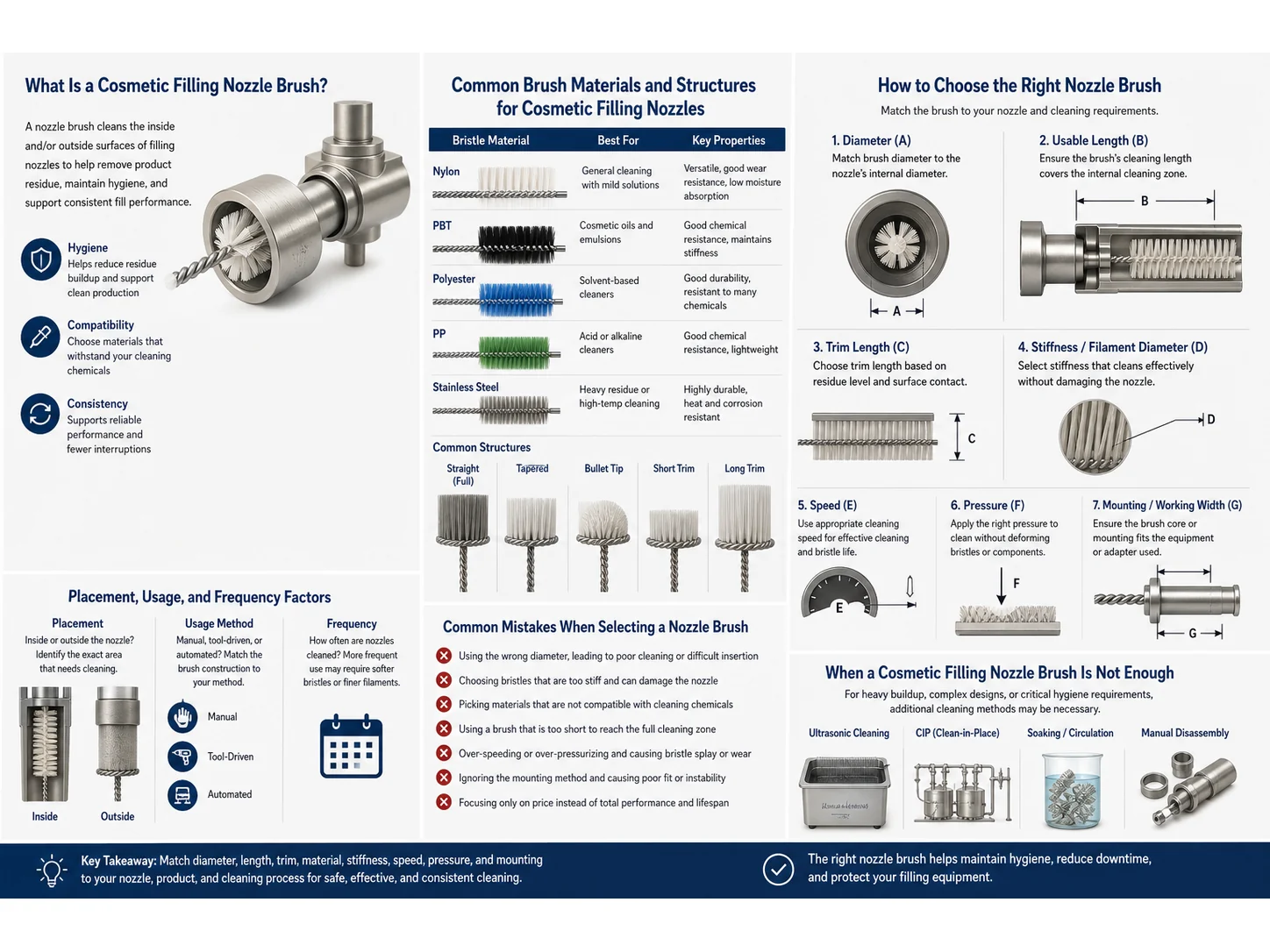
What Is a Cosmetic Filling Nozzle Brush?
A cosmetic filling nozzle brush is a specialized cleaning tool with a narrow profile and bristles configured to scrub the interior of filling nozzles. It typically consists of a twisted-wire or plastic stem, bristles made from chemically resistant materials, and a handle or machine-mounting end. Its purpose is to remove creams, lotions, serums, or powders that cling to nozzle walls and can compromise product quality, cause clogging, or lead to cross-contamination between batches. Unlike general-purpose tube brushes, these brushes must often meet extra requirements for particle-free operation and compatibility with aggressive sanitation agents.
Common Brush Materials and Structures for Cosmetic Filling Nozzles
The choice of bristle material and core design directly affects cleaning performance, durability, and contamination risk. The table below compares the most common options found in hygienic and cosmetic-grade nozzle brushes.
| Bristle Material | Typical Stiffness | Chemical Resistance | Shedding Risk | Best Use Case |
|---|---|---|---|---|
| Nylon (6.6 or 6.12) | Medium to firm | Good with most solvents and alkalis; limited with strong acids | Low if mechanically set | General cosmetic creams and lotions with standard CIP cleaners |
| Polyester (PET) | Soft to medium | Excellent with acids and many solvents; less absorbent than nylon | Low | Acidic formulations or products requiring repeated acid sanitizing |
| PTFE (Teflon®) | Soft | Nearly universal; withstands aggressive chemicals and high temperatures | Very low, but bristles can flex easily | High-purity or solvent-heavy products where contamination must be zero |
| Tampico (natural fiber) | Medium | Limited; may degrade with strong chemicals or prolonged moisture | Moderate | Manual cleaning of viscous pastes where fiber absorbency helps lift residue |
| Stainless steel wire | Firm to very firm | Excellent against most chemicals, but may corrode with chlorides | Negligible | Heavy residue or baked-on product, but only on stainless steel nozzles to avoid scratching |
Core materials commonly include galvanized or stainless steel twisted wire (durable but may scratch) and plastic-coated wire or pure polymer stems (non-metallic, ideal for sensitive nozzle materials). Handle styles range from simple loop ends for manual use to threaded or quick-connect fittings for automated cleaning heads.
How to Choose the Right Nozzle Brush
Selecting a cosmetic filling nozzle brush requires balancing five practical factors:
- Nozzle inner diameter (ID): Measure the tightest passage the brush must pass through. The brush diameter should be slightly larger than the nozzle ID—typically 0.5–1.0 mm oversize—to ensure bristle contact without excessive force or shaft wear.
- Product residue characteristics: For oily or waxy residues, a stiffer nylon or stainless steel brush may be needed. For water-soluble residues or light creams, a softer polyester or PTFE brush can clean effectively without risk of scratching.
- Cleaning agent compatibility: Check the chemical resistance of the bristle and core materials against the CIP detergents, sanitizers, or solvents used. A brush that swells or degrades in hot caustic soda will quickly shed bristles and fail hygiene validation.
- Bristle retention and shedding control: In cosmetic production, loose bristles are a serious foreign-body risk. Look for brushes with mechanically crimped or heat-set bristles rather than simple glue-in types. Request material certifications or lot-specific shed-rate data if available.
- Handle and reach requirements: If nozzles are deep or mounted in tight manifold spaces, a brush with a long, flexible stem and a comfortable non-slip handle (or a machine-adaptable shank) will improve operator efficiency and cleaning consistency.
Whenever possible, conduct a sample trial with the actual nozzle geometry and product residue. A visual or borescope inspection after cleaning provides the most reliable selection data.
Placement, Usage, and Frequency Factors
Nozzle brushes are not only about selection—how and when they are used affects hygiene outcomes. In high-speed filling lines, brushes may be used during changeovers, and cleaning frequency can range from every batch to end-of-shift. For clean-in-place (CIP) systems that still require manual attention, a brush with a quick-connect handle allows operators to clean without full disassembly. Brushes should be stored dry and replaced on a schedule to prevent microbial growth in bristles and to maintain cleaning effectiveness. Documenting brush usage (date, operator, inspection result) supports GMP compliance.
Common Mistakes When Selecting a Nozzle Brush
- Choosing by cost drivers alone: A low-cost brush that sheds bristles can cause a production line shutdown or a product recall costing far more than a premium brush.
- Ignoring chemical compatibility: Using a nylon brush with a ketone solvent, for example, can cause bristles to soften, swell, and break off inside the nozzle.
- Using wire brushes on soft metals or plastics: Stainless steel bristles can scratch aluminum or polymer nozzle parts, creating crevices that harbor bacteria.
- Selecting the wrong diameter: A brush that is too small leaves residue behind; one that is too large can bend the stem, break bristles, or damage the nozzle bore.
- Overlooking handle length and ergonomics: An awkward, too-short handle makes thorough cleaning difficult, leading to missed areas and inconsistent results.
When a Cosmetic Filling Nozzle Brush Is the Wrong Choice
Brushes are effective tools, but they have limits. If a nozzle has complex internal cross-drilled holes, blind passages, or delicate surface finishes, a brush alone may not reach every critical area. In such cases, complementary cleaning methods—such as ultrasonic baths, high-pressure spray cleaning, or automated flushing systems—should be considered. Additionally, if a product is extremely sensitive to any particulate contamination, even the lowest-shed brush may not meet the threshold; disposable swabs or single-use cleaning devices might be required. Finally, if documentation and validation standards demand absolute repeatability and traceability (as in some pharmaceutical-grade cosmetics), a validated automated cleaning process with monitored parameters often replaces manual brushing.
Final Takeaway
A cosmetic filling nozzle brush solves a narrow but critical hygiene problem. The right brush balances diameter, material resistance, and handling to match your nozzle, product, and cleaning chemicals. Always test a sample with real residues and cleaning agents before standardizing; what works in theory often fails where product buildup, temperature, and operator technique meet. Use this guide as a practical starting point—not a substitute for a sample trial or a thorough supplier review.
Frequently Asked Questions
What diameter brush should I use for my filling nozzle?
Measure the smallest inner diameter of the nozzle. Choose a brush diameter that is 0.5–1.0 mm larger than that measurement for effective bristle contact. If the nozzle has a tapered bore, size for the narrowest point.
Can I use the same brush for oil-based and water-based products?
Yes, if the brush material resists the cleaning chemicals needed for both. However, always physically verify that no cross-contamination remains. Some manufacturers keep separate brush sets for different product families to reduce risk.
How do I know if a brush is truly “low-shed”?
Request a shed-rate specification or a sample to test under your cleaning conditions. A simple rinse-and-filter test (filter the rinse solution and count loose bristles) provides a practical quality check.
Is stainless steel wire safe for all cosmetic filling nozzles?
Only for nozzles made of stainless steel or other hard metals. Stainless steel bristles can scratch softer materials like aluminum, brass, or PTFE-coated surfaces, creating contamination traps.
How often should I replace a nozzle cleaning brush?
Replace when bristles show visible wear, when shedding increases, or when the brush no longer effectively cleans. For documented hygiene programs, set a maximum cycle count based on initial testing—often every 1,000 cleaning strokes or after 3–6 months of heavy use.
Can a brush sterilize a filling nozzle?
No. Brushes are mechanical cleaning tools. They physically remove residue but do not sterilize. Sterilization is achieved through validated heat, chemical, or radiation processes after cleaning. A brush prepares the surface for effective sterilization by removing organic soil.
What if my nozzle has threads or intricate ports?
A standard round brush may not clean threads or side ports effectively. Consider brushes with shaped bristles, side-action designs, or supplemental cleaning with interdental-style brushes made for small ports. In some cases, a combination of brush, pipe cleaner, and solvent rinse is needed.
Technical References
Which bristle material fits this job — AISI 304 Stainless Steel Wire, Nylon PA or PBT?
| Material | Continuous temperature (°C) | Peak temperature (°C) | Water absorption | Hardness |
|---|---|---|---|---|
| AISI 304 Stainless Steel Wire | 400 | 500 | 0% | Rockwell B 70–95 depending on temper and cold work |
| Nylon PA | 93 | 121 | 0.3–9% by PA grade and conditioning | Medium to firm; filament diameter and trim length control bending force. |
| PBT | 120–140 | 160–180 | 0.05–0.20% | Shore D 80–90 |
Figures as published by Alleima; Brushtec / DuPont; Perlon. Confirm the exact grade against the supplier datasheet before ordering.
What should replace Handheld Detail Brushes for nozzle?
- Handheld Detail Brushes — Handheld detail brushes cover general precision cleaning; auto-detailing brushes impose tighter controls for painted, polished, leather, display, and trim surfaces.
- AISI 304 Stainless Steel Wire — Use AISI 316 stainless steel wire for chloride, marine, dairy, beverage, chemical washdown, or higher pitting-resistance requirements. Use carbon steel for dry aggressive cutting and brass or abrasive nylon for lower marking risk.
- Nylon PA — Compare Nylon PA with PP, PBT, PET. Change material when wet stiffness, temperature, chemical resistance, conductivity, particle shedding, or surface marking becomes the limiting factor.
- PBT — Compare PBT with Nylon, PP, PET. Change material when wet stiffness, temperature, chemical resistance, conductivity, particle shedding, or surface marking becomes the limiting factor.