
What Is a Semiconductor Cassette Brush?
A semiconductor cassette brush is a cleaning tool designed specifically for the interior channels, slots, and surfaces of wafer carriers, FOUPs, FOSBs, and other precision handling cassettes used in semiconductor fabrication. Unlike general‑purpose brushes, it typically uses low‑contamination materials, particle‑free bristles, and controlled stiffness to avoid scratching coated or polished surfaces while effectively lifting off chemical residues, slurries, or process debris.
These brushes often feature:
- PVA sponge heads or soft nylon/PTFE bristles that minimize particle shedding.
- Cleanroom‑compatible handles and cores made from polypropylene, stainless steel, or anodized aluminum.
- Custom shapes to reach inside narrow slots or around locking mechanisms.
Common Types and Material Options for Semiconductor Cassette Brushes
Engineers and buyers typically choose from these variations:
- Bristle Brush: Traditional style with nylon, PTFE, or conductive fibers. Good for scrubbing stubborn residues.
- PVA Sponge Brush: Super‑absorbent, soft, and particle‑free. Excellent for wet cleaning and chemical compatibility.
- Foam/Sponge Core with Outer Brush Layer: Combines absorption with mild scrubbing.
- Custom‑Molded Brushes: Designed for a specific cassette model or cleaning station interface.
Here is a quick reference for material and typical use case:
| Material | Typical Use | Key Benefit |
|---|---|---|
| Nylon (soft, flag‑tipped) | General cassette scrubbing | Durable, good chemical resistance |
| PVA Sponge | Wet cleaning, absorption | Particle‑free, non‑abrasive |
| PTFE (Teflon) | Aggressive chemical environments | Extreme chemical inertness |
| Conductive Fibers | ESD‑sensitive areas | Static dissipation |
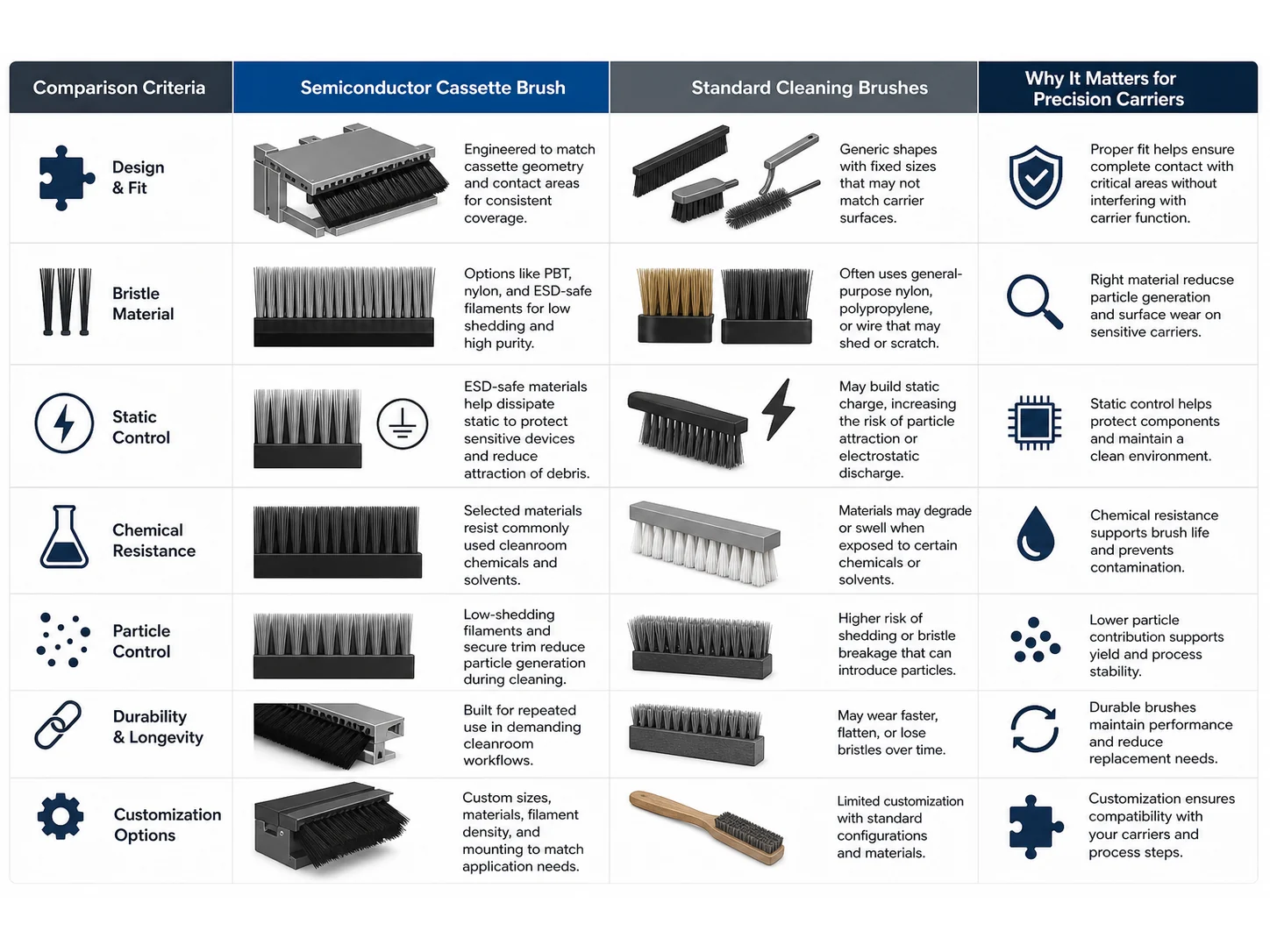
Semiconductor Cassette Brush vs Standard Cleaning Brushes: Key Differences
The table below highlights the practical differences that matter most in a precision carrier cleaning environment:
| Factor | Semiconductor Cassette Brush | Standard Cleaning Brush |
|---|---|---|
| Particle/Lint Generation | Extremely low; materials tested for low shedding and outgassing | Often sheds bristles or fibers, unsuitable for cleanrooms |
| Chemical Resistance | Resists aggressive chemicals (SC1, SC2, solvents) | May degrade or swell in harsh chemicals |
| Surface Protection | Soft, non‑scratching tips with rounded profiles | Stiff bristles can scratch wafer carriers or coatings |
| Static Control | Conductive or dissipative options to prevent ESD damage | Typically non‑conductive, can build up static |
| Custom Fit | Designed for specific carrier slots and automation handling | General‑purpose shapes may not reach critical areas |
| Cleanroom Compatibility | Low outgassing, cleanroom‑washed and packaged | Not designed for cleanroom use; may contain oils or contaminants |
| Cost and Availability | Higher cost, longer lead times for custom designs | Low cost, widely available off the shelf |
How to Choose the Right Brush for Precision Carriers
Several factors determine the best brush choice for your cleaning process:
- Type of residue: Is it slurry, dried chemical, polymer, or particulate? Different bristle stiffness or material may be needed.
- Surface sensitivity: Does the carrier have a special coating that could be scratched? Use softer materials like PVA or flag‑tipped nylon.
- Equipment interface: Is the brush hand‑held or mounted in an automated cleaning station? Shaft dimensions and handle design matter.
- Wet or chemical exposure: Will the brush be used with DI water, solvents, or aggressive cleaning chemicals? Check material compatibility charts.
- Hygiene and contamination control: Cleanroom class and outgassing limits may dictate brush material and packaging.
- Maintenance frequency: How often will brushes be replaced? Consider durability vs. cost.
- Custom size requirements: Many automation stations need exact brush diameters, lengths, and mounting features to avoid misalignment.
Common Mistakes When Choosing a Cleaning Brush
Avoid these common pitfalls:
- Assuming a cheaper standard brush will perform the same in a cleanroom setting.
- Overlooking static electricity buildup that can attract particles post‑cleaning.
- Choosing by bristle stiffness alone without testing on a sample carrier.
- Ignoring chemical compatibility, leading to brush swelling or contamination.
- Not verifying the brush core material for outgassing in vacuum or heated processes.
- Buying a one‑size‑fits‑all brush that misses critical corners or leaves residues.
When a Semiconductor Cassette Brush Is the Wrong Choice
These brushes are essential for routine cleaning, but they cannot fix embedded contaminants, heavy plating buildup, or damaged carrier surfaces. If a cassette has been exposed to a process excursion or physical damage, it may require ultrasonic cleaning, chemical immersion, or even replacement. Additionally, high‑speed automated cleaning systems may demand specially engineered brush rolls with precise runout tolerances—off‑the‑shelf semiconductor cassette brushes might not meet those specs without a supplier drawing review. Always test a brush on a representative coupon or a non‑critical carrier before full‑scale deployment.
Final Takeaway
Choosing between a semiconductor cassette brush and a standard cleaning brush is a clear‑cut decision when you consider particle contamination risks, chemical exposure, and surface sensitivity. For any task involving wafer carriers or precision handlers, the extra cost of a purpose‑built brush is justified by reduced rework, higher yields, and longer carrier life. Standard brushes remain useful for general equipment cleaning outside the cleanroom where contamination is less critical. Always specify your cleaning chemistry, handling interface, and cleanliness requirements to the supplier to get the right match.
Frequently Asked Questions
What makes a semiconductor cassette brush different from a regular brush?
A semiconductor cassette brush uses low‑particle‑shedding materials, cleanroom‑compatible cores, and often anti‑static or chemical‑resistant bristles. It is designed to clean without scratching sensitive surfaces or contaminating the wafer carrier.
Can I use a standard nylon brush if I clean gently?
Even with gentle pressure, a standard nylon brush may leave fibers or generate static that attracts particles. In cleanroom environments, this can lead to yield‑killing defects. It is safer to use a purpose‑engineered cassette brush.
How do I know if the brush is leaving particles on the carrier?
Inspect the carrier under a particle‑counting light or run a surface particle test after brushing. If counts increase, the brush may be shedding. Switching to a PVA sponge or flagged‑tip nylon brush often eliminates this issue.
Are there antistatic options for semiconductor cassette brushes?
Yes. Brushes with conductive fibers or carbon‑filled cores dissipate static charges and are recommended for ESD‑sensitive processes. Always check the brush’s surface resistivity specification with the supplier.
What is the typical replacement frequency for a semiconductor cassette brush?
Replacement depends on usage intensity and chemical exposure. In automated lines, brushes might be swapped weekly; in manual operations, they can last months. A good practice is to inspect bristles for wear or stiffness change after each cleaning cycle.
Can I order a brush with exact dimensions for our automated station?
Yes, many manufacturers offer custom dimensions, including shaft diameter, overall length, and brush head shape. Provide a drawing or CAD file to ensure proper fit and runout tolerance for your equipment.
Should I request a sample before purchasing in bulk?
Absolutely. Testing a sample on a scrap carrier or dedicated coupon validates material compatibility, cleaning effectiveness, and particle performance before committing to a production order.
What is the best brush material for cleaning carriers with chemical residues?
PVA sponge and PTFE bristles offer the best chemical resistance. PVA is excellent for aqueous chemicals, while PTFE withstands aggressive solvents and acids without degrading or introducing extractable contaminants.
Technical References
- EOS/ESD Association — ESD Fundamentals
- EOS/ESD Association — Principles of ESD Control
- NISTIR 4653 — Metrology for the Semiconductor Industry
- ISO 14644-1 Cleanrooms and Associated Controlled Environments
Which bristle material fits this job — Nylon PA, PVA Sponge or AISI 304 Stainless Steel Wire?
| Material | Continuous temperature (°C) | Peak temperature (°C) | Water absorption | Hardness |
|---|---|---|---|---|
| Nylon PA | 93 | 121 | 0.3–9% by PA grade and conditioning | Medium to firm; filament diameter and trim length control bending force. |
| PVA Sponge | 60 | 90 | — | Soft absorbent contact material; hardness/compression is controlled by foam or sponge density. |
| AISI 304 Stainless Steel Wire | 400 | 500 | 0% | Rockwell B 70–95 depending on temper and cold work |
Figures as published by Brushtec / DuPont; Alleima. Confirm the exact grade against the supplier datasheet before ordering.
What should replace Nylon PA when it stops working?
- Nylon PA — Compare Nylon PA with PP, PBT, PET. Change material when wet stiffness, temperature, chemical resistance, conductivity, particle shedding, or surface marking becomes the limiting factor.
- PVA Sponge — Compare PVA Sponge with PU sponge, PP sponge, microfiber. Change material when wet stiffness, temperature, chemical resistance, conductivity, particle shedding, or surface marking becomes the limiting factor.
- AISI 304 Stainless Steel Wire — Use AISI 316 stainless steel wire for chloride, marine, dairy, beverage, chemical washdown, or higher pitting-resistance requirements. Use carbon steel for dry aggressive cutting and brass or abrasive nylon for lower marking risk.