
What Is a Vacuum Cleaner Brush Attachment?
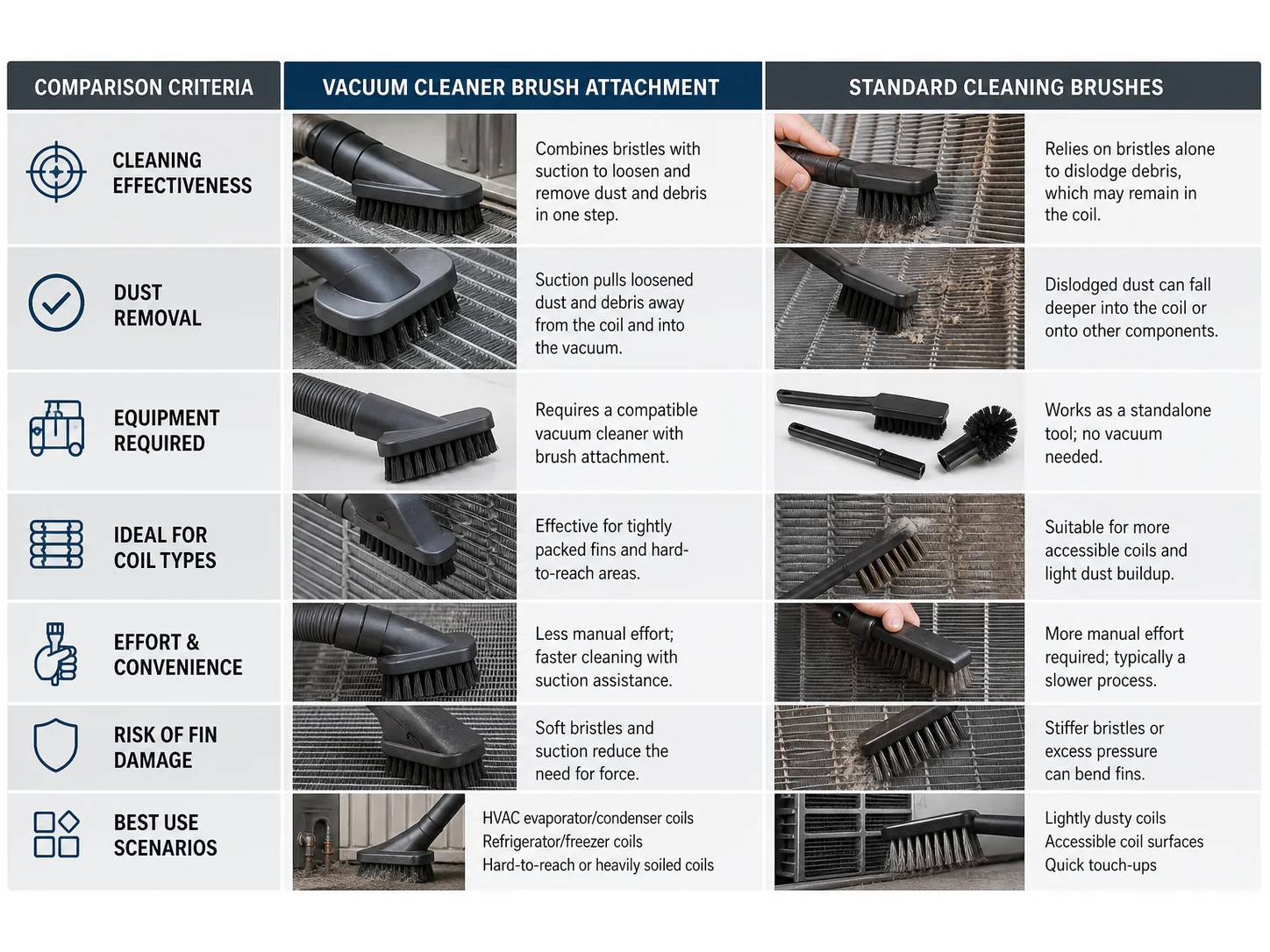
A vacuum cleaner brush attachment is a detachable nozzle or brush head that fits onto the hose of a shop vac or household vacuum. It typically features a narrow profile, soft to medium bristles, and a direct airflow path to capture loosened debris immediately. Unlike a standard cleaning brush, the attachment uses suction to pull particles into the vacuum rather than scattering them into the air. For appliance coils, this means less dust redistribution and a lower chance of pushing debris deeper into the unit.
Common Types of Brushes for Coil Cleaning
Both vacuum brush attachments and standard cleaning brushes come in several forms. The right choice depends on the coil type, accessibility, and the kind of buildup you’re dealing with.
Vacuum Cleaner Brush Attachments
- Crevice tool with bristles: A long, flat nozzle with soft edge bristles; ideal for sliding between condenser coil fins.
- Round dusting brush: Ring-shaped brush around a central suction opening; gentle on delicate surfaces.
- Combination upholstery tool: Wider head with a removable brush strip; useful for vent covers and accessible coil areas.
- Specialized coil cleaning nozzle: Extra-narrow profile with angled bristles designed specifically for tight coil spacing.
Standard Cleaning Brushes
- Coil brush / fin comb: Long, thin wire or plastic bristles in a flat or round configuration; used to straighten fins and loosen debris manually.
- Bottle brush / tube brush: Cylindrical brush with radial fibers; good for reaching inside duct openings or coil spacings.
- Stiff hand brush: Short, densely packed bristles; better for heavy crusty buildup but risky on soft metals.
Vacuum Brush Attachment vs Standard Brushes: A Comparison Table
| Feature | Vacuum Brush Attachment | Standard Cleaning Brush |
|---|---|---|
| Debris Removal | Captures dust as it’s loosened; excellent for loose, dry debris | Knocks debris loose but may spread it; requires separate collection |
| Surface Contact | Gentle bristles reduce risk of bending fins when properly selected | Can be too aggressive; stiff brushes may deform aluminum fins |
| Reach & Access | Limited by hose flexibility and attachment length; may struggle in deep internal voids | Can reach deeper with a flexible stem; bottle brushes can curve around obstacles |
| Ease of Use | One-step cleaning—suction and agitation together; requires a vacuum with enough power | Two-step: brush first, then vacuum or wipe away residue; more manual effort |
| Dust Containment | Excellent; dust goes directly into the vacuum | Poor; can make a mess and spread allergens |
| Wet/Dry Compatibility | Typically dry use only; moisture can damage vacuum internals unless specifically rated | Can be used with solvents or coil cleaners; easy to rinse and reuse |
| Hygiene | Prevents cross-contamination when attached to a clean vacuum system | Brushes must be thoroughly cleaned between tasks to avoid transferring oils or chemicals |
How to Choose the Right Brush for Appliance Coils
Selecting between a vacuum brush attachment and a standard brush depends on several practical factors:
- Residue type: For dry lint and dust, a vacuum brush attachment is usually sufficient. For greasy, sticky buildup, a standard brush and a coil cleaning chemical may be needed first.
- Surface sensitivity: Aluminum fins (common on condensers) bend easily. A soft-bristled vacuum attachment or a plastic-bristled standard brush reduces risk. Wire brushes should be avoided unless the coil is robust.
- Equipment interface: If you already use a shop vac, a brush attachment is an easy addition. Standard brushes require no vacuum, so they work anywhere—even where power isn’t available.
- Wet or chemical exposure: Standard brushes can be dipped in cleaning solvents. Most vacuum attachments are not designed for wet use—check before applying any liquid.
- Hygiene expectations: In food service or healthcare environments, a dedicated vacuum attachment keeps debris contained and prevents airborne dust. Standard brushes can spread contaminants.
- Maintenance frequency: For monthly preventive cleaning, a vacuum brush attachment speeds up the job. For infrequent deep-clean overhauls, a standard brush may be more economical and require less setup.
- Custom size requirements: If the coil spacing is non-standard, you may need a brush with a specific diameter or bristle length. Standard brushes come in more size options, while vacuum attachments are often one-size-fits-most.
Common Mistakes When Cleaning Appliance Coils
- Using a stiff wire brush: This can bend or puncture soft aluminum fins, reducing airflow efficiency. Always test on a hidden area first.
- Pushing debris deeper with a vacuum-only approach: Without a brush to agitate, a vacuum may simply press lint further into the coil. Attach a brush to loosen particles before suction.
- Ignoring coil material: Copper coils may tolerate metal brushes, but aluminum fins require nylon or soft polypropylene bristles.
- Relying on a single universal attachment: Coils vary in spacing and accessibility; using the wrong size leaves dirt behind. Keep a few brush profiles on hand.
- Skipping regular maintenance: Heavy buildup often requires a standard brush and chemical cleaner, which takes much longer than routine vacuum brushing. Schedule cleaning before it becomes a problem.
- Using a wet brush on a vacuum-rated attachment not designed for moisture: This can damage the vacuum motor or lead to mold growth inside the hose. Always verify wet/dry compatibility.
When a Vacuum Cleaner Brush Attachment Is the Wrong Choice
A vacuum brush attachment performs well on loose, dry debris, but it has clear limits. If coils are heavily coated with hardened grease, caked-on dirt, or corrosion, suction alone—even with a brush—will not remove the buildup. In these cases, a combination approach is best: apply a commercial coil cleaner, agitate with a standard brush, and then use a wet/dry vacuum (with a liquid-rated attachment) to rinse and remove residues. For deeply embedded blockages inside multi-layer evaporator coils, compressed air or professional coil cleaning systems may be required. Additionally, if the coil design is exceptionally intricate or the working space is too narrow for any available attachment, a standard flexible brush or fin comb may be the only tool that fits. Always consult the equipment manual or a technician if you’re unsure about safe cleaning methods.
Final Takeaway
Choose a vacuum cleaner brush attachment when you need fast, clean removal of dry dust and want to avoid recirculating airborne debris. It’s the preferred tool for routine preventive maintenance of accessible condenser coils. Choose a standard cleaning brush when you face stubborn, adhered soils, need to apply chemical cleaners, or require a very specific size or stiffness to match complex coil geometries. In many cases, the best strategy is to use both: loosen caked debris with a standard brush, then finish with a vacuum brush attachment to extract everything in one pass.
Frequently Asked Questions
Can I use any vacuum brush attachment for refrigerator coils?
Not all attachments fit. Look for a narrow crevice-tool style with soft bristles. The attachment must fit between the coil fins without forcing them apart. Measure the gap before buying.
How often should I clean appliance coils?
For most home refrigerators, every 6 months is sufficient. In commercial kitchens or dusty environments, monthly cleaning prevents efficiency loss and component strain.
Do I need a special brush for wet cleaning?
If you plan to use a coil cleaner or water, choose a standard brush with synthetic bristles that resist chemicals. Never use a vacuum attachment rated for dry use only. After wet cleaning, ensure components are completely dry before restarting.
Can a standard coil brush scratch the coils?
Yes, especially if the bristles are metal or very stiff. Even plastic bristles can cause micro-marring on soft aluminum. Always test on a small, less critical area, and use a gentle touch.
What size brush fits between condenser coil fins?
Fin spacing varies widely. Typical refrigerator condensers have gaps between 3 and 6 mm. A brush or attachment with bristles no thicker than the fin gap (and ideally slightly smaller) will fit without damage. Some fin combs include a multi-size tool for measuring spacing.
Should I turn off the appliance before cleaning coils?
Always disconnect power or unplug the appliance before cleaning exposed coils. This eliminates electrical shock risk and prevents the fan from starting unexpectedly. For built-in or inaccessible coils, consult the service manual.
Can I use compressed air instead of a brush?
Compressed air can work for loose dust, but it often simply blows debris deeper into the unit or into the surrounding area. A vacuum brush attachment is more controlled and prevents recontamination. If you use compressed air, always follow with a vacuum to collect airborne particles.
How do I know if my vacuum has enough suction for coil cleaning?
A typical shop vac with a 1.5 to 2 HP motor provides adequate airflow for coil cleaning through a narrow attachment. For built-in home vacuum systems, a long hose can reduce suction; test the attachment’s airflow by feeling suction at the nozzle tip with the machine running. If it can lift a small piece of tissue easily, it’s likely strong enough.
Technical References
- U.S. Department of Energy — Air Conditioner Maintenance
- EPA — Should You Have the Air Ducts in Your Home Cleaned
- EPA — Particulate Matter Basics
- OSHA — 1910.147 Control of Hazardous Energy
- EPA — Mold Cleanup in Your Home
- NIST — Metric SI
Which bristle material fits this job — Nylon PA, Polypropylene PP or Rubber?
| Material | Continuous temperature (°C) | Peak temperature (°C) | Water absorption | Hardness |
|---|---|---|---|---|
| Nylon PA | 93 | 121 | 0.3–9% by PA grade and conditioning | Medium to firm; filament diameter and trim length control bending force. |
| Polypropylene PP | 80–100 | 120–140 | ≤0.03% | Shore D 65–75 |
| Rubber | 100 | 130 | very low | Specified by compound and Shore hardness; published TPE families can span roughly 50–80 Shore A, but that is a product-family example rather than a universal rubber range. |
| PBT | 120–140 | 160–180 | 0.05–0.20% | Shore D 80–90 |
Figures as published by Brushtec / DuPont; Perlon. Confirm the exact grade against the supplier datasheet before ordering.
What should replace Handheld Detail Brushes for appliance?
- Handheld Detail Brushes — Handheld detail brushes cover general precision cleaning; auto-detailing brushes impose tighter controls for painted, polished, leather, display, and trim surfaces.
- Tube & Pipe Bore Brushes — Tube and bore brushes work by radial contact inside a confined diameter; wire wheels and cups work mainly on external edges, profiles, welds, and broad surfaces.
- Bottle & Container Brushes — Bottle and container brushes are selected around an opening plus a larger vessel body and bottom geometry; tube and bore brushes are selected mainly around a long diameter-controlled passage. Closest alternative: Tube & Pipe Bore Brushes.
- Roller and Conveyor Brushes — Roller and conveyor brushes hold cylindrical line contact across a working width, including helix-wound builds where the filament path is set to move loosened material toward one side; a strip brush holds the same line without rotating, so it seals or wipes but cannot carry residue along the width.