
What Is a Vacuum Cleaner Brush Attachment for Home Maintenance?
A vacuum cleaner brush attachment is a brush tool engineered to attach to a vacuum hose, crevice tool, or wand adapter. In home maintenance kits, these attachments are typically used for tasks where a standard floor brush or upholstery tool falls short—such as scraping and agitating debris from gutter channels, loosening lint from dryer vent walls, or dislodging leaves from roof valleys. The brush can be round, flat, or contoured, and often features bristles on all sides to work in confined or irregular spaces. Unlike a built-in vacuum brush roller, this accessory is user‑replaceable and highly customizable for specific jobs.
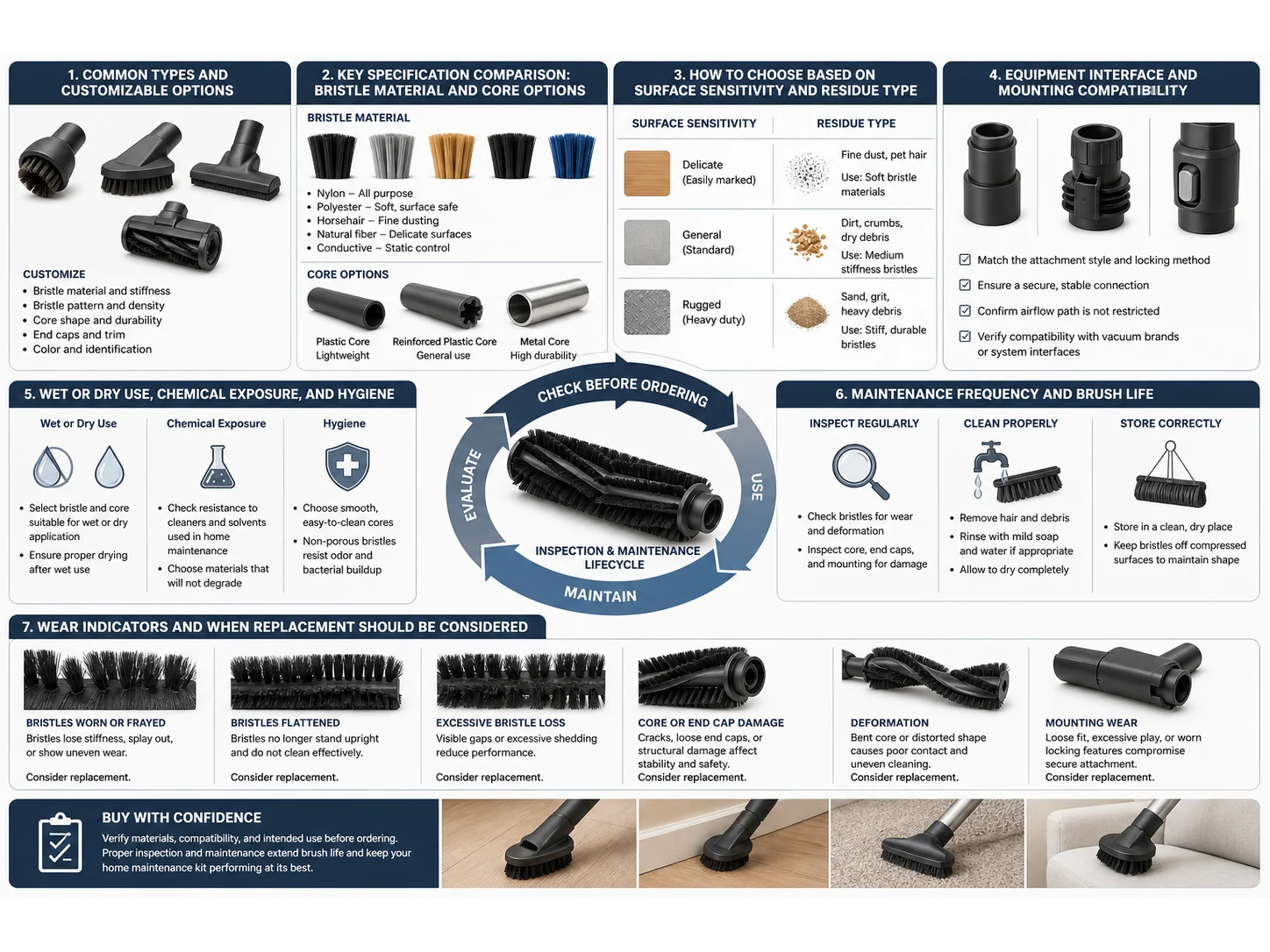
Common Types and Customizable Options
Custom vacuum brush attachments are defined by several variables that you’ll need to specify: bristle material, bristle diameter and length, overall brush diameter, core/handle construction, and mounting interface. Some designs integrate a fixed shaft, while others use a threaded socket or quick‑connect adapter to mate with standard vacuum accessories. Understanding these options is the first step to ordering a part that fits and performs.
Key Specification Comparison: Bristle Material and Core Options
| Bristle Material | Best Home Maintenance Uses | Stiffness | Moisture/Chemical Resistance | Typical Max Temp | Core Compatibility |
|---|---|---|---|---|---|
| Polypropylene (PP) | Light debris, dry lint, general gutter sweeping | Medium-soft | Good water resistance; limited solvent tolerance | ~180°F (82°C) | Plastic or aluminum |
| Nylon | Dryer vents, moderately stuck-on dust and lint | Medium-stiff | Good; resists many cleaning chemicals | ~250°F (121°C) | Aluminum or stainless |
| Horsehair (natural) | Sensitive painted surfaces, antique gutters, fine dust | Soft | Poor—absorbs moisture; not for wet use | ~140°F (60°C) | Wood or plastic |
| Stainless steel wire | Chimney deposit agitation, heavy‑duty roof debris, rust‑prone areas | Hard | Excellent—rust‑resistant, withstands most solvents | ~500°F (260°C) | Stainless steel |
| Brass wire | Non‑sparking applications, softer metal surfaces, marine gutters | Medium‑hard | Excellent corrosion resistance, non‑sparking | ~400°F (204°C) | Brass or stainless |
Core materials typically include plastic (light, non‑corrosive), aluminum (light, durable), or stainless steel (heavy‑duty, high‑temperature). Your choice depends on weight, exposure, and the required stiffness.
How to Choose Based on Surface Sensitivity and Residue Type
Residue type and surface material dictate which bristle stiffness you can safely use. Soft, painted, or coated surfaces (e.g., powder‑coated downspouts, decorative roof flashing) demand non‑abrasive materials like PP or horsehair to avoid scratching. Stubborn deposits such as creosote, baked‑on leaves, or mineral buildup may require metal bristles, but always test in a small hidden area first. For mixed tasks, a dual‑diameter brush or a brush with a softer outer layer can provide protection while still agitating debris.
Equipment Interface and Mounting Compatibility
The attachment must securely connect to your vacuum system. Common interfaces include friction‑fit over a standard 32 mm or 35 mm hose end, threaded connections, or proprietary quick‑release couplings. Before ordering, measure the outer diameter of your hose end or existing tool coupler accurately. Also consider airflow restriction: a brush that is too dense or too long can starve the vacuum of airflow, reducing suction efficiency. Ask the supplier for a cross‑sectional open area estimate if you’re unsure.
Wet or Dry Use, Chemical Exposure, and Hygiene
If you plan to use the attachment for wet pickup or with cleaning chemicals, bristle and core materials must resist swelling, corrosion, or degradation. Stainless steel or polypropylene are preferred for wet environments. For tasks like cleaning kitchen exhaust vents where grease is present, choose a material that can be degreased easily without bristle fall‑out. Hygiene isn’t a primary concern in most gutter or vent cleaning, but if you alternate between indoor and outdoor uses, select a brush that can be thoroughly cleaned and dried.
Maintenance Frequency and Brush Life
A custom attachment used in heavy‑debris environments may wear faster. Ask the supplier about expected lifespan under your use conditions. Check if replacement bristle cartridges are available or if the brush must be replaced as one piece. Consider cleanability: open‑construction brushes are easier to rinse out than tightly packed bristles. If you use the attachment with corrosive chemicals, inspect it regularly for bristle loss or core pitting.
Custom Size and Drawing Requirements
For a truly custom attachment, you’ll likely need to provide a drawing or at least key dimensions: overall length, diameter, bristle length, core diameter, and mounting detail. Even a rough sketch with measurements reduces the risk of receiving a part that doesn’t fit. Many suppliers can work from a sample if you ship them your existing coupler or hose end. Clearly note tolerances if the brush must fit into a tight channel or tube.
Common Mistakes to Avoid When Ordering
- Not measuring the mounting interface exactly, leading to a loose or incompatible fit.
- Choosing bristle stiffness based on guesswork rather than residue type and surface hardness.
- Overlooking airflow blockage—a brush that’s too dense can choke the vacuum.
- Ignoring chemical compatibility, especially when using degreasers or bleach.
- Ordering without confirming the core material’s temperature tolerance for chimney use.
- Assuming all “vacuum brush attachments” fit all vacuums without verifying the coupler design.
- Not requesting a sample or test piece for critical applications, resulting in costly delays.
When a Custom Vacuum Brush Attachment May Not Be Enough
There are cleaning tasks where even the best brush attachment hits a limit. Extremely hard deposits like baked‑on creosote in chimneys may require mechanical spinning rods or chemical treatments before a brush can finish the job. If the debris is sticky or tar‑like, bristles can become clogged and ineffective quickly. In confined spaces with complex geometries, a static brush may not reach all areas; an articulated head or camera‑assisted tool might be necessary. Always evaluate whether a brush alone can complete the cleaning or if it needs to be part of a larger kit.
Final Takeaway: The Buyer’s RFQ Checklist
Use this checklist when preparing an inquiry or request for quotation. It covers the essential points to communicate with a supplier:
- Define the cleaning task and the type of debris (e.g., dry leaves, wet lint, creosote).
- List all surfaces the brush will contact and their sensitivities.
- Measure vacuum hose or port dimensions (inner and outer diameter).
- Select bristle material and stiffness based on residue and surface.
- Specify whether the attachment will see wet, dry, or chemical use.
- Determine required brush diameter, length, and bristle length.
- Confirm core construction and the acceptable temperature range.
- Provide mounting interface details or a drawing/sample.
- Ask about airflow impact and replacement/refill policy.
- Request a test sample or production drawing for approval if quantities justify it.
Frequently Asked Questions
Can I use a metal‑bristle brush attachment on plastic gutters?
Generally no. Metal bristles can scratch or gouge PVC, vinyl, or painted surfaces. Stick with polypropylene or horsehair for plastic gutters. If you must use metal for stubborn debris, test on a hidden area and consider a brush with a softer outer guard.
How do I measure my vacuum’s hose for a custom attachment?
Measure the outer diameter (OD) of the hose end or the inner diameter (ID) of the cuff that receives the tool. For friction‑fit attachments, the brush mount should match the hose OD. For threaded connections, note the thread pitch and diameter. A caliper gives the most accurate reading.
What’s the most durable bristle material for dryer vent cleaning?
Nylon is a strong all‑around choice for dryer vent lint; it resists heat and moisture, and it’s stiff enough to agitate compacted lint without damaging the metal duct. Stainless steel offers greater durability for commercial or high‑volume use but may scratch aluminum ducts.
Do I need a drawing to order a custom brush attachment?
Not always, but for a precise fit a dimensioned sketch or sample part is strongly recommended. At minimum, provide the overall length, diameter, bristle length, and mounting interface dimensions. Many suppliers can guide you through a simple measurement sheet.
How can I tell if a brush will restrict airflow too much?
If the bristles are packed very densely and tightly around the core, airflow can be reduced. A good rule of thumb: when you look through the brush from the end, you should see visible gaps between bristle rows. Some suppliers provide free‑air path measurements. Always test with your vacuum to confirm adequate suction.
Can I use the same attachment for both dry and wet pickup?
Yes, if the materials are rated for moisture. Stainless steel, polypropylene, and certain nylons work for wet/dry applications. Avoid natural horsehair and wood cores. Verify that the mounting adhesive or crimping method is water‑resistant as well.
What should I do if the attachment doesn’t fit perfectly?
Do not force it—a loose fit can fly off during use, while an overly tight fit can damage the hose end. Contact the supplier with exact measurements and photos. Many suppliers offer one‑time adjustments or can re‑machine the coupler within your provided tolerance.
Technical References
- U.S. Department of Energy — Air Conditioner Maintenance
- EPA — Should You Have the Air Ducts in Your Home Cleaned
- EPA — Particulate Matter Basics
- OSHA — 1910.147 Control of Hazardous Energy
- EPA — Mold Cleanup in Your Home
- NIST — Metric SI
Which bristle material fits this job — AISI 304 Stainless Steel Wire, Horsehair or Nylon PA?
| Material | Continuous temperature (°C) | Peak temperature (°C) | Water absorption | Hardness |
|---|---|---|---|---|
| AISI 304 Stainless Steel Wire | 400 | 500 | 0% | Rockwell B 70–95 depending on temper and cold work |
| Horsehair | 60–80 | 100–120 | 8–15% | — |
| Nylon PA | 93 | 121 | 0.3–9% by PA grade and conditioning | Medium to firm; filament diameter and trim length control bending force. |
| Polypropylene PP | 80–100 | 120–140 | ≤0.03% | Shore D 65–75 |
| Rubber | 100 | 130 | very low | Specified by compound and Shore hardness; published TPE families can span roughly 50–80 Shore A, but that is a product-family example rather than a universal rubber range. |
Figures as published by Alleima; Brushtec / DuPont; Perlon. Confirm the exact grade against the supplier datasheet before ordering.
When are Roller and Conveyor Brushes the wrong choice for vacuum cleaner brush attachment?
- Roller and Conveyor Brushes — Use a stationary strip brush for a fixed linear seal or wipe, or another process when rotating line contact interferes with the product or cannot discharge the residue safely.
- AISI 304 Stainless Steel Wire — Avoid using AISI 304 as the default in marine, brine, hypochlorite, and persistent chloride environments; use AISI 316 when higher pitting and crevice-corrosion resistance is required.
- Horsehair — Not for aggressive scrubbing or wet chemical process cleaning.
- Nylon PA — The nylon family spans several grades, so heat, moisture and chemical limits should follow the selected PA resin rather than a generic nylon value.
What should replace Roller and Conveyor Brushes for vacuum cleaner brush attachment?
- Roller and Conveyor Brushes — Roller and conveyor brushes hold cylindrical line contact across a working width, including helix-wound builds where the filament path is set to move loosened material toward one side; a strip brush holds the same line without rotating, so it seals or wipes but cannot carry residue along the width.
- AISI 304 Stainless Steel Wire — Use AISI 316 stainless steel wire for chloride, marine, dairy, beverage, chemical washdown, or higher pitting-resistance requirements. Use carbon steel for dry aggressive cutting and brass or abrasive nylon for lower marking risk.
- Horsehair — Compare Horsehair with Boar bristle, goat hair, microfiber. Change material when wet stiffness, temperature, chemical resistance, conductivity, particle shedding, or surface marking becomes the limiting factor.
- Nylon PA — Compare Nylon PA with PP, PBT, PET. Change material when wet stiffness, temperature, chemical resistance, conductivity, particle shedding, or surface marking becomes the limiting factor.