
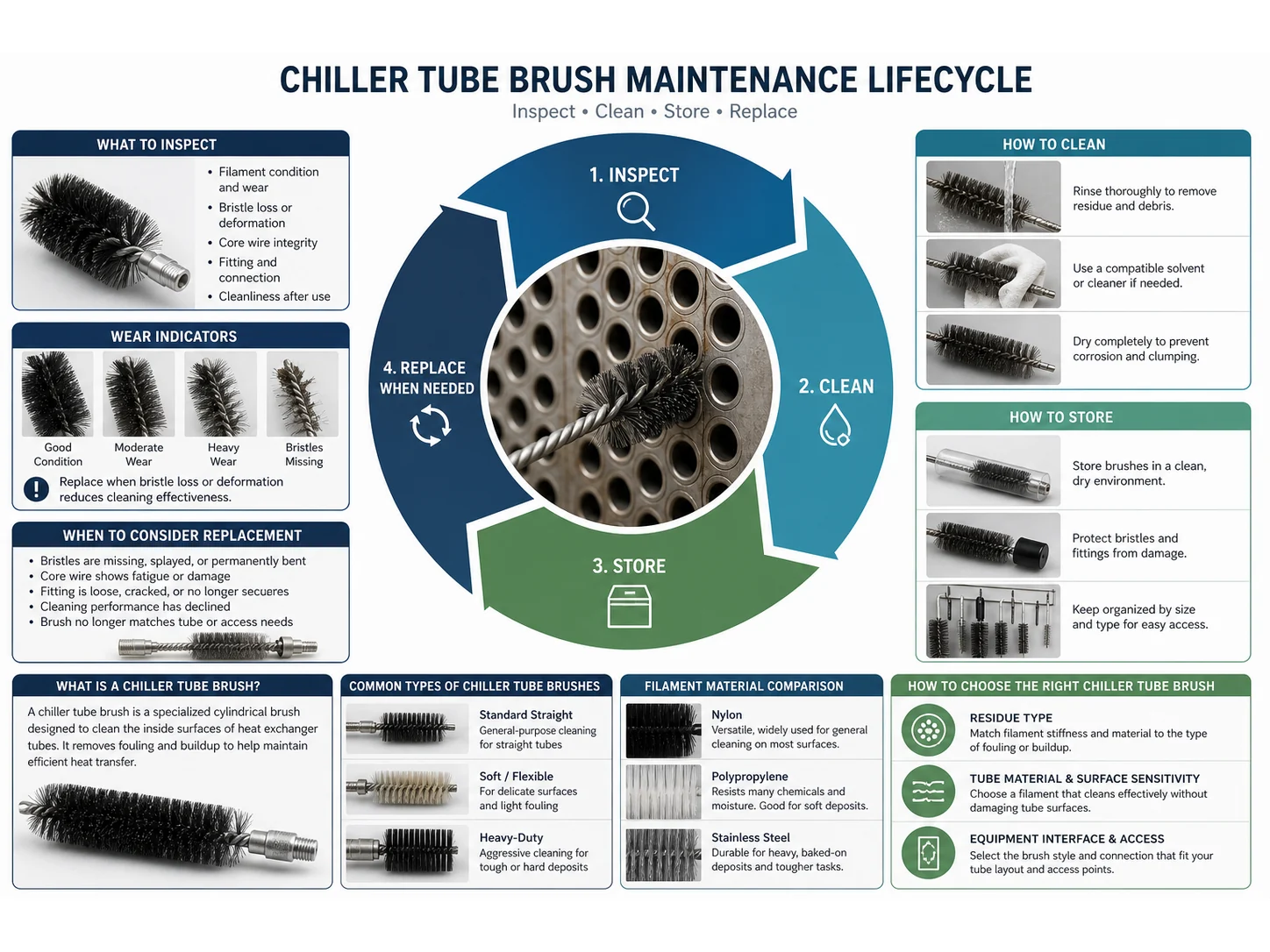
What Is a Chiller Tube Brush?
A chiller tube brush is a specialty cleaning brush made up of a central core—usually a twisted wire handle or flexible shaft—wrapped with abrasive or non-abrasive filament. It is sized to match the internal diameter of a heat exchanger tube, often in the range of 1/4″ to 1″ for common chillers. The brush scrapes or scrubs away soft fouling that restricts heat transfer and raises energy costs. In practice, many facilities use chiller tube brushes as part of a scheduled preventive cleaning program, either by hand or mounted on a rotary tube cleaning machine.
For boilers, chillers, cooling towers, condenser systems, heat-exchanger maintenance, and O&M practices, this article cites U.S. Department of Energy FEMP — Operations & Maintenance Best Practices: A Guide to Achieving Operational Efficiency, Release 3.0; boiler, chiller, cooling tower, and heat-exchanger maintenance chapters.
Common Types of Chiller Tube Brushes
Brushes vary by filament material, core design, and diameter. Knowing the main options prevents ordering a brush that is too aggressive for soft copper tubes or too soft to remove caked-on deposits in steel tubes.
- Nylon filament brushes: Good for light slime, algae, and soft mud. Least aggressive; safe for most tube materials.
- Brass or bronze wire brushes: Moderate aggression. Used for soft scale or light mineral buildup. Conductive, but can leave brass traces on stainless steel if not rinsed properly.
- Stainless steel wire brushes: High aggression for hard scale, rust, or baked-on deposits in steel and cupronickel tubes. Never use on soft metals without testing.
- Tampico or natural fiber brushes: Soft polishing action; used for sensitive surfaces or after chemical cleaning.
- Abrasive nylon (impregnated with grit): Aggressive cleaning without metal wire contamination. Works well on hard mineral scale where metal wire is too harsh.
- Spiral-wound strip brushes: Continuous radial fill for uniform 360° cleaning, often used with powered tube brushing machines.
Filament Material Comparison for Chiller Tube Brushes
| Filament Type | Best For | Typical Tube Materials | Aggression Level | Risk Factors to Watch |
|---|---|---|---|---|
| Nylon | Light biofilm, slime, mud | Copper, cupronickel, stainless steel | Low | Can melt if used dry at high speed |
| Brass Wire | Soft scale, light carbonate buildup | Copper, mild steel, cast iron | Medium | May leave brass residue; avoid in some hygienic loops |
| Stainless Steel Wire | Hard scale, rust, baked-on fouling | Stainless steel, cupronickel, carbon steel | High | Can scratch or gall softer tubes; risk of galvanic corrosion if particles remain |
| Tampico Fiber | Light polishing, post-chemical clean | All sensitive tube materials | Very Low | Too soft for any adhered deposit; degrades quickly in strong acids |
| Abrasive Nylon (grit-impregnated) | Mineral scale, stubborn yet thin deposits | Stainless steel, copper, cupronickel | Medium-High | Abrasive grit selection critical; wrong grit can score tube surface |
How to Choose the Right Chiller Tube Brush for Your Heat Exchanger
Selection is not just about matching brush diameter to tube ID. Use these filters to narrow down what you need.
Residue Type
Soft, slimy deposits call for nylon or Tampico. Thin, hard scale often needs abrasive nylon or brass wire. Thick rust or mineral crust may require stainless steel or stepwise cleaning starting with a softer brush.
Tube Material and Surface Sensitivity
Copper and aluminum tubes are easily scored. Never use stainless steel wire on them unless you have validated compatibility through a sample test. Even brass wire may be too harsh for thin-wall enhanced tubes.
Equipment Interface and Access
Can you reach tube ends without obstruction? If tubes are short and accessible, a manual twisted-wire brush with a tee handle may work. For longer tubes (greater than 8 ft), a flexible shaft chiller tube brush machine is more practical. Quick-connect couplers and hollow shaft designs let you flush water while brushing, which cools the brush and removes debris.
Wet or Dry Use
Most chiller tube brushes are intended for wet cleaning, often with a water flush. Running a nylon brush dry at high RPM can melt the filament. Check whether your process exposes the brush to acids, chlorides, or high-temperature fluids that could attack the brush core or filament.
Hygiene and Foreign Material Concerns
In food-grade, pharmaceutical, or high-purity loops, even trace brass or carbon steel particles from a brush are unacceptable. Specify all-stainless construction or use nylon/Tampico brushes dedicated to the loop.
Maintenance Frequency
If you clean weekly, invest in durable brush materials (abrasive nylon or stainless wire) and standardized diameters that can be stocked. If cleaning is annual and fouling is light, disposable nylon brushes may be cost-effective.
Custom Size and Fit Requirements
Standard brushes are available in 1/16″ increments, but enhanced tubes (internally grooved or rifled) sometimes need a custom diameter or softer fill density to clean the groove bottoms without damaging ridge tips. Request a dimensional drawing and a sample brush before committing to a large order.
Setup and Usage Factors That Affect Cleaning Performance
Even the right brush underperforms if used improperly. Key operational factors include:
- Brush diameter vs. tube ID: A brush should have 0.005″–0.015″ oversize fill for light deposits, up to 0.025″ for heavy scale. Too much oversize can buckle the brush or gall the tube.
- Rotational speed: Manual operation relies on consistent twisting; a drill-driven brush should stay below 1,500 RPM for most nylon and brass wire types. Stainless steel brushes can handle higher speeds but generate more heat.
- Feed rate: Advancing too fast leaves rings of fouling; too slow causes unnecessary wear. A steady pace with a water flush gives best results.
- Water flush direction: Flush water should flow toward the brush head, carrying debris out ahead. Flushing from behind can pack debris and increase the risk of tube blockage.
Common Mistakes When Selecting a Chiller Tube Brush
- Choosing by cost drivers or generic “tube brush” tag: A low-cost brush with unknown filament may shed bristles inside the tube or have a core that corrodes after one use.
- Assuming one brush size fits all tubes: Many chillers have mixed tube diameters across passes. Verify all tube IDs before ordering.
- Using stainless steel wire on soft copper without testing: The resulting scratches create nucleation sites for future fouling and can lead to under-deposit corrosion.
- Neglecting the core and handle construction: A brush that snaps off inside the tube because of a weak core becomes a costly extraction job.
- Skipping the water flush: Dry brushing hardens some deposits and bakes them onto the tube wall.
- Ignoring chemical compatibility: Some nylon grades degrade in strong acids or amines. Check your cleaning agent before wetting the brush.
When a Chiller Tube Brush Is the Wrong Choice
A chiller tube brush is designed for soft to moderately hard deposits that can be removed by mechanical scrubbing. It is not a substitute for:
- Chemical descaling when scale is thick, complex, or deep in enhanced tube grooves. In such cases, a soak with inhibited acid followed by a soft brush rinse may be safer.
- Hydroblasting or high-pressure water jetting for obstructions like complete tube blockages, hardened cement-like scale, or when brush access is limited.
- Rotary tube cleaners with cutter heads for extremely hard, baked-on deposits that would shred a brush in minutes.
- Sample testing and supplier drawing review when tube condition is unknown or when altering the tube surface could void a warranty or accelerate corrosion. If you cannot identify the deposit or tube alloy, start with a tube sample and consult the chiller manufacturer instructions.
Final Takeaway: Making the Right Call
Choose a chiller tube brush when your fouling is soft or semi-hard, you can safely match filament aggression to tube metal, and the equipment allows unobstructed brush travel with a water flush. Step up to a powered chiller tube brush machine for long tubes or repetitive jobs, but never skip the material compatibility check. When deposits are heavy, unknown, or tightly bonded to sensitive tube surfaces, invest in a deposit analysis and consider a multi-step cleaning approach rather than reaching for the most aggressive brush.
Frequently Asked Questions
What is the difference between a chiller tube brush and a boiler tube cleaning brush?
The core function is similar—cleaning the inside of tubes—but boiler tube brushes often encounter harder, baked-on soot and scale at higher temperatures, so they commonly use steel wire fill and heavier cores. Chiller tube brushes prioritize softer filings for waterside fouling and are more likely to use nylon or brass.
How do I know what size chiller tube brush to order?
Measure the actual inside diameter of each tube pass with a caliper or go/no-go gauge. For light deposits, select a brush with fill about 0.005″–0.010″ larger than the tube ID. For heavier scale, you may go up to 0.025″ oversize, but always test first to avoid jamming.
Can I use a chiller tube brush with a drill instead of a dedicated brushing machine?
Yes, for short tubes (under 6 ft) with flexible shaft brushes designed for power drive. For longer tubes or high-volume maintenance, a proper chiller tube brush machine maintains consistent speed, feeds water automatically, and reduces the risk of bending a long shaft in the tube.
Is a stainless steel wire brush safe for all heat exchanger tubes?
No. Stainless steel wire should only be used on tubes that are metallurgically compatible, such as stainless steel or cupronickel. On copper or aluminum, it can scratch the surface and promote pitting. Always verify with the tube manufacturer or perform a sample test.
How often should I replace a chiller tube brush?
Replace when filament wear reduces brush diameter below the tube ID, when bristles are flattened or missing, or when the core shows signs of corrosion or fatigue. In high-frequency use, check brush condition weekly. For annual cleaning, inspect before each season.
Do I need a special brush for enhanced or rifled tubes?
Often yes. Standard brushes may not reach the bottom of grooves or can damage the ridge tips. Look for brushes with soft filament density or have a custom diameter designed for your specific enhanced profile. A supplier drawing review is recommended.
Why does my chiller tube brush leave streaks after cleaning?
Streaking usually means the brush is too small, the filament is not stiff enough, or you are advancing too quickly. Try a slightly larger diameter or a different filament type, and ensure the water flush is directed toward the brush head to carry debris out.
Can I clean chiller tubes without any brush at all?
In some low-fouling applications, chemical circulation alone or backflushing with a turbulent water flush can maintain cleanliness. However, periodic mechanical brushing is still the norm for most open cooling tower systems to remove sessile biofilm that chemicals cannot fully penetrate.
Technical References
- U.S. Department of Energy — Air Conditioner Maintenance
- ASME — Y14.5 Dimensioning and Tolerancing
- OSHA — 1910.147 Control of Hazardous Energy
- American Brush Manufacturers Association — Brush Lingo
Which bristle material fits this job — AISI 304 Stainless Steel Wire, Nylon PA or Abrasive Nylon?
| Material | Continuous temperature (°C) | Peak temperature (°C) | Water absorption | Hardness |
|---|---|---|---|---|
| AISI 304 Stainless Steel Wire | 400 | 500 | 0% | Rockwell B 70–95 depending on temper and cold work |
| Nylon PA | 93 | 121 | 0.3–9% by PA grade and conditioning | Medium to firm; filament diameter and trim length control bending force. |
| Abrasive Nylon | 120 | 150 | 0.1–1.0% | Abrasive filament; stiffness and cutting level is controlled by PA base, grit type, grit size, filament diameter and trim height. |
| Brass Wire | 150–200 | 250–300 | 0% | Rockwell B 40–90 |
| AISI 316 Stainless Steel Wire | 400 | 500 | 0% | Rockwell B 70–95 depending on temper and cold work |
Figures as published by Alleima; Brushtec / DuPont; Perlon. Confirm the exact grade against the supplier datasheet before ordering.
What should replace Tube & Pipe Bore Brushes for chiller tube brush?
- Tube & Pipe Bore Brushes — Tube and bore brushes work by radial contact inside a confined diameter; wire wheels and cups work mainly on external edges, profiles, welds, and broad surfaces.
- AISI 304 Stainless Steel Wire — Use AISI 316 stainless steel wire for chloride, marine, dairy, beverage, chemical washdown, or higher pitting-resistance requirements. Use carbon steel for dry aggressive cutting and brass or abrasive nylon for lower marking risk.
- Nylon PA — Compare Nylon PA with PP, PBT, PET. Change material when wet stiffness, temperature, chemical resistance, conductivity, particle shedding, or surface marking becomes the limiting factor.
- Abrasive Nylon — Compare Abrasive Nylon with PP, PBT, PET. Change material when wet stiffness, temperature, chemical resistance, conductivity, particle shedding, or surface marking becomes the limiting factor.