
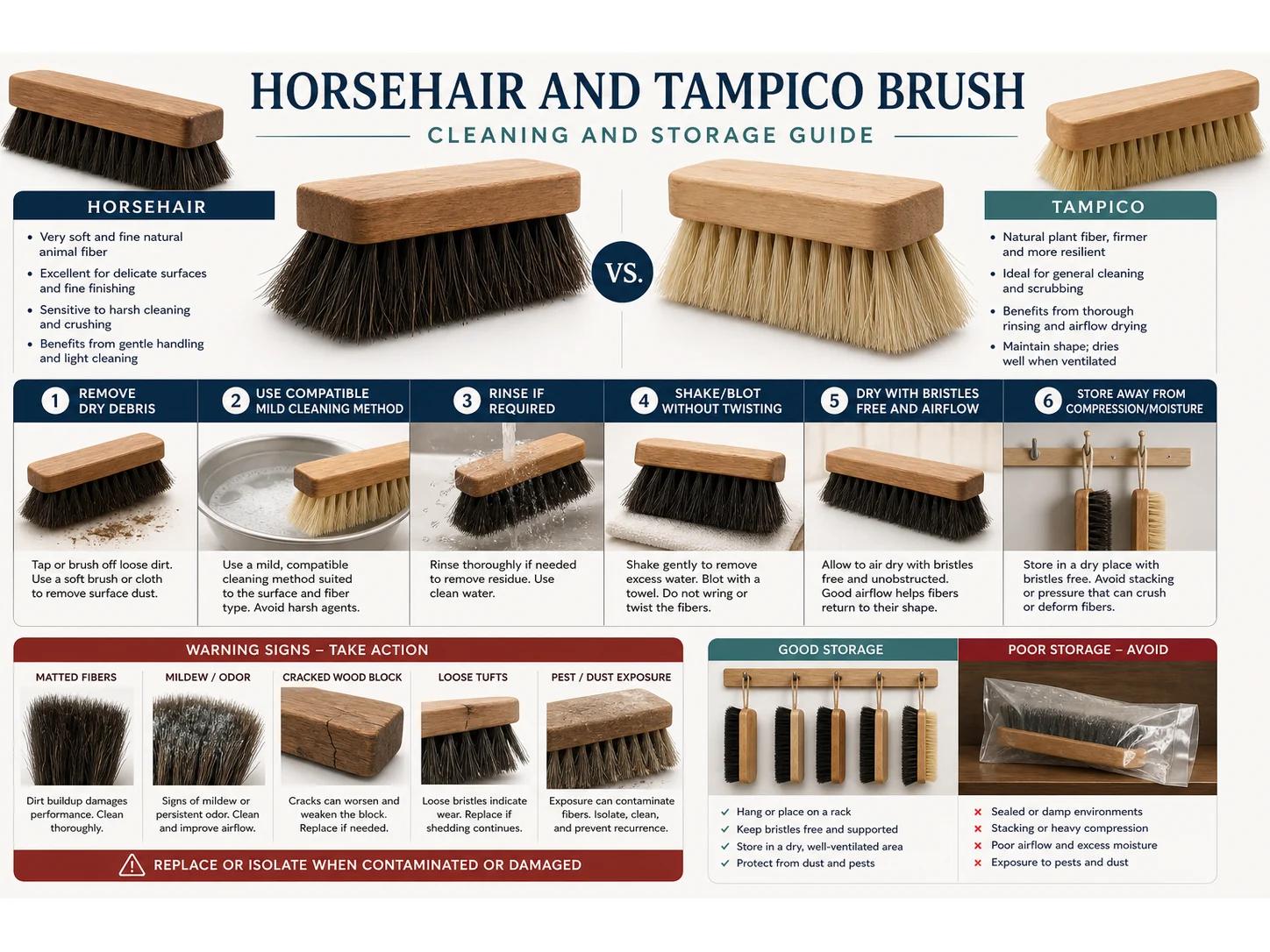
What Is Natural Bristle Brush Maintenance?
Natural bristle brush maintenance is the routine of cleaning, drying, and storing brushes made from animal- or plant-derived fibers to preserve their functional and structural integrity. It focuses on removing residues without degrading the bristles, preventing moisture-related damage, and maintaining the original shape of the brush head.
Because natural bristles are porous and protein- or cellulose-based, they react differently to water, detergents, and environmental conditions than nylon or polyester filaments. Proper maintenance extends brush life, maintains performance, and prevents cross-contamination between materials.
How Natural Bristle Care Differs from Synthetic Bristle Care
Natural and synthetic bristles have distinct physical properties, so their care regimens diverge in several critical ways. The table below summarizes the key differences.
| Care Factor | Natural Bristle (Horsehair & Tampico) | Synthetic Bristle (Nylon, Polyester) |
|---|---|---|
| Cleaning Agent | Mild soap or gentle brush cleaner; avoid harsh solvents, ammonia, or bleach | Tolerates stronger detergents and solvent-based cleaners |
| Water Exposure | Soaking can damage the bristle structure; always rinse quickly, do not submerge the ferrule | Can be soaked for extended periods without damage |
| Drying | Air dry only; reshape while damp; avoid direct heat or sunlight | Shake to remove water; heat drying is often safe |
| Storage | Hang bristles down or lay flat; protect from dust and crushing | Can be stored upright on bristle tips if sturdy |
| Lifespan | Will eventually dry out, split, or lose shape after repeated cycles | Resistant to chemical breakdown; may simply wear down mechanically |
Step-by-Step Guide to Cleaning Natural Bristle Brushes
Follow these steps after each use or when buildup is visible:
- Remove excess material. Wipe the brush on a clean cloth or against the lip of a container to remove as much product or residue as possible.
- Rinse under lukewarm running water. Hold the brush with bristles pointing downward to prevent water from entering the ferrule.
- Apply a mild soap. Use a pH-neutral liquid soap or a dedicated brush cleaner. Work a small amount into the bristles with your fingers, moving from the base to the tips.
- Rinse thoroughly. Continue rinsing with bristles down until the water runs clear. Keep the metal ferrule dry to avoid loosening the knot.
- Reshape while damp. Gently press the bristles into their original form with your fingers or a lint-free cloth.
- Dry correctly. Lay flat on a clean towel or hang with bristles facing down. Never stand the brush upright on its bristles while wet.
Never use hot water, as it can strip natural oils from horsehair and cause Tampico fibers to become brittle. Avoid soaking the brush head in a cup of water or solvent; prolonged immersion can weaken the glue inside the ferrule and cause bristles to fall out.
Proper Drying and Storage for Horsehair and Tampico Brushes
Drying and storage are where most natural brushes fail prematurely. Use this checklist to extend brush life:
- After cleaning, gently squeeze out excess water with a clean towel—never twist or wring.
- Place the brush on a dry towel in a well-ventilated area, away from direct sunlight and heat sources.
- For hanging storage, use a brush holder or clip that suspends the brush with bristles pointing down to prevent water from settling into the ferrule.
- Once fully dry, store brushes in a container or wrap that protects the bristles from dust, crushing, and pests.
- Avoid airtight containers that can trap residual moisture; allow air circulation.
Horsehair is animal protein and can attract insects if stored in damp conditions. Tampico, derived from agave plants, resists pests better but can mildew if not fully dried. Both will lose shape if weight is applied to the bristles during storage.
Common Mistakes That Damage Natural Bristles
Many brush failures are caused by simple, avoidable errors. Here are the most frequent mistakes and why they matter:
- Soaking brushes in water or solvent. Weakens both the bristle structure and the adhesive bond, leading to shedding and ferrule corrosion.
- Using hot water or harsh cleaners. Degrades natural proteins/ cellulose, causing brittleness and splitting.
- Drying brushes with heat. Hair dryers, radiators, or direct sun can crack and distort bristles.
- Storing brushes wet or in sealed containers. Promotes mold, mildew, and adhesive failure.
- Applying excessive force during cleaning. Scraping, twisting, or crushing the bristles can permanently kink them.
- Using a natural bristle brush for incompatible materials. Some oils, waxes, or solvents react with natural fibers, accelerating deterioration.
When Should You Replace a Natural Bristle Brush?
Even with excellent care, natural bristle brushes have a finite functional life. Look for these signs that replacement is needed:
- Excessive shedding. A few loose bristles after cleaning are normal for new brushes, but continuous shedding indicates glue failure or bristle breakage.
- Permanent matting or clumping. If bristles cannot be reshaped after cleaning and remain stuck together, the brush’s performance is compromised.
- Brittle, split, or broken bristles. Over time, repeated moisture and drying cycles degrade the fiber. Bristles that feel rough, rigid, or have split ends will leave streaks or scratches.
- Loss of shape—flared, splayed, or hooked tips. A brush that no longer returns to its intended form cannot provide consistent application.
- Ferrule damage. Rust, cracks, or separation between the handle and ferrule can harbor bacteria and cause handle instability.
If the brush shows one or more of these signs, it is better to retire it than to continue using it on quality work. For high-value brush handles, consider re-knotting if economically viable, but only with proper ferrule and bristle replacement.
Final Takeaway: Simple Habits for Long-Lasting Natural Bristle Brushes
Caring for horsehair and Tampico brushes does not require expensive products or complex routines. The formula is straightforward: clean promptly with mild soap, minimize water exposure to the ferrule, never soak, reshape while damp, and dry thoroughly in a protected position. By avoiding common shortcuts—like hot water, soaking, or forced drying—you can significantly extend the life of your natural bristle brushes and maintain their performance through many cycles.
When Standard Natural Bristle Brush Care Is the Wrong Choice
This brush is not enough when the main problem is blocked access, unsafe working conditions, damaged equipment, incompatible chemicals, or a process setting that keeps recreating the residue. In those cases, review surface finish, solvent exposure, access angle, scratch tolerance, and soil severity and confirm the surrounding cleaning method before increasing brush stiffness or contact pressure.
Frequently Asked Questions
Can I use vinegar or baking soda to clean natural bristle brushes?
It is best to avoid vinegar, baking soda, or other acidic or alkaline solutions on natural bristles. These substances can strip natural oils from horsehair and weaken Tampico fibers. Stick to mild, pH-neutral soaps.
How often should I clean a horsehair or Tampico brush?
Clean the brush after every use when working with water-based products, or at least after every few uses if dealing with oils or waxes. Regular cleaning prevents buildup that becomes harder to remove and prolongs bristle integrity.
Is it normal for a few hairs to fall out when I clean a natural bristle brush?
A small amount of shedding is normal for new brushes, but it should stop after a few cleanings. Continuous loss indicates that water or cleaner has penetrated the ferrule and weakened the adhesive, or that the bristles are being damaged by improper handling.
Can I use dish soap on natural bristles?
Mild, additive-free liquid dish soap is acceptable, but avoid degreasing dish soaps that contain strong solvents or bleach. Rinse extremely well to remove all residue, as leftover soap can dry and stiffen the bristles.
What should I do if my brush bristles have dried out and feel stiff?
Try gently reconditioning them by rinsing in lukewarm water, applying a tiny amount of hair conditioner or glycerin, then rinsing thoroughly and reshaping. This may temporarily restore flexibility, but if bristles remain brittle and break easily, replacement is the only reliable fix.
Can I clean natural bristle brushes in an ultrasonic cleaner?
Ultrasonic cleaners use high-frequency vibration that can loosen bristles and damage the ferrule bond. It is not recommended for natural bristle brushes, especially those with wooden handles or hair-based knots.
How do I store brushes that I use only occasionally?
After thorough cleaning and complete drying, wrap the brush head in acid-free tissue paper or store it in a breathable cloth pouch. Keep the brush in a cool, dry place away from extreme temperatures and pests. A light dusting of talcum powder or a camphor block can help deter insect damage to horsehair.
Which bristle material fits this job — Horsehair, Nylon PA or Tampico Fiber?
| Material | Continuous temperature (°C) | Peak temperature (°C) | Water absorption |
|---|---|---|---|
| Horsehair | 60–80 | 100–120 | 8–15% |
| Nylon PA | 93 | 121 | 0.3–9% by PA grade and conditioning |
| Tampico Fiber | 70–90 | 110–130 | 10–18% |
| Boar Bristle | 60–80 | 100–120 | 10–18% |
Figures as published by Brushtec / DuPont. Confirm the exact grade against the supplier datasheet before ordering.
What should replace Handheld Detail Brushes for natural bristle brush?
- Handheld Detail Brushes — Handheld detail brushes cover general precision cleaning; auto-detailing brushes impose tighter controls for painted, polished, leather, display, and trim surfaces.
- Horsehair — Compare Horsehair with Boar bristle, goat hair, microfiber. Change material when wet stiffness, temperature, chemical resistance, conductivity, particle shedding, or surface marking becomes the limiting factor.
- Nylon PA — Compare Nylon PA with PP, PBT, PET. Change material when wet stiffness, temperature, chemical resistance, conductivity, particle shedding, or surface marking becomes the limiting factor.
- Tampico Fiber — Compare Tampico Fiber with Compare with horsehair for softer dry contact, sisal for firmer plant-fiber scrubbing and nylon for more uniform recovery. Change material when wet stiffness, temperature, chemical resistance, conductivity, particle shedding, or surface marking becomes the limiting factor.