
What Is a Nylon Brush for Drill?
A nylon brush for drill is a circular or cup-shaped brush with filaments made of polyamide (nylon). Unlike wire brushes, nylon is non-metallic and non-sparking, making it the first choice when surface integrity is critical. The bristles can be impregnated with abrasive grit for more aggressive cleaning, but standard nylon bristles rely on flexibility and resilience to dislodge contaminants without abrasion. They are typically used with corded or cordless drills to speed up manual cleaning tasks.
Common Types of Nylon Brushes for Drill
Nylon brushes for drills come in several shapes to match different part geometries:
- Cup brush: Ideal for flat or slightly contoured surfaces. The bristle face is perpendicular to the drill axis.
- Wheel brush: A narrow brush for edges, corners, and narrow channels.
- End brush: A small, stem-mounted brush for tight spots, holes, and recesses.
- Tube brush: A cylindrical brush for cleaning the inside of pipes, tubes, and bores.
- Mini brush: Very small diameter brushes for precision work like electronic contacts or small mold cavities.
Nylon Brush for Drill Options Comparison
| Brush Type | Typical Bristle Stiffness | Common Shank/Diameter | Best Use on Scratch-Sensitive Parts | Mistakes to Avoid |
|---|---|---|---|---|
| Cup brush | Soft, medium, hard | 2″–4″ dia, 1/4″ hex shank | Large flat areas: painted panels, anodized aluminum, polished molds | Using hard bristles on soft substrates; excessive speed |
| Wheel brush | Medium, hard | 3″–6″ dia, 1/4″ round shank | Narrow grooves, weld seams, edges | Over-flexing bristles causing scratching; wrong diameter for groove width |
| End brush | Soft, medium | 1″–2″ dia, 1/4″ round shank | Internal corners, small cavities, threaded holes | Pushing too deep causing shank contact; skipping test on scrap |
| Tube brush | Soft, medium | 1/4″–2″ dia, wire stem or loop handle (adapter needed for drill) | Pipe interiors, heat exchanger tubes, boiler tubes | Wrong diameter selection (too tight or too loose); inadequate stem rigidity |
| Mini brush | Soft | 3/8″–1″ dia, 1/8″ shank | Precision electronics, delicate connectors, optical surfaces | Using without a speed-controlled drill; ignoring chemical compatibility |
How to Choose a Nylon Brush for Scratch-Sensitive Parts
Selecting the right brush requires balancing cleaning power with surface safety. Consider these factors:
- Contaminant type: Light dust and oxidation need only soft bristles; baked-on grease or carbon may require a stiffer nylon or impregnated nylon, which increases scratch risk.
- Substrate material: Aluminum and brass are softer than steel; always start with a soft grade nylon brush. For painted surfaces, verify paint hardness.
- Drill speed: High RPM generates heat and increases bristle impact force. Use variable-speed drills and stay below 2,500 RPM for scratch-sensitive work.
- Brush diameter: Match the brush diameter to the area size. A brush too large can overclean surrounding surfaces; too small increases localized pressure.
- Accessibility: End brushes or mini brushes are needed for confined areas; avoid forcing a cup brush into a tight corner.
- Wet vs. dry use: Nylon absorbs moisture; wet cleaning may soften bristles further. Ensure chemicals are compatible with nylon (e.g., avoid strong acids).
Common Mistakes When Using Nylon Brushes on Scratch-Sensitive Parts
Avoid these frequent errors:
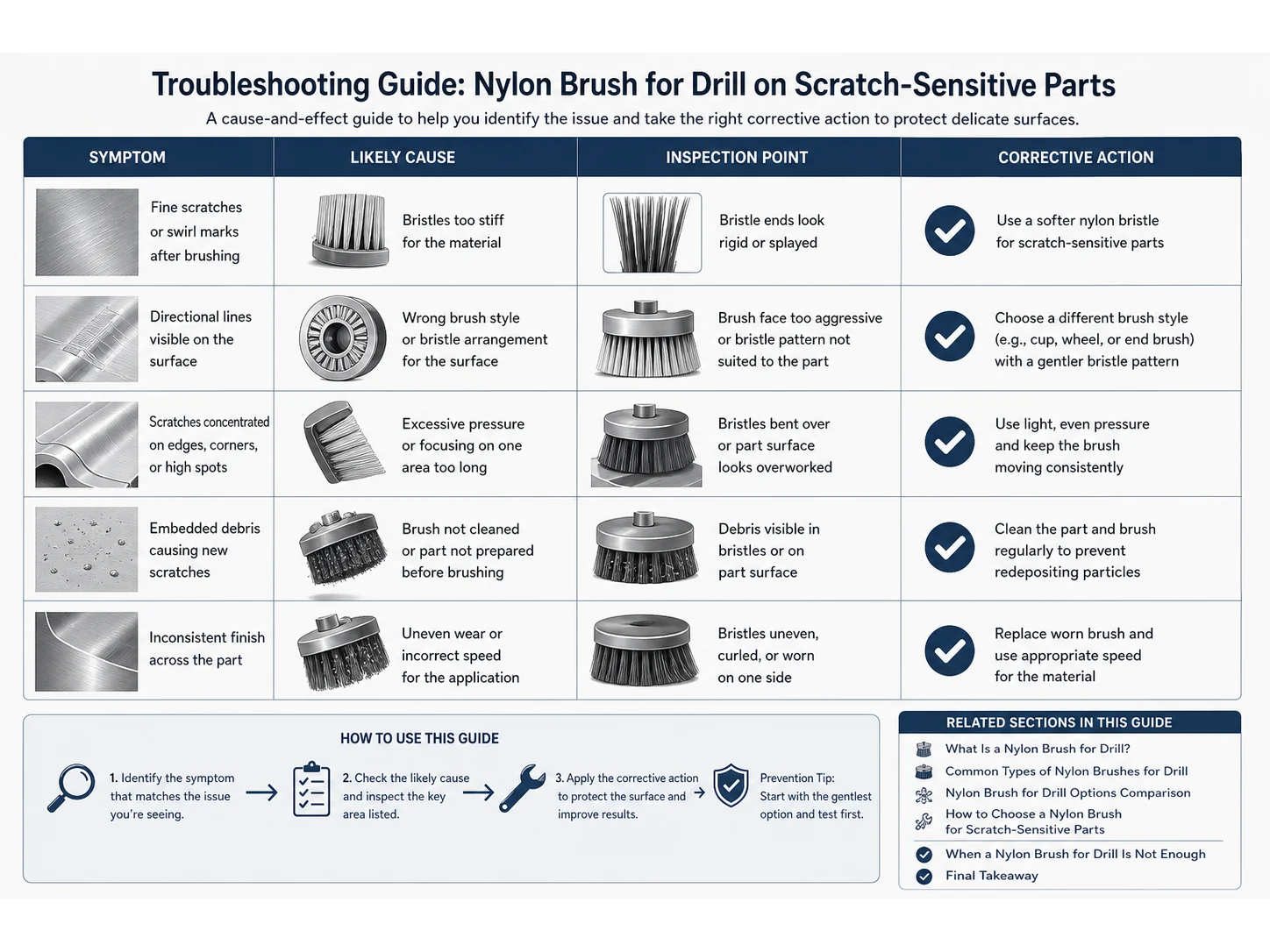
- Mistake 1: Assuming all nylon is safe. Hard-grade nylon or abrasive-impregnated bristles can still scratch soft metals. Always verify bristle stiffness with a test patch.
- Mistake 2: Using wire brush habits. Operators often apply excessive pressure as they would with a steel brush. Let the bristle tips do the work with light, consistent contact.
- Mistake 3: Skipping the test patch. Always test on a non-critical area or scrap piece before cleaning the visible surface.
- Mistake 4: Ignoring drilled RPM limits. Running a nylon brush too fast melts bristle tips, creates smear, or causes uneven wear that can scratch. Refer to the brush manufacturer’s maximum RPM rating.
- Mistake 5: Using a damaged or contaminated brush. Bristles can embed metal particles from previous jobs. Dedicate brushes for scratch-sensitive work and inspect before use.
- Mistake 6: Wrong brush geometry. A cup brush on a curved tube exterior can cause edge cutting; a tube brush with a loose fit can spin unevenly and mar the bore.
- Mistake 7: Inadequate shank engagement. A poorly secured brush wobbles, causing uneven contact and scratching. Use a chuck that grips the full shank.
When a Nylon Brush for Drill Is the Wrong Choice
Nylon brushes remove surface-level contaminants. They cannot substitute for:
- Heavy rust or scale removal that requires chemical stripping or abrasive blasting.
- Deep corrosion pitting where surface material must be cut, not just cleaned.
- Extreme heat-affected scale (e.g., weld slag) that needs a stainless steel brush or mechanical grinding.
- Critical surface finish requirements where even soft nylon could alter the Ra value; consult the finish specification before proceeding.
- Applications with static-sensitive electronics where non-conductive nylon may generate a charge; use anti-static brushes or ionization.
If in doubt, request a sample drawing and test results from the brush supplier, or perform a documented trial before full-scale use.
Final Takeaway
Protecting scratch-sensitive parts begins with matching the nylon brush stiffness, diameter, and shape to the actual cleaning task. Avoid the common pitfall of treating all nylon brushes as universally gentle. Always test on scrap, control drill speed, inspect bristles between uses, and recognize when the residue demands a more aggressive method beyond nylon’s safe operating window.
Frequently Asked Questions
Can I use a nylon brush for drill on painted surfaces?
Yes, but only a soft-grade nylon brush at low speed. Always test on an inconspicuous area first, as some paints are extremely soft.
How do I determine the right stiffness for my application?
Start with the softest available nylon and increase stiffness only if cleaning is insufficient. Bristle stiffness is often color-coded (e.g., white for soft, black for hard), but verify with the supplier.
What diameter brush should I choose?
Select a diameter that covers the work area efficiently without overlapping onto adjacent sensitive surfaces. For tubes, the brush diameter should be slightly larger than the bore to ensure light interference.
Can I use a nylon brush with water or cleaning chemicals?
Nylon is resistant to many chemicals, but strong acids, phenols, and some solvents can degrade it. Check the chemical compatibility chart from the brush manufacturer. Wet use may require a slower drill speed to avoid splashing.
How do I prevent the brush from leaving swirl marks?
Swirl marks often result from excessive speed or pressure. Reduce RPM, use light pressure, and keep the brush moving to prevent dwell marks.
What shank type works with a standard drill?
Most drill nylon brushes come with a 1/4-inch hex shank or round shank. Hex shanks prevent slipping in keyless chucks and are recommended for consistent rotation.
How often should I replace a nylon brush for drill?
Replace when bristles become permanently bent, worn unevenly, or contaminated with embedded particles. A brush used on scratch-sensitive parts should be inspected more frequently and replaced at the first sign of deterioration.
Is a nylon brush drill attachment safe for stainless steel?
For stainless steel with a brushed or polished finish, a soft nylon brush can be used for light cleaning without scratching if the bristle stiffness is appropriate. Avoid using a nylon brush that has been previously used on carbon steel to prevent cross-contamination.
Technical References
- ABMA — ANSI B165.1 Power Brush Safety Slips
- OSHA — 1910.242 Hand and Portable Powered Tools
- OSHA — 1910.215 Abrasive Wheel Machinery
- OSHA — Personal Protective Equipment
- British Plastics Federation — Thermoplastics
Which bristle material fits this job — Nylon PA, AISI 304 Stainless Steel Wire or Conductive Nylon?
| Material | Continuous temperature (°C) | Peak temperature (°C) | Water absorption | Hardness |
|---|---|---|---|---|
| Nylon PA | 93 | 121 | 0.3–9% by PA grade and conditioning | Medium to firm; filament diameter and trim length control bending force. |
| AISI 304 Stainless Steel Wire | 400 | 500 | 0% | Rockwell B 70–95 depending on temper and cold work |
| Conductive Nylon | 80–110 | 130–160 | 0.5–2.5% | Shore D 75–88 |
| PA6 Nylon | 80–100 | 130–160 | 1.5–3.0% | Shore D 75–85 |
| PBT | 120–140 | 160–180 | 0.05–0.20% | Shore D 80–90 |
Figures as published by Brushtec / DuPont; Alleima; Perlon. Confirm the exact grade against the supplier datasheet before ordering.
What should replace Handheld Detail Brushes when they stop working?
- Handheld Detail Brushes — Handheld detail brushes cover general precision cleaning; auto-detailing brushes impose tighter controls for painted, polished, leather, display, and trim surfaces.
- Nylon PA — Compare Nylon PA with PP, PBT, PET. Change material when wet stiffness, temperature, chemical resistance, conductivity, particle shedding, or surface marking becomes the limiting factor.
- AISI 304 Stainless Steel Wire — Use AISI 316 stainless steel wire for chloride, marine, dairy, beverage, chemical washdown, or higher pitting-resistance requirements. Use carbon steel for dry aggressive cutting and brass or abrasive nylon for lower marking risk.
- Conductive Nylon — Compare Conductive Nylon with Anti-static filament, carbon fiber, stainless conductive filament, standard PA6. Change material when wet stiffness, temperature, chemical resistance, conductivity, particle shedding, or surface marking becomes the limiting factor.