
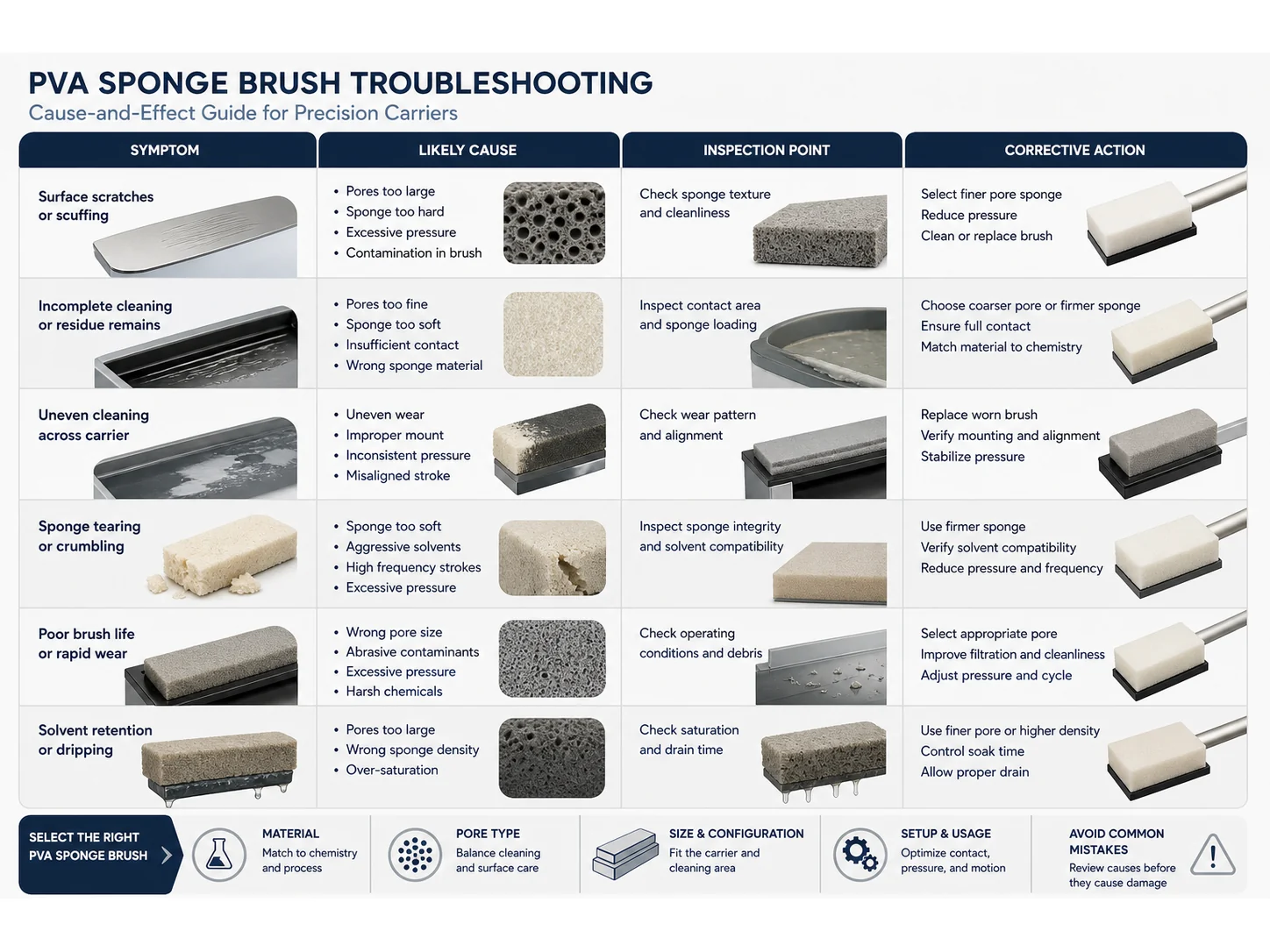
What Is a PVA Sponge Brush?
A PVA sponge brush uses a hydrophilic, open-cell polymer structure that becomes soft and flexible when wet, and hard and rigid when dry. It is lint-free, highly absorbent, and non-abrasive, making it ideal for precision cleaning where residue control and scratch prevention are critical. Unlike traditional foam or bristle brushes, a PVA sponge brush leaves no fiber contamination and can hold cleaning solutions effectively while gently wiping away particulate and thin films.
Common Types and Configurations for Precision Carriers
PVA sponge brushes are available in several configurations to fit different carrier cleaning systems:
- Roller Brushes: Cylindrical shapes with or without a core, used in automated rotary scrubbers. Diameters typically range from 20 mm to 80 mm, and lengths can exceed 500 mm.
- Flat Sheets or Blocks: Thick sheets or blocks that can be cut to size or mounted on a backing plate for linear wiping actions.
- Custom-Molded Shapes: Engineered for unique carrier geometries, such as curved channels or recessed areas, using mold tooling.
- Disc Brushes: Circular discs for polishing or spot cleaning on rotating spindles.
Core materials include plastic (ABS, PVC) for general use, and stainless steel (304 or 316) for chemical resistance or cleanroom compatibility. Mounting options include press-fit shafts, bolt patterns, and adhesive backing.
Comparing PVA Sponge Brush Options
| Type | Material Composition | Pore Size (µm) | Wet Hardness | Typical Diameter Range | Core Options | Best For |
|---|---|---|---|---|---|---|
| Standard Roller | Pure PVA | Fine (10–50) | Soft | 20–80 mm | ABS, SS304 | Gentle particle removal on glass, wafer, or AR-coated carriers |
| High-Density Roller | Composite (PVA + stiffening agents) | Medium (50–100) | Medium-Firm | 30–60 mm | SS304, SS316 | Moderate residue, coated surfaces needing more scrubbing pressure |
| Flat Block / Sheet | Pure PVA | Fine–Coarse | Soft–Firm | Custom thickness (5–50 mm) | None, adhesive backing | Manual wiping of sensitive optics; easy field replacement |
| Custom Shape | Engineered PVA | Specified by application | As required | N/A | Custom | Unique carrier geometries (grooves, channels); requires tooling |
How to Choose the Right PVA Sponge Brush
Matching a PVA sponge brush to your precision cleaning task requires evaluating multiple decision factors:
- Residue Type: Fine particles (<10 µm) demand a small pore size to trap them effectively. Oily films or dried chemicals may require a coarser pore with higher absorption to lift contaminants.
- Surface Sensitivity: Delicate coatings (anti-reflection, conductive films) need the softest wet hardness to avoid micro-scratches. Bare glass or ceramic can tolerate medium stiffness.
- Equipment Interface: Measure shaft diameter, keyway dimensions, overall length, and mounting type precisely. A mismatched brush will not install correctly or may cause vibration.
- Chemical Exposure: PVA resists mild acids and alkalis (pH 2–10) but prolonged contact with strong solvents like ketones or high pH (>10) can degrade the sponge. Always verify chemical compatibility for your cleaning agents.
- Hygiene Requirements: For cleanroom classes ISO 5 and below, select sealed bearings and non-shedding core materials. Some PVA brushes can be autoclaved, but check temperature limits (usually <60°C dry heat).
- Maintenance Frequency: Quick-change designs reduce downtime. If operators must replace brushes often, prioritize simple mounting methods.
- Custom Size Needs: If an off-the-shelf diameter does not fit your carrier spacing, consider custom-molded brushes. Lead times and tooling costs apply, but the long-term cleaning consistency often pays off.
Setup and Usage Factors That Affect Performance
Correct handling of a PVA sponge brush is critical to achieving consistent results:
- Pre-Wetting: Always soak the brush in deionized water until fully softened before operation. A partially dry brush is stiff, can scratch surfaces, and wears unevenly.
- Pressure and Alignment: Excessive contact pressure collapses pores, reduces cleaning efficiency, and distorts the brush. Check alignment regularly; a misaligned roller brush will wear into a cone shape.
- Storage: If left to dry completely, the brush hardens and may crack upon re-wetting. Store in a sealed bag with a small amount of moisture or in a humidified cabinet.
- Post-Use Cleaning: Flush the brush with clean DI water to remove captured particles. For sticky residues, ultrasonic cleaning in water can restore performance. Avoid harsh chemicals that damage the PVA structure.
Common Mistakes When Specifying PVA Sponge Brushes
- Choosing by diameter alone without checking pore size compatibility with target residues. A brush that looks right may not clean effectively.
- Assuming all PVA brushes have identical chemical resistance. Composite formulations may swell or degrade in certain solvents even if pure PVA is resistant.
- Not verifying core material suitability. For example, an ABS core may soften in warm cleaning solutions, while SS304 can rust in chloride-containing baths if not properly passivated.
- Neglecting dry storage conditions. Repeated hard-dry cycling can create internal cracks that lead to early failure.
- Selecting a brush that doesn’t match the equipment interface. Even a 1 mm difference in shaft diameter can prevent installation or cause runout.
- Expecting one brush to handle all residue types. A fine-pore PVA brush loaded with viscous residues quickly clogs; a coarse brush won’t capture fine particles.
- Ignoring cleanroom compatibility. Unsuitable core materials, adhesives, or packaging can introduce contamination into your process.
- Skipping on-site testing. Without a sample test on the actual carrier with the real cleaning chemistry, even a well-specified brush may surprise you with poor performance or short life.
When a PVA Sponge Brush Is the Wrong Choice
PVA sponge brushes excel at gentle, non-abrasive wet cleaning, but they have clear boundaries:
- Abrasive or Large Debris: Hard particles (>300 µm) can tear the sponge. Use a stiffer brush, such as nylon or a test tube brush style with bristles, for chunky contamination.
- High-Temperature Processes: Above 60°C, PVA begins to soften excessively and may deform or dissolve. For hot cleaning, consider a brush with heat-resistant filaments.
- Aggressive Chemical Environments: Strong acids (pH <2) or alkalines (pH >10) degrade PVA rapidly. In such cases, a different polymer (e.g., PTFE) or a non-sponge brush may be required.
- Deep Scratches or Texture: If the carrier surface has deep scratches, a soft sponge cannot reach into crevices. A soft-bristle brush or ultrasonic agitation works better.
- Dry Wiping: PVA must be wet to function. For dry dust removal, an anti-static or microfiber brush is more appropriate.
When in doubt, request a factory sample and a detailed mechanical drawing. Test under your actual process conditions—including cleaning agents, pressure, speed, and carrier handling—before placing a full order.
Final Takeaway
Selecting the right PVA sponge brush for precision carriers means focusing first on pore size versus residue, surface sensitivity, and chemical exposure. Relying only on size or cost drivers leads to cleaning failures. Always test samples against your specific process conditions and validate compatibility with the equipment interface.
Frequently Asked Questions
What is a PVA sponge brush made of?
A PVA sponge brush is manufactured from polyvinyl alcohol, often combined with natural cellulose or other modifiers to control pore size, hardness, and absorbency. The material is open-cell and becomes soft when saturated with water.
Can PVA sponge brushes be used with isopropyl alcohol or acetone?
Brief exposure to IPA or acetone is generally safe for pure PVA, but prolonged submersion or high concentrations can cause swelling and loss of mechanical integrity. Always check the manufacturer’s chemical compatibility chart for your specific solvent blend.
How do I know the right pore size for my cleaning process?
Match the pore size to the typical particle size of the residues you need to remove. Fine pores (10–50 µm) capture submicron to small particles effectively, while medium pores (50–100 µm) handle larger debris without clogging instantly. Coarse pores (>100 µm) are best for high-load, loose debris where absorbency matters more than entrapment.
Can I cut a PVA sponge brush to a custom size?
Flat sheet PVA can often be cut with a sharp blade to fit a custom holder. However, roller brushes should never be cut; altering the diameter or length can destroy dynamic balance, mounting integrity, and cleaning uniformity. For roller brushes, order the exact size needed or request custom molding.
How often should I replace a PVA sponge brush?
Replacement intervals depend on contamination load, chemical exposure, and mechanical stress. Inspect weekly for surface tearing, permanent compression, or a loss of absorbency. A well-maintained brush in a clean process may last several months, while a heavily loaded application might require replacement every few weeks.
Are PVA sponge brushes safe for Class 100 cleanrooms?
Yes, provided the brush uses cleanroom-compatible materials: non-shedding cores, sealed bearings, and low-outgassing adhesives. Always request particle-count data from the supplier and perform initial wipe-down or pre-cleaning before introducing the brush to the clean environment.
What is the difference between a PVA sponge brush and a conventional foam brush?
The main differences are material behavior and contamination control. A PVA sponge is hydrophilic and becomes truly soft when wet, absorbs water aggressively, and leaves virtually no lint or particles when used correctly. Conventional polyurethane or polyester foam brushes can be hydrophobic, shed particles as they degrade, and provide less uniform wetting.
Can a PVA sponge brush scratch a glass carrier?
When fully pre-wetted and used with appropriate contact pressure, a pure PVA sponge brush is non-abrasive and will not scratch glass or similar surfaces. However, if the brush is used dry, contaminated with hard particles, or contains a composite with abrasive fillers, scratching is possible. Always test on a non-production sample first.
Technical References
Which bristle material fits this job — PVA Sponge, AISI 304 Stainless Steel Wire or Microfiber?
| Material | Continuous temperature (°C) | Peak temperature (°C) | Water absorption | Hardness |
|---|---|---|---|---|
| PVA Sponge | 60 | 90 | — | Soft absorbent contact material; hardness/compression is controlled by foam or sponge density. |
| AISI 304 Stainless Steel Wire | 400 | 500 | 0% | Rockwell B 70–95 depending on temper and cold work |
| Microfiber | 80–120 | 140–170 | 0.2–1.0%Material Itself ; Structure Can Absorb 3–7 Times Its Own Weight | — |
| PU Sponge | 80 | 110 | — | Soft absorbent contact material; hardness/compression is controlled by foam or sponge density. |
| Felt | 120 | 150 | — | Broad range from soft conformable pad to dense firm polishing wheel; density and thickness stated. |
Figures as published by Alleima. Confirm the exact grade against the supplier datasheet before ordering.
What should replace Handheld Detail Brushes for sponge brush?
- Handheld Detail Brushes — Handheld detail brushes cover general precision cleaning; auto-detailing brushes impose tighter controls for painted, polished, leather, display, and trim surfaces.
- PVA Sponge — Compare PVA Sponge with PU sponge, PP sponge, microfiber. Change material when wet stiffness, temperature, chemical resistance, conductivity, particle shedding, or surface marking becomes the limiting factor.
- AISI 304 Stainless Steel Wire — Use AISI 316 stainless steel wire for chloride, marine, dairy, beverage, chemical washdown, or higher pitting-resistance requirements. Use carbon steel for dry aggressive cutting and brass or abrasive nylon for lower marking risk.
- Microfiber — Compare Microfiber with Cotton yarn, wool, felt, soft PBT filament. Change material when wet stiffness, temperature, chemical resistance, conductivity, particle shedding, or surface marking becomes the limiting factor.