
What Is a Grill Brush and Why Does Selection Matter?
A grill brush is a cleaning tool specifically designed to remove food residue, grease, and carbon buildup from grill grates. Selection matters because grate materials react differently to abrasives. Porcelain-coated grates scratch easily, while heavy cast iron needs aggressive cleaning. Using the wrong brush can void a grate warranty, create safety hazards, or reduce the life of your grill.
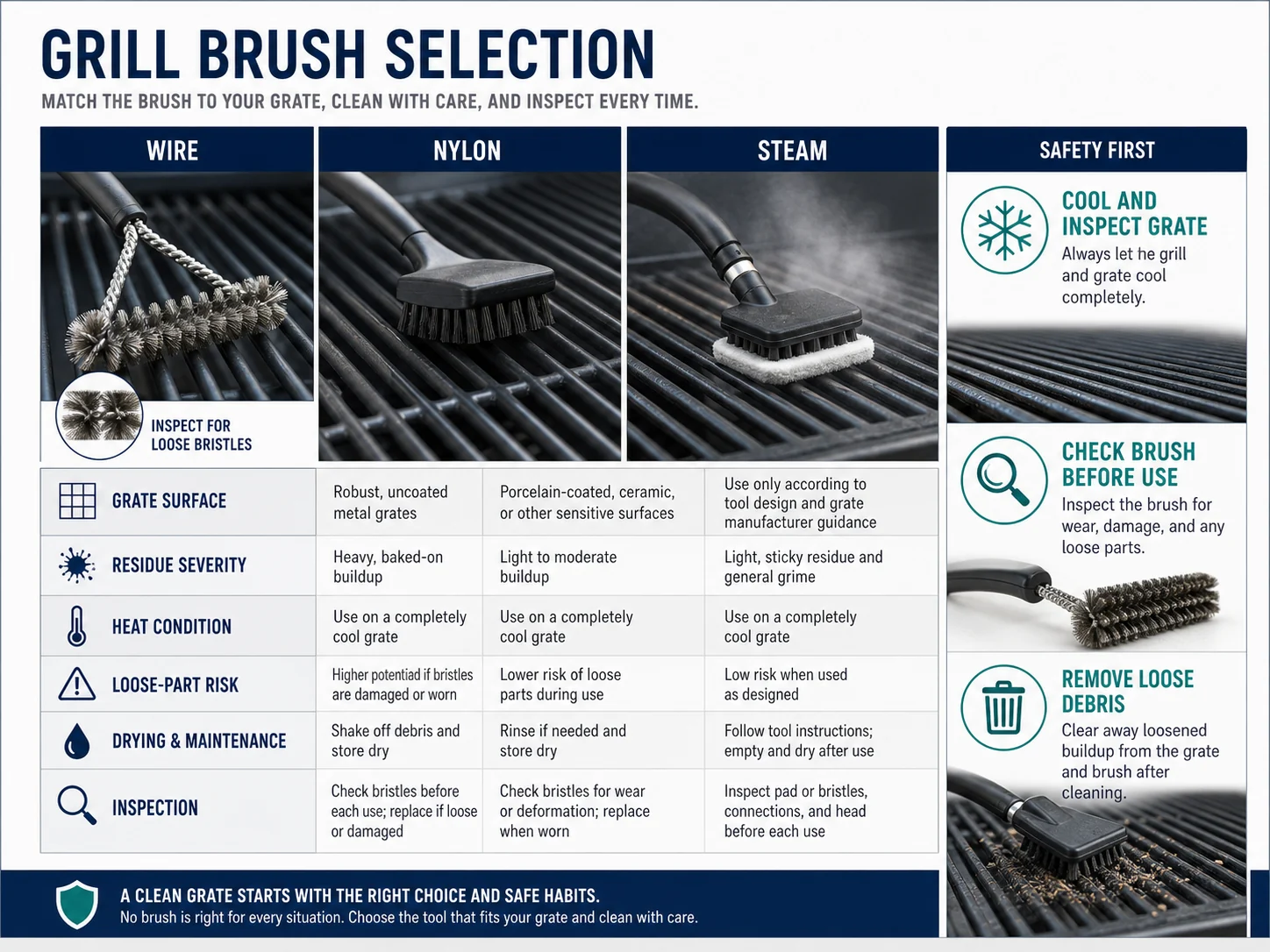
Common Types of Grill Brushes: Wire, Nylon, and Steam
Three main categories dominate the market:
- Wire brushes: Use metal bristles (stainless steel, brass, or carbon steel) to scrape off stubborn debris. They are the most common but carry a bristle shedding risk.
- Nylon brushes: Feature abrasive nylon bristles that are softer and safer for delicate surfaces like porcelain. Some have added abrasive grit.
- Steam cleaners: Use hot steam to loosen grime without any bristles. No shedding risk, but they require electricity or batteries and are less effective on heavy carbon.
Wire vs Nylon vs Steam: A Practical Comparison
| Feature | Wire Brush | Nylon Brush | Steam Cleaner |
|---|---|---|---|
| Cleaning power | High (stainless steel); moderate (brass) | Low to moderate | Moderate |
| Best grate material | Cast iron, heavy stainless steel | Porcelain-coated, ceramic | All types |
| Risk of bristle shedding | Yes – ingestion hazard | Minimal (bristles are thicker and softer) | None |
| Surface safety | Can scratch coated grates | Safe for coatings | Safe for all surfaces |
| Typical cost/complexity | $ | $–$$ | $$–$$$ |
| Maintenance | Rinse and check for loose bristles | Wash with soap and water | Refill water, descale |
How to Choose the Right Grill Brush for Your Grate Material and Cleaning Routine
Start by identifying your grate material. For uncoated cast iron or heavy-duty stainless steel, a stainless steel wire brush offers the best one-pass cleaning. If you have porcelain-coated, ceramic, or thin stainless grates, switch to a nylon brush or a steam cleaner to avoid chipping or scratching. Frequency matters: if you grill daily, a quick post-cook nylon scrub may be enough; for weekend warriors who face accumulated carbon, a wire brush or even a pumice stone might be needed. Also consider handle length and grip if you clean while the grill is hot.
Grill Brush Safety: The Wire Bristle Ingestion Risk and Warnings
Lost wire bristles from grill brushes pose a serious health risk. They can stick to grill grates, transfer to food, and if swallowed, cause injuries ranging from mouth perforations to intestinal punctures. The CDC and emergency room data have documented numerous cases. To reduce risk:
- Inspect the brush before each use and discard if bristles are loose or bent.
- After brushing, wipe grates with a damp cloth or half an onion to catch stray bristles.
- Consider bristle-free alternatives like coiled wire (no individual bristles), nylon mesh, or steam.
- Never use a wire brush on a surface where food might be directly placed without wiping afterward.
If you or someone you’re cooking for experiences abdominal pain after eating grilled food, mention the possibility of a wire bristle to a doctor.
Common Mistakes When Selecting a Grill Brush
- Ignoring grate material: Using a heavy stainless steel brush on a porcelain grate can chip the coating, leading to rust.
- Choosing bristle stiffness by cost alone: A low-cost wire brush may use low-quality steel that rusts or sheds quickly.
- Not replacing brushes regularly: Dull, bent bristles clean poorly and are more likely to break free.
- Using a steam cleaner on heavy carbon: Steam alone may not remove thick, baked-on carbon; you’ll need a pumice stone or scraping tool.
- Cleaning only once per season: Infrequent cleaning hardens residue, requiring harsher methods that can damage grates.
When a Pumice Stone Is a Better Option for Heavy Carbon
For thick, rock-hard carbon deposits that resist wire brushes, a grill pumice stone (also called a grill stone or cleaning block) is often more effective. It’s made of porous volcanic rock that grinds away carbon without the bristle risk. Use it on cast iron or stainless steel grates; avoid on porcelain or enamel unless the manufacturer says it’s safe. Pumice is aggressive, so it’s best saved for occasional deep cleaning, not daily maintenance.
Final Takeaway: Matching the Brush to the Task
There is no single “best” grill brush. Let your grate material and cleaning frequency guide your choice:
- Porcelain or coated grates → nylon brush or steam for daily care.
- Cast iron or uncoated steel → high-quality stainless steel wire brush; inspect and replace regularly.
- Safety-first kitchens or high-volume grilling → steam cleaner or bristle-free coiled wire tool.
- Stubborn carbon layers → pumice stone, then maintain with a gentler method.
No matter which you pick, always wipe grates after brushing to remove any loosened debris or potential bristles.
When a Wire Grill Brush Is the Wrong Choice
This brush is not enough when the main problem is blocked access, unsafe working conditions, damaged equipment, incompatible chemicals, or a process setting that keeps recreating the residue. In those cases, review residue type, food-contact area, cleanability, storage, and cross-contamination risk and confirm the surrounding cleaning method before increasing brush stiffness or contact pressure.
Frequently Asked Questions
Can I use a wire brush on porcelain grill grates?
It’s not recommended. Steel wire brushes can chip or scratch porcelain coatings, exposing the metal underneath to rust. Use a nylon brush or a steam cleaner instead.
How often should I replace my grill brush?
Replace a wire brush as soon as you notice loose, bent, or rusted bristles—typically every season for frequent grillers. Nylon brushes last longer but should be replaced when bristles wear down. Steam cleaners have no brush replacement but may need descaling.
What is the safest grill brush if I’m worried about wire bristles?
Bristle-free options are safest. Steam cleaners and coiled wire brushes (with a single helical coil instead of individual bristles) eliminate the ingestion risk. Nylon brushes shed very rarely and the fibers are visible and soft.
Can a steam cleaner really remove baked-on grease?
Steam softens grease and lighter residue but struggles with thick carbon. For heavy buildup, pre-soak or use a pumice stone first, then maintain with steam. It’s best as a maintenance tool after a deep clean.
Do brass wire brushes work on all grill grates?
Brass is softer than stainless steel and safer on porcelain, but it wears out faster and can still leave marks if pressed hard. It’s a middle-ground option for occasional use, but nylon is still safer for delicate surfaces.
How do I clean a grill without a wire brush?
Use a nylon scraper or pad, a steam cleaner, a pumice stone, or even a ball of aluminum foil. Wipe afterward with an oiled cloth to condition the grates. For a quick clean, a hot burn-off followed by a stiff nylon brush works well.
Is a grill brush with a scraper necessary?
Not always, but a scraper helps loosen stubborn, flat carbon layers that bristles can’t reach. Some brushes have integrated scrapers. If yours doesn’t, a separate stainless steel scraper can complement your brush.
How should I care for my grill brush to extend its life?
Rinse after each use and let it air dry. Avoid soaking wooden handles. Store the brush head covered or facing downward to protect bristles. Never leave a brush dangling inside the grill where heat can warp bristles.
Technical References
Which bristle material fits this job — Nylon PA, AISI 304 Stainless Steel Wire or Abrasive Nylon?
| Material | Continuous temperature (°C) | Peak temperature (°C) | Water absorption | Hardness |
|---|---|---|---|---|
| Nylon PA | 93 | 121 | 0.3–9% by PA grade and conditioning | Medium to firm; filament diameter and trim length control bending force. |
| AISI 304 Stainless Steel Wire | 400 | 500 | 0% | Rockwell B 70–95 depending on temper and cold work |
| Abrasive Nylon | 120 | 150 | 0.1–1.0% | Abrasive filament; stiffness and cutting level is controlled by PA base, grit type, grit size, filament diameter and trim height. |
| AISI 316 Stainless Steel Wire | 400 | 500 | 0% | Rockwell B 70–95 depending on temper and cold work |
| Aramid Fiber | 160–200 | 250–300 | 2–7% | — |
Figures as published by Brushtec / DuPont; Alleima; Perlon. Confirm the exact grade against the supplier datasheet before ordering.
What should replace Handheld Detail Brushes for grill brush?
- Handheld Detail Brushes — Handheld detail brushes cover general precision cleaning; auto-detailing brushes impose tighter controls for painted, polished, leather, display, and trim surfaces.
- Nylon PA — Compare Nylon PA with PP, PBT, PET. Change material when wet stiffness, temperature, chemical resistance, conductivity, particle shedding, or surface marking becomes the limiting factor.
- AISI 304 Stainless Steel Wire — Use AISI 316 stainless steel wire for chloride, marine, dairy, beverage, chemical washdown, or higher pitting-resistance requirements. Use carbon steel for dry aggressive cutting and brass or abrasive nylon for lower marking risk.
- Abrasive Nylon — Compare Abrasive Nylon with PP, PBT, PET. Change material when wet stiffness, temperature, chemical resistance, conductivity, particle shedding, or surface marking becomes the limiting factor.