
Custom Cleaning Brush
Machine Guide Rail Brush
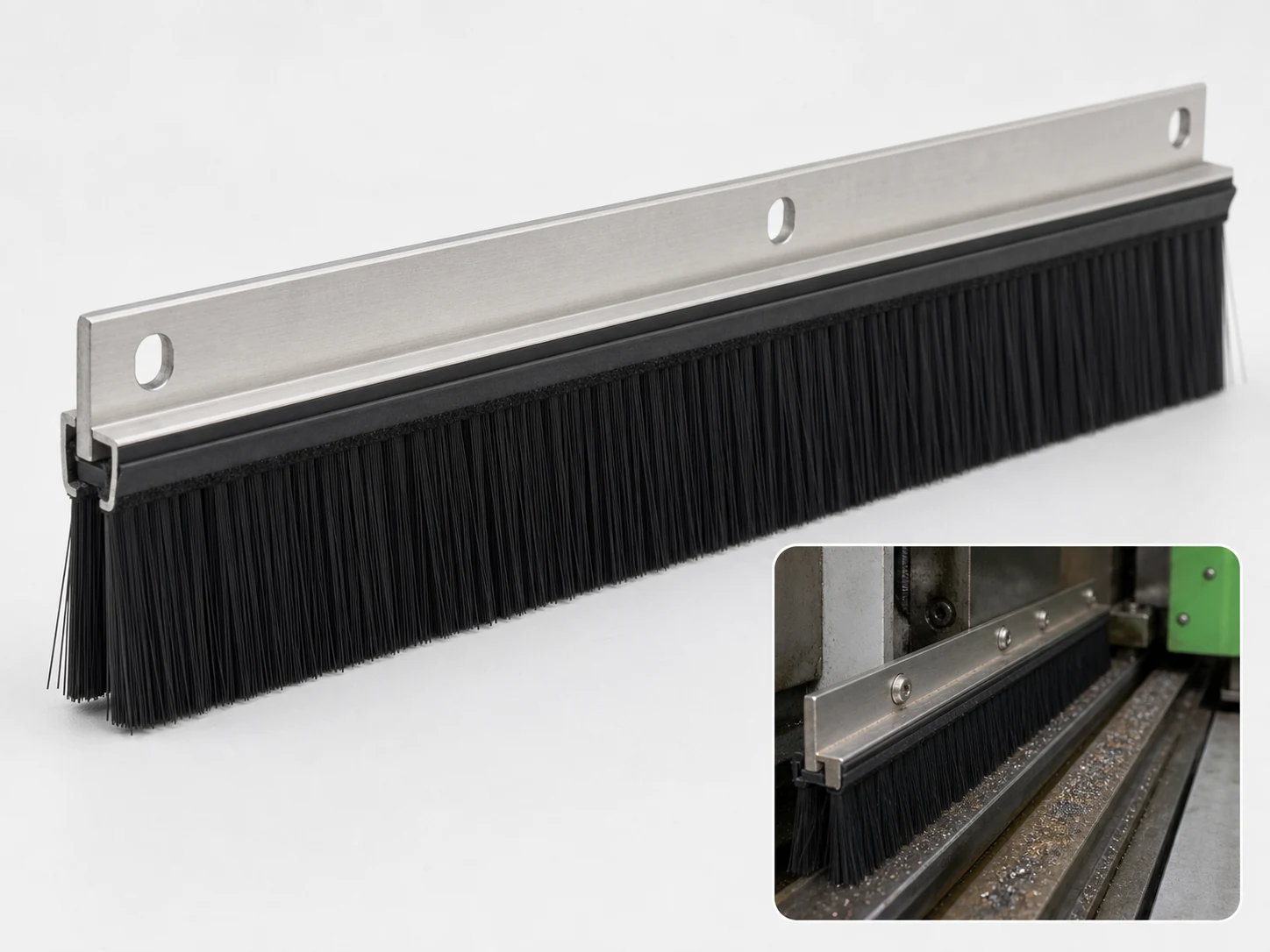
Custom machine guide rail brush for cleaning slots, rails, pins, and narrow machine paths. Nylon, PBT, felt, or rubber fill. Strip length 100–3000 mm.
Large-format brush
100 pcs
Minimum order
Built one at a time on a core or channel: full-width rollers, sweeper brooms and long strip.
Production lead time, once the specification is confirmed
- Up to 100 pcsWithin 20 days
- 101–1,000 pcsWithin 30 days
- Over 1,000 pcsConfirmed with your quotation
Peak season can extend these times; the shipping date is confirmed in writing with your quotation. Sampling and shipping are quoted separately.
A linear strip brush engineered to mount alongside guide rails, slots, and machine tracks, clearing dust, chips, and process debris from moving contact surfaces without disturbing precision tolerances.
What can this brush do for you?
Continuous cleaning along the entire travel path
Unlike rotating brushes that only clean where the bristle head touches, this strip brush stays in a fixed position while the carriage or workpiece glides past. The full length of the rail receives the same contact on every stroke. No skipped zones at the ends of the travel, no buildup at the reversal point.
Filament tips lift debris instead of pushing it into the rail
The fill is angled forward from the backing channel. This orientation lets each filament tip slide under light particles, lift them from the rail groove, and carry them clear of the contact area. A straight, perpendicular fill would only push chips and fibers down into ball tracks and bearing pockets.
Selectable fill stiffness for the actual residue on your line
Nylon PA and PBT filaments cut through dry dust, wood chips, small burrs, and light oxide without holding moisture. Felt and rubber fills work as compliant wipers that collect fine film, absorb oily residue, or seal a gap while allowing a rail to pass. The same brush architecture supports either approach, so you do not have to change the mounting or rail design when the cleaning requirement shifts.
Fixed mounting that keeps hands away from moving axes
Once installed in an aluminum carrier, angle holder, or existing machine channel, the brush requires no operator input during the cycle. Rail cleaning happens every time the axis moves, automatically, without adding a separate manual step or exposing anyone to pinch points.
Replaceable strip, reusable mounting hardware
When the filament tips eventually compress or wear, you remove the worn strip and slide in a new one. The holder, screws, and bracketry remain in place. Downtime is limited to the strip change itself, and your spare parts inventory stays smaller.
What is a Machine Guide Rail Brush?
A Machine Guide Rail Brush is a continuous linear brush strip installed next to a guide rail, slot, or linear track on industrial equipment. It consists of a metal or polymer backing channel filled with filaments or wiper material. The strip is clamped or screwed into a holder so the working tips press lightly against the moving rail, pin, or harness channel.
In normal operation, the rail or carriage travels past the fixed brush. Filament tips sweep the top and shoulder of the rail, flicking away dust, chips, fibers, and light grease before those residues can enter ball screws, linear bearings, seals, or electrical harness runs. The brush does not rotate and does not require drive power. It is a passive component that works every time motion occurs.
The working height of the fill, called the trim height, determines how the brush contacts the rail. A small portion of that height is intentionally compressed against the rail surface. That compression sets contact pressure. Too little compression allows debris to slip underneath. Too much flattens the filaments, reduces tip action, and accelerates wear. The correct setting depends on the fill material, rail clearance, and the type of residue you are removing.
This is a precision-cleaning component, not a heavy scraping tool. It is designed for routine debris control on moving machine elements, not for removing welded spatter, hardened grease deposits, or deep corrosion. For those conditions, a powered brush roll, scraper, or chemical pre-cleaning should be considered before the rail brush is expected to perform.
Technical Specifications
All values below represent the standard build range for this product. Final dimensions and materials are confirmed against your rail drawing and mounting constraints.
| Parameter | Value / Options |
|---|---|
| Strip length | 100–3000 mm, cut to rail length or segmented for long axes |
| Trim height | 12.7–152.4 mm, selected for required contact reach and available clearance |
| Channel width | 3.2–14.3 mm, matched to holder or slot profile |
| Filament diameter | 0.10–1.27 mm; finer filaments for dust control, heavier filaments for chips and fibers |
| Fill materials | Nylon PA, PBT, felt, rubber; mix or zone fills available |
| Backing material | Galvanized steel, stainless steel, or aluminum channel |
| Mounting holder | Straight channel, aluminum carrier, angle holder, or custom profile |
| Working compression | 5–25% of trim height; 5–15% for wiping/dust control, 10–25% for sealing without crushing fill |
| Operating temperature | Material-dependent: Nylon/PBT up to ~80–120°C continuous; felt and rubber per grade |
| Environment | Dry, lightly oiled, or washdown; specify chemical and moisture exposure for fill selection |
| Brush type | Custom Strip Seal Brushes |
| How it is driven | Fixed in place, no drive of its own |
| Cleaning target | cnc machining center and milling machine, gantry and pick-and-place system, and woodworking equipment cleaning |
| Surface or part | rails, slots, guide rails, tracks, channel, pins, harness channels, and aluminum |
| Residue or debris | dust, chips, fiber, particles, cutting fluid, lint, grease, and adhesive residue |
| Mounting / connection | Straight channel, aluminum carrier, angle holder, or custom profile |
For rails with varying height or a worn section, a compression range rather than a single fixed number is often the right choice. We can zone the fill density or use a spring-loaded holder to maintain consistent contact along the full travel.
Where does this brush work best?
The brush fits any machine where a linear surface or groove needs repeated, hands-free debris removal.
- CNC machining centers and milling machines: linear guide rails and way covers collect chips and cutting fluid mist. The brush keeps the rail surface clean so lubricant stays on the bearing path and seals are not abraded by trapped swarf.
- Gantry and pick-and-place systems: long aluminum or steel rails in automated assembly lines attract lint, fibers, and small plastic particles from product handling. Continuous contact removes these before they accumulate in the carriage.
- Packaging and printing machines: conveyor rails, guide slots, and registration tracks collect paper dust, label adhesive residue, and film fragments. Felt or nylon fills capture the fines without scratching anodized or polished surfaces.
- Woodworking equipment: sawdust and fine wood fibers pack into slots and pin channels. Stiffer PBT or nylon fills push the material out before it compacts.
- Textile and fiber-processing machines: harness channels, pin tracks, and guideways accumulate fiber wraps and process lint. The brush removes the wrap before it jams a needle or tensions a thread incorrectly.
How do I choose the right one?
Start with the available mounting space. Measure the gap beside the rail, the height from the rail face to the nearest machine casting, and whether a straight channel, angle bracket, or existing slot is available for anchoring. The brush can only clean what it can reach; if the mounting point sits too far from the rail, the fill must be longer, which reduces contact pressure.
Match the fill material to the debris and environment.
- Nylon PA: good general choice for dry dust, fine chips, fibers, and light oil. Resists abrasion and recovers well after repeated compression.
- PBT: slightly stiffer and better chemical resistance than nylon in wet or solvent-laden air. Preferred when cutting fluid or washdown chemistry is present.
- Felt: absorbs and holds fine dust and oil film. Best for wiper-style cleaning where you want particles collected rather than thrown. Not recommended for large chips or heavy debris that will pack the felt.
- Rubber: a flexible sealing lip rather than a filament brush. Use when the primary goal is wiping oil, excluding debris from a gap, or providing a light seal without aggressive filament contact.
Set the compression correctly. For wiping and dust control, compress the fill 5–15% of its trim height against the rail. For a tighter seal that still allows the rail to pass, use 10–25%. A simple test: install the strip, run the rail through one full cycle, then look at the filament tips. They should spring back upright. If the tips stay folded over, backing is too strong or compression is too high. If debris remains in the rail groove, increase compression slightly or switch to a stiffer filament.
Plan for replacement. Brush fill wears as a consumable. On a 24/7 machine, check the strip weekly for the first month to establish a wear rate. Replace the strip when compression drops below the recommended minimum or when the tips no longer reach the rail surface.
When this brush is not the right tool. If the rail is severely pitted or the debris includes hardened weld spatter, grinding dust that has fused to the surface, or thick baked grease, a passive strip brush will not restore the rail. In those cases, use a powered wire wheel or roller brush for the aggressive cleaning step, then install the Machine Guide Rail Brush as the ongoing maintenance cleaner. If the rail is too narrow or the gap too tight for any filament to fit, consider an air knife or vacuum capture system instead.
Can I customize this brush?
Yes. Machine Guide Rail Brushes are almost always built to a specific machine rather than selected from a catalog. We need the rail drawing or a sketch, plus the available mounting area and the type of residue you want to control. A photo of the current setup helps us identify interference points.
We can adjust:
- Strip dimensions: overall length, trim height, channel width, and fill projection angle
- Fill configuration: filament diameter, density, material, zone fills (stiffer at the ends, softer in the middle), or a segmented mix of brush and wiper
- Backing and holder: straight U-channel, aluminum carrier, angle holder, or a custom profile matched to your existing slot; stainless steel backing for washdown or corrosion-prone lines
- Mounting interface: pre-drilled holes, slotted holes, clips, spring loading, or a continuous clamping strip
- End treatments: flat cut ends, notched ends, sealed ends to prevent filament loss, or corner returns for L-shaped rail sections
- Color and marking: color-coded backings for different fill materials, stamped part numbers, or batch labels for traceability
- Packaging: straight lengths, coiled for long strips, individual bags, or bulk cartons
If your project requires material documentation, inspection reports, or third-party testing to validate wear rate, filament retention, or chemical compatibility, we can assist with those requirements during the project-quote process.
Which filament lasts longest on a machine guide rail brush?
How do I know if the compression setting is correct?
Run the rail through one full travel cycle while the brush is installed. Stop and inspect the filament tips. They should be upright, not permanently bent or splayed. Run a clean white cloth along the rail after the brush passes: no visible dust stripe or residue means the contact is working. If you see a clean stripe with residue on both sides, the brush is only cleaning the crown of the rail and not the shoulder. Increase compression or trim height slightly.
Can I use one strip brush on a rail that runs vertically?
Yes, with the right fill angle and density. Vertical rails tend to shed debris downward, so the fill should be angled slightly upward against the direction of travel to lift particles rather than let them fall through. A stiffer PBT or nylon works better than felt on vertical surfaces because felt slumps and loses contact over time.
Will nylon filaments scratch a precision-ground or hard-chrome rail?
Nylon and PBT filaments are softer than hardened steel and most rail coatings. They will not cut the surface in normal wiping use. However, if chips become embedded in the filament tips or the backing is misaligned so the metal channel rubs the rail, scratching can occur. Inspect the tips periodically and keep the backing clear of the rail face.
How often should I replace the strip?
There is no universal number. Use the compression check: when you can no longer achieve the specified 5–15% compression without re-shimming the holder, or when filament tips are worn shorter than 60% of the original trim height, it is time to replace the strip. On high-speed gantries running three shifts, replacement may be monthly. On a lightly used packaging line, the same strip can last a year or more.
What is the difference between a brush strip and a rubber wiper strip?
A brush strip uses individual filaments that flick, lift, and carry debris out of the contact path. A rubber wiper strip uses a solid lip that scrapes and seals. Brush strips handle chunky, dry, or fibrous debris better. Rubber wipers handle oil film, fine dust, and moisture better. When one cannot do both jobs, specify a combined strip with a brush zone and a wiper zone in the same backing.
Can I install the brush at an angle to the rail instead of straight?
Yes, and in some cases a 10–20° mounting angle improves debris ejection because it creates a cross-sweeping motion. However, the angle also changes the effective contact width and can accelerate wear on the downstream edge of the fill. Test the angle on a short section before committing the full length. If you need a consistent angled sweep across the entire rail, we can manufacture the strip with a pre-set bias so it installs square but sweeps at an angle.
Guides that go deeper on this
Custom Manufacturing RFQ
Describe Your Application
To prepare the correct quotation, provide the dimensions, cleaning task, residue, material, mounting details, quantity, and a drawing or photo.
Drawing or photo optional — it speeds things up, it does not gate the enquiry.
Custom Brush RFQ
Send Your Brush Project
Upload a drawing, product photo, or sample photo and provide the core dimensions and cleaning conditions.
“We need a brush to remove wet residue from a stainless steel conveyor, about 800mm wide. The current brush wears quickly. We can send photos.”
“We sell drinkware and need a cleaning brush to include with the product. Quantity around 5,000 pieces.”