
Custom Cleaning Brush
Oven Band Brush
Industrial oven band brushes for continuous removal of carbonized flour, oil, and sugar from baking oven conveyor bands.
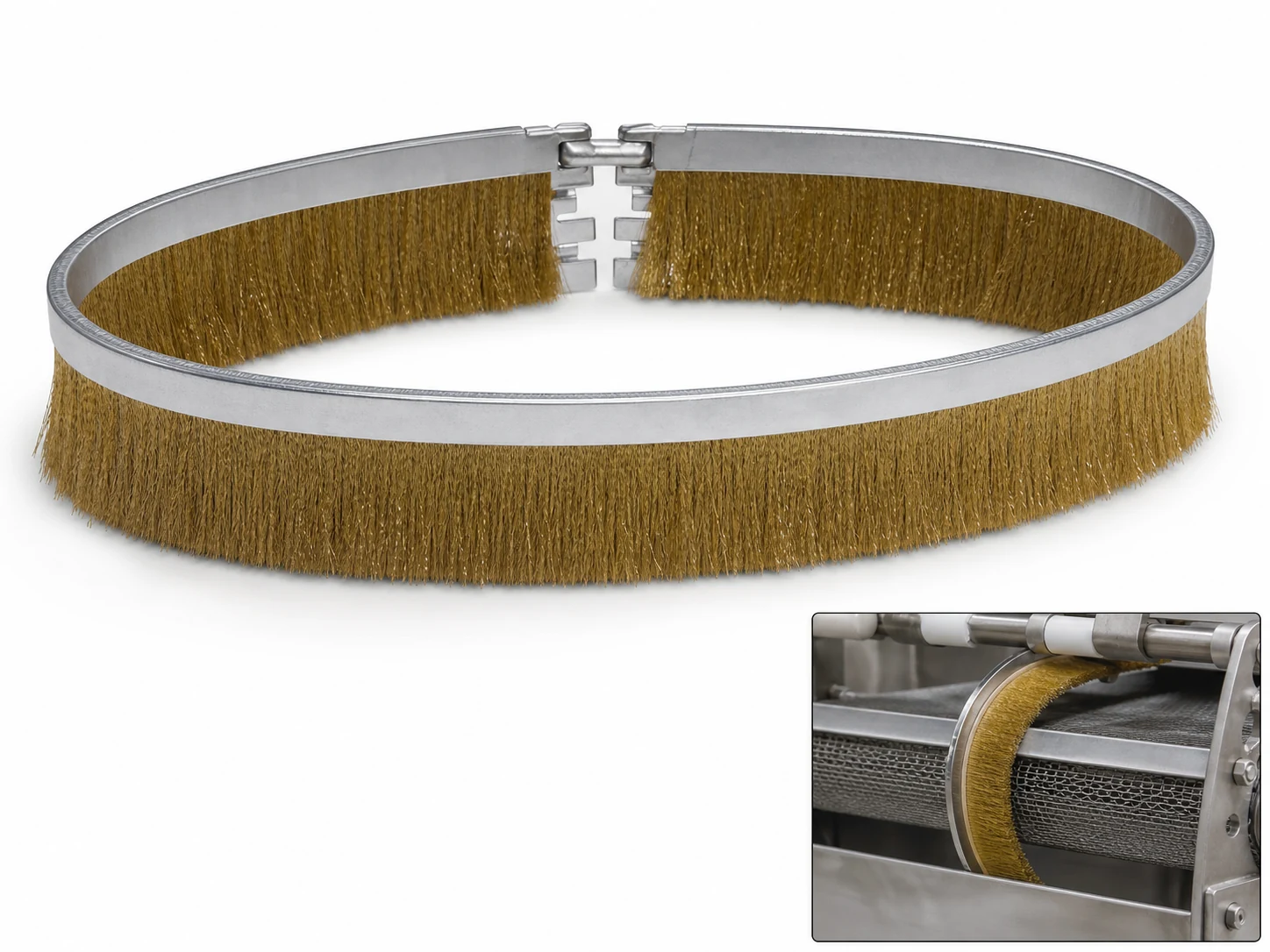
Medium brush
100 pcs
Minimum order
Worked with two hands or on a pole: chimney, gutter and pond-filter brushes, discs, cups and tank brushes.
Production lead time, once the specification is confirmed
- Up to 100 pcsWithin 7 days
- 101–5,000 pcsWithin 14 days
- 5,001–50,000 pcsWithin 21 days
- Over 50,000 pcsConfirmed with your quotation
Peak season can extend these times; the shipping date is confirmed in writing with your quotation. Sampling and shipping are quoted separately.
A machine-mounted roller or strip brush that continuously removes carbonized flour, oil, sugar, and baked-on crumbs from moving oven bands while the line stays in operation. It is built to the band width, contact temperature, and residue type of your specific baking or food-processing conveyor.
What can this brush do for you?
Clean the band without stopping production
The brush mounts beside the band on an adjustable holder and either rides against the moving surface or is driven to rotate. Debris is removed on the return leg or in a defined cleaning section while the oven and product flow continue, instead of requiring a shutdown and manual scraping.
Remove carbonized residue without chewing up the band
Brass wire fill removes baked carbohydrate deposits and carbon build-up from stainless steel and carbon steel bands with less surface damage than steel wire. It is a middle-ground fill for lines that need more cutting action than nylon but want to avoid deep scoring or sparking on the band surface.
Match the fill to the oven temperature
Nylon PA is used in cooler or washdown sections; PPS filament supports continuous contact temperatures up to about 200–260°C depending on grade; brass or stainless steel wire covers high-heat and heavy-scale applications. The fill and holder are selected from the temperature actually seen at the brush contact point, not from the oven nameplate alone.
Maintain full-width contact on the band
Working width and trim length are cut to the band width, mesh pattern, and available mounting space. The brush contacts the full carry surface or return surface without riding on side guides, support rollers, or drive components that would cause uneven wear and missed strips of residue.
Shed dry residue instead of packing with it
Wire and filament spacing is set so flour, carbon dust, and dry crumbs fall away from the fill as the brush rotates. This reduces loading that would bend the fill over, lift the brush away from the band, or redeposit debris onto product.
What is an Oven Band Brush?
An oven band brush is a purpose-built conveyor maintenance element installed on the return side or in a dedicated cleaning section of a tunnel oven, dryer, or baking line. It removes flour, fat, sugar, and carbonized food residue from the band so this material cannot accumulate, drop into the product side, or create lumps and dark specks on baked goods.
Depending on the line, the brush is supplied as a powered roller brush that continuously rotates against the band, or as a fixed or spring-loaded strip brush for lighter residue loads. The powered roller form is used when continuous mechanical cleaning is needed during production; the strip form is used where access is tight or only light dusting has to be controlled.
On a powered roller, rotation can be either against or with the band direction. Counter-rotation increases cleaning action, while same-direction rotation with a differential surface speed reduces fill wear and is gentler on coated bands. The fill contacts the hot or warm band surface continuously, so every material in the brush, wire, filament, core, holder, and bearing area, must tolerate the process temperature and any cleaning chemicals.
This is a band-cleaning component, not a manual oven brush and not a product-contact finishing tool. It works best with dry or partially carbonized residues; very sticky semi-melted sugar or chocolate may need a scraper, spray, or wash system ahead of or in combination with the brush.
Technical Specifications
Exact dimensions, fill choice, and drive interface are defined from your band drawing or measurements. Typical specification range for single brush sections:
| Parameter | Available specification |
|---|---|
| Brush form | Powered roller brush or fixed strip brush, selected from access space and residue load |
| Working width | 100–300 mm per section; multiple sections ganged for full oven band width |
| Trim length | 20–80 mm, matched to band sag, mesh depth, and bracket travel |
| Fill materials | Brass wire (approx. 0.10–0.30 mm), nylon PA (approx. 0.20–0.60 mm), PPS filament for high-temperature contact, stainless steel wire on request |
| Fill pattern | Spiral-wound or straight strip fill; density adjusted for debris type and shed behavior |
| Core / shaft | Steel shaft or stainless steel core; diameter and end configuration matched to bearings and drive |
| Mounting | Adjustable spring-loaded bracket, fixed flange, pillow block, or machine-specific holder |
| Drive | Free-running contact, chain/sprocket, belt, or direct motorized drive; counter-rotation or same-direction differential speed |
| Contact temperature | Nylon PA for cooler sections; PPS for approx. 200–260°C depending on grade; brass/stainless steel wire for higher or more aggressive conditions |
| Band compatibility | Stainless steel mesh, carbon steel, and solid steel bands; coated bands require non-abrasive fill |
| Brush type | Custom Strip Seal Brushes |
| How it is driven | Fixed in place, no drive of its own |
| Cleaning target | cracker tunnel oven, roll oven conveyor, and flatbread lines using solid steel band cleaning |
| Surface or part | bands, roller, conveyors, metal, spring, and carbon steel |
| Residue or debris | flour, sugar, oil, crumbs, carbon, fat, seasoning, and dust |
| Mounting / connection | Adjustable spring-loaded bracket, fixed flange, pillow block, or machine-specific holder; Free-running contact, chain/sprocket, belt, or direct motorized drive; counter-rotation or same-direction differential speed |
When specifying, use the band temperature at the brush contact rather than the oven set temperature. Radiant heat, band speed, and cleaning position all change the actual temperature the fill sees.
Where does this brush work best?
- Biscuit, cookie, and cracker tunnel ovens where flour, fat, and sugar carbonize on wire-mesh or steel bands during the bake and would otherwise build into burnt specks on product bottoms.
- Bread, bun, and roll oven conveyors where dough wash, oil, and flour mix on the band and need continuous removal on the return leg.
- Pizza, tortilla, and flatbread lines using solid steel bands that pick up corn solids, shortening, and charred crumbs.
- Wafer and sugar-cone take-away conveyors where light carbon and dry product carryover is present.
- Coated or mesh bands in lower-temperature drying or cooling sections where non-metallic nylon or PPS fill protects the surface while removing fresh oil, seasoning, or dust.
How do I choose the right one?
Start with the band and the mounting space
Record band width, mesh count or surface finish, return-leg clearance, support roller spacing, and drive-side access. These determine working width, trim length, brush OD, and whether the brush mounts as a single section or multiple ganged sections.
Choose fill from the residue and the band surface
Brass wire handles moderate baked-on carbon on metal bands with less scoring than steel. Nylon PA conforms around mesh weave and removes fresh flour, oil, and seasoning without marking coated or light-gauge bands. PPS filament works in continuous hot-zone cleaning where nylon cannot survive. Stainless steel wire is reserved for heavy scale on a robust steel band where metal shedding is already controlled.
| Operating condition | Preferred fill | Key trade-off |
|---|---|---|
| Moderate baked carbon on stainless or carbon steel mesh; band temperature below about 120°C | Brass wire | More aggressive than nylon, less damaging than steel |
| Fresh flour, oil, or seasoning on coated or light-gauge mesh; lower temperature | Nylon PA | Conforms to mesh; wears faster; limited temperature range |
| Continuous hot-zone cleaning above 150°C with dry carbon or powder residues | PPS filament, grade-dependent | Non-metallic and heat resistant, less aggressive than wire |
| Heavy scale, long intervals between manual cleaning, robust steel band | Stainless steel wire | Maximum cutting; risk of band scoring and metal shedding |
| Sticky sugar, chocolate, or semi-melted fat that smears and packs | Use a scraper, air knife, or wash system instead of or ahead of the brush | Fill loads and stops cleaning |
Set rotation and pressure to the residue load
For heavier carbon, use powered counter-rotation with light to moderate pressure so residue lifts without excessive band wear. For light dusting or delicate coated bands, let the brush ride with same-direction relative motion at a differential speed or use a fixed strip. Adjustable spring holders should be specified so pressure stays consistent as trim shortens.
Check the actual contact temperature
Do not use the oven control setpoint. Measure the band surface or use previous operating data at the brush position. Nylon PA has a lower ceiling; PPS covers most continuous oven sections up to the stated grade limit; above that, metal wire is the only practical fill. Also choose core and holder materials rated for the same temperature.
When this is the wrong tool
Use an oven band brush where dry, carbonized, or powdery residues dominate and the line can be cleaned in place. If residue is tacky when it reaches the cleaning point, choose a scraper, steam or water wash, or air-knife system instead. If the band has a fragile non-stick or ceramic coating, avoid metal wire entirely and validate any abrasive fill on an off-line sample before installation.
Can I customize this brush?
Oven band brushes are configured to the band and the oven, not pulled from a fixed size list. We will need the band width, band material and mesh count, return-leg clearance, drive side, band speed, actual contact temperature, residue type, and photos or drawings of the current installation. If you are replacing an existing brush, send the old unit or the shaft-end and bracket dimensions.
Adjustable parameters include:
- Working width and trim length — single section or multiple sections covering the full band width
- Fill material and size — brass wire, nylon PA, PPS, stainless steel wire, custom wire or filament diameters, density, and fill orientation
- Brush form — powered roller, free-running roller, or fixed strip; OD and spiral vs. straight fill pattern
- Core and shaft — solid or tubular steel, stainless steel for washdown and high-humidity areas, custom keyway, flats, or threaded ends
- Mounting configuration — adjustable spring arm, fixed bracket, pillow block, flange, or bolt-in interface matched to the oven frame
- Drive interface — sprocket, pulley, bored hub, or direct-drive coupling; free-wheel or powered rotation
- Cleaning position — return-leg top, return-leg bottom, or dedicated cleaning station; upward or downward contact
- Packaging — bulk line-replacement packaging, paired sets, or project-specific labeling
If the project requires material certificates, inspection reports, or third-party testing, include that requirement with the band measurements so the specification is built around acceptance criteria from the start.
When is an oven band brush worn out rather than just dirty?
Can I run the brush at full oven temperature?
Yes, when the fill, core, and holder materials are selected for the actual contact temperature. Installation, inspection, and pressure adjustments must always be done with the line locked out and the band cooled to a maintenance-safe temperature. High-temperature fill does not make maintenance work safe on a hot machine.
How do I verify the brush is contacting the entire band width?
After a short dry run, shut the line down and inspect the band surface. The cleaned or polished path left by the brush should match the band width evenly with no unworn stripes. If the contact pattern is narrower than the band or heavier on one side, re-level the brush shaft and adjust the bracket so the working face is parallel to the band.
What should I check when the brush loads up instead of shedding residue?
Stop the line and inspect the fill. If the residue is sticky sugar, chocolate, or semi-melted fat, the material is outside the brush normal operating window and a scraper or wash system should be used upstream. Also check the fill density, trim length, angle of contact, and rotation direction. A brush that packs quickly often has too-short trim for the debris volume or too much contact pressure.
How do I know when to replace the brush?
Measure the trim length at several points across the brush. When fill has shortened to the point that the bracket is near its travel limit and contact pressure cannot be restored, replace the section. Also inspect for broken or bent wires, melted filament groups, shaft runout, and loose section joints. A brush with shedding wire or uneven contact risks both product contamination and uneven band cleaning.
Can this brush be used on a PTFE-coated or non-stick oven band?
Only with a non-metallic fill selected for the coating and temperature. Brass and steel wire can cut or glaze a non-stick surface and shorten coating life. Nylon PA or PPS filament can be used if the coating manufacturer allows light mechanical contact; test on a spare or off-line band section before full production where the coating condition is critical.
Guides that go deeper on this
Custom Manufacturing RFQ
Describe Your Application
For a custom quote, we need the key dimensions, surface or part, residue, material preference, quantity, and reference image or drawing.
Drawing or photo optional — it speeds things up, it does not gate the enquiry.
Custom Brush RFQ
Send Your Brush Project
Upload a drawing, product photo, or sample photo and provide the core dimensions and cleaning conditions.
“We need a brush to remove wet residue from a stainless steel conveyor, about 800mm wide. The current brush wears quickly. We can send photos.”
“We sell drinkware and need a cleaning brush to include with the product. Quantity around 5,000 pieces.”