
Custom Cleaning Brush
PA66 Tire Cleaning Brush
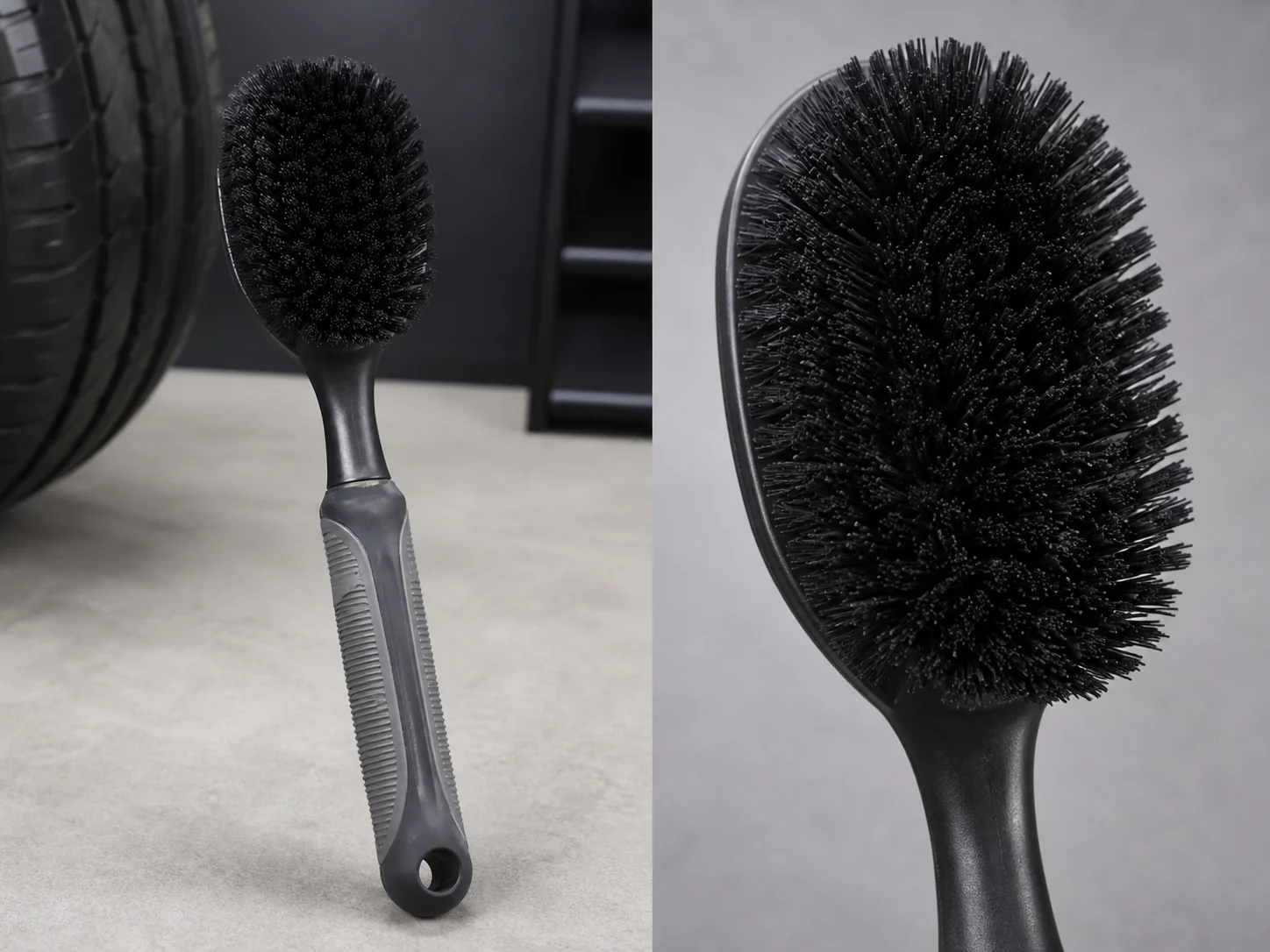
PA66 nylon tire cleaning brush with oval 160 mm head, stiff bristles for tread blocks, grooves and sidewalls. TPE-overmolded handle.
Small brush
500 pcs
Minimum order
Held in one hand: tube, bottle, detail and swab brushes — including long-handled ones with a small head.
Production lead time, once the specification is confirmed
- Up to 500 pcsWithin 7 days
- 501–50,000 pcsWithin 14 days
- Over 50,000 pcsWithin 21 days
Peak season can extend these times; the shipping date is confirmed in writing with your quotation. Sampling and shipping are quoted separately.
The PA66 Tire Cleaning Brush is a stiff nylon-bristle hand brush built for scrubbing tread blocks, grooves, sidewall shoulders and raised lettering on passenger, light-truck and commercial tires. The oval 65 × 160 mm head and TPE-overmolded polypropylene handle give controlled two-hand scrubbing on wet, chemical-covered rubber without cutting or scuffing the tire surface.
What can this brush do for you?
Stiff PA66 Filament Cuts Caked Mud and Old Dressing
PA66 nylon filament holds its stiffness when wet and recovers its shape after heavy flexing, so the tufts keep digging into packed mud, dried rubber bloom and oxidized tire dressing instead of flattening after a few strokes. Nylon is also tolerant of the diluted alkaline and solvent-based tire cleaners used in wash bays, which lets the brush stay in service where detergents and degreasers are in constant use.
Oval 65 × 160 mm Head Follows the Sidewall Curve
The oval profile removes hard corners that catch on raised lettering, rim protection ribs and tread shoulders. The long 160 mm axis sweeps a wide band on the sidewall with each stroke, while the 65 mm width drops into circumferential grooves and clears between tread blocks. Operators spend fewer strokes per tire and get more consistent coverage.
Molded TPE Grip Stays Controllable With Wet, Soapy Hands
The TPE/TPR overmold on the polypropylene core gives a non-slip grip surface when the handle is wet with tire cleaner, foam or water. The 35 mm grip diameter and 220 mm handle length keep the operator’s hand behind the splash zone while still providing enough reach to scrub the lower sidewall without stooping.
Fixed Head Removes Wobble and Tuft Shedding at the Connection
Tuft bundles are locked into the polypropylene head block in a fixed connection, so there is no threaded or snap joint to loosen under hard scrubbing. The fixed build keeps the brush square to the tire, reduces tuft pull-out and makes the brush safe for repeated two-hand pressure on commercial tire cleaning lines.
Fast Rinsing, Fast Drying, Low Water Retention
PA66 filament absorbs very little water and does not pack debris into its own fibers. A quick rinse removes soap, mud and rubber particles, and the brush dries quickly between uses. In high-volume detailing and fleet wash operations, the brush does not stay heavy and wet from vehicle to vehicle.
What is a PA66 Tire Cleaning Brush?
The PA66 Tire Cleaning Brush is a hand-guided scrubbing brush used in tire washing, detailing prep and fleet cleaning workflows to remove road film, mud, rubber bloom and used tire dressing from tire rubber. It is normally used with a spray-on tire cleaner or degreaser: the operator wets the tire, scrubs the tread, grooves, sidewall and lettering with back-and-forth or circular strokes, then rinses the loosened residue away. The brush’s job is to provide mechanical agitation for films that a pressure washer or foam alone will not lift.
PA66, a nylon 6.6 polymer, is the working material because it combines stiffness, flex recovery and wear resistance with practical chemical tolerance to the diluted cleaners used in tire care. It is significantly more rigid than polyester or polypropylene filament, so it cleans deeper into tread lugs and around lettering, but it is not a wire brush: it removes surface contamination without tearing or scuffing cured tire rubber.
The handle is a polypropylene core overmolded with TPE/TPR. The PP core keeps the handle rigid and dimensionally stable in wet environments; the TPE layer provides grip. The head is fixed, not replaceable or swiveling, which keeps production cost and failure points low for high-frequency wash applications.
Technical Specifications
Listed values are the standard production configuration. Head dimensions, filament diameter, trim length, handle length and colors can be adjusted for volume projects.
| Parameter | Standard Configuration |
|---|---|
| Bristle material | PA66 nylon filament |
| Head shape | Oval |
| Head length | 160 mm |
| Head width | 65 mm |
| Bristle trim length | 25 mm standard; project range 18–32 mm |
| Filament diameter | 0.30–0.50 mm, selected by stiffness requirement |
| Tuft pattern | Evenly spaced rows; custom density available |
| Handle / base material | PP core with TPE/TPR overmold |
| Handle length | 220 mm |
| Grip diameter | 35 mm |
| Connection | Fixed, tufts anchored in PP head block |
| Overall length | Approximately 380 mm |
| Operating temperature | -20°C to 80°C continuous use |
| Chemical exposure | Compatible with common tire cleaners, mild soaps and diluted degreasers; avoid prolonged immersion in strong acids or concentrated oxidizers |
| Color / marking | Standard color with custom colors and marking available |
| Brush type | Custom Handheld Detail Brushes |
| How it is driven | Hand-guided |
| Cleaning target | automotive detailing bay, commercial tire and wheel cleaning line, and fleet wash operation cleaning |
| Surface or part | sidewalls, lettering, grooves, shoulders, roads, tread blocks, profiles, and rims |
| Residue or debris | mud, dressing, road film, rubber bloom, dried mud, clay, and surface contamination |
| Mounting / connection | Fixed, tufts anchored in PP head block |
Where does this brush work best?
- Automotive detailing bays: scrubbing sidewalls, raised white lettering and tire shoulders before applying dressing.
- Commercial tire and wheel cleaning lines: repeated use on passenger cars, SUVs and light trucks; the fixed head and stiff bristles withstand high-volume two-hand scrubbing.
- Fleet wash operations: mud-caked tires on delivery vans, buses and service trucks; the oval head helps clear packed mud from tread and lug areas when paired with a pressure washer.
- Off-road and motorsport cleanup: after mud or clay events, stiff PA66 tufts break down dried mud in deep tread lugs without damaging tread rubber.
- Tire dressing preparation: removal of old silicone or water-based dressing, rubber bloom and road film so new dressing bonds evenly.
How do I choose the right one?
Start with the residue and the tire surface. Light road film on frequent-maintenance vehicles needs less aggression than dried mud on an off-road or commercial tire. Stiffness is controlled primarily by filament diameter and trim length: longer trim reaches deeper into tread lugs, while shorter trim gives more controlled sidewall contact.
Check the cleaning chemical. PA66 is a good default for diluted tire cleaners and degreasers. For prolonged contact with strong acids, concentrated solvents or cleaning solutions above 80°C, request a different filament grade and confirm handle and overmold compatibility before committing.
Consider the handle and working position. The standard 220 mm handle with fixed head is designed for standing two-hand use on standard wheel diameters. For extended reach on lifted vehicles or tall commercial tires, a longer custom handle can be specified. For repetitive one-hand work, the grip diameter and overmold hardness can be adjusted.
| If this matches your operation | Recommended configuration |
|---|---|
| Light road film, frequent maintenance | 0.30–0.35 mm filament, 25 mm trim, standard oval head |
| Heavy mud, dried clay, off-road cleanup | 0.50 mm filament, 30–32 mm trim, same or larger head |
| Sidewall lettering and appearance-sensitive tires | 0.30 mm filament, 18–20 mm trim, optional flagged tips |
| High-volume commercial tire wash line | Fixed head, firmer TPE overmold, replaceable-head option if required |
This is a tire rubber brush. Use a separate softer brush for painted wheel faces, clear-coated rims or matte wheels. Use a wheel barrel brush for inner wheel barrels. Wire brushes are for metal scaling only, not tire rubber. If the residue is tar, heavy petroleum staining or deeply embedded contamination, apply the correct solvent or dedicated tire cleaner first; the brush provides agitation, not chemical replacement.
Can I customize this brush?
Most tire brush programs are customized because tire sizes, cleaning chemicals, operator working positions and packaging requirements vary. To define the right configuration, send us the tire types and sizes, the residue you regularly remove, the cleaning chemicals, the operator working position and any packaging or branding requirements. Photos or a drawing of your current brush help us match or improve the exact fit.
- Head geometry: head length, width, oval or rectangular profile, curved contour to match the sidewall, and bristle field shape.
- PA66 filament: diameter, trim length, tip finish such as cut, flagged or crimped, tuft hole pattern and density, color, and multi-zone stiffness for tread versus lettering.
- Handle and ergonomics: length, grip diameter, TPE hardness, surface texture, finger grooves, hanging hole, logo position, and PP or other core material if the chemical environment demands it.
- Connection: fixed is standard; a replaceable head or two-piece design can be developed for high-volume replacement programs.
- Color and marking: bristle color, handle color, pad printing, embossed logo, laser marking or private-label branding.
- Packaging: bulk cartons, individual polybag, header card, retail sleeve, boxed set with a wheel brush, or project-specific packing.
- Project support: material data sheets, chemical compatibility notes, pre-production samples, photo or video inspection, and third-party testing assistance according to your project requirements.
Which filament survives the cleaning and still lasts on a PA66 tire cleaning brush?
How can I tell if the PA66 bristles are the right stiffness before committing to a production run?
Ask for filament samples in two or three diameters and trim lengths. Test each sample on the same tire with your normal cleaner and scrub pressure. After the test, check whether the tufts spring back to upright and whether the residue clears in a reasonable number of strokes. If tufts stay bent or flattened, the configuration is too soft for your process; if the operator has to use excessive force, the filament is too stiff or the trim is too long.
Can this brush be used on the wheel rim while scrubbing the tire?
It is designed for tire rubber, not painted, clear-coated or polished wheel surfaces. Occasional contact with the rim is usually harmless, but stiff PA66 filament should not be used as the primary wheel-face brush. Keep a separate softer brush for the rim face and a wheel barrel brush for the barrel to avoid transferring embedded grit and to protect the wheel finish.
How do I know when a tire cleaning brush has reached end of life?
Replace the brush when you see persistent bristle splay, permanently bent or flattened tufts, melted or frayed filament ends, tuft loss, or cracks in the handle or overmold. A quick field check is to run your hand over the bristle face: if the tips no longer stand clear of each other or the brush feels mushy under normal pressure, cleaning time and chemical use will increase.
Does brushing remove all tire contamination, including tar and heavy petroleum stains?
No. The brush provides mechanical agitation for road film, mud, rubber bloom and old dressing, but it will not dissolve tar, heavy grease or deeply embedded petroleum residues. Use the correct solvent or dedicated tire cleaner first, allow the required dwell time, then scrub and rinse. Pressure washing alone also will not remove film that is adhered to the rubber; brushing is the agitation step between chemical action and rinsing.
What is the correct way to clean and store the brush between shifts?
Rinse the brush under clean water to remove soap and loosened debris, shake out excess water, and hang it by the handle or store it bristles-up. Do not soak it for extended periods in concentrated chemicals, and do not leave it in direct sunlight or near a heat source. Periodic inspection of the fixed head connection helps catch tuft loosening before it becomes tuft loss.
Guides that go deeper on this
Custom Manufacturing RFQ
Describe Your Application
Send the key measurements, cleaning requirement, residue, material direction, mounting method, quantity, and drawing or photo.
Drawing or photo optional — it speeds things up, it does not gate the enquiry.
Custom Brush RFQ
Send Your Brush Project
Upload a drawing, product photo, or sample photo and provide the core dimensions and cleaning conditions.
“We need a brush to remove wet residue from a stainless steel conveyor, about 800mm wide. The current brush wears quickly. We can send photos.”
“We sell drinkware and need a cleaning brush to include with the product. Quantity around 5,000 pieces.”