
Custom Cleaning Brush
PBT Wheel Rim Brush
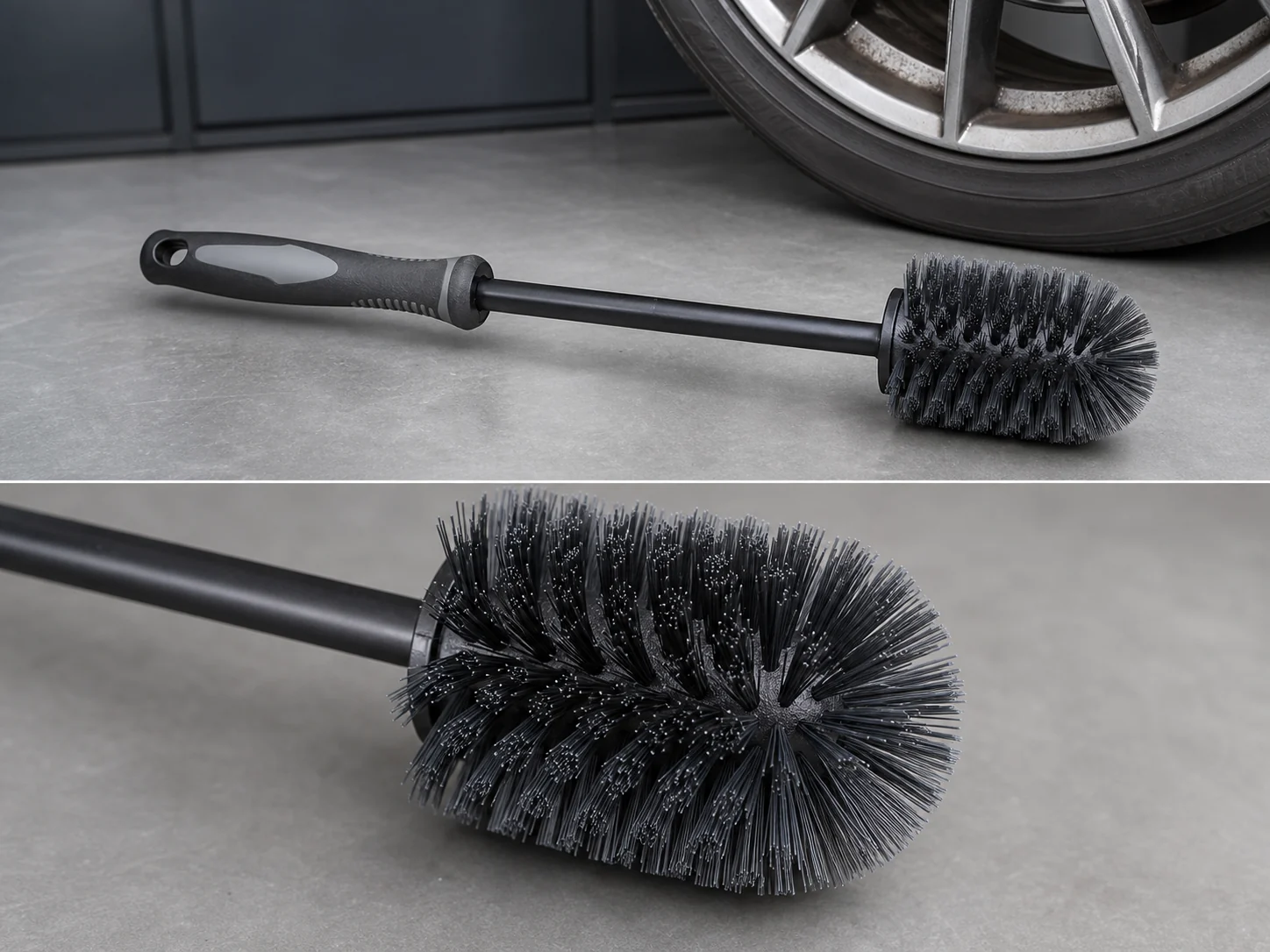
PBT wheel rim brush with 50 mm round head and 180 mm bristle length for cleaning brake dust, road film, and grime from wheel barrels and behind spokes.
Small brush
500 pcs
Minimum order
Held in one hand: tube, bottle, detail and swab brushes — including long-handled ones with a small head.
Production lead time, once the specification is confirmed
- Up to 500 pcsWithin 7 days
- 501–50,000 pcsWithin 14 days
- Over 50,000 pcsWithin 21 days
Peak season can extend these times; the shipping date is confirmed in writing with your quotation. Sampling and shipping are quoted separately.
This PBT wheel rim brush uses a 50 mm round head with 180 mm of dense PBT bristles to scrub brake dust, road film, and grime from wheel barrels, behind spokes, and around lug nut recesses. The fixed connection and 300 mm TPE-overmolded handle give operators the reach and control needed for safe, scratch-free wheel cleaning.
What can this brush do for you?
Reaches Into the Wheel Barrel and Behind Spokes
The 50 mm round head slides into the space between the rim and brake components, and the 180 mm bristle length follows the contour of the barrel as you push and pull. Instead of stopping at the face of the wheel like a flat brush, the cylindrical head rotates against the inner rim surface, lifting brake dust from areas a sponge or mitt can’t touch.
PBT Bristles Resist Wheel Cleaners and Brake Dust
PBT (polybutylene terephthalate) filaments do not absorb water or wheel cleaning chemicals, so they keep their stiffness and shape after repeated soaking in acidic or alkaline detergents. Brake dust is abrasive and often mixes with metal particles, but PBT resists breakage and matting far longer than natural fibers, which means the brush keeps its scrubbing pressure over many washes.
Stiff Enough to Remove Caked Deposits, Safe for Coated Wheels
The filament diameter and density are selected to break up dried brake dust, road film, and rubber bloom, but the rounded tips and medium-firm flex prevent the scratching that wire or aggressive nylon brushes cause on clear-coated, painted, chrome, and powder-coated wheels. The result is a clean barrel and spoke back without micro-marring the finish.
Cleans in Any Orientation Without Repositioning the Brush
Because bristles are set around the full circumference of the head, the brush scrubs whether you push straight in, pull back, or rotate the handle. There is no flat face to align, so operators can clean complex multi-spoke designs quickly and reach the back side of the rim without twisting the wrist.
Handle Keeps Hands Away From Chemicals and Hot Components
The 300 mm polypropylene handle with TPE overmold provides a secure grip and enough distance to keep knuckles clear of the wheel face, brake caliper, and cleaning solution. The 25 mm grip diameter fits comfortably in a gloved hand and reduces fatigue during repetitive wheel cleaning.
Fixed Head Stays Put During Hard Scrubbing
The brush head is permanently connected to the handle, so there are no loose couplings to back off or snap during aggressive use. The one-piece build survives the torque and side pressure of deep barrel scrubbing and simplifies tool management for detailing teams and fleet wash bays.
What is a PBT Wheel Rim Brush?
A PBT Wheel Rim Brush is a hand-guided cleaning tool built around a round, bristled head that is inserted into the wheel barrel and worked back and forth against the inner rim. The PBT filaments, which are set radially around the head, scrub off brake dust, road film, grease, and other deposits that settle on the surfaces behind the spokes and between the rim and the brake components.
The brush consists of three main parts: a cylindrical brush head with a 50 mm outer diameter and 180 mm of working length, a 300 mm handle made from a polypropylene core with a TPE/TPR overmold, and a fixed connection between the two. The handle provides the reach and leverage needed to apply pressure inside the wheel, while the round head maintains contact with the curved barrel surface as the operator pushes, pulls, and rotates the brush.
This is a regular-maintenance tool for wheels that are washed frequently. It is not designed to replace chemical stripping or to grind away heavy rust, nor should it be used on extremely soft, uncoated aluminum finishes without testing. Its role is consistent, scratch-safe removal of the deposits that build up between washes.
Technical Specifications
The following are the standard dimensions and materials for the PBT Wheel Rim Brush. All values can be adjusted to match your wheel dimensions and application.
| Parameter | Specification |
|---|---|
| Head diameter | 50 mm (round, bristle tip-to-tip) |
| Head length | 180 mm (working bristle area) |
| Head shape | Round / cylindrical with 360° bristle coverage |
| Bristle material | PBT (polybutylene terephthalate) |
| Bristle diameter | 0.3–0.5 mm (project-selected for stiffness and finish safety) |
| Bristle trim | Level; spiral or flagged options available |
| Handle material | Polypropylene (PP) core with TPE/TPR overmold |
| Handle length | 300 mm (from grip end to head base) |
| Grip diameter | 25 mm (ergonomic, glove-friendly) |
| Connection | Fixed, integrally molded (no swivel or replaceable head) |
| Overall reach (grip to head tip) | Approximately 480 mm |
| Operating conditions | Water-based detergents, wheel cleaners, ambient temperature; not for continuous high-temperature or solvent-immersion use |
| Color / marking | Customizable (see customization section) |
| Brush type | Custom Handheld Detail Brushes |
| How it is driven | Hand-guided |
| Cleaning target | detailing shop and car washes cleaning alloy, fleet maintenance and rental car operation, and auto dealership prep bay cleaning |
| Surface or part | spokes, rims, roads, recesses, grilles, gaps, metal, and aluminum |
| Residue or debris | brake dust, road film, rust, metal particles, and grease |
| Mounting / connection | Fixed, integrally molded (no swivel or replaceable head) |
The 50 mm head diameter fits most passenger car and light truck wheels with a spoke gap of at least 45–50 mm. For tighter or larger wheels, head diameter and length can be modified.
Where does this brush work best?
- Detailing shops and car washes cleaning alloy wheels where brake dust accumulates inside the barrel and behind spokes.
- Fleet maintenance and rental car operations that need a durable, chemical-resistant brush for high-volume wheel cleaning.
- Auto dealership prep bays where wheels must be cleaned without introducing swirl marks or scratches.
- Mobile detailers working on multiple wheel designs; the round head adapts to different spoke patterns.
- Motorcycle and powersport wheels with narrow spokes and tight barrels (with custom dimensions if needed).
- Similar cylindrical or recessed areas: wheel wells, suspension components, and grille openings where a round brush can reach what flat brushes miss.
How do I choose the right one?
The standard PBT Wheel Rim Brush is configured for passenger car wheels, but the correct choice depends on four factors: minimum spoke clearance, barrel depth, surface finish, and the cleaning chemicals used.
Measure the narrowest gap
The 50 mm head must pass through the opening between spokes or between rim and caliper without jamming. Measure the smallest gap and order a head diameter at least 3–5 mm smaller than that clearance. If your fleet includes wheels with tighter spokes, choose a smaller head diameter.
Match bristle stiffness to the finish and residue
Standard PBT is medium-firm, suitable for clear-coated, painted, chrome, and powder-coated wheels with normal brake dust. If you clean soft custom finishes or high-gloss black rims that show micro-scratches, request flagged PBT or a softer material. If the wheels have extremely heavy, baked-on deposits from track use or winter salt, a slightly stiffer filament may help, but test first to avoid marring.
Check handle length and grip
The 300 mm handle is comfortable for most users and provides enough clearance from the wheel face. For deep-dish wheels or operators who prefer more standoff, the handle can be extended. The 25 mm grip diameter is designed for gloved hands; let us know if your operators wear thick chemical gloves.
Verify chemical compatibility
PBT resists most commercial wheel cleaners, including acidic iron removers and alkaline degreasers at normal dilution. However, prolonged soaking in strong oxidizing acids or solvents above ambient temperature can degrade any polymer filament. Specify your cleaning chemical and contact time so we can confirm suitability.
When another brush type is better
If you need to remove heavy rust scale or welded-on metal particles, use a stainless steel wire brush instead. If the wheel has extremely narrow spokes (gap under 25 mm), a small-diameter tube brush or a specialty spoke brush will fit better. If the job requires single-use or lint-free contact (e.g., paint prep), a disposable foam or microfiber applicator may be more appropriate.
Can I customize this brush?
Yes. The PBT Wheel Rim Brush can be tailored to your wheel sizes, chemical environment, and operator preferences. To define a custom build, provide the following information: minimum spoke gap or barrel clearance, barrel depth, rim material and finish, wheel cleaner type, and handle length preference. A photo or drawing of the wheel helps us confirm the head geometry.
Head geometry
Diameter (typically 30–70 mm), length (100–250 mm), round or tapered profile, bristle trim (level, spiral, flagged), and bristle density.
Bristle material and stiffness
PBT standard, but alternative filaments (nylon, PP, PET, horsehair) available if surface requirements change; filament diameter adjustable from soft to firm.
Handle
Length, grip diameter, overmold material and hardness, end hook/hanging feature, color.
Core and connection
PP core standard; other engineering resins possible; fixed connection standard, but threaded or replaceable head designs can be produced for high-volume programs.
Color, branding, and packaging
Custom bristle color, handle color, pad printing, laser marking, or molded logo. Bulk cartons, individual polybags, retail hang tags, or white-label retail packaging.
Project support
If you need material documentation, third-party testing for chemical resistance, or inspection reports, we can assist as part of the customization process.
Which filament survives the cleaning and still lasts on a PBT wheel rim brush?
How do I check whether the 50 mm head will fit my wheels?
Measure the narrowest opening the head must pass through — usually the gap between adjacent spokes or between the rim and brake caliper. The head diameter should be at least 3–5 mm smaller than that gap. If the opening is smaller than about 45 mm, request a custom head diameter.
Will the PBT bristles scratch my wheel finish?
PBT is medium-firm and generally safe for clear-coated, painted, chrome, and powder-coated wheels when used with normal pressure and a suitable wheel cleaner. However, any aggressive scrubbing with a dirty or contaminated brush can cause micro-marring. For high-gloss or soft finishes, we recommend flagged PBT bristles or a softer natural fiber. Always test on an inconspicuous area first.
How should I clean and store the wheel rim brush between uses?
Rinse the head thoroughly with water to remove loosened brake dust and chemical residue. Flex the bristles with your fingers or a comb to dislodge trapped particles, then hang the brush by the handle end to dry. Do not store the brush with weight resting on the bristles, and keep it away from strong solvents and direct sunlight for long periods.
Can I use this brush on motorcycle wheels or truck wheels?
Yes, but the standard 50 mm head and 180 mm length are sized for passenger car wheels. Motorcycle wheels often have narrower spoke gaps and shallow barrels, so a smaller head diameter may be needed. Truck wheels usually require a longer head and possibly a longer handle. Specify your wheel dimensions when ordering so we can adjust the geometry.
How do I know when the brush needs to be replaced?
Inspect the bristles regularly for splaying, permanent bending, or missing filaments. If the head no longer presses firmly against the barrel surface, or if the handle shows cracks or the overmold is peeling, replace the brush. PBT bristles resist water absorption and matting, but they will eventually wear from abrasion against the rim and brake dust.
Does using this brush replace chemical wheel cleaning?
No. The brush is designed to agitate and lift deposits after a wheel cleaner has been applied, but it does not dissolve iron particles or brake dust on its own. For heavily contaminated wheels, apply an appropriate wheel cleaner, allow the recommended dwell time, then use the brush to agitate the surface before rinsing. The brush is a mechanical step in the cleaning process, not a chemical replacement.
Guides that go deeper on this
Custom Manufacturing RFQ
Describe Your Application
Please share the brush dimensions, working area, residue type, material direction, quantity, and a drawing or photo for quotation.
Drawing or photo optional — it speeds things up, it does not gate the enquiry.
Custom Brush RFQ
Send Your Brush Project
Upload a drawing, product photo, or sample photo and provide the core dimensions and cleaning conditions.
“We need a brush to remove wet residue from a stainless steel conveyor, about 800mm wide. The current brush wears quickly. We can send photos.”
“We sell drinkware and need a cleaning brush to include with the product. Quantity around 5,000 pieces.”