
Custom Cleaning Brush
Synthetic Wool Wheel Cleaning Brush
Dense synthetic wool on a flexible twisted-wire core: the head compresses between spokes and into rim barrels without gouging painted finishes.
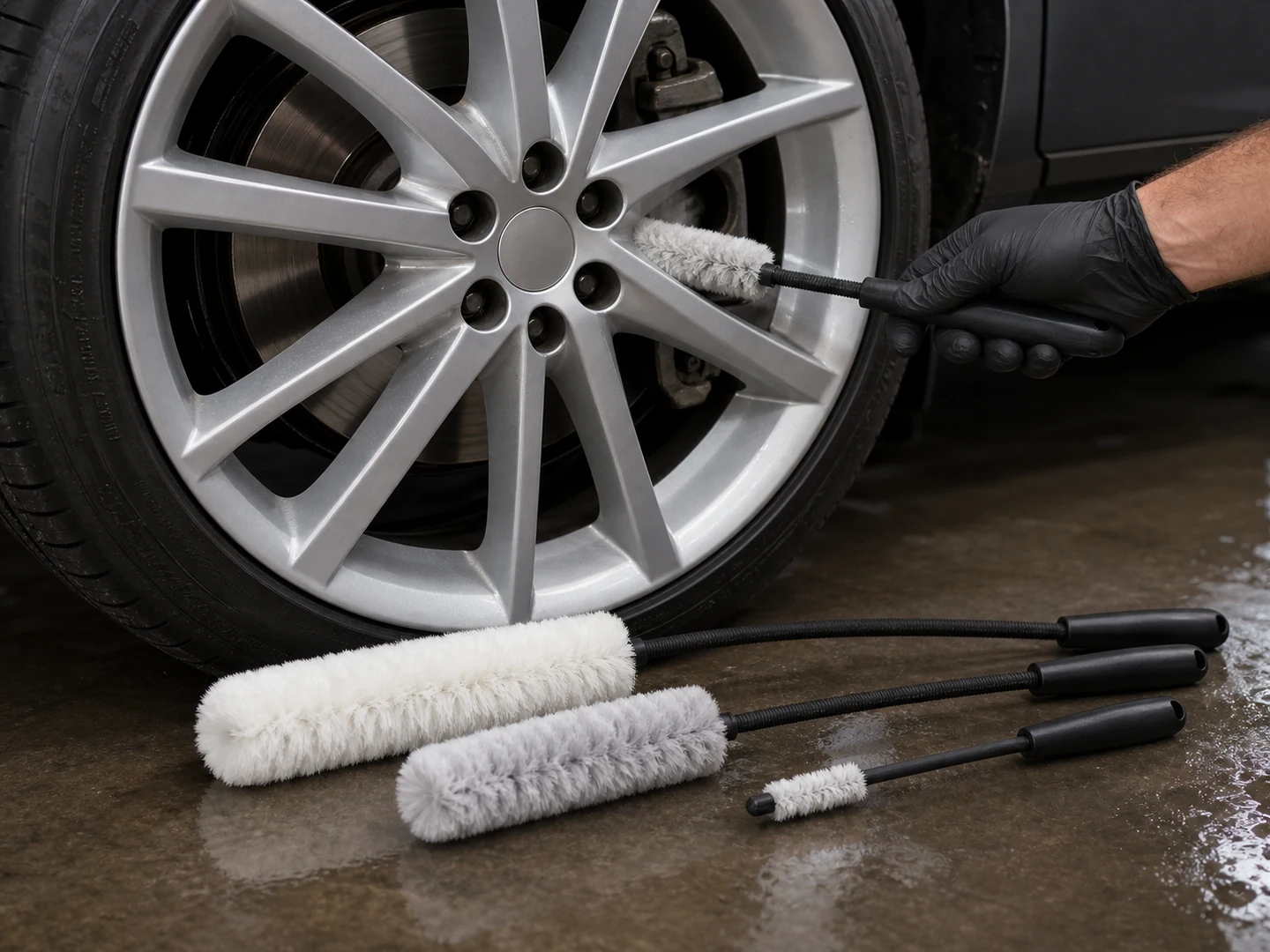
Small brush
500 pcs
Minimum order
Held in one hand: tube, bottle, detail and swab brushes — including long-handled ones with a small head.
Production lead time, once the specification is confirmed
- Up to 500 pcsWithin 7 days
- 501–50,000 pcsWithin 14 days
- Over 50,000 pcsWithin 21 days
Peak season can extend these times; the shipping date is confirmed in writing with your quotation. Sampling and shipping are quoted separately.
A hand-guided detailing brush with a dense fill of synthetic wool (microfiber) around a flexible twisted-wire core, built for cleaning wheel rims, spokes, barrels, tires, and chain-and-sprocket areas where fine dust and road film collect. The soft, conforming filament tips scrub tightly around contours without gouging painted, coated, or polished surfaces.
What can this brush do for you?
Reaches behind spokes and into rim barrels
The rounded synthetic wool head compresses into gaps between spokes and slips into the inner barrel where flat brushes and sponges cannot follow. The flexible core bends along the barrel curvature, so contact continues from the rim lip to the deepest part of the wheel.
Lifts brake dust and road film without scratching coatings
Synthetic wool filaments are fine, rounded, and non-abrasive. When used with a light deflection of about 1–5 mm on painted or clear-coated surfaces, the brush removes fine brake dust, road film, and water spots by agitation rather than abrasion. Powder coat, anodized, and polished finishes keep their appearance.
Cleans tires, sidewalls, and chain links with the same tool
The dense fill works on rubber tread and sidewalls, lifting mud, rubber bloom, and embedded road grime. On motorcycle or bicycle chains and sprockets, the fibers slip between rollers and teeth to carry degreaser into the contact areas and flush out grit.
Works wet or dry with common detailing chemicals
Synthetic wool tolerates water-based wheel cleaners, car wash soaps, and degreasers. Use it with a bucket, pump sprayer, or foam cannon. The fibers release trapped particles when rinsed, so the brush stays effective through multiple wheels in the same session.
Washable and reusable across vehicles
Synthetic wool does not absorb water or hold detergent the way natural wool does. A quick rinse removes brake dust and debris from the fill, the brush air-dries quickly, and the fibers recover their loft for the next job.
What is a Synthetic Wool Wheel Cleaning Brush?
A Synthetic Wool Wheel Cleaning Brush is a hand-guided detailing tool that uses synthetic wool — typically polyester or nylon microfiber with a wool-like texture — twisted into a galvanized or stainless steel wire core. The handle extends reach, while the fill flares radially from the core to scrub the inner surfaces of wheels, rims, tires, and chain drives.
During use, the operator wets the brush with cleaner, inserts the head into the wheel area, and moves it with push-pull and rotating strokes. The filament ends do the cleaning; the twisted wire core provides flex so the brush follows curved barrels and irregular spoke shapes instead of skipping over them.
This is a detail-cleaning brush for fine residue removal. It is not a wire brush, not an abrasive cup brush, and not a tool for removing heavy rust, scale, or baked-on carbon. The right configuration depends on the narrowest access gap, the barrel depth, the finish you need to protect, and the residue you need to remove.
Technical Specifications
The dimensions below are production base ranges for the standard wheel-cleaning configuration. All values can be adjusted to your wheel profile, access gap, and cleaning process.
| Parameter | Value / Options |
|---|---|
| Overall length | 300–500 mm, matched to deepest barrel reach and operator preference |
| Head diameter | 40–100 mm, selected to pass between spokes and contact the barrel |
| Working length | 120–300 mm, the fill section that scrubs the surface |
| Filament diameter | 0.10–0.40 mm — finer for painted surfaces, thicker for tires and chains |
| Core diameter | 3–10 mm, controls flexibility of the twisted-wire stem |
| Handle diameter | 20–35 mm, with optional overmold or textured grip |
| Fill material | Synthetic wool — polyester, nylon, or microfiber blend |
| Core material | Galvanized steel wire or stainless steel, project-selectable |
| Handle material | Plastic, rubber-overmold, or project-specified |
| Contact deflection | 1–5 mm on painted/coated surfaces; 3–10 mm on tires, chains, textured plastics |
| Brush type | Custom Handheld Detail Brushes |
| How it is driven | Hand-guided |
| Cleaning target | alloy and painted wheel rim, tire and sidewall, and motorcycle and bicycle chain cleaning |
| Surface or part | spokes, rims, gaps, roads, chains, sidewalls, tread blocks, and wheel arches |
| Residue or debris | road film, dust, road grime, rubber bloom, fine dust, mud, particles, and fine particles |
| Mounting / connection | Fixed |
The deflection values are operating guidance, not product limits. They keep the filament tips working on the surface without over-bending the fill or creating excessive pressure on delicate finishes.
Where does this brush work best?
- Alloy and painted wheel rims, including multi-spoke, split-spoke, mesh, and directional designs, where the inner barrel, spoke back surfaces, rim lip, and lug nut recesses must be cleaned without scratching.
- Tires and sidewalls, removing rubber bloom, mud, and road grime from tread blocks and lettering.
- Motorcycle and bicycle chains, sprockets, and cassettes, cleaning links and teeth when paired with degreaser.
- Wheel arches, fender liners, and body gaps behind tires where fine particles and film accumulate.
- Cooled brake calipers, suspension arms, and visible components around the wheel area that require soft scrubbing.
How do I choose the right one?
Start from the wheel you need to clean, not from the brush catalog. The most important choices are fit, filament behavior, core flexibility, and handle reach.
Measure the narrowest access gap first
Find the smallest opening the brush must pass through — usually the gap between a spoke and the barrel or between two spokes. The head diameter should be slightly smaller than that gap, or compress into it without forcing. Too large, and the brush will jam or pop out; too small, and it will not contact the barrel surface effectively.
Match filament length and diameter to the finish
Long, fine filaments (0.10–0.20 mm) are the safe choice for painted, clear-coated, and polished wheels. Shorter, thicker filaments (0.25–0.40 mm) apply more scrubbing force and are better for tires, textured plastics, and chain drives. Use the lower end of the deflection range on delicate finishes.
Choose core flexibility for the barrel profile
A flexible twisted-wire core follows the curved inner barrel and lets the head work around spoke intersections. A stiffer or larger-diameter core gives more direct pressure on flat faces or heavy deposits but may not conform to deep dish profiles. Tell us whether the wheel is flat, concave, or deeply dished.
Set the handle reach and grip
The overall length must let the operator reach the back of the barrel without placing hands inside the wheel well. Handle diameter should suit gloved hands. Longer handles increase leverage but reduce control in close gaps; balance reach against maneuverability.
Consider the cleaning chemistry
Synthetic wool withstands most water-based wheel cleaners, degreasers, and shampoos. If your process uses acid, strong alkaline, or solvent-based products, specify the exact chemical family and concentration so we can choose compatible filament and core materials. Even small amounts of solvent can degrade certain synthetic fibers over time.
When to use a different brush
Use a wire, steel-wire, or abrasive brush when the wheel has heavy rust, scale, or baked-on carbon that soft filaments cannot remove. Use a narrow detail swab or boar-hair brush for crevices under 10 mm. Use a heat-resistant brush if the wheel or brake area is hot. Synthetic wool is the right choice when you need fine residue removal without marking the finish — not when you need aggressive metal removal.
| Cleaning scenario | Recommended configuration |
|---|---|
| Painted or clear-coated multi-spoke wheel | 40–60 mm head, 0.10–0.20 mm filament, flexible core, long handle |
| Tires and sidewalls | 60–100 mm head, 0.25–0.40 mm filament, stiffer core, shorter working length |
| Motorcycle/bicycle chain and sprocket | 40–50 mm narrow head, mid-length filament, overall length under 400 mm |
| Deep concave barrel behind caliper | Small head fitted to caliper clearance, 200–300 mm working length, flexible core |
Can I customize this brush?
Yes. Synthetic wool wheel cleaning brushes are built around the wheel geometry and the cleaning process, so nearly every dimension and material can be adjusted. To define the configuration, provide the wheel model or a photo, the narrowest gap dimension, barrel depth, finish type, residue to remove, cleaning chemical, and preferred handle style.
We can adjust:
- Head geometry — diameter, working length, fill density, rounded or tapered profile
- Filament — diameter, polyester/nylon/microfiber blend, color, cut style, flagged tips
- Core — diameter, galvanized or stainless steel wire, flexibility level, twisted or single-stem construction
- Handle — length, shape, grip material, hanging feature, overmold or logo branding
- Marking and packaging — custom color coding, pad print, laser mark, bulk, individual bag, or retail-ready pack
If your project requires documentation, material declarations, inspection, or third-party testing support, we can assist with those requirements during the customization process.
What size should a synthetic wool wheel cleaning brush be, and how long does it last?
How do I check whether this brush will fit between the spokes of my wheel?
Measure the narrowest gap between a spoke and the barrel or between two spokes at the point where the brush must pass. The brush head should be about 5–10% smaller than that gap, or it should compress through without jamming. If the head pops out or binds, use a smaller diameter or a narrow-profile variant.
Will synthetic wool scratch polished or clear-coated wheels?
Synthetic wool filaments themselves are non-abrasive. Scratches on wheel finishes almost always come from abrasive particles already on the wheel or trapped in the brush. Use a clean brush on painted surfaces, rinse the head between wheels, and keep contact deflection in the 1–5 mm range. Pre-rinse heavily soiled wheels before brushing.
Can I use this brush with acid-based wheel cleaners or strong degreasers?
Synthetic wool is compatible with most water-based wheel cleaners, degreasers, and car wash soaps. Strong acids, high-alkaline cleaners, or solvent-based products can degrade the fiber and attack the core. Specify the exact chemical family and concentration to us, and we will select compatible filament and core materials for your process.
How do I clean and maintain the brush between vehicles?
Rinse the head under running water after each wheel, working your fingers through the fill to release trapped brake dust and grit. For heavier contamination, soak in a mild detergent solution and rinse. Hang to dry. Replace the brush if the fill mats permanently, filaments pull out, or the core shows corrosion or a permanent bend.
Can this brush reach the inner barrel behind the brake caliper?
It depends on the clearance between the caliper and the barrel while the wheel is stationary. The head must pass through that gap. If clearance is less than about 10 mm, choose a narrower head or a barrel brush with a slimmer profile. Measure the gap before ordering.
Does this brush replace a wire brush for wheel cleaning?
No. Synthetic wool is for fine residue removal and surface-safe scrubbing. Heavy rust, scale, or baked-on deposits need a wire or abrasive brush, which will typically mark wheel finishes. Use synthetic wool first, and escalate to a more aggressive tool only when necessary.
Guides that go deeper on this
Custom Manufacturing RFQ
Describe Your Application
For a custom quote, we need the key dimensions, surface or part, residue, material preference, quantity, and reference image or drawing.
Drawing or photo optional — it speeds things up, it does not gate the enquiry.
Custom Brush RFQ
Send Your Brush Project
Upload a drawing, product photo, or sample photo and provide the core dimensions and cleaning conditions.
“We need a brush to remove wet residue from a stainless steel conveyor, about 800mm wide. The current brush wears quickly. We can send photos.”
“We sell drinkware and need a cleaning brush to include with the product. Quantity around 5,000 pieces.”