
Custom Cleaning Brush
Rubber Mold Cleaning Brush
Rubber Mold Cleaning Brush for mold maintenance: clean release agent, vulcanized flash, carbon, and oils from cavities, vent grooves, and parting lines.
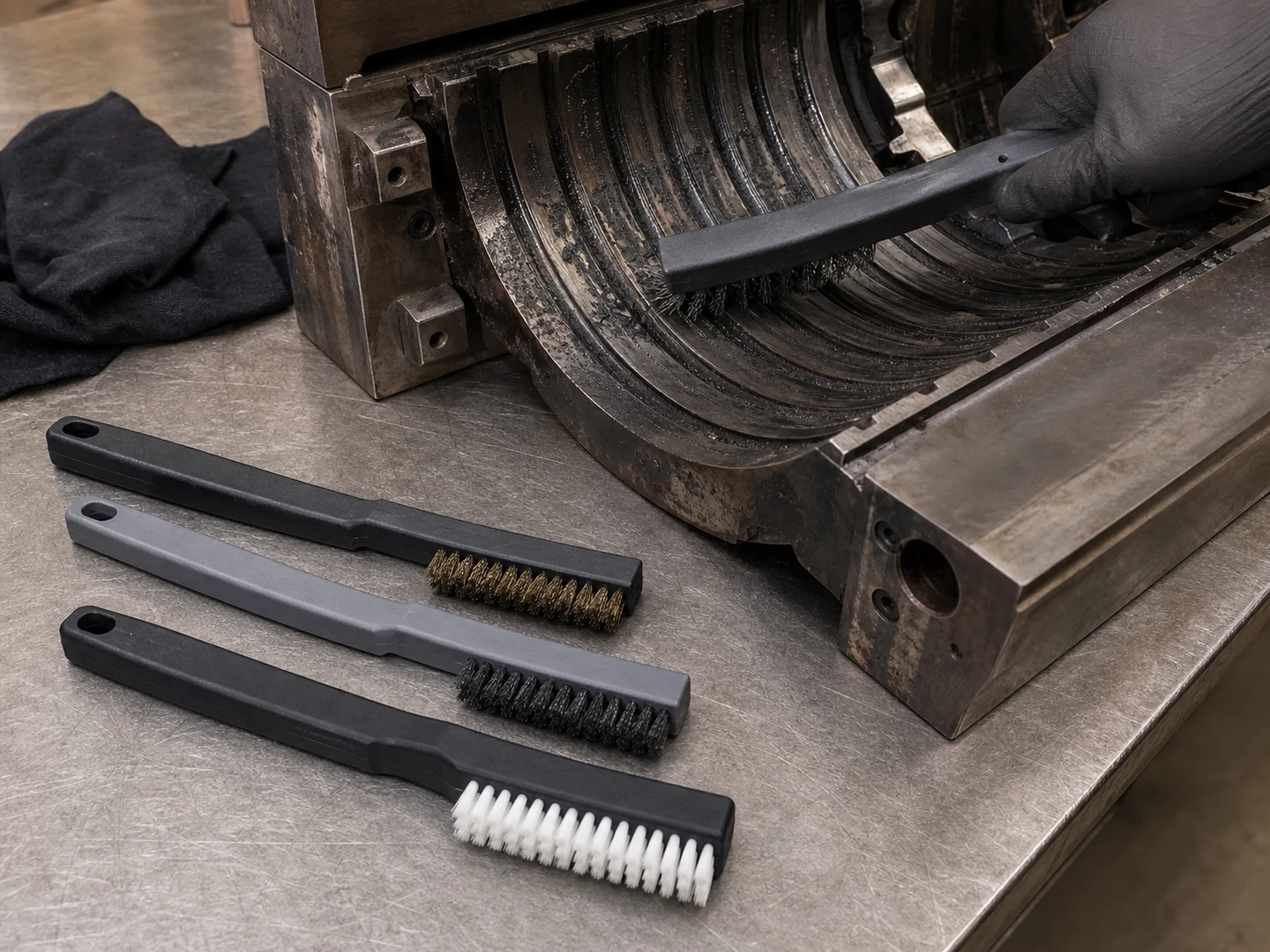
Small brush
500 pcs
Minimum order
Held in one hand: tube, bottle, detail and swab brushes — including long-handled ones with a small head.
Production lead time, once the specification is confirmed
- Up to 500 pcsWithin 7 days
- 501–50,000 pcsWithin 14 days
- Over 50,000 pcsWithin 21 days
Peak season can extend these times; the shipping date is confirmed in writing with your quotation. Sampling and shipping are quoted separately.
Rubber Mold Cleaning Brush is a maintenance brush for reaching into mold cavities, vent grooves, parting lines, and textured tool faces on rubber and elastomer molding tooling. Configurable filament options—SiC abrasive nylon, brass wire, nylon PA, and stainless steel wire—remove release agents, vulcanized flash, carbon, oxide, oils, and chips while matching the level of aggression to the surface being cleaned.
What can this brush do for you?
Reach Vent Grooves, Cavity Bottoms, and Parting-Line Seams
The head profile can follow the narrow vent slots, undercut angles, and cavity openings that generic stubs cannot enter. A slim profiled head with a controlled trim length puts filament where release agent and cured rubber actually collect, so operators spend less time digging with picks, modified screwdrivers, and improvised tools.
Cover the Whole Mold Maintenance Cycle With One Brush Family
Nylon PA handles routine wipe-down after demolding. Brass wire removes cured rubber flash and medium deposits from parting lines and pins. SiC abrasive nylon attacks release-agent build-up and carbon on textured faces. Stainless steel wire is reserved for carbonized or baked-on residue on hardened tool steel. Keeping the head profile constant while changing filament gives maintenance teams a predictable tool set across the cycle.
Clean Without Cutting Into Polished Cavity Steel
Brass wire and nylon are softer than tool steel, so they remove surface deposits without digging into the cavity face. This reduces repolishing between maintenance intervals and keeps fine textures from being rounded off during routine cleaning. SiC abrasive nylon and stainless steel are kept for hardened or non-cosmetic surfaces that can accept more mechanical action.
Use Non-Sparking Brass Where Solvents Are Present
Brass wire is non-sparking against tool steel, which lowers ignition risk when cleaning molds that still carry solvent-based mold cleaners or release-agent residue. If your wipe-down procedure uses flammable cleaners, brass gives a mechanical cleaning option that does not introduce steel-on-steel sparking.
Keep Hands Out of the Press Window
Long handles, angled shanks, and rubber-overmolded grips let operators clean deep cavities and parting faces without placing hands between mold halves or behind moving components. The grip stays controllable even when the operator is wearing gloves or working around oily release agent.
What is a Rubber Mold Cleaning Brush?
A Rubber Mold Cleaning Brush is a hand-guided mold maintenance tool built around a narrow profiled brush head mounted on a handle or reinforced shaft. The head is filled with dense filament selected for the deposits the mold actually accumulates—release agent, cured rubber flash, carbon, oxide, dust, and light oil—and for the finish of the tooling it contacts.
In a rubber molding cell, this brush is used after demolding and during preventive maintenance. Operators work the head along the cavity face, around core pins and ejector pins, through vent grooves, and across the parting line to loosen and remove material before the next shot or before the mold enters storage. Its main contribution is keeping vents open, preventing residue from hardening, and reducing the need for metal scrapers on precision tool steel.
It is a mechanical removal step, not a chemical cleaner. The brush performs best on accessible surfaces with light to moderate deposits. Heavy carbonization, rust, or deeply embedded contamination may require chemical, ultrasonic, dry-ice, or media cleaning first. Operating temperature and solvent exposure also matter, because nylon filament and rubber grips have heat limits that brass or stainless wire do not.
Technical Specifications
| Parameter | Standard / Selectable Range |
|---|---|
| Overall length | 150–400 mm, matched to cavity depth, operator reach, and press opening |
| Head width | 5–30 mm, sized to the vent groove, cavity mouth, or parting-line clearance |
| Trim length | 10–25 mm; shorter for heavy deposits, longer for flexible reach into deep cavities |
| Filament material | Nylon PA 6/6, SiC-impregnated abrasive nylon, brass wire, stainless steel wire |
| Filament diameter | Nylon: 0.10–0.50 mm; brass wire: 0.10–0.30 mm; stainless steel wire: 0.15–0.35 mm |
| Head profile | Straight, angled, curved, pencil point, single spiral, double spiral, or cavity-specific custom form |
| Handle / stem | Fixed wooden or plastic handle, metal shaft, rubber-overmolded grip, or reinforced long-reach handle |
| Interface | Fixed head or replaceable head with threaded, set-screw, crimped, or ferruled connection |
| Operating temperature | Nylon system: up to approximately 120°C; brass/stainless wire: higher when handle and stem permit; specify cleaning temperature |
| Chemical exposure | Filament and handle selected for release agents, mineral spirits, mold cleaners, alkaline or solvent-based cleaners |
| Fill configuration | Standard, dense, sparse, or patterned fill to match residue type and access space |
| Brush type | Custom Handheld Detail Brushes |
| How it is driven | Hand-guided |
| Cleaning target | compression and injection rubber mold, vent groove and gas vent slot, and parting line and shut-off face cleaning |
| Surface or part | molds, cavities, vents, grooves, parting lines, pins, tooling, and metal |
| Residue or debris | mold, release agent, oil, carbon, chips, dust, oxide, and rust |
| Mounting / connection | Fixed head or replaceable head with threaded, set-screw, crimped, or ferruled connection |
These are starting build windows. Final dimensions, filament selection, and interface are fixed to the mold dimensions and residue you are cleaning.
Where does this brush work best?
- Compression and injection rubber molds for O-rings, gaskets, seals, diaphragms, grommets, and technical elastomer parts, where residue collects in narrow ring-shaped cavities.
- Vent grooves and gas vent slots that clog with cured rubber and release agent, causing air traps or short shots.
- Parting lines and shut-off faces where flash and release residue build up along the mold edge.
- Ejector pins, core pins, slides, lifters, and other moving mold components carrying rubber film.
- Textured cavity faces and grip surfaces where molded detail must be cleaned without polishing away the grain.
- Loading fixtures, tool jaws, guide rails, and platen areas in rubber molding cells that collect dust, oil, chips, and rubber crumbs.
- Pre-storage mold preparation, when release agent and residue must be removed before applying rust preventive.
How do I choose the right one?
Start by mapping the access points on your mold. The smallest opening the head must enter controls the width, and the deepest feature controls the trim length and reach.
1. Size the head to the smallest opening it must enter
Measure vent width, groove depth, cavity mouth, and any undercut angle. The head should enter without binding and still put filament on the surface being cleaned. A head wider than the vent will force the filament sideways and lose contact. A trim length shorter than the cavity depth will leave residue in the bottom.
2. Match the filament to the deposit and the mold finish
| Residue and surface condition | Recommended filament | Why / caution |
|---|---|---|
| Light oil, dust, release film on polished or textured steel | Nylon PA | Softest option for routine wipe-down without scratching |
| Cured rubber flash, medium deposits | Brass wire | Low scratch risk and non-sparking; monitor for surface wear on soft molds |
| Release-agent build-up, carbon on textured faces | SiC abrasive nylon | Aggressive enough for stuck film; may dull fine texture, so test on a non-critical area first |
| Carbonized, baked-on residue on hardened tool steel | Stainless steel wire | For heavy residue only; not for aluminum, plated, polished, or fine-textured surfaces |
For polished cosmetic cavities, stay with nylon or soft brass. Move to SiC nylon or stainless steel only when the surface and deposit justify the added abrasion, and always test on a non-critical area of the same finish.
3. Choose the handle and reach that keeps the operator safe
Deep cavities need longer reinforced handles or metal shafts. Angled or curved heads reach undercuts and sidewall features without forcing awkward hand positions. A rubber-overmolded grip improves control when release agent or oil is on the operator’s gloves. High-volume maintenance may justify replaceable heads so the handle and shaft are reused while only the worn fill is replaced.
4. Confirm the cleaning environment
If the mold will be cleaned while warm above about 120°C, nylon filament and rubber grips are not suitable; select brass or stainless wire with a high-temperature handle or clean the mold cooled. If flammable solvents are part of the wipe-down procedure, brass wire is the safer mechanical option. If the tool will contact multiple rubber compounds, consider color-coded handles to reduce cross-contamination.
When brushing is not the right first move: severe carbonization, blind holes, or micro-textured cavities may call for chemical stripping, ultrasonic cleaning, dry-ice blasting, or media blasting before finish brushing. Large sections of attached flash should be lifted with a brass or copper scraper first, then the brush removes the loosened material.
Can I customize this brush?
Yes. Rubber mold cleaning brushes are built around the mold geometry, not around a fixed catalog size. We can adjust the head, filament, handle, and packaging to match your maintenance procedure.
- Brush head — width, length, trim length, straight/angled/curved/pencil/spiral profile, single or double spiral, and head-to-handle angle.
- Filament — material, diameter, SiC grit size for abrasive nylon, crimped or straight wire, fill density, and trim style.
- Handle and stem — overall length, wood/plastic/metal construction, rubber-overmolded grip, non-slip texture, hanging hole, and fixed or replaceable head connection.
- Color and marking — custom color, laser marking, pad printing, part numbers, or color coding by production line or rubber compound.
- Packaging — bulk boxes, individual sleeves, maintenance kits, or shadow-board-ready sets for mold PM carts.
To define the correct configuration, provide the mold material and surface finish or texture designation, the residue type and how hard it becomes between cleaning cycles, the access measurements, cleaning temperature, chemicals used, and whether cleaning is manual or assisted. A drawing, cavity photo, or sample of the residue helps us get the profile right faster.
If your project requires material declarations, safety-related documentation, inspection criteria, or third-party testing for plant or customer requirements, we can support those as part of the customization process.
Which filament survives the cleaning and still lasts on a rubber mold cleaning brush?
How do I tell whether a filament is too aggressive for a cavity surface?
Test on a non-critical area of the same insert, or on a spare blank with the same finish. Stroke the brush exactly as you would during cleaning, then inspect under magnification for scratch lines, gloss change, or texture damage. If marks appear, move down one level: stainless steel to brass, SiC nylon to nylon, or brass to nylon. If no marks appear and residue remains, move up one level and test again.
Can I use the brush while the mold is still hot?
It depends on the filament and handle. Nylon PA and SiC nylon soften near 120°C, and rubber grips degrade sooner. If you clean molds at 60–80°C, specify heat-resistant components. For hotter surfaces, use brass or stainless wire with an all-metal or high-temperature handle. When in doubt, clean the mold cooled.
Does this brush replace scraping with brass or copper tools?
It removes most routine deposits, but thick, firmly attached flash may still need to be lifted with a brass or copper scraper first. Use the brush after scraping to remove loosened material from vents, texture, and parting lines. Do not rely on the brush to cut through large sections of attached flash.
What should I check when the brush head bends instead of reaching the cavity bottom?
This usually means the head width is too large for the opening, the stem flexes too much, or the trim length is too short for the depth. Measure the actual depth and open width, then request a longer trim length, a stiffer stem core, or an angled head. Providing the cavity drawing prevents this mismatch before the first build.
How do I clean and store the brush so it does not contaminate the next mold?
Remove embedded rubber and release agent with a solvent compatible with the filament, rinse, and air dry. Keep separate brushes or color-coded sets for different rubber compounds, especially when molding light-colored, medical, or food-contact parts. Replace the brush when filament mats, bends permanently, or will not release accumulated debris.
When should I skip brushing and go straight to ultrasonic or dry-ice cleaning?
For blind holes, micro-textures, trapped pockets, or heavy carbon layers, brushing may not complete the job. Use ultrasonic, dry-ice, chemical stripping, or media blasting for those areas first, then use the brush for finish cleanup and inspection. The brush is a maintenance tool for accessible cavities, vent grooves, parting lines, and fixtures—not a substitute for deep mold refurbishment.
Guides that go deeper on this
Custom Manufacturing RFQ
Describe Your Application
An accurate custom quote starts with the dimensions, working surface, residue, material choice, connection, quantity, and reference files.
Drawing or photo optional — it speeds things up, it does not gate the enquiry.
Custom Brush RFQ
Send Your Brush Project
Upload a drawing, product photo, or sample photo and provide the core dimensions and cleaning conditions.
“We need a brush to remove wet residue from a stainless steel conveyor, about 800mm wide. The current brush wears quickly. We can send photos.”
“We sell drinkware and need a cleaning brush to include with the product. Quantity around 5,000 pieces.”