
Custom Cleaning Brush
Tire Mold Vent Cleaning Brush
Tire mold vent cleaning brush with brass wire or nylon PA fill for clearing cured rubber, flash, and carbon from vent holes.
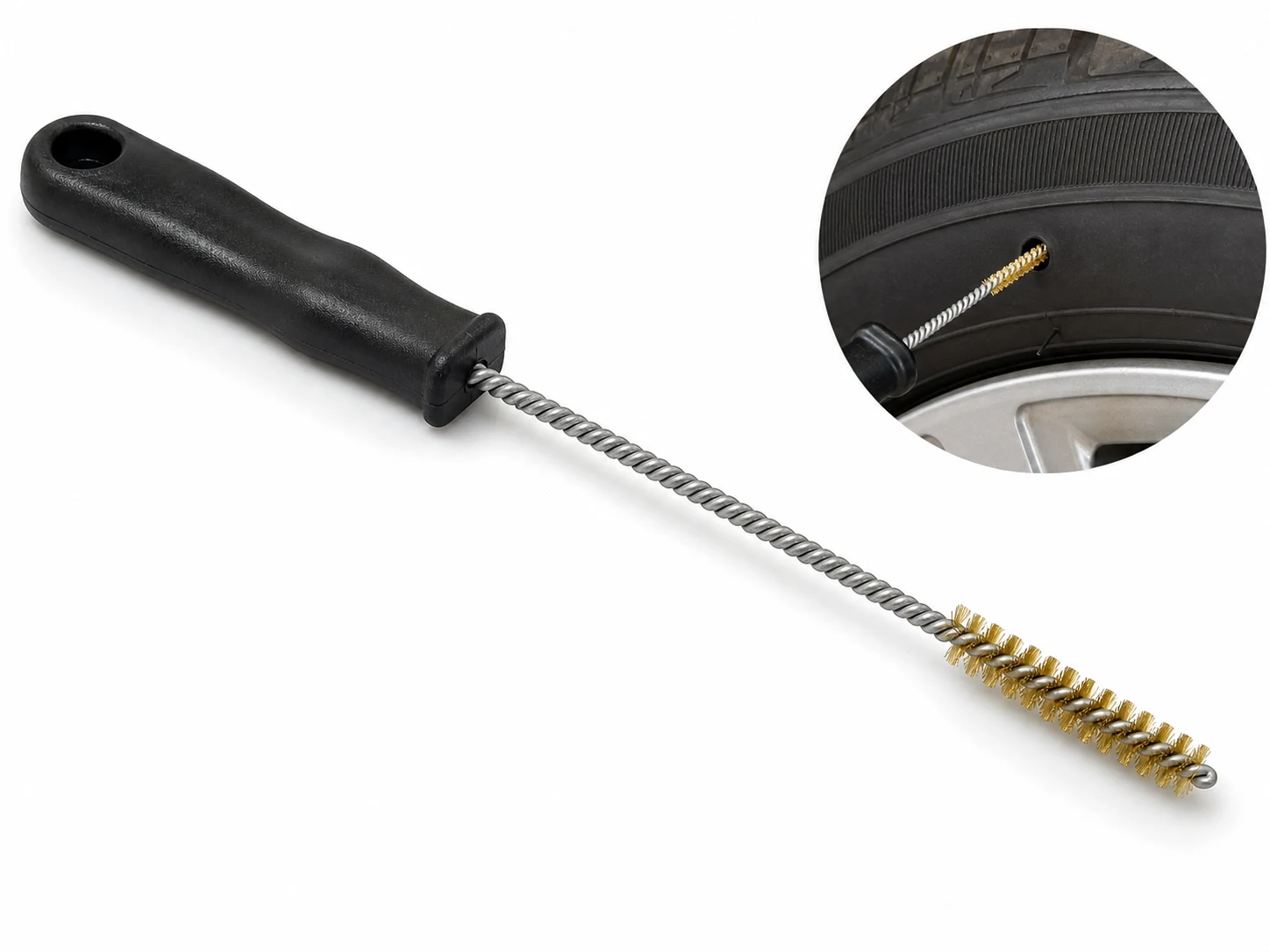
Small brush
500 pcs
Minimum order
Held in one hand: tube, bottle, detail and swab brushes — including long-handled ones with a small head.
Production lead time, once the specification is confirmed
- Up to 500 pcsWithin 7 days
- 501–50,000 pcsWithin 14 days
- Over 50,000 pcsWithin 21 days
Peak season can extend these times; the shipping date is confirmed in writing with your quotation. Sampling and shipping are quoted separately.
A fine-diameter hand brush engineered to clear cured rubber, flash, release residue, and carbonized deposits from tire mold vent holes and narrow tread cavities. Brass or nylon fill is sized to the vent ID so plugged vents open without enlarging or scoring the hole.
What can this brush do for you?
Vent holes on a tire mold do a simple job: they let trapped air escape during curing. When they fill with rubber and carbon, the mold can no longer vent properly, and tire appearance and curing quality suffer. This brush removes that blockage with controlled, hand-applied contact that matches the vent diameter.
Clears plugged vents without changing the hole diameter
Brass wire is harder than cured rubber and carbonized release agent, but softer than the steel typically used for tire molds. The wire scrubs the vent bore walls and removes deposits, while the mold surface stays intact. The result is a vent that returns to its original ID instead of becoming progressively larger with each cleaning.
Reaches vent holes buried in tread details
The brush head is only 10–25 mm long and sits at the tip of a thin stem, so it can be inserted into vents located at the bottom of deep tread grooves, inside narrow sipes, or behind sidewall lettering. Operators can clean each vent individually without removing large sections of the mold or working around obstacles with a bulky tool.
Follows angled and curved vent bores
Many vent holes are not drilled straight through the mold; they angle to follow the tread block or exit through a curved wall. A flexible stem bends to follow the bore path, keeping the fill section in contact with the walls even when the hole changes direction inside the mold.
Two fill materials protect the mold surface
Brass wire is the standard choice for steel molds, where it removes carbonized deposits without cutting the vent walls. Nylon PA fill is used on aluminum molds or as a final pass on any mold to remove loose residue without leaving metal marks. Selecting the right material prevents the brush itself from becoming a source of mold damage.
Controlled hand cleaning preserves vent accuracy
The brush is designed for hand use on a cooled mold. An operator can feel the resistance of each vent, avoid forcing a clogged hole, and apply just enough pressure to dislodge deposits. This level of control is difficult to achieve with power tools and reduces the risk of oversizing vents during routine maintenance.
What is a Tire Mold Vent Cleaning Brush?
A Tire Mold Vent Cleaning Brush is a small-diameter mechanical cleaning tool used to clear the vent holes and narrow cavities of tire molds. It combines a short brush section at the tip with a thin stem and a handle sized for hand use. The brush is inserted into each vent bore, rotated or reciprocated by hand, and withdrawn to remove loosened rubber and carbon.
The tool fills the gap between general mold cleaning methods—solvent soak, ultrasonic cleaning, dry ice blasting—and the small-bore cleaning those methods cannot always reach. Solvent and ultrasonic systems clean large mold surfaces, but vent holes often retain compacted rubber flash and carbonized release agent. A fine brush provides the mechanical action needed to break those deposits free without reaming the hole larger.
The brush is not a substitute for mold cleaning or a reaming tool. It does not remove heavy, baked-on contamination from the entire mold surface, and it should not be used to change vent diameter. Its role is precise: to restore airflow through the vents while preserving the original geometry of the mold.
Technical Specifications
The table below lists the parameters buyers commonly check before ordering. All dimensions and materials can be adjusted to match your vent sizes and mold materials.
| Parameter | Value / Options |
|---|---|
| Brush outer diameter (fill diameter) | 1.5–5.0 mm, selected to match vent hole ID with a slight interference fit |
| Brush section length | 10–25 mm, matched to vent depth |
| Overall length | 80–150 mm, adjusted for reach and handle preference |
| Stem type | Straight stainless steel (rigid) or flexible polymer-coated wire (for angled/curved vents) |
| Fill material | Brass wire (steel molds, carbon deposits) or nylon PA (aluminum molds, final pass) |
| Fill wire / filament diameter | Brass: 0.05–0.15 mm; Nylon: 0.10–0.25 mm, selected for deposit hardness and mold sensitivity |
| Handle | Knurled aluminum, PP, or TPE-overmolded grip; 40–60 mm working length |
| Operating condition | Hand use on cooled molds; compatible with common mold cleaning solvents when rinsed after use |
| Brush type | Custom Tube & Pipe Bore Brushes |
| How it is driven | Hand-guided |
| Cleaning target | passenger car, segmented or two-piece mold, and vent cleaning |
| Surface or part | molds, vents, holes, aluminum, bores, walls, cavities, and metal |
| Residue or debris | mold, carbonized deposits, release agent, carbon, and oxide |
| Mounting / connection | Threaded Removable / Fixed |
For custom orders, provide the measured vent ID, vent depth, bore angle, mold material, and deposit type. We will select the fill section, stem, and handle to match.
Where does this brush work best?
- Passenger car, light truck, and OTR tire molds with vented tread patterns, sidewall lettering, and intricate sipes where vents are small and hard to access.
- Segmented or two-piece molds after disassembly, when individual segments are laid out and vents are exposed for direct manual cleaning.
- Vents clogged with cured rubber flash, carbonized release agent, or oxide deposits at the bottom of deep tread grooves.
- Steel molds where brass wire provides effective deposit removal without cutting the vent walls.
- Aluminum molds where nylon fill cleans without leaving metal marks or scratching the softer mold surface.
- Routine mold maintenance programs that include targeted vent cleaning as part of the cycle between press runs.
How do I choose the right one?
Start with the vent hole ID and depth
Measure the vent bore with a pin gauge or micrometer. The brush outer diameter should be 0.3–0.5 mm larger than the vent ID to create light bristle pressure against the walls. A brush that is too small will slide through without cleaning; one that is too large will jam or bend the stem. The brush section length should be at least as long as the full vent depth, so the fill reaches the bottom of the bore.
Select fill material by mold metal and deposit type
For steel molds with carbonized deposits, brass wire is the usual first choice: it cuts through rubber and carbon yet remains softer than the mold steel. For aluminum molds, brass can still mark the surface, so nylon PA fill is preferred. Nylon is also useful as a second pass on any mold to remove loosened debris without metal contact. Stainless steel wire is an option only if deposits are exceptionally hard and the mold is hardened steel—test on a non-critical vent first.
| Mold material | Recommended fill | Reason |
|---|---|---|
| Steel | Brass wire | Removes carbon and rubber without cutting vent walls |
| Aluminum | Nylon PA | No metal marking; safe on softer mold surface |
| Steel, heavy carbon (with test) | Stainless wire | Harder than brass for stubborn deposits; risk of scoring if overaggressive |
| Any mold, final cleaning pass | Nylon PA | Removes loose debris without scratching |
Match stem flexibility to the vent geometry
If vents are straight and have clear axial access from the mold face, a rigid stainless steel stem gives the best control and feed force. For angled, curved, or recessed vents where the bore changes direction, a flexible polymer-coated wire stem follows the path without binding. Choose flexibility based on how many awkward angles your mold has, not on operator preference alone.
Consider the handle for repetitive manual work
Operators may clean hundreds of vents per mold. A knurled or TPE-overmolded handle improves grip and reduces hand fatigue. Handle length affects torque and control; shorter handles give more precision in tight areas, longer handles help reach deep into mold segments. Specify handle form after trying on a sample mold if possible.
When to use a different tool
If a vent is completely blocked and the brush will not enter, do not force it. Use a solvent soak or a soft pin to open the entrance first. If the deposit is so hard that brass bends or nylon melts, the mold may need chemical or ultrasonic cleaning before mechanical brushing. If you need to resize or restore a vent to an exact diameter, use a precision reamer—not a brush. And if the mold is hot, wait for it to cool before brushing.
Can I customize this brush?
Yes. The brush is built to your vent measurements, mold material, and deposit conditions. We can adjust the following variables:
- Brush outer diameter — any size from 1.5 to 5.0 mm, finer increments available on request
- Brush section length and shape — straight, tapered, or spherical tip to match bore profile
- Stem length, thickness, and flexibility — rigid stainless or flexible coated wire
- Fill material and density — brass, nylon PA, stainless, or mixed; wire/filament diameter selected for deposit hardness
- Handle style and material — knurled aluminum, PP, TPE, straight or ergonomic, with hanging hole or color coding
- Marking and identification — custom color, handle engraving, or pad printing for tool crib organization
- Packaging — bulk, individual protective tubes, sets of mixed diameters, or project-specific packing
To define your custom configuration, provide the measured vent ID, vent depth, bore angle or curvature, mold material, deposit type, cleaning solvent, number of vents cleaned per mold, and any ergonomic preferences. A sample mold segment or scale drawing accelerates the process.
If your project requires material documentation, inspection reports, or third-party testing, we can assist with those requirements during the customization process.
When is a tire mold vent cleaning brush worn out rather than just dirty?
How do I check that the brush diameter is correct before cleaning a full mold?
Insert the brush into one vent by hand. You should feel light, even bristle resistance as the fill enters and travels the bore. If the stem scrapes against the hole wall or the brush cannot be inserted without force, the diameter is too large. If the brush drops in with no resistance and you can see daylight around the fill, it is too small. Verify on three to five representative vents first.
Can I use this brush on a hot mold?
No. The mold should be cooled to a safe handling temperature before vent cleaning. Hot molds can soften nylon fill and make rubber deposits tackier and harder to remove. Brass fill is unaffected by typical mold temperatures, but the operator still needs safe working conditions. Always allow molds to cool before manual vent cleaning.
Does this brush replace solvent or ultrasonic mold cleaning?
No. The brush handles specific vent bores and narrow cavities that general cleaning systems often miss. Solvent, ultrasonic, or dry ice cleaning is still needed for the overall mold surface. Vent brushing is a supplementary step, not a replacement for the complete cleaning cycle.
How can I inspect the brush for wear before it damages a vent?
After every mold cleaning, inspect the fill section under magnification or a bright light. Look for flattened, splayed, or missing bristles, and measure the brush outer diameter with a caliper. If the effective diameter has dropped by more than 0.2 mm from new, replace the brush. A worn brush loses cleaning action and forces the operator to push harder, which increases the risk of oversizing the vent.
What should I do if a vent is completely blocked and the brush cannot enter?
Do not force the brush. Apply a solvent soak targeted at the vent opening, or use a soft brass pin to open a starter channel. Once the brush tip can enter, continue with the normal cleaning motion. If the blockage remains after solvent treatment, the mold may need ultrasonic cleaning or a different removal method before mechanical brushing.
How many molds can one brush clean before replacement?
There is no fixed number because vent count, deposit hardness, and operator technique vary. A practical rule is to inspect after cleaning each mold and replace when the fill shows visible flattening or the diameter measurement drops by 0.2 mm. Ordering brushes in sets allows operators to rotate and compare wear across the mold cleaning cycle.
Guides that go deeper on this
Custom Manufacturing RFQ
Describe Your Application
To prepare the correct quotation, provide the dimensions, cleaning task, residue, material, mounting details, quantity, and a drawing or photo.
Drawing or photo optional — it speeds things up, it does not gate the enquiry.
Custom Brush RFQ
Send Your Brush Project
Upload a drawing, product photo, or sample photo and provide the core dimensions and cleaning conditions.
“We need a brush to remove wet residue from a stainless steel conveyor, about 800mm wide. The current brush wears quickly. We can send photos.”
“We sell drinkware and need a cleaning brush to include with the product. Quantity around 5,000 pieces.”