
Custom Cleaning Brush
200mm PBT Small Disc Brush
200mm PBT disc brush with a PP snap-fit hub for powered cleaning, deburring and finishing on metal, plastic, glass and wood. Custom trim and density.
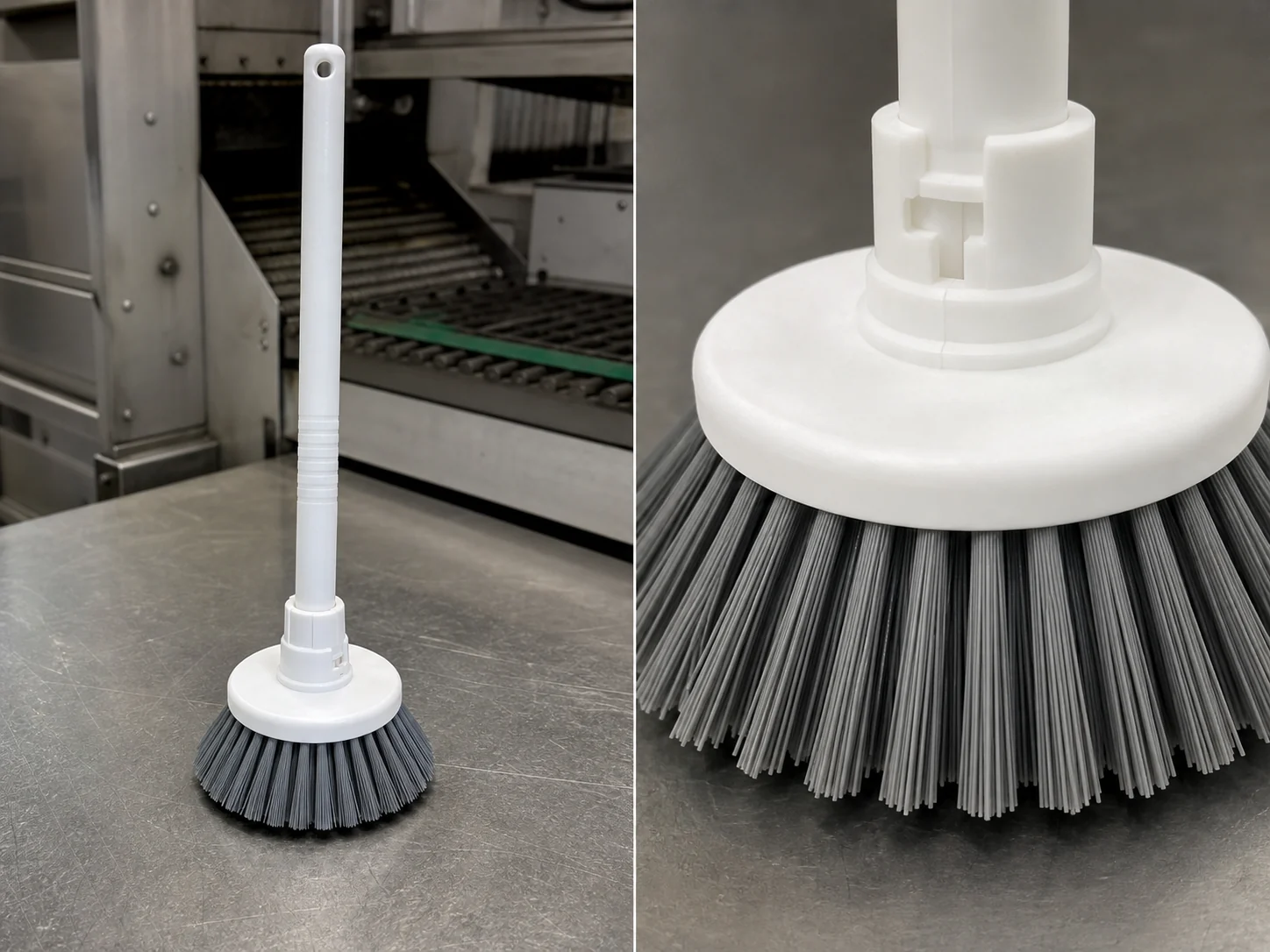
Medium brush
100 pcs
Minimum order
Worked with two hands or on a pole: chimney, gutter and pond-filter brushes, discs, cups and tank brushes.
Production lead time, once the specification is confirmed
- Up to 100 pcsWithin 7 days
- 101–5,000 pcsWithin 14 days
- 5,001–50,000 pcsWithin 21 days
- Over 50,000 pcsConfirmed with your quotation
Peak season can extend these times; the shipping date is confirmed in writing with your quotation. Sampling and shipping are quoted separately.
The 200mm PBT Small Disc Brush is a machine-mounted rotary brush that pairs a full 200 mm working face with moisture-resistant PBT filament and a snap-fit polypropylene hub. It is built for powered cleaning, light deburring, and surface finishing on metal, plastic, glass, and wood where a handle-free, quickly replaceable brush head is needed.
What can this brush do for you?
Covers a Wide Working Path in One Pass
The 200 mm round face spreads PBT bristles across a broad contact area, so a rotating drive can clean or deburr a flat surface with fewer passes than a narrow cup or end brush. For sheet, plate, and panel work, this reduces machine travel and evens out filament wear across the face.
PBT Filament Keeps Its Stiffness in Wet Conditions
PBT monofilament absorbs very little moisture, so the bristles do not soften or collapse when the brush runs with water-based coolants, detergents, or damp workpieces. The result is stable contact pressure and predictable cleaning action from the first pass to the end of the shift, even in wet stations.
Snap-Fit Hub Replaces Without Tools
The polypropylene base uses a snap-fit connection to the drive spindle, so there is no handle, no set screw, and no separate adapter plate to tighten. Operators can click a worn disc off and a fresh one on in seconds, which keeps cleaning or deburring cells running during scheduled changeovers.
Trim Length Balances Reach and Aggression
The bristle trim height can be specified from 20 mm to 50 mm. A shorter trim creates a firmer, flatter contact for edge deburring and controlled line cleaning. A longer trim flexes more and reaches into shallow grooves, radiused transitions, or uneven surfaces. Buying the right trim means the brush does the job without being too stiff or too soft for the workpiece.
Runs Wet or Dry Across Common Industrial Materials
PBT is compatible with the water, light oils, and neutral to mild cleaning solutions found in many surface-prep and post-machining processes. The same disc can move from a dry deburring cell to a wet wash station without changing bristle material, as long as the process fluids stay within the material limits described in the specification table.
What is a 200mm PBT Small Disc Brush?
The 200mm PBT Small Disc Brush is a circular rotary brush whose working face is a 200 mm disc of PBT monofilament anchored in a polypropylene hub. It has no handle and no operator grip; it mounts directly to a rotary drive through a snap-fit interface, so it is intended to be used as a replaceable brush head on a machine, fixture, or power tool rather than as a hand brush.
In operation, the drive rotates the disc and the tips of the PBT filaments contact the workpiece. The brush can be run face-on to cover flat areas, or it can be angled so the outer filament rows work along edges, corners, or profiled sections. PBT filament is selected because it provides a firm but non-metallic contact: it can remove light oxides, dust, fine flash, and surface films without cutting into the base material the way a wire brush can. The round 200 mm format keeps the working diameter compact enough for localized cleaning while still covering enough area to be productive.
The polypropylene hub keeps the rotating mass low and resists most aqueous process fluids. It also sets the temperature ceiling for the tool: PP is typically stable to around 80°C in continuous use, so the brush should not be run against very hot parts or in ovens. If the process runs hotter, the hub material must be changed. The snap-fit connection does the holding work; there are no additional fasteners, so the drive-side geometry must be matched to the brush hub to avoid vibration or slip.
Technical Specifications
| Parameter | Standard Value / Options |
|---|---|
| Disc diameter | 200 mm |
| Disc shape | Round, flat working face |
| Filament material | PBT (polybutylene terephthalate) monofilament |
| Trim length | 20–50 mm, project-selectable |
| Filament diameter | 0.3–0.8 mm, selected for the application |
| Hub material | Polypropylene (PP) |
| Handle | None; direct drive mounting |
| Drive connection | Snap-fit to spindle or drive plate |
| Fill pattern | Straight, crimped, or wave-set; density specified per project |
| Working orientation | Face-on or angled edge contact |
| Typical operating speed | 1,200–3,000 RPM; final rating confirmed to the machine |
| Ambient/fluid temperature | Up to 80°C continuous for standard PP hub; higher temperatures require a different hub material |
| Compatibility | Wet or dry use with water, coolants, and neutral-to-mild cleaning solutions within PBT/PP limits |
| Brush type | Custom Disc Brushes |
| How it is driven | Machine-driven, mounted in the equipment |
| Cleaning target | flat metal sheet and plate line, cnc-machined part, and glass sheet and panel edge cleaning |
| Surface or part | hubs, metal, edges, plastic, glass, wood, sheets, and panels |
| Residue or debris | dust, oxide, burrs, scale, fiber, loose particles, loose scale, and coolant |
| Mounting / connection | Snap-fit to spindle or drive plate |
Values shown describe the standard 200 mm configuration. Diameter, trim, hub, and snap-fit geometry are adjusted to the customer’s machine drawing.
Where does this brush work best?
- Flat metal sheet and plate lines, where light oxide, dust, or loose scale must be removed before coating, bonding, or assembly.
- CNC-machined parts after milling or drilling, using the outer rows to break fine edge burrs and clean profiled surfaces without changing part dimensions.
- Glass sheet and panel edges, where controlled PBT contact removes grinding residue or handling debris without scratching the surface when the correct filament diameter is selected.
- Wood and composite panels, for removing sanding dust, fiber lift, or loose particles from faces and edges before finishing.
- Plastic molded components after demolding, where light flash and dust on flat faces need to be cleared without aggressive metal contact.
- Rotary cleaning stations and fixture-mounted systems that need a quickly replaceable 200 mm brush head without a handle or tool-mounted adapter.
How do I choose the right one?
Check the snap-fit geometry first
Measure the mating feature on your drive: hub bore, groove position, retention tab size, and any flat or key feature. The brush hub must match this profile. A snap-fit that is slightly off will allow the disc to wobble, vibrate, or lift under load, which shortens filament life and can mark the workpiece. Send a spindle drawing or a sample drive hub when ordering.
Let the profile depth set the trim length
If the surface is flat and the main job is edge contact, a 20–25 mm trim gives a stiff, stable working face. If the part has shallow recesses, radiused transitions, or uneven areas, a 35–50 mm trim lets the filaments flex into those features. Use the shortest trim that still reaches the contact area; longer trim increases reach but reduces edge pressure.
Match filament diameter to surface sensitivity
For glass, polished metal, coated surfaces, or fine plastic parts, choose a finer filament, typically 0.3–0.4 mm, to keep contact soft. For heavy dust, fiber, wood, or thicker oxide films, a 0.5–0.8 mm filament with a denser fill provides more tip pressure. PBT is non-metallic, but it can still mark soft plastics if the filament is too coarse or the speed is too high, so test on scrap parts when the surface is critical.
Confirm the chemical and temperature limits
PBT works well with water, coolants, and neutral or mild cleaning solutions. Strong acids, strong alkalis, and some chlorinated or aromatic solvents can attack the filament or the PP hub. The standard PP hub also limits continuous use to about 80°C. If your process uses aggressive chemistry or hotter workpieces, specify the fluid and temperature so the hub and filament grade can be changed accordingly.
Know when a different brush is the better tool
This disc brush removes light residues, fine burrs, and surface films. It is not a substitute for heavy stock removal or scale breaking. If the part has hard scale, deep burrs, or welded spatter, use a wire brush, abrasive-filament brush, or bonded abrasive disc first. If the finish must be polished to a bright or mirror condition, follow with a softer natural-fiber or non-woven finishing tool. If the cleaning job must be done by hand, choose a brush with a handle; this version is designed for a powered drive.
Can I customize this brush?
The 200 mm diameter and PBT filament are the standard configuration, but nearly every dimension and interface can be adjusted to fit a specific drive or process. To define a custom brush, provide the spindle or drive drawing, hub bore and retention dimensions, required RPM, workpiece material, residue type, process fluid, and any edge or recess distances the brush must reach.
- Filament and face construction: trim length, filament diameter, fill density, straight/crimped/wave-set pattern, center hole or segmented face, and alternative filament lengths outside the 20–50 mm range.
- Hub and connection: hub material (standard PP, glass-filled PP, nylon, or metal), snap-fit groove geometry, keying, center bore, and retention tabs.
- Disc dimensions: overall diameter adjusted to the machine guard and working area.
- Color and marking: hub color for visual identification, color-coded filaments, pad-printed or laser-marked part numbers.
- Packaging: bulk boxes, tray packs, individual polybags, or customer-specific labels and barcodes.
- Project support: material data sheets, inspection records, and third-party testing or documentation can be arranged when the customer’s specification requires it.
What size should a 200mm PBT small disc brush be, and how long does it last?
How do I verify the snap-fit will fit my drive?
Compare the hub drawing against the drive side: bore diameter, groove depth, tab dimensions, and the distance from the mounting face to the filament plane. If the drive part is available, dry-fit the brush without power and confirm the disc seats fully and does not rock. If it clicks in but feels loose, the retention feature is undersized or worn.
Can this brush be used with water or cleaning chemicals?
Yes. PBT filament and the PP hub are intended for wet and dry use with water, coolants, and neutral to mild cleaning solutions. Avoid prolonged immersion in strong acids, strong alkalis, or aggressive solvents at elevated temperature. After wet operation in a batch process, rinse the face clear of loosened debris so the residue does not dry inside the filament pack.
What does this brush not remove?
It is not designed to break hard scale, rust crust, weld spatter, or deep machining burrs. Those conditions require wire, abrasive-filled, or bonded abrasive tools. Use this PBT disc for light films, dust, fine flash, and edge cleanup; if you are unsure whether a residue is too heavy, test on a scrap area with the planned speed and trim length before putting the brush into production.
How do I know when the brush needs replacement?
Inspect the hub for cracks, whitening, or deformed snap features. Check the filament face for flattened, twisted, or burned tips, and for uneven trim wear that creates a visible step across the disc. If the brush vibrates at the same RPM where it ran smoothly before, or if cleaning time increases significantly, replace the disc. A worn brush that is run too long can generate heat and damage the hub.
Should I run it face-on or on the edge?
Face-on spreads load over the full filament pack and is appropriate for flat areas. Edge-on concentrates contact on the outer rows and is useful for corners, channels, and narrow edges, but it wears the outer filament faster and may require a stiffer trim or higher fill density. If the machine position is fixed, a shorter trim and denser fill will usually support edge work better than the standard face-oriented configuration.
What should I provide to get a working replacement for an existing disc?
Send the worn disc or its drawing, the machine type and RPM, the workpiece material, and the residue you are removing. If the original brush is still mounted, include photos of the hub and drive side so the snap-fit geometry can be matched exactly. This is especially important when the brush came with equipment and no separate part drawing exists.
Guides that go deeper on this
Custom Manufacturing RFQ
Describe Your Application
For a custom quote, we need the key dimensions, surface or part, residue, material preference, quantity, and reference image or drawing.
Drawing or photo optional — it speeds things up, it does not gate the enquiry.
Custom Brush RFQ
Send Your Brush Project
Upload a drawing, product photo, or sample photo and provide the core dimensions and cleaning conditions.
“We need a brush to remove wet residue from a stainless steel conveyor, about 800mm wide. The current brush wears quickly. We can send photos.”
“We sell drinkware and need a cleaning brush to include with the product. Quantity around 5,000 pieces.”