
Custom Cleaning Brush
250mm PBT Glass Edge Disc Brush
A rotary PBT disc wraps the glass edge for full-perimeter contact, clearing polishing residue and abrasive fines on a quick-change mounting.
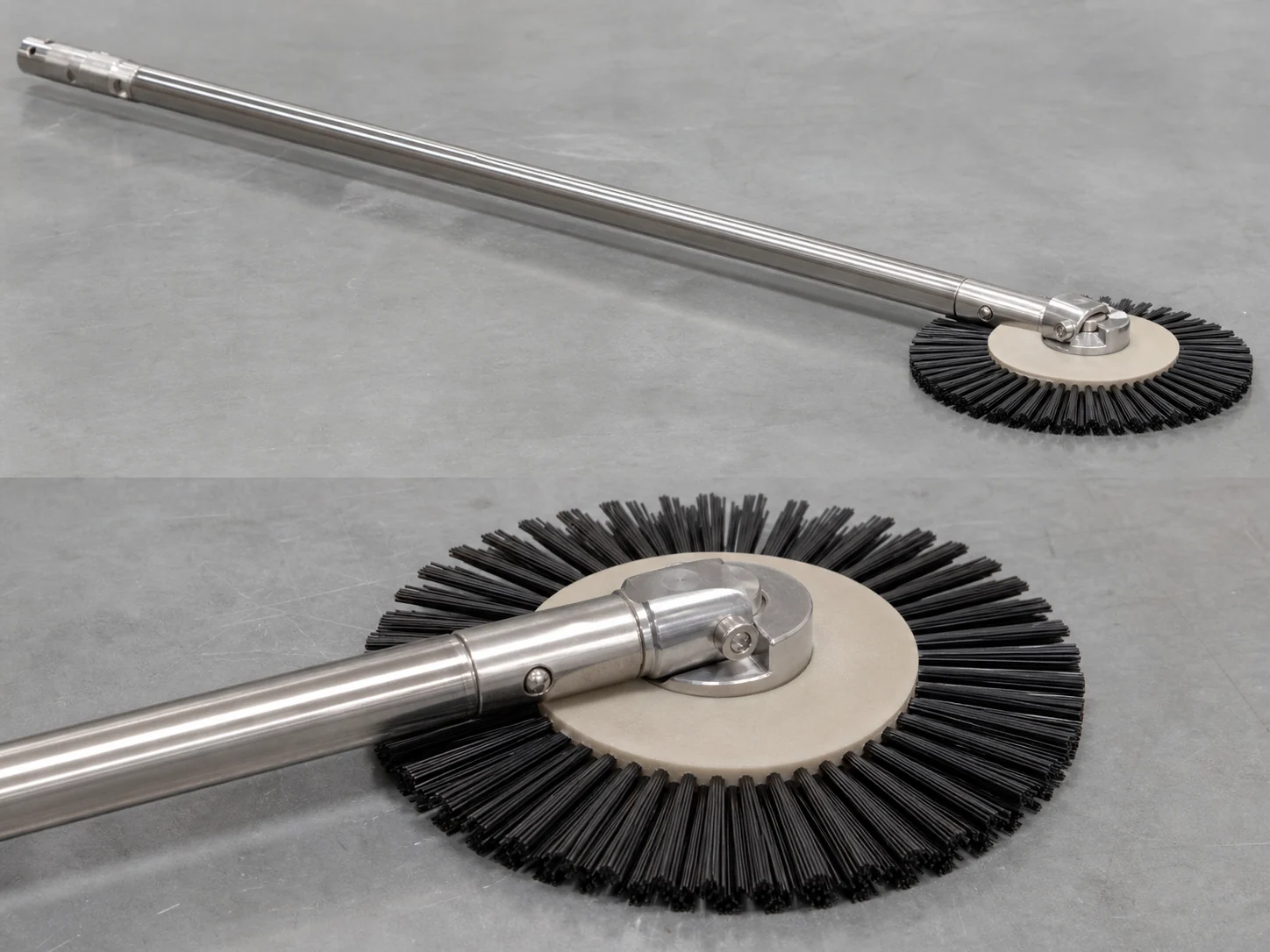
Medium brush
100 pcs
Minimum order
Worked with two hands or on a pole: chimney, gutter and pond-filter brushes, discs, cups and tank brushes.
Production lead time, once the specification is confirmed
- Up to 100 pcsWithin 7 days
- 101–5,000 pcsWithin 14 days
- 5,001–50,000 pcsWithin 21 days
- Over 50,000 pcsConfirmed with your quotation
Peak season can extend these times; the shipping date is confirmed in writing with your quotation. Sampling and shipping are quoted separately.
The 250mm PBT Glass Edge Disc Brush is a rotary cleaning tool for glass processing lines that removes dust, polishing residue, oil film, and abrasive fines from glass edges and adjacent surfaces. The 250mm disc works with quick-change mounting to keep edge cleaning, deburring, and light polishing steps moving without machine downtime.
What can this brush do for you?
Full-perimeter contact wraps the glass edge
The rotating disc sweeps filaments across the edge face and the adjacent glass surfaces in one pass, removing debris that flat brushes or cup brushes leave behind. This gives you a cleaner edge before coating, lamination, or inspection.
PBT filaments hold stiffness in wet conditions
PBT absorbs very little water and keeps its mechanical properties in humid or coolant-flushed edge-processing environments. Cleaning pressure stays consistent whether the line runs dry or wet, so residue removal does not drop off as the shift progresses.
Quick-change coupling keeps the line moving
The brush hub mounts to the machine spindle with a quick-change interface. A worn brush swaps out in seconds without re-alignment or extended downtime, which matters when the brush is one component in a continuous glass processing cell.
Balanced for high-speed rotation
Each disc is dynamically balanced for its intended operating speed. That reduces vibration, protects spindle bearings, and produces even filament wear so the brush cleans consistently across its full 250mm diameter.
Adjustable filament spec matches the cleaning step
Filament diameter, trim length, and density can be set for light dust removal or more aggressive deburring. The same 250mm platform can cover multiple process steps by changing the filament configuration instead of the machine setup.
What is a 250mm PBT Glass Edge Disc Brush?
A 250mm PBT Glass Edge Disc Brush is a rotary disc brush mounted on a driven spindle in glass processing equipment. It contacts the edge of glass panels, sheets, or cut shapes to remove debris left by cutting, grinding, and polishing steps. The working element is a ring of PBT filaments anchored around a stainless-steel disc core. As the disc rotates, the filaments sweep across the edge and the surfaces immediately adjacent to it, carrying away dust, slurry, oil film, and loose fines.
The brush can run wet or dry. On lines with coolant or rinse water, the PBT filaments stay stiff and the stainless core resists corrosion. The quick-change coupling allows fast replacement when filaments wear. The disc is not a heavy grinding or polishing tool; it is a final cleaning and light deburring device that works after the grinding and polishing stages, before the glass moves to coating, lamination, or inspection.
Technical Specifications
The values below are typical for the 250mm platform. Filament diameter, trim length, disc thickness, and coupling interface are selected during project review to match the actual machine and cleaning step.
| Parameter | Value / Options |
|---|---|
| Brush diameter (including bristles) | 250 mm |
| Head shape | Round disc |
| Disc thickness | 30 mm |
| Bristle material | PBT (standard); nylon PA6.12 available on request |
| Filament diameter | 0.15–0.50 mm, selected by cleaning aggressiveness |
| Filament trim length | 20–40 mm, adjustable to application |
| Base / disc material | AISI 304 stainless steel (316 or other grades on request) |
| Connection | Quick-change coupling (bolt-on hub, taper, or machine-specific interface) |
| Operating environment | Suitable for wet or dry operation; project-specific speed rating supplied with balance data |
| Brush type | Custom Disc Brushes |
| How it is driven | Machine-driven, mounted in the equipment |
| Cleaning target | glass edge, pre-coating preparation, and deburring and edge blending cleaning |
| Surface or part | edges, glass, glass edges, machine guides, profiles, panels, sheets, and stainless-steel |
| Residue or debris | dust, oil film, fines, polishing residue, slurry, coolant, sharp edges, and fingerprints |
| Mounting / connection | Quick-change coupling (bolt-on hub, taper, or machine-specific interface) |
Where does this brush work best?
- Glass edge cleaning after grinding and polishing: removes swarf, slurry, and abrasive particles that remain on edges before coating or lamination.
- Pre-coating preparation: removes dust, oil film, and fingerprints from glass edges and near-edge surfaces on architectural or automotive glass.
- Deburring and edge blending: softens micro-chips and sharp edges on freshly cut or ground glass, reducing handling damage and improving safety.
- In-line inspection cleaning: ensures optical inspection systems see clean edges, reducing false rejects.
- Bevel and shaped edge processing: works on straight edges, bevels, and gentle curves when the machine guides the brush along the profile.
How do I choose the right one?
Start with the machine interface. The quick-change coupling must match the spindle or arbor on your line. Measure the mounting dimensions before ordering; a mismatch stops the line.
Check the edge geometry. The 250mm diameter covers typical glass edge thicknesses and allows contact without interfering with adjacent surfaces or machine guards. For tight curves, a smaller diameter disc or a cup brush may conform better. Confirm the minimum radius of any curved edges you need to clean.
Select the filament for the residue. Thinner filaments, 0.15–0.25mm, work for light dust and polishing residue removal. Thicker filaments, 0.30–0.50mm, handle deburring and heavier contamination. PBT is the default because it is tough, low in water absorption, and does not scratch uncoated glass. If the glass has a delicate coating, consider a softer nylon filament.
Set trim length and density. Shorter trim and higher density give firmer, more aggressive contact. Longer trim and lower density provide a softer wipe that conforms to slight edge irregularities. Choose based on whether the step is cleaning or deburring.
Consider wet or dry operation. PBT and the stainless disc handle both conditions. If the line uses coolant, the disc material and filament must be compatible with that chemistry. Specify the coolant type during selection.
When to use a different brush. If cleaning deep interior channels or holes, use a cup brush or end brush. If the residue is heavy mineral scale or silicone contamination, a wire brush or abrasive-impregnated filament brush may be required. For large flat surfaces rather than edges, a roller brush is more efficient. If the glass is extremely delicate and even PBT contact could mar it, a natural bristle brush may be the safer choice.
Can I customize this brush?
The 250mm disc is a platform, not a fixed part. We can adjust the following to fit your line and process:
- Diameter: other sizes such as 200mm or 300mm, or a custom diameter for a specific machine.
- Disc core: diameter, thickness, material — AISI 304 or 316 stainless steel, aluminum for lower rotating mass, or engineered plastic for lightweight applications.
- Filament: PBT standard; nylon PA6.12, polypropylene, abrasive-impregnated PBT, or other options. Filament diameter, trim length, and density are selected to meet the cleaning aggressiveness needed.
- Coupling: quick-change style, bolt circle, taper, keyway, or a custom machine interface. We can match your existing spindle or arbor.
- Balancing: dynamic balancing to the RPM you specify for high-speed lines.
- Color, marking, and packaging: custom color, pad print, laser marking, or project-specific packing.
If your project requires documentation, inspection, or third-party testing, we can support those requirements during the customization process.
What pressure keeps a 250mm PBT glass edge disc brush clean without wearing it early?
How do I know when to replace the disc brush?
Replace when the filaments are worn to less than 50% of the original trim length, or when cleaning performance drops and residue remains after a pass. Also inspect for uneven wear, missing filament clusters, or damage to the disc core or coupling.
Can this brush be used on curved glass edges?
Yes, for gentle curves the disc can follow the edge if the machine provides the motion. For tight radii, the 250mm disc may not conform fully. A smaller diameter disc or a cup brush might work better. Provide the minimum radius of your curved edges so we can confirm fit.
Does the brush need to run wet?
No. Dry running works for dust and light residue removal. Wet running with a mild coolant or water improves cleaning of polishing slurry and reduces heat buildup. Choose based on your process, and make sure the filament and disc materials are compatible with the coolant you use.
What is the maximum speed?
The safe speed is determined after balancing and depends on the disc construction and coupling. We supply a maximum RPM rating with each configuration. Do not exceed it, as overspeed can cause filament loss or disc failure.
How do I clean the brush between batches?
Rinse with water or a mild detergent solution, then dry. Avoid aggressive solvents or high-pressure spray that could deform filaments or damage the coupling.
Can this brush remove mineral scale or heavy deposits?
PBT is intended for mechanical removal of loose particles, dust, oil film, and light residue. Heavy mineral scale or baked-on deposits require chemical descaling or abrasive media. The disc brush is not a replacement for those steps.
Guides that go deeper on this
Custom Manufacturing RFQ
Describe Your Application
Please share the brush dimensions, working area, residue type, material direction, quantity, and a drawing or photo for quotation.
Drawing or photo optional — it speeds things up, it does not gate the enquiry.
Custom Brush RFQ
Send Your Brush Project
Upload a drawing, product photo, or sample photo and provide the core dimensions and cleaning conditions.
“We need a brush to remove wet residue from a stainless steel conveyor, about 800mm wide. The current brush wears quickly. We can send photos.”
“We sell drinkware and need a cleaning brush to include with the product. Quantity around 5,000 pieces.”