
Custom Cleaning Brush
Disc Brush Glass
Non-marring disc brush glass for flat glass washing lines. Nylon 6/12 and PP filaments 0.25–0.35 mm for 0.7–21 mm glass, 800–3300 mm pass width.
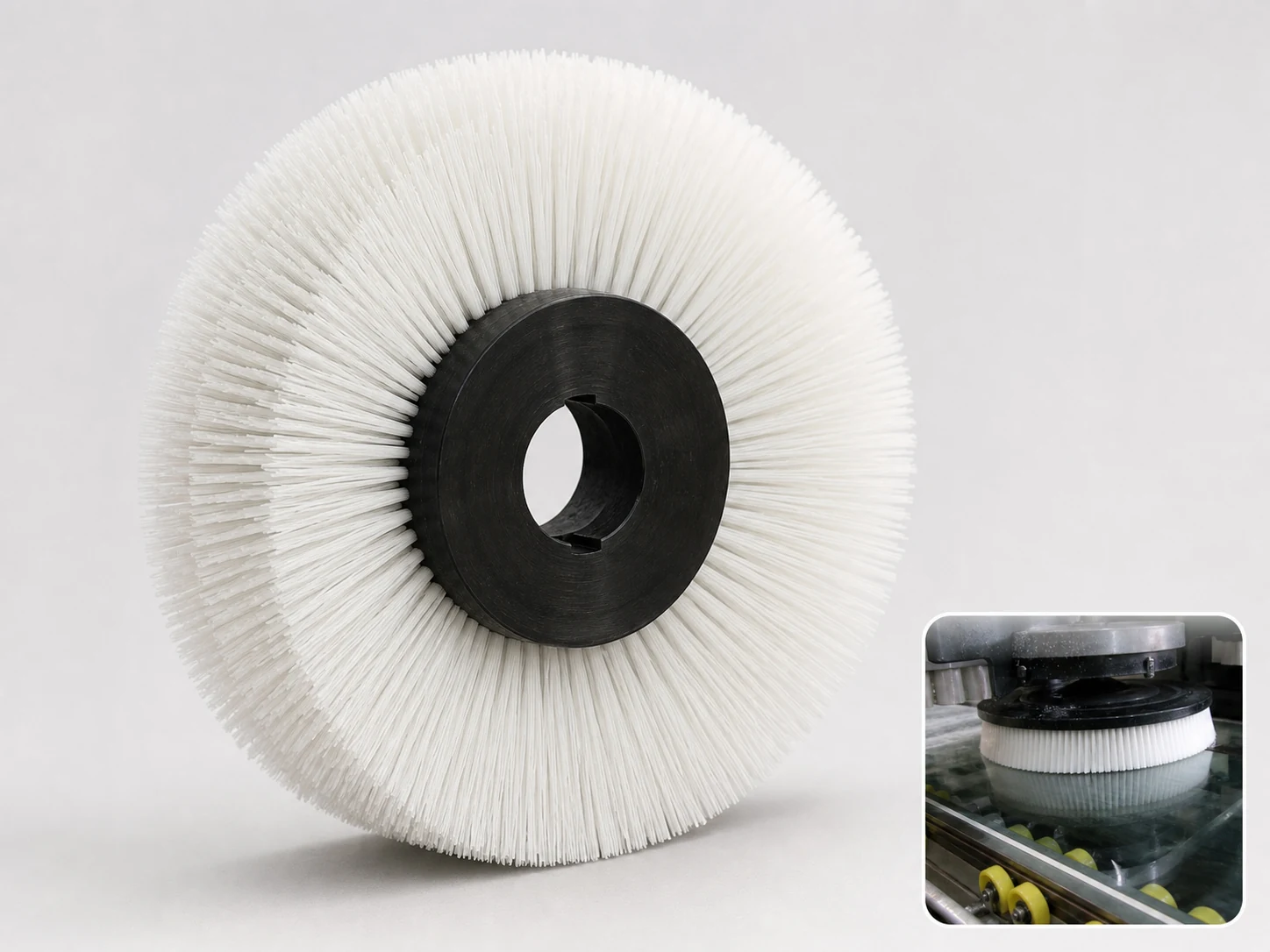
Large-format brush
100 pcs
Minimum order
Built one at a time on a core or channel: full-width rollers, sweeper brooms and long strip.
Production lead time, once the specification is confirmed
- Up to 100 pcsWithin 20 days
- 101–1,000 pcsWithin 30 days
- Over 1,000 pcsConfirmed with your quotation
Peak season can extend these times; the shipping date is confirmed in writing with your quotation. Sampling and shipping are quoted separately.
A non-marring disc brush built for flat glass washing and coating lines. It uses Nylon 6/12 or polypropylene filaments on machine-specific disc hubs to scrub glass panels from 0.7 mm to 21 mm thick, removing glass dust, cutting residue, process film, and oxide/contaminant deposits before coating, tempering, or lamination.
What can this brush do for you?
Full-width scrubbing without unwashed bands
Disc brushes are mounted along rotating or oscillating shafts across the washer pass width. Each disc overlaps the adjacent one, so the full glass surface receives continuous contact instead of leaving narrow unwiped lanes between brush elements. That is especially important before coating: a band of dust or film carried through the washer will show up as a coating defect downstream.
Soft enough for pre-coat glass, firm enough to remove process film
The filaments are Nylon 6/12 (PA 6/12) or high-density polypropylene in 0.25–0.35 mm diameters. The fine filament tips break the bond between residue and glass without the hard edge contact of a wire or abrasive brush. Glass dust, cutting oil film, and light oxide deposits release under normal spray and rotational contact without marking float, low-E, or coated surfaces.
Wet-line stability where water and detergent are always present
Nylon 6/12 absorbs less moisture than standard nylon 6, helping the brush keep its trim height and stiffness through continuous wet cycles. Discs do not collapse or mat as quickly under spray pressure, so cleaning pressure stays more consistent between scheduled replacements.
Works inside machines from 800 mm to 3300 mm
The disc OD, hub bore, core thickness, and spacer layout are dimensioned for the machine, not one universal size. This includes BENTELER Type 45-style coating washers and similar wide lines, where full-width coverage and correct shaft fit are critical to the brush row.
Thin to thick sheet handling
The brush line can serve glass thicknesses from 0.7 mm up to 21 mm. For thin products, filament diameter and contact pressure are kept low to avoid lifting or scratching. For thick sheets, the same disc array continues to hold contact across the slower feed sections.
Field-serviced in sections instead of one long replacement
Each disc is a separate element on the shaft. Worn discs can be replaced individually or in modules, so only the affected zones need renewing rather than the full working width.
What is a Disc Brush Glass?
A Disc Brush Glass is a rotating circular brush element designed for the brush rows inside flat glass washing and coating lines. Bristle filaments radiate outward from a central disc hub. Multiple discs are stacked on driven shafts above and below the glass conveyor. When a sheet passes through, the upper and lower disc rows scrub both faces while water and detergent spray carries loosened material away from the contact zone.
The brush contacts flat glass faces and the immediate washer work zones under each disc. It is normally part of a multi-stage wet process: pre-wash for coarse particles, washing with detergent for film and fingerprints, and rinse before drying. Disc brushes are selected when the line needs full-surface mechanical cleaning without changing the optical surface of the glass.
Operating conditions matter as much as brush geometry. Rotational speed, oscillation stroke, water pressure, detergent chemistry, and line speed all affect how much residue the filament tips can remove and how fast the brush wears. The disc brush is sized to these conditions rather than simply selected by pass width.
It is a face-cleaning element, not an edge brush. Edge and corner work in the same line is handled by separate cup, end, or roller brushes.
Technical Specifications
The dimensions below are built around your machine’s existing shaft, spacer, and pass height. We verify the key dimensions against a drawing or sample before production.
| Parameter | Value / Configuration |
|---|---|
| Brush type | Rotating / oscillating disc brush for flat glass washer brush rows |
| Disc outside diameter | Machine-specific; matched to shaft spacing, brush gap, and required overlap |
| Bore / hub | Machined to shaft diameter and drive feature; keyway, pin, spline, or quick-change hub as required |
| Core thickness | Machine-specific; sized to existing spacer pack and stack length |
| Filament material | Nylon 6/12 (PA 6/12) or high-density polypropylene; non-marring grades |
| Filament diameter | 0.25–0.35 mm; finer for coated or thin glass, heavier for oxide films |
| Trim length / filament density | Project-set for contact pressure, wear life, and detergent access |
| Glass thickness range | 0.7–21 mm |
| Line working width reference | 800–3300 mm for BENTELER Type 45-style coating/washing lines |
| Operating medium | Wet detergent spray; water temperature and pH specified per project |
| Core / hub material | Polypropylene, polyamide, or reinforced hub; stainless insert where repeated mounting requires |
| Mounting orientation | Top brush row, bottom brush row, or both; rotation direction confirmed from machine |
| How it is driven | Machine-driven, mounted in the equipment |
| Cleaning target | flat glass washing machines ahead of coating, insulating glass and architectural glass line, and automotive glass washer cleaning |
| Surface or part | glass, hubs, flat glass, sheets, edges, bands, panels, and bores |
| Residue or debris | dust, oxide, contaminant deposits, fingerprints, oil, oil film, process film, and pitch |
| Mounting / connection | Machined to shaft diameter and drive feature; keyway, pin, spline, or quick-change hub as required; Top brush row, bottom brush row, or both; rotation direction confirmed from machine |
Where does this brush work best?
- Flat glass washing machines ahead of coating, tempering, laminating, or printing stations, where a dust band or oil film becomes a visible defect downstream.
- Insulating glass and architectural glass lines after cutting, grinding, or drilling, where glass powder and coolant residues remain on sheet faces.
- Automotive glass washers before silkscreen printing or bending, where the sheet must leave the rinse stage free of fingerprints, dust, and light oxide.
- Solar cover glass and display-glass cleaning upstream of vacuum coating, where surface quality is measured optically.
- BENTELER Type 45-style washers and comparable 800–3300 mm wide lines where brush rows must match machine shaft pitch and pass height.
Typical residue handled by these brush rows: glass chips and powder, cutting/grinding swarf, cutting oil, separator dust, water-spot film, light oxide/contaminant deposits, and general process contamination on both upper and lower sheet faces.
How do I choose the right one?
Start from the machine, not from a catalog size
Record the shaft diameter, keyway or drive pin, spacer thickness, disc pitch, available pass height, and the distance from the brush OD to the glass surface. Disc OD, bore, and core thickness must match these existing dimensions. A disc that fits the bore but changes the OD alters overlap and contact pressure, which changes cleaning quality and brush life.
Check coverage across the full working width
Adjacent discs must maintain slight overlap at the glass face. If the OD is reduced or the spacer setup is changed, unbrushed lanes can appear between discs. On wide lines, sections may be built as modules so the same hub and filament spec repeat without cumulative length error.
Choose filament by residue, surface, and line chemistry
- 0.25 mm filament: light dust, fingerprints, and sensitive or coated glass surfaces.
- 0.30–0.35 mm filament: cutting oil films, oxide/contaminant deposits, uncoated float glass, and longer service intervals.
- Nylon 6/12: preferred for wet lines where dimensional stability under moisture matters.
- Polypropylene: less absorbent and often chosen where detergent chemistry is aggressive or a softer contact is preferred.
Match pressure to glass thickness and line speed
Thin glass from 0.7 mm to about 3 mm benefits from finer filaments and controlled contact. Thick sheets at 15–21 mm can accept a firmer brush, but brush-to-glass interference is still limited by the machine’s pass gap. If thin sheets lift, vibrate, or scratch, reduce filament diameter or trim length before changing machine speed.
When a disc brush is not the right tool
Use a cup or end brush for edges, corners, and drilled holes. Use a wire or abrasive disc only when the glass surface specification allows mechanical abrasion and the goal is heavy scale or coating removal, not pre-coat cleaning. For baked-on mineral scale, acid or ultrasonic cleaning is often more effective than any filament brush. A disc brush will not compensate for failed spray nozzles, low water pressure, or wrong detergent dosing.
| Line condition | Suggested disc brush configuration |
|---|---|
| Dust and fingerprints on coated glass | Nylon 6/12, 0.25 mm, moderate density |
| Cutting oil / light oxide on float glass | Nylon 6/12, 0.30–0.35 mm, higher density |
| Harsh detergent or long wet cycles | Polypropylene or Nylon 6/12 confirmed against pH |
| Thin glass 0.7–3 mm | Fine filament, soft contact, verified pass gap |
| Wide line 2500–3300 mm | Modular sections, matched hubs and overlap |
Can I customize this brush?
Every disc brush is configured around the washer it will run in. To define the configuration, we need the shaft drawing, machine model or pass width, glass thickness range, line speed, detergent and water temperature, plus the specific defect the brush row is supposed to eliminate. Send us the existing brush or drawing, and we will verify or recalculate the critical dimensions.
What we can adjust:
- Disc geometry — OD, core thickness, bore/hub ID, keyway, drive pin, spacer face, and stack section length.
- Filament — Nylon 6/12 or high-density polypropylene; 0.25–0.35 mm diameter; crimped, straight, or project-specified; trim length and fill density.
- Color and coding — custom filament or hub color, marking on hub face, color-coded sections by machine row or product grade.
- Interface — quick-change hubs, stainless inserts, reinforced cores, or two-piece designs for faster strip/rebuild.
- Packaging — bulk pallet, shaft-length sets, individually tagged modules, or project-specific cartons with traceability codes.
If your project requires material declarations, inspection data, or third-party validation for detergent compatibility or filament wear, we can assist with those requirements during customization.
When is a disc brush glass worn out rather than just dirty?
How do I know when a disc brush needs to be replaced rather than just adjusted?
Check trim length against the new specification, disc OD, filament matting or cracking, and hub wear. If the discs have lost overlap or cleaning bands remain after spray pressure and pass gap have been corrected, replace the worn modules rather than slowing the line to compensate.
Is a disc brush the correct element for cleaning glass edges and corners?
No. Disc brushes clean the flat upper and lower faces. Edges, corners, and drilled holes are handled by cup, end, or roller brushes. If edge defects persist on a line with only disc rows, the solution is an edge brush station, not a harder disc brush filament.
Can the same disc brush be used in both top and bottom rows?
Only if the hub, rotation direction, drive feature, and trim length are specified the same. Bottom rows drain and load differently, so confirm detergent flow and filament density with the machine configuration before running one spec in both positions.
What should be checked before installing a new disc set?
Check shaft runout and bearing play, spacer stack length, key condition, and spray nozzle alignment. A bent or worn shaft creates uneven disc contact and accelerates filament loss, which no new brush can correct.
Does the brush remove all oxide deposits?
It removes light oxide/contaminant film under normal wet detergent action. Heavy scale or fused oxide requires acid washing or a separate abrasive process. A filament disc brush is not a replacement for chemical descaling.
How can I verify full-width cleaning after changing discs?
Run a purposely contaminated sheet or a marker streak through the line at normal speed and inspect both faces before drying. Wipe the surface with a white cloth or check under inspection light. Any recurring band that aligns with a spacer or hub indicates a fit or overlap problem, not a filament problem.
Guides that go deeper on this
Custom Manufacturing RFQ
Describe Your Application
Please include the main sizes, application, residue, preferred material, interface, quantity, and any drawing or sample available.
Drawing or photo optional — it speeds things up, it does not gate the enquiry.
Custom Brush RFQ
Send Your Brush Project
Upload a drawing, product photo, or sample photo and provide the core dimensions and cleaning conditions.
“We need a brush to remove wet residue from a stainless steel conveyor, about 800mm wide. The current brush wears quickly. We can send photos.”
“We sell drinkware and need a cleaning brush to include with the product. Quantity around 5,000 pieces.”