
Custom Cleaning Brush
200mm PBT Storage Tank Brush
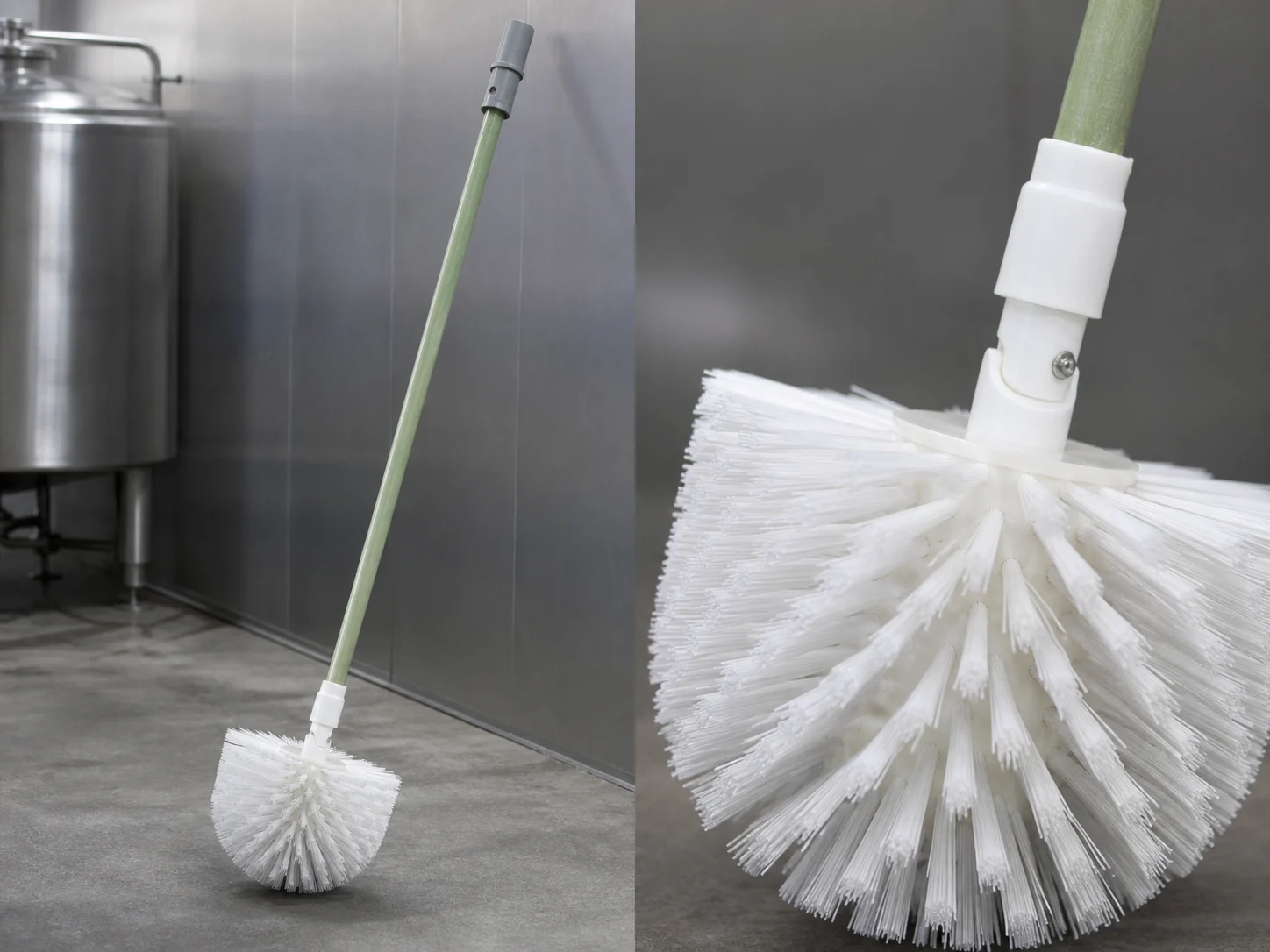
200mm PBT Storage Tank Brush for industrial tank cleaning. Twisted stainless steel core, quick-change coupling, 400mm head length.
Medium brush
100 pcs
Minimum order
Worked with two hands or on a pole: chimney, gutter and pond-filter brushes, discs, cups and tank brushes.
Production lead time, once the specification is confirmed
- Up to 100 pcsWithin 7 days
- 101–5,000 pcsWithin 14 days
- 5,001–50,000 pcsWithin 21 days
- Over 50,000 pcsConfirmed with your quotation
Peak season can extend these times; the shipping date is confirmed in writing with your quotation. Sampling and shipping are quoted separately.
A large-diameter PBT brush for scrubbing the interior walls, bottoms, and corners of storage tanks, IBC totes, and process vessels. The 200 mm head covers wide surfaces with each stroke, while the twisted stainless steel core and quick-change coupling support pole-mounted or extended-reach cleaning.
What can this brush do for you?
Wide 200 mm Diameter for Faster Tank Coverage
The 200 mm brush head contacts a large arc of the tank wall with every stroke. Compared with smaller brushes, this diameter reduces the number of passes needed to cover sidewalls, floors, and curved transitions, cutting overall scrubbing time in large vessels.
PBT Bristles Stay Stiff in Wet and Chemical Service
PBT monofilament absorbs very little moisture, so the bristles keep their flexural stiffness even after prolonged exposure to water, detergents, and many cleaning chemicals. Bristles that stay upright continue to scrub instead of flattening onto the surface, which keeps cleaning pressure consistent along the full head length.
Twisted Stainless Steel Core Withstands Pull-Stroke Cleaning
Bristles are locked into a twisted stainless steel wire core rather than glued or stapled. This construction holds the PBT tufts securely when the brush is pulled back across a rough tank wall, and the stainless core resists bending, kinking, and corrosion during repeated submersion.
Quick-Change Coupling for Pole and Head Changes
The brush is supplied with a quick-change coupling at the handle end. Operators can attach an extension pole for deep tanks, change to a different length handle, or swap the brush head without tools, reducing setup time between vessels.
Optional Glass-Fiber-Reinforced Handle
For operators who want a lighter, insulated grip, the stainless steel shaft can be fitted with a glass-fiber-reinforced handle. This reduces hand fatigue on long cleaning sessions and provides an additional barrier between the operator and any chemical residue on the shaft.
What is a 200mm PBT Storage Tank Brush?
A 200mm PBT Storage Tank Brush is a cylindrical cleaning tool built by twisting PBT monofilament between two stainless steel wires to form a dense spiral bristle pattern. The bristled section measures 200 mm in diameter and 400 mm in length, producing a round cross-section that fits through tank manways and then expands full contact onto interior walls.
In use, the brush is mounted on a handle or extension pole and guided along the tank wall, floor, and corner transitions. The stiff PBT bristles mechanically loosen liquid films, soft product residues, powder deposits, and light scale, while the circular head allows continuous scrubbing when rotated or pushed along curved surfaces.
This is not a high-speed power brush or a tool for hard deposits. It is designed for manual or low-speed pole-guided cleaning inside storage tanks, IBC totes, and process vessels where access openings are large enough for the head. For hardened mineral scale, carbonized deposits, or aggressive surface preparation, a stainless steel wire or abrasive-filled brush is more appropriate.
Technical Specifications
The values below describe the standard configuration. Dimensions, bristle diameter, core material, and coupling interface can be adjusted for your project.
| Parameter | Standard Value / Options |
|---|---|
| Brush head diameter | 200 mm (custom diameters available) |
| Bristled section length | 400 mm |
| Head profile | Cylindrical, round cross-section |
| Bristle material | PBT (polybutylene terephthalate) |
| Bristle diameter | 0.6 mm standard (0.4–1.2 mm available) |
| Core construction | Twisted stainless steel wire (304 or 316) |
| Handle material | Stainless steel shaft; optional glass-fiber-reinforced grip |
| Overall length (coupling to grip end) | 900 mm |
| Grip diameter | 32 mm |
| Connection | Quick-change coupling (interface matched to your pole or handle) |
| Maximum service temperature | 120°C (248°F) intermittent; confirm for continuous exposure |
| Chemical resistance | Resists most detergents, weak acids and alkalis, oils, and common solvents; not suitable for strong oxidizing acids or hot concentrated alkalis |
| Brush type | Custom Bottle & Container Brushes |
| How it is driven | Hand-guided |
| Cleaning target | industrial storage tank, ibc tote and intermediate bulk container, and mixing and blending vessel cleaning |
| Surface or part | tanks, vessels, corners, walls, floors, pads, sidewalls, and interior corners |
| Residue or debris | scale, powder, product film, protein film, yeast, carbonized deposits, light scale, and liquid film |
| Mounting / connection | Quick-change coupling (interface matched to your pole or handle) |
Where does this brush work best?
The 200mm PBT Storage Tank Brush is used where large interior surfaces need mechanical cleaning before rinsing or as a supplement to CIP systems.
- Industrial storage tanks — water, chemical, and food liquid tanks with manway openings of at least 220 mm, where sidewalls and floors collect product film and residues.
- IBC totes and intermediate bulk containers — top openings allow the brush to reach corners, bottom drains, and interior corners that are difficult with flat pads.
- Mixing and blending vessels — product buildup around baffles, impeller housings, and discharge ports is loosened by the bristle tips.
- Fermentation and brewing tanks — yeast, protein film, and beer stone precursor residues are removed manually between CIP cycles.
- Process tanks in food, beverage, and pharmaceutical plants — where a brush is needed to scrub residues that a spray ball cannot fully remove.
How do I choose the right one?
Use these checks before ordering or before adapting the standard configuration.
Confirm the tank opening clearance
Measure the smallest access opening diameter. The 200 mm head needs at least about 220 mm of clear opening to pass without forcing. If your opening is smaller, a smaller head diameter is required. If the opening is much larger, you may be able to use a larger head for even faster coverage.
Match the handle reach to tank depth
The standard handle reaches 900 mm from the coupling to the grip end. For deeper tanks, attach an extension pole to the quick-change coupling. Keep in mind that long poles bend; for very deep tanks, a thicker wall extension or a lighter brush head may be needed.
Select bristle stiffness for the residue
PBT works well on soft film, powder, slime, and light mineral haze. For dried-on polymer deposits or thick, hardened scale, PBT will not generate enough cutting force — you need stainless steel wire or an abrasive-filled brush. For delicate linings or painted interiors, switch to a softer bristle material such as polypropylene or Tampico.
Verify chemical and temperature compatibility
PBT is resistant to many cleaning chemicals, but check your specific detergent concentration and temperature. Continuous exposure to strong acids, hot concentrated alkalis, or chlorinated solvents at high temperatures can degrade the bristles. If in doubt, send us your SDS and operating temperature.
Manual or powered operation
This brush is designed for manual or low-speed pole use. The quick-change coupling can be adapted to a rotary machine, but high RPM will cause excessive bristle wear and possible core fatigue. If you need powered scrubbing, tell us the RPM and torque so we can reinforce the core or recommend a machine-specific brush.
If after these checks the brush still fits the job, the standard configuration can be ordered as-is. If any parameter needs to change, the next section explains what can be customized.
Can I customize this brush?
Yes. The 200mm PBT Storage Tank Brush is a configurable product because tank sizes, access openings, residues, and cleaning processes vary widely. To define a custom configuration, provide these details:
- Tank internal diameter, height, and smallest access opening
- Type of residue to be removed (film, powder, scale, biofilm, etc.)
- Cleaning chemicals and wash temperature
- Desired handle length, grip diameter, and material
- Coupling interface (existing pole, quick-change brand, or machine adapter)
- Manual or powered use, and if powered, the RPM and torque
We can adjust the following elements:
- Head dimensions — diameter (e.g., 150, 250, 300 mm) and bristled length
- Bristle parameters — material (PBT, nylon, polypropylene, stainless steel), diameter, stiffness, and trim type
- Core and handle — 304 or 316 stainless steel, glass-fiber or polymer grip, extended lengths
- Coupling — quick-change, threaded, or custom machine mount
- Color and marking — bristle color, handle color, pad printing, laser marking, or identification banding
- Packaging — bulk, individually bagged, or project-specific packing
For projects requiring material documentation, certificates of analysis, inspection reports, or third-party testing, we can support those requirements during the customization process.
Which filament survives the cleaning and still lasts on a 200mm PBT storage tank brush?
How do I know if the 200 mm head will fit through my tank opening?
Measure the smallest internal diameter of the manway or access port. The brush head needs at least 20 mm of additional clearance to pass without jamming, so the opening should be at least 220 mm. If the opening has a lip, step, or internal obstruction, account for that reduced clearance as well.
Can I use this brush on a drill or power tool?
The standard quick-change coupling can be adapted to a drill chuck or other rotary interface, but the brush is not designed for high-speed use. For occasional low-speed powered scrubbing under 500 RPM, it may be usable if the core is reinforced. For continuous powered cleaning, specify a machine brush version with a heavier core and shorter bristles.
What should I do after cleaning to keep the brush in good condition?
Rinse the bristles and core with clean water to remove cleaning chemical residue, then hang the brush vertically with the bristles down so water drains away from the coupling. Do not store the brush resting on its bristles, as this can cause permanent set. Inspect the core for corrosion and the bristles for flattening before next use.
Is PBT safe for food contact surfaces?
PBT is widely used in food processing equipment. If your application requires food contact certification or a specific material declaration, we can supply the necessary documentation during customization. The standard configuration uses stainless steel core wire, which is also suitable for food processing when selected in the correct grade.
How often should I replace the brush?
Replace the brush when the bristles have shortened noticeably, when more than 10% of the bristles have fallen out, or when the core wire shows signs of corrosion or fatigue bending. A brush with flattened or missing bristles will not clean consistently and may leave residues behind.
Does this brush remove hardened mineral scale?
No. PBT bristles are not aggressive enough to cut through hard mineral scale, calcium carbonate deposits, or baked-on carbon. For those residues, use a stainless steel wire brush or an abrasive-filled brush. Use the PBT brush for film, soft residues, and light haze that a wire brush might scratch or embed into the surface.
Guides that go deeper on this
We have not written a guide specific to this one yet. The material that covers selection, filament, dimensions, maintenance and sourcing is collected in the technical resources library.
Custom Manufacturing RFQ
Describe Your Application
For a custom quote, we need the key dimensions, surface or part, residue, material preference, quantity, and reference image or drawing.
Drawing or photo optional — it speeds things up, it does not gate the enquiry.
Custom Brush RFQ
Send Your Brush Project
Upload a drawing, product photo, or sample photo and provide the core dimensions and cleaning conditions.
“We need a brush to remove wet residue from a stainless steel conveyor, about 800mm wide. The current brush wears quickly. We can send photos.”
“We sell drinkware and need a cleaning brush to include with the product. Quantity around 5,000 pieces.”