
Custom Cleaning Brush
300mm PBT Fermentation Tank Bottom Brush
300mm round PBT head on 316 SS handle removes yeast film, protein, hop residue and biofilm from fermentation tank bottoms, cones, welds and drain areas.
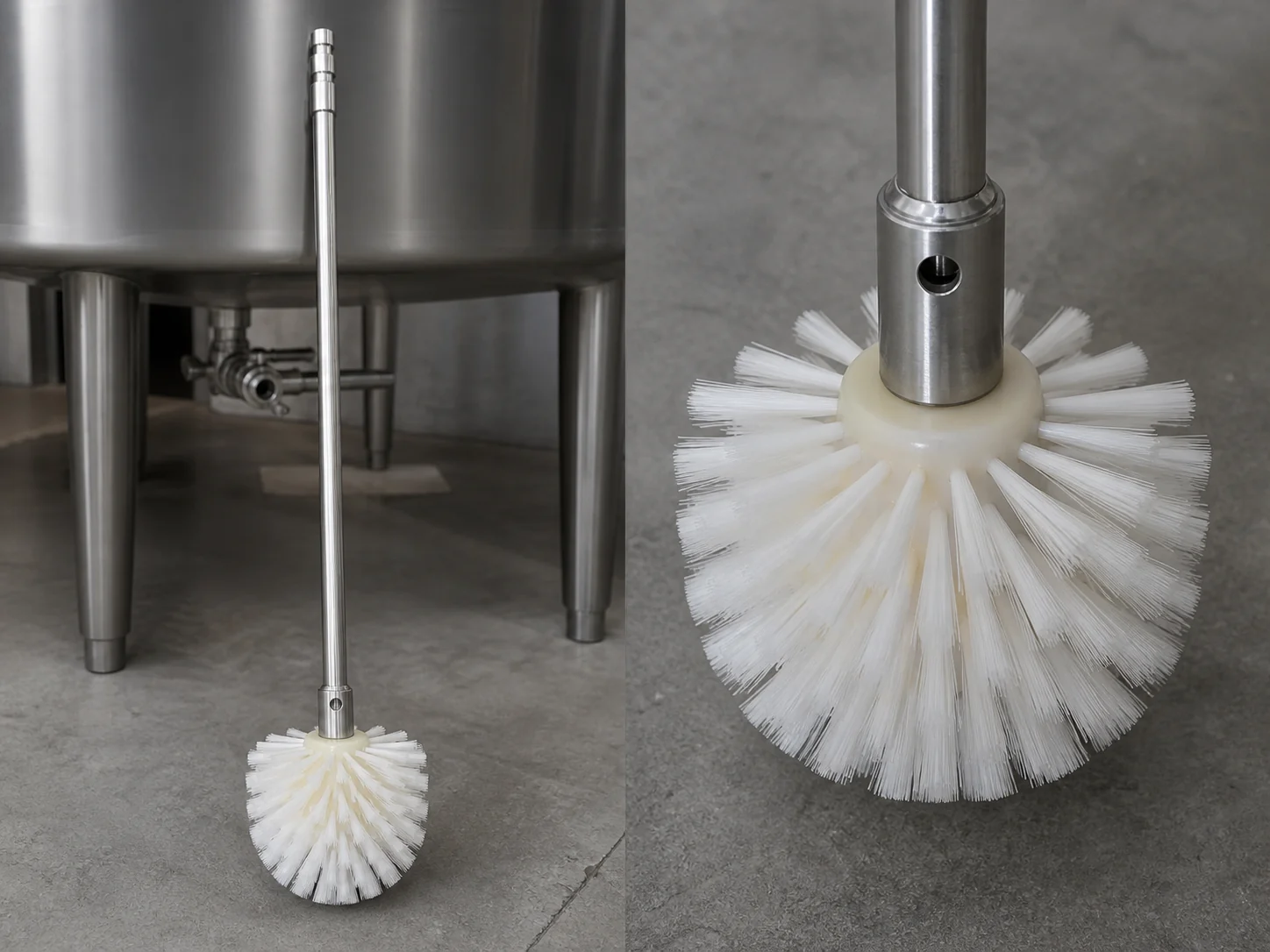
Medium brush
100 pcs
Minimum order
Worked with two hands or on a pole: chimney, gutter and pond-filter brushes, discs, cups and tank brushes.
Production lead time, once the specification is confirmed
- Up to 100 pcsWithin 7 days
- 101–5,000 pcsWithin 14 days
- 5,001–50,000 pcsWithin 21 days
- Over 50,000 pcsConfirmed with your quotation
Peak season can extend these times; the shipping date is confirmed in writing with your quotation. Sampling and shipping are quoted separately.
A 300 mm round bottom-contact brush with stiff PBT bristles and a long AISI 316 stainless steel handle, built to remove yeast film, protein soil, hop resin, biofilm, and softened mineral deposits from the floor, cone, lower sidewall, drain ring, and weld zones of fermentation and process tanks.
What can this brush do for you?
Clears the tank bottom in wide, controlled passes
The 300 mm diameter face packs a full field of PBT tufts across the working side, so every forward, pull, or rotary stroke contacts a broad area of the floor at once. On a 2–3 m diameter conical fermenter, that means fewer repeated passes to work from the center drain out to the lower sidewall.
Stiff enough to lift attached biofilm, soft enough to protect polished stainless
PBT filaments keep their stiffness in hot, wet, chemical-laden conditions and recover better than many nylon grades after repeated flexing. The brush applies real mechanical pressure to dried yeast film, protein, and hop residue, yet the plastic tips do not scour or leave carbon-steel contamination on polished 316/316L tank surfaces.
316 stainless construction survives the chemical environment
The head block, handle tube, and coupling are AISI 316 stainless steel, so the assembly does not introduce rust, stain, or plating fragments into the vessel. That matters when the same brush goes from hot alkaline foam to acid rinse and back during a typical fermentation area turnaround.
Long reach without entering the sump zone
The 1200 mm handle and 38 mm grip put the operator’s hands above the bottom residue layer and splash zone while still delivering enough torque to scrub the cone and center drain. The polished tube is easy to rinse and dries quickly between batches.
Quick-change head keeps the handle in service
A 316 stainless quick-change coupling separates the brush head from the handle without tools. When the 300 mm head wears, a replacement head swaps in during the same CIP window, and the handle continues in use across tanks or shifts.
Round face follows the dish and drain recess
The round profile keeps contact inside the bottom dish and around the center outlet, where CIP spray patterns are weakest. Where the floor transitions to a cone weld, a perimeter tuft row can be added to brush the corner without changing the 300 mm footprint.
What is a 300mm PBT Fermentation Tank Bottom Brush?
A 300mm PBT Fermentation Tank Bottom Brush is a manual tank-cleaning tool with a round, fully tufted PBT brush head mounted at the end of a 1200 mm AISI 316 stainless steel handle. It is designed for the bottom-facing surfaces of fermentation and storage vessels — the floor dish, the cone transition, the lower shell, the outlet recess, and the weld zone where CIP spray balls leave shadow areas.
In use, the operator inserts the head through the manway or bottom access door, places the bristle face on the bottom, and works with push-pull, side-to-side, or rotating strokes. The PBT filaments break the film of settled solids and the 316 structure handles the hot washdown water and cleaning chemicals. Loosened soil is then carried away by the final rinse or the vessel CIP program.
This is a manual finishing and shadow-area cleaning tool, not a replacement for a CIP skid, a powered floor scrubber, or a chemical descaling procedure. It is the tool you reach for when the bottom still carries a visible film or slippery yeast layer after the automatic wash cycle.
Technical Specifications
| Parameter | Standard configuration / selectable options |
|---|---|
| Brush head diameter | 300 mm |
| Head shape | Round, bottom-contact disc |
| Bristle material | PBT |
| Bristle trim length | 25–40 mm, selected by soil and tank finish |
| Tuft pattern | Full-face straight or spiral rows; optional angled perimeter tuft row |
| Head base / block | AISI 316 stainless steel, resin-set or staple-secured tufting |
| Handle material | AISI 316 stainless steel, polished |
| Handle length | 1200 mm standard |
| Grip diameter | 38 mm |
| Connection | Quick-change coupling, 316 stainless steel |
| Overall length | Approx. 1250–1350 mm depending on head block height and coupling style |
| Operating temperature | PBT bristle service up to 100°C continuous wet exposure; stainless structure rated higher |
| Chemical environment | Compatible with common alkaline and acid-based brewery, wine, and food-plant cleaners; validate concentrated oxidizing solutions |
| Brush type | Custom Bottle & Container Brushes |
| How it is driven | Hand-guided |
| Cleaning target | conical beer fermenter and unitank, wine fermentation tank, and beverage process vessel cleaning |
| Surface or part | tanks, welds, floors, drain, vessels, sidewalls, weld zones, and bottom transitions |
| Residue or debris | yeast, protein, yeast film, biofilm, scale, resin, mineral scale, and protein film |
| Mounting / connection | Quick-change coupling, 316 stainless steel |
Where does this brush work best?
- Conical beer fermenters and unitanks after yeast harvest, focusing on the bottom dish, cone-to-shell weld, lower sidewall, and outlet/drain area.
- Wine fermentation tanks with pomace, protein film, and settled lees at the bottom and lower manway zones.
- Dairy, juice, and beverage process vessels where yeast and protein films settle on dish bottoms and CIP spray balls leave shadow areas.
- Bioreactor and pharmaceutical buffer tanks with polished 316L bottoms requiring non-scratch manual post-rinse cleaning.
- Bright tanks and storage tanks where mineral scale, beerstone, or protein rings start at the bottom transition and near the outlet port.
How do I choose the right one?
Start with the manway and tank bottom
Measure the smallest access opening the head must pass through. The 300 mm head needs a clear opening substantially larger than 300 mm — typically at least 330–350 mm inside diameter to allow entry without forcing and without scraping the head against the manway rim. If your opening is smaller, specify a reduced head diameter or a two-piece design in the project review.
Also check the bottom shape: flat dish, shallow dish, or steep cone. A flat or gently dished floor is the 300 mm round face’s natural match. Steep cone bottoms may only receive full contact at the center unless angled perimeter tufts or a cone-matched head are specified.
Match the soil type to bristle diameter and trim length
| Typical bottom condition | Configuration guidance |
|---|---|
| Fresh yeast film, soft biofilm | Moderate PBT filament diameter, shorter trim for firmer scrubbing |
| Dried protein, hop resin, sticky trub | Higher filament diameter, longer trim, full-face tuft pattern for more mechanical lift |
| Polished, highly reflective 316L finish | Test a softer PBT or reduced trim pressure before full adoption; PBT is non-scratch relative to steel wire |
| Mineral scale or beerstone | Acid softening or CIP first; use PBT to remove softened scale; hard scale may require wire brushing or chemical descaling |
Set the handle reach to the vessel depth
The 1200 mm handle is selected for tanks where the operator can work from the bottom manway or a low platform and still control the brush. For deeper vessels where the bottom is farther from the only access, a longer handle can be manufactured, but every added 300 mm reduces feel and increases shaft flex; specify the shortest handle that still reaches the work zone.
Verify chemical and temperature exposure
PBT is chosen for its resistance to hot alkaline and acid-based tank cleaners and its ability to hold bristle shape. For validation, request a sample tuft and soak test in your actual cleaning chemistry at process temperature before committing a production run. This is more reliable than a generic compatibility table.
When a different tool is correct
Switch to a wire or abrasive brush if the deposit is hard mineral scale, heat-set carbon, or weld spatter. Use a powered disc or long shaft machine for very large floors or heavy production. If the vessel cannot be opened, a CIP spray system is the only practical route. PBT bottom brushing works best on accessible stainless floors carrying organic films, not on bound scale or inaccessible enclosed tanks.
Can I customize this brush?
For project definition, provide the manway inner diameter, tank bottom diameter and dish/cone angle, distance from access point to bottom, soil description, cleaning chemical, temperature, and any coupling or holder already in use. We can adjust:
- Head diameter, from smaller manway-fit sizes to larger floor-coverage versions
- PBT filament diameter, trim length, tuft spacing, and tuft pattern; optional angled or perimeter tufts for cone/weld contact
- Head base material and tuft anchoring method selected for chemical exposure
- Handle length, grip diameter, grip overmold, and handle finish, including anti-slip or color-coded zones
- Coupling style: quick-change, threaded, safety-lock, or an existing customer interface
- Color coding, laser marking, or identification bands to separate product-contact and non-contact brushes
- Bulk or individual packaging, with washdown-resistant tags if required
If your program requires material declarations, inspection reports, or third-party testing support, provide those requirements during the configuration phase.
When is a 300mm PBT fermentation tank bottom brush worn out rather than just dirty?
How do I confirm the 300 mm head will pass through the manway?
Measure the narrowest internal diameter of the access opening or any internal obstruction the head must pass. The opening should be at least 330–350 mm for comfortable entry with the 300 mm head, allowing clearance for hand guidance and avoiding scraping the manway rim. If the vessel has a smaller oval or side inspection port, specify the reduced head size before ordering.
Does this brush remove beerstone or heavy mineral scale by itself?
No. PBT bristles lift organic films and detach partially dissolved scale after an acid or CIP step, but they do not dissolve mineral deposits. Hard beerstone should first be treated with an appropriate acid cleaning cycle; the brush then removes the softened residue so it can be rinsed out.
How can I verify the bottom, cone weld, and drain ring are actually clean?
Before the vessel dries, inspect the center outlet recess, weld seams, and the bottom-to-cone transition with a flashlight or borescope. Wipe each zone with a white lint-free cloth; any yellow/brown film, slippery feel, or hop odor means contact or bristle pressure in that zone needs adjustment — typically a perimeter tuft row, a different trim length, or a longer handle position.
What should I inspect on the brush before each cleaning shift?
Check that the quick-change coupling is fully engaged, the handle tube has no cracks or deep scratches, and the head base shows no loose or pulled tufts. Look at the bristle face: if center tufts are flattened, splayed, or shorter than half their original trim, replace the head. Also confirm no metal fragments or foreign objects are trapped in the tufts before the brush enters the tank.
Can the brush handle hot caustic and chlorine-based sanitizers?
PBT tolerates common hot alkaline and acid-based cleaners used in breweries and food plants. Strong oxidizing agents or concentrated chlorine solutions at elevated temperature should always be sample-tested, because AISI 316 handle components can suffer chloride pitting under prolonged high-temperature exposure. Where the site uses high-chloride chemistry, discuss alternative handle materials or exposure limits.
Does bottom brushing replace the CIP cycle?
No. Manual brushing targets bottom and weld shadow areas where spray-ball impact is weakest and removes settled solids after yeast harvest or before rinse. The vessel still needs the programmed CIP wash, sanitization, and rinse steps. Brushing is a step in the turnaround sequence, not a replacement for the chemical or thermal wash.
Guides that go deeper on this
We have not written a guide specific to this one yet. The material that covers selection, filament, dimensions, maintenance and sourcing is collected in the technical resources library.
Custom Manufacturing RFQ
Describe Your Application
To quote this brush accurately, send the size, material, cleaning target, residue, quantity, and any available drawing or sample photo.
Drawing or photo optional — it speeds things up, it does not gate the enquiry.
Custom Brush RFQ
Send Your Brush Project
Upload a drawing, product photo, or sample photo and provide the core dimensions and cleaning conditions.
“We need a brush to remove wet residue from a stainless steel conveyor, about 800mm wide. The current brush wears quickly. We can send photos.”
“We sell drinkware and need a cleaning brush to include with the product. Quantity around 5,000 pieces.”