
Custom Cleaning Brush
85mm PBT Fermentation Bottle Brush
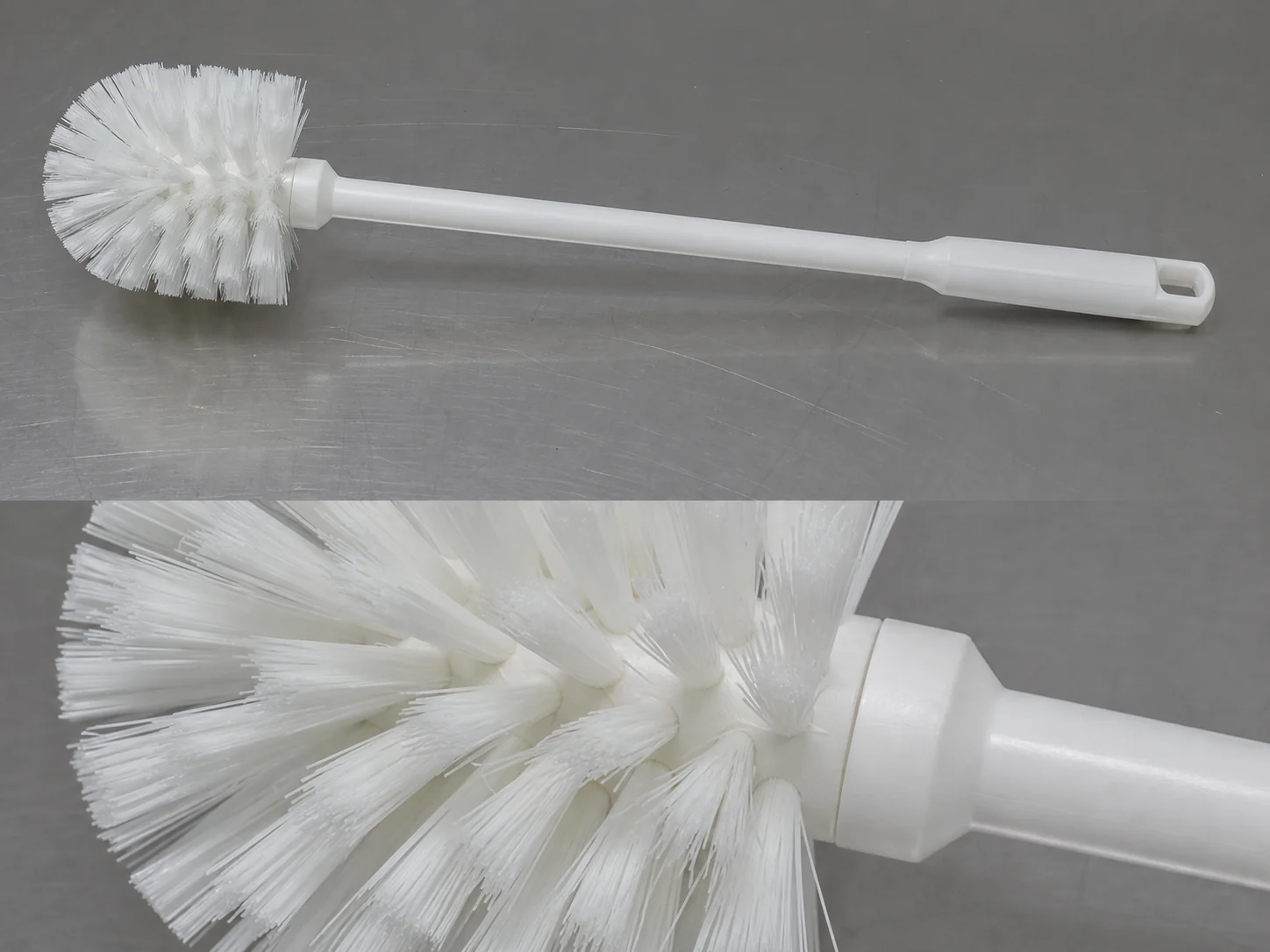
85mm PBT fermentation bottle brush with 220mm bristled head and 350mm PP handle for wide-mouth fermenters. Custom sizes and materials available.
Small brush
500 pcs
Minimum order
Held in one hand: tube, bottle, detail and swab brushes — including long-handled ones with a small head.
Production lead time, once the specification is confirmed
- Up to 500 pcsWithin 7 days
- 501–50,000 pcsWithin 14 days
- Over 50,000 pcsWithin 21 days
Peak season can extend these times; the shipping date is confirmed in writing with your quotation. Sampling and shipping are quoted separately.
An 85 mm round-head fermentation bottle brush built with PBT bristles and a 350 mm polypropylene handle for scrubbing wide-mouth fermenters, crocks, and jars — removing krausen rings, yeast film, fruit debris, and sticky organic residue through the full depth of the vessel.
What can this brush do for you?
85 mm head covers the sidewall, shoulder, and bottom in one sweep
The round head carries radial bristle fill along a 220 mm working length, so each push, pull, and rotating stroke contacts the vertical wall and the curved bottom transition at the same time. Wide-mouth fermenters usually build residue right at that base-to-wall curve, and this brush works that line without switching tools.
PBT bristles stay stiff when wet
PBT absorbs very little moisture compared with conventional nylon, so the bristles keep their recovery and scrub pressure even after sitting in wash water or sanitizer. In fermentation cleaning the brush often stays wet through a full batch cycle, and a filament that goes limp in water leaves residue behind.
Long fixed handle keeps the operator’s hands clear of the solution
The 350 mm polypropylene handle plus the 220 mm bristled section puts roughly 570 mm between the grip and the head tip. Operators can clean tall vessels without pushing their hands into the opening, and the fixed connection removes the joint movement and loosening problems that threaded or clamp-on assemblies add.
Firm enough for organic film, controlled enough for food-contact surfaces
PBT sits between soft natural fibers or silicone and aggressive wire brushes. It removes sticky sugar film, dried fruit pulp, yeast sediment, and biofilm under normal hand pressure, while the rounded filament ends create much less scratch risk on glass or food-grade plastic fermenter interiors than wire or abrasive pads.
Easy to rinse and inspect after batch use
The smooth PP handle and open bristle structure do not trap large amounts of residue, so the brush can be rinsed, hung, and visually inspected between batches. If a tuft is damaged or the head begins to deform, it is visible before it affects the next cleaning cycle.
What is a 85mm PBT Fermentation Bottle Brush?
It is a hand-guided bottle brush with a round, bristled head 85 mm in diameter and 220 mm long, permanently fixed to a 350 mm polypropylene handle. The bristles are PBT filament, a polyester material selected because it holds its shape and stiffness in the wet, warm, often acidic or alkaline cleaning environment of fermentation vessels. The brush passes through the mouth of a wide-mouth container and cleans the inner wall, shoulder, and base with push-pull and rotating strokes.
This is not a narrow-neck carboy brush and not a wire or abrasive scrubber. The 85 mm head requires a vessel opening large enough for entry and rotation, typically around 90 mm or larger. Within that fit, it handles regular mechanical removal of fermentation residue such as dried krausen, fruit pieces, vegetable fibers, yeast sediment, powder residues, and pellicle film before the rinse and sanitation steps.
The brush is most effective when used with the correct cleaning chemical for the residue, not as a dry tool. Wetting softens the organic film, the PBT bristles dislodge it, and the rinse carries it away. It is part of a cleaning sequence, not a substitute for sanitizing.
Technical Specifications
The values below describe the standard 85mm PBT Fermentation Bottle Brush. Head diameter, length, bristle grade, and handle details can be adjusted for your vessel dimensions.
| Parameter | Value / Options |
|---|---|
| Head diameter | 85 mm nominal, round head |
| Head length | 220 mm bristled working area |
| Bristle material | PBT (polybutylene terephthalate) filament — wet-stiffness and chemical-resistant grade |
| Handle material | Polypropylene (PP) |
| Handle length | 350 mm |
| Grip diameter | 20 mm |
| Overall reach | Approx. 570 mm from handle end to head tip |
| Connection | Fixed, non-removable head-to-handle joint |
| Opening required | Minimum approx. 90 mm inside diameter for free entry and rotation |
| Bristle stiffness | Medium-firm standard; firmer or softer PBT grades available by project |
| Service environment | Common fermentation cleaners, hot water, dilute acids and alkalis at normal use temperatures; confirm for solvent or strong-oxidizer exposure |
| Brush type | Custom Bottle & Container Brushes |
| How it is driven | Hand-guided |
| Cleaning target | wide-mouth glass or plastic fermentation jar, brewing and beverage vessel, and food and beverage ingredient container cleaning |
| Surface or part | vessels, containers, pads, walls, glass, plastic, sidewalls, and ports |
| Residue or debris | yeast, sediment, yeast film, sugar, powder, syrup, organic film, and fiber |
| Mounting / connection | Fixed, non-removable head-to-handle joint |
Where does this brush work best?
- Wide-mouth glass or plastic fermentation jars and crocks used for sauerkraut, kimchi, pickles, kombucha, hot sauce, and sugar washes, where the opening accepts the 85 mm head and the depth is within the brush’s reach.
- Brewing and beverage vessels that develop krausen rings, yeast sediment, and hop or fruit debris on the sidewall and base after fermentation or packaging.
- Small-batch fermenters and test vessels in pilot plants or commercial kitchens, where operators need a repeatable hand tool for daily post-batch residue removal rather than a disposable pad.
- Food and beverage ingredient containers that hold sticky powders, syrups, or purées and leave a film that water alone will not remove.
- Open-top tanks or containers with an access port of at least 90 mm, where the long handle keeps hands away from the cleaning solution.
How do I choose the right one?
Check the narrowest opening before anything else. The brush head is 85 mm across and must pass through the vessel mouth with enough clearance to rotate and reverse direction. If the inside diameter is less than about 90 mm, the head will bind at the rim or scrape the threads. For narrow-neck carboys, small-mouth demijohns, or tubing, choose a smaller-diameter tube brush instead.
Match the contact stiffness to the residue and the surface. PBT works well on wet or softened organic residue — yeast film, fruit pulp, krausen, sugar syrup, vegetable pieces. It is not the right tool for hard mineral scale, carbonized deposits, or baked-on solids; those require a wire brush, abrasive cleaner, or chemical descaling before brushing. If the vessel is highly polished or internally coated, test the PBT brush on a sample area or choose a softer bristle or silicone brush.
Think about the cleaning chemistry and temperature. PBT and PP handle common brewery and fermentation cleaners, hot tap water, and normal sanitizer contact well. If your process uses strong solvents, chlorinated cleaners at high concentration, or temperatures above normal wash-water ranges, specify the full chemical list so the bristle and handle grades can be matched to it.
Set the reach from the vessel depth, not just the mouth. The working section reaches from the head tip back 220 mm, plus the 350 mm handle. A vessel deeper than the total reach will leave a residue band at the bottom. Measure the distance from the rim to the lowest point you need to clean, and leave enough exposed handle to grip and control the brush outside the vessel.
Consider the contact pattern. The round head cleans curves and circular surfaces best. If your vessel has square corners, a deep under-rim ledge, a drain fitting, or an internal baffle, one brush cannot reach every feature; plan an additional angled brush or detail brush for those areas.
Can I customize this brush?
Yes. The 85mm PBT version is a standard configuration, but the brush can be produced to your vessel dimensions and process. To quote a custom configuration, provide the minimum mouth inside diameter, internal body diameter, internal depth, wall and bottom geometry, vessel material, residue type, cleaning chemical list, wash water temperature, and how the brush will be stored between uses. A vessel drawing or photo speeds up the fit check.
We can adjust:
- Head geometry — diameter, bristled length, round or tapered profile, end shape for curved bases, or a secondary detail section for threads and under-rim areas.
- Bristle package — PBT filament diameter, cut length, trim angle, bristle density, stiffness grade, or a material change to nylon, PP, or another filament where the chemistry or surface requires it.
- Core and connection — corrosion-resistant wire core, molded core, or other project-suitable construction; fixed, threaded, or quick-connect handle interface depending on your handling system.
- Handle — length, straight or loop grip, color, texture, hanging hole, or a two-piece/extension design for deeper vessels.
- Marking and packaging — custom color, pad print, laser marking, SKU coding, bulk packing, individual bags, or retail-ready packaging.
If your fermentation or food-contact project requires material declarations, third-party testing, inspection protocols, or other documentation, we can support those requirements during the customization stage so the brush specification matches your quality system.
Which filament survives the cleaning and still lasts on a 85mm PBT fermentation bottle brush?
What is the smallest opening this brush will fit?
Allow an inside mouth diameter of at least 90 mm. The 85 mm head needs clearance to enter, rotate, and reverse without scraping the rim or jamming in the neck. If the opening is exactly 85 mm, the brush will be too tight for practical use.
Can I use this brush in a glass carboy or narrow-neck jug?
No. The 85 mm head cannot pass through the small neck of a typical carboy or demijohn. For those vessels, choose a smaller-diameter tube brush or a flexible-neck brush sized to the opening.
Will the PBT bristles scratch my glass or plastic fermenter?
Under normal hand pressure on glass or food-grade plastic, PBT is much less likely to scratch than wire or abrasive pads. However, PBT is still a mechanical filament. On highly polished, coated, or display surfaces, run a small spot test first, or choose a softer bristle material for that vessel.
How should I check the brush between batches?
Look for flattened or splayed bristles, missing tufts, a bent core, or cracks in the handle. Run a gloved finger along the head under light to feel for embedded debris. If the bristles no longer spring back after bending, or the head no longer presses the vessel wall during rotation, it is time to replace the brush.
Does brushing replace rinsing and sanitizing?
No. Brushing loosens and removes attached organic residue. Rinse the vessel to carry away the loosened material, then run your normal sanitation or sterilization step. A brush is a cleaning tool, not a sanitizing substitute.
Can this brush handle boiling water or autoclave cycles?
PBT and PP tolerate normal hot tap water and warm cleaning solutions, but repeated boiling or autoclaving can soften or distort the plastic components. If your process includes high-temperature cycles, specify the exact temperature and exposure time so we can confirm the right material combination for your SOP.
Guides that go deeper on this
Custom Manufacturing RFQ
Describe Your Application
For a custom quote, we need the key dimensions, surface or part, residue, material preference, quantity, and reference image or drawing.
Drawing or photo optional — it speeds things up, it does not gate the enquiry.
Custom Brush RFQ
Send Your Brush Project
Upload a drawing, product photo, or sample photo and provide the core dimensions and cleaning conditions.
“We need a brush to remove wet residue from a stainless steel conveyor, about 800mm wide. The current brush wears quickly. We can send photos.”
“We sell drinkware and need a cleaning brush to include with the product. Quantity around 5,000 pieces.”