
Custom Cleaning Brush
55mm PBT Food Bottle Brush
55mm round PBT bottle brush for food and beverage containers. 150mm head, 250mm PP handle.
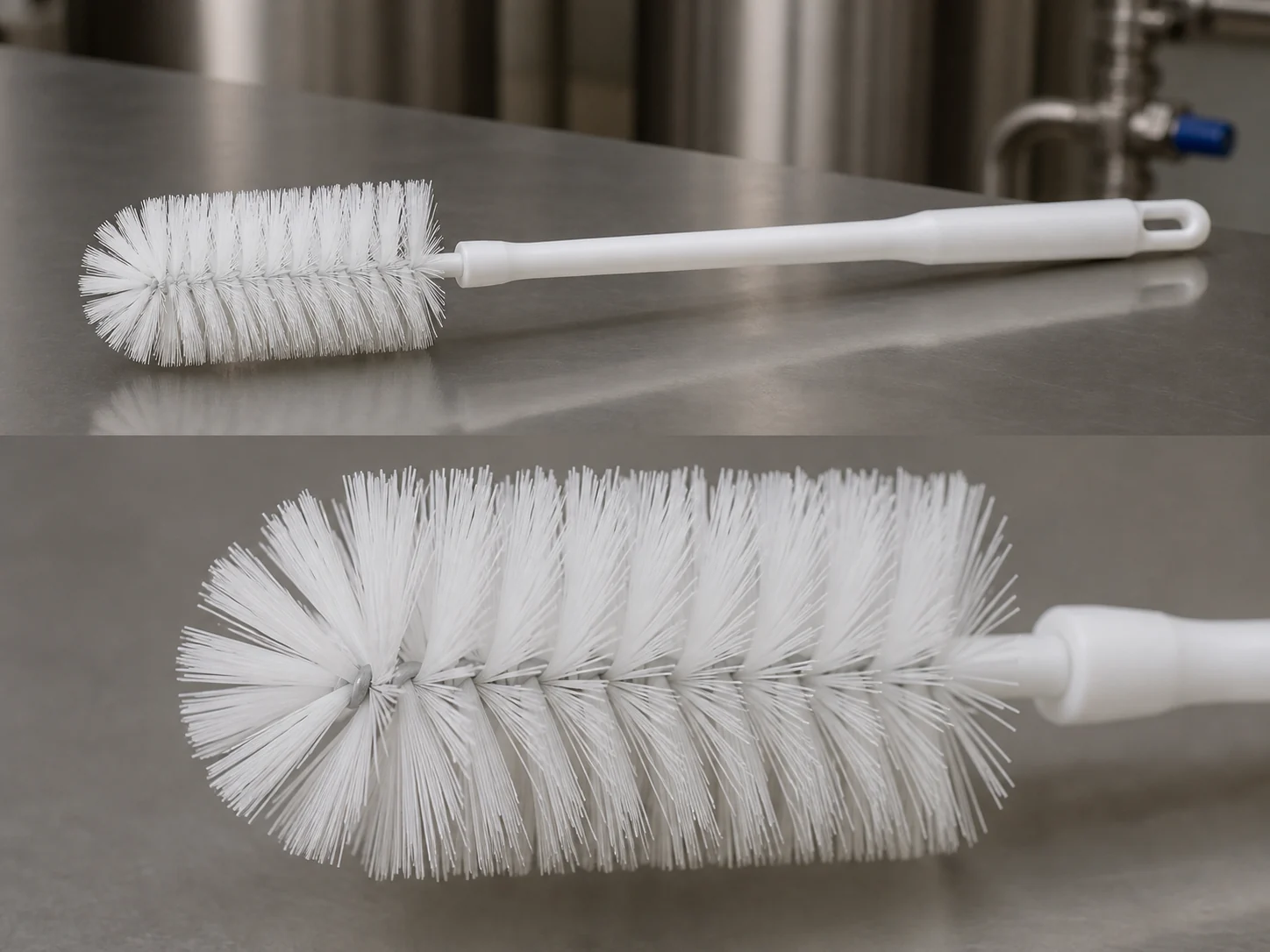
Small brush
500 pcs
Minimum order
Held in one hand: tube, bottle, detail and swab brushes — including long-handled ones with a small head.
Production lead time, once the specification is confirmed
- Up to 500 pcsWithin 7 days
- 501–50,000 pcsWithin 14 days
- Over 50,000 pcsWithin 21 days
Peak season can extend these times; the shipping date is confirmed in writing with your quotation. Sampling and shipping are quoted separately.
The 55mm PBT Food Bottle Brush is a round-head, polyester-bristle cleaning tool for wide-mouth food and beverage containers. Its 55mm head compresses through the neck and expands to scrub sidewalls, shoulders, and bases, while the PBT filament holds its shape through repeated hot-wash and sanitation cycles.
What can this brush do for you?
Compresses Through the Opening, Then Recovers Against the Wall
The 55mm round head is built with PBT filament that flexes as you push it through a bottle neck, then springs back against the interior wall once inside. That means the brush does not stop cleaning at the opening zone. It maintains sidewall contact across the full travel of the head, which reduces the need to stop and reposition the brush to reach missed areas in wide-mouth water bottles, jars, and mixing containers.
Holds Its Stiffness in Hot Water and Detergent
PBT polyester filament absorbs very little water and keeps its bend recovery after repeated exposure to hot water, alkaline detergents, and many food-sanitation chemicals. The bristles stay upright instead of matting flat, so the 55mm head delivers the same scrubbing pressure on later cycles. For food production and reusable bottle programs, that means more consistent cleaning between replacements.
Round Head Covers the Base and Shoulder Transition
The round profile and 150mm head length let the brush follow the inside curve where the sidewall meets the base. A straight-ended or narrow head tends to leave a ring of residue at that transition. Because the head is round and fully bristled, it presses into the base corner as you push down and into the shoulder as you withdraw. Fewer dead spots reduce the chance of biofilm or product film building up.
Fixed PP Handle Keeps the Tool in One Piece
The brush is built with a fixed connection between the PBT bristle head and the polypropylene handle. In a cleaning routine that involves push-pull, twist, and soaking, a screw-on or press-fit head can loosen and drop into the container. The fixed construction removes that failure mode and leaves no crevice at the connection point for residue to lodge.
Metal-Free Assembly for Food Areas
The entire tool is PBT and polypropylene, with no metal core, no wire wrap, and no exposed metal tip. That matters in food and beverage areas where metal contact or metal detection interference is a concern. The brush can be used around glass-lined, coated, or plastic containers without the risk of scratching from a wire stem.
What is a 55mm PBT Food Bottle Brush?
The 55mm PBT Food Bottle Brush is a hand-operated cleaning brush with a round bristle head made from PBT polyester filament, mounted on a fixed polypropylene handle. It is built for cleaning the inside of food and beverage containers that have a neck opening large enough for the 55mm head to pass through and a body wide enough for the head to contact the sidewall.
During use, the operator inserts the head, pushes it to the base, then rotates and pulls upward. The bristle tips scrape and lift liquid film, product residue, powder, and loose particles from interior walls, threads, neck, shoulder, and base. The round profile and full bristle coverage work with both linear push-pull and rotational motion. Because PBT is stiff enough to scrub but compliant enough to avoid scratching most glass, polycarbonate, copolyester, and stainless surfaces, it works for reusable bottle interiors, mixing containers, jars, and processing vessels with smooth walls.
This is a medium-duty cleaning tool. It is not a wire brush for baked-on carbon or mineral scale, and it is not a flexible silicone brush for very small openings or extremely curved necks. Its job is consistent, repeatable interior cleaning where the opening is at least about 45mm and the residue is fresh film, fat or protein deposits, or loose particles.
Technical Specifications
Values shown are the standard configuration. For high-volume or line-specific programs, head diameter, bristle stiffness, handle length, and color can be adjusted without changing the working principle.
| Parameter | Value / Options |
|---|---|
| Head diameter | 55 mm round |
| Head length | 150 mm |
| Bristle material | PBT polyester filament, food-grade suitable |
| Bristle diameter | 0.20–0.35 mm, selected for stiffness |
| Bristle trim length | 15–22 mm, depending on interior profile |
| Handle material | Polypropylene (PP) |
| Handle length | 250 mm |
| Overall length | 400 mm total (head + handle) |
| Grip diameter | 14 mm |
| Connection | Fixed, one-piece assembly |
| Metal content | None (all plastic) |
| Operating temperature | Suitable for normal hot water and wash cycles up to 100°C contact |
| Chemical exposure | Resists alkaline detergents, neutral cleaners, and common food-sanitation solutions at recommended dilution; avoid strong oxidizers or solvents |
| Brush type | Custom Bottle & Container Brushes |
| How it is driven | Hand-guided |
| Cleaning target | wide-mouth reusable water bottle and sports bottle, food processing mixing container, and reusable bottle cleaning kit and food sanitation cleaning |
| Surface or part | containers, necks, shoulders, sidewalls, thread, profiles, corners, and bases |
| Residue or debris | protein, particles, carbon, scale, powder, loose particles, liquid film, and mineral scale |
| Mounting / connection | Fixed, one-piece assembly |
Where does this brush work best?
- Wide-mouth reusable water bottles and sports bottles where the neck is 45mm or larger and the body diameter is between roughly 60mm and 90mm.
- Protein shaker cups and blender bottles with interior threads and shoulder corners; the round head reaches under the threads.
- Food processing mixing containers, ingredient bins, and sauce buckets that need a handheld brush for wash-down between batches.
- Beverage dispensing containers with accessible top openings where a fixed, metal-free brush is preferred.
- Reusable bottle cleaning kits and food sanitation tool sets where a durable, chemical-resistant brush is required.
How do I choose the right one?
Check the opening clearance first
The 55mm head needs the narrowest neck opening to be at least 45mm. PBT filament compresses, but if the opening is much smaller, the head will jam or fold permanently. Measure the minimum inside diameter of the neck or cap opening. If it is under 45mm, select a smaller head diameter or a tube brush instead.
Match bristle stiffness to the residue
Standard PBT gives medium stiffness for removing beverage film, light protein residue, powders, and particles without scratching. For dried or sticky deposits that require more pressure, specify a thicker PBT filament or a denser fill. For very soft coated surfaces where abrasion is a risk, switch to softer polyester or a silicone contact brush. For hard scale or carbon, wire or abrasive brushes are more appropriate.
Confirm the reach and handle length
The 150mm head scrubs the bottom 150mm of the interior, and the handle allows insertion to about 250mm beyond the grip. If the container depth exceeds that combined reach, specify a longer handle or an extension. Also check whether the operator needs to hold the brush above the container without leaning; the 14mm grip diameter is comfortable with gloves.
Account for the wash environment
If cleaning uses hot water up to 100°C, standard PBT and PP are suitable. Steam autoclaving above 120°C may distort the PP handle, so if the process includes steam, ask for heat-stabilized polymer options. Strong acids or oxidizers may degrade the bristles; verify chemical compatibility before selecting this brush for aggressive manual cleaning.
When another brush fits better
Use a smaller head or a bottle brush with a narrower profile if the opening is under 45mm. Use a silicone bottle brush if the surface is scratch-sensitive or the neck is very small with flexible curvature. Use a wire bottle brush if scale or carbon is baked on. Use a disposable swab if cross-contamination is the primary concern. This brush is for medium-duty, reusable, wide-mouth food container cleaning.
Can I customize this brush?
Customization is usually driven by the container geometry and the cleaning process. To define the right configuration, provide the minimum neck ID, internal body ID, internal depth, surface material, residue type, cleaning chemical, wash temperature, and preferred handle form. A drawing or sample photo helps speed up the evaluation.
We can adjust:
- Head geometry: diameter, head length, taper, dome profile, end shape, or multi-diameter form.
- Bristle configuration: PBT filament diameter, trim length, fill density, crimped or straight filament, and color.
- Handle: length, grip diameter, ergonomic shape, hanging hole, textured grip, or molded branding.
- Connection: fixed standard, or a replaceable-head design if the application requires serviceable parts.
- Packaging: bulk, polybag, retail card, kit assembly, or project-specific packing.
- Marking: pad print, laser marking, molded logo, or identification coding.
If your project requires material documentation, food-contact declarations, inspection, or third-party testing support, we can assist with those requirements during the customization process.
When is a 55mm PBT food bottle brush worn out rather than just dirty?
How do I verify the 55mm head will pass through my bottle opening?
Measure the narrowest internal opening. PBT bristles flex about 10 to 15 percent of head diameter under hand pressure. If the opening is below 45mm, the head will jam or permanently bend. Test with a sample brush, or send the dimension to us before ordering.
What detachable parts should I remove before using the brush?
Remove caps, spouts, valves, gaskets, straws, and any inserts. Clean the threads and small parts separately. The brush needs clear access to the body, shoulder, and base; loose parts can catch the bristles and prevent full wall contact.
How do I confirm the interior is actually clean after brushing?
After brushing and rinsing, inspect the neck, shoulder, and base under strong light. Wipe the base and shoulder with a white lint-free cloth. Any visible film, residue trace, or odor means the head profile, bristle trim, or cleaning motion needs adjustment. A clean cloth with no visible transfer indicates the residue has been removed, although sanitizing may still be required.
Does this brush replace sanitizing or final rinse steps?
No. Brushing loosens and removes attached residue, but loosened debris still needs to be rinsed away. If your process requires sanitizing, run that as a separate step after cleaning. The brush is one stage in the cleaning sequence, not the entire sequence.
How should I store and inspect the brush between production shifts?
Rinse the brush after each use and hang or store it with the bristles uncompressed. Inspect for matted or bent bristles, clogged residue at the base, cracks in the handle, or a loose head. If the bristles no longer spring back after compression, replace the brush. In food facilities, include the brush in the sanitation inspection log.
When should I choose a silicone bottle brush instead?
Choose silicone when the interior surface is coated or fragile and even medium PBT stiffness could mark it, when the bottle neck is very small and a silicone head can compress more, or when the residue is very soft. Choose PBT when you need more scrubbing stiffness and heat and chemical tolerance on smooth hard surfaces.
Guides that go deeper on this
Custom Manufacturing RFQ
Describe Your Application
To prepare the correct quotation, provide the dimensions, cleaning task, residue, material, mounting details, quantity, and a drawing or photo.
Drawing or photo optional — it speeds things up, it does not gate the enquiry.
Custom Brush RFQ
Send Your Brush Project
Upload a drawing, product photo, or sample photo and provide the core dimensions and cleaning conditions.
“We need a brush to remove wet residue from a stainless steel conveyor, about 800mm wide. The current brush wears quickly. We can send photos.”
“We sell drinkware and need a cleaning brush to include with the product. Quantity around 5,000 pieces.”