
Custom Cleaning Brush
300mm Spring SS304 Pipe Brush
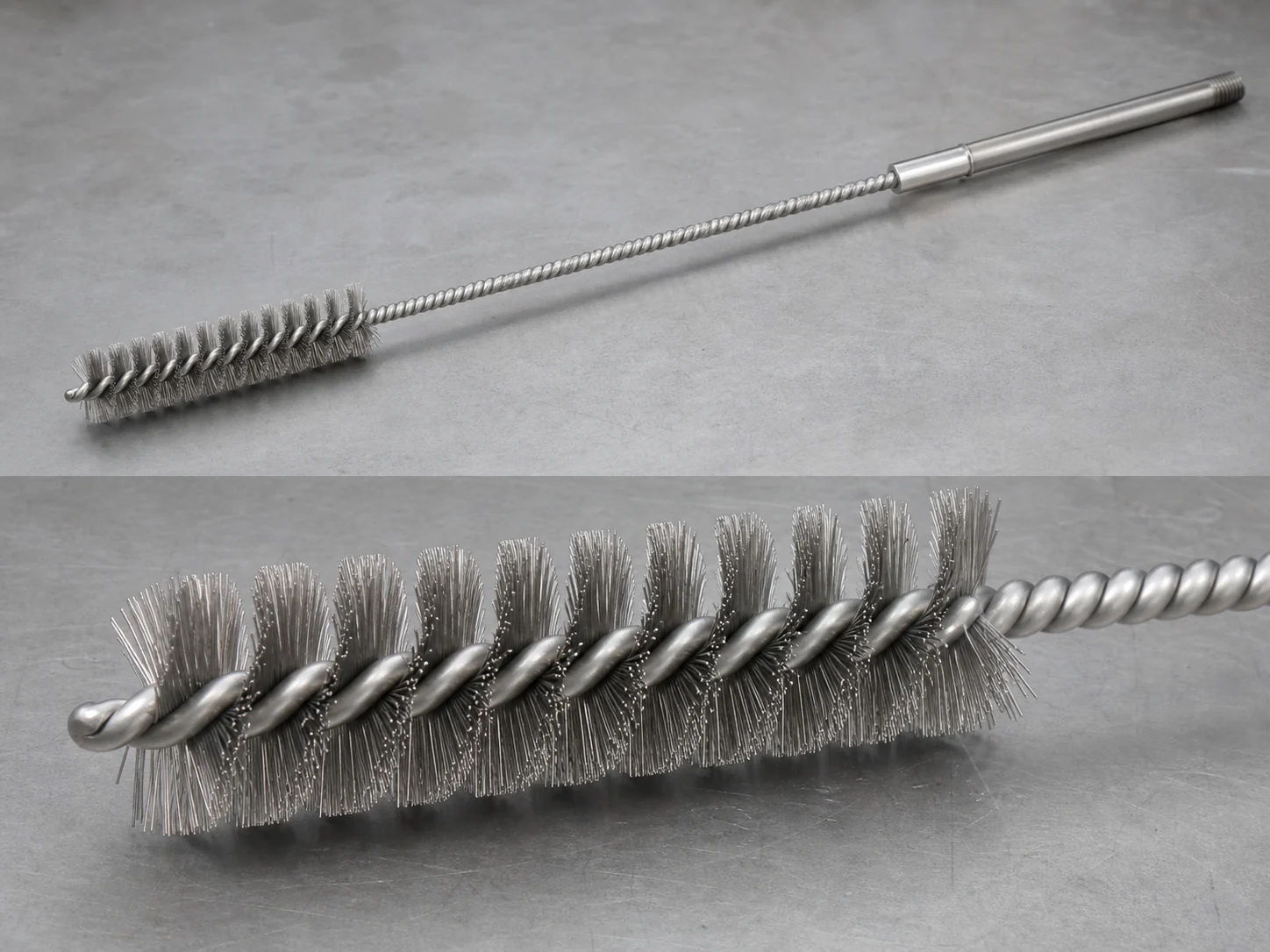
SS304 spring pipe brush with a 300 mm brushing length and 40 mm OD for pipe, tube and bore interiors. Threaded mount for manual extension or powered use.
Small brush
500 pcs
Minimum order
Held in one hand: tube, bottle, detail and swab brushes — including long-handled ones with a small head.
Production lead time, once the specification is confirmed
- Up to 500 pcsWithin 7 days
- 501–50,000 pcsWithin 14 days
- Over 50,000 pcsWithin 21 days
Peak season can extend these times; the shipping date is confirmed in writing with your quotation. Sampling and shipping are quoted separately.
A 300 mm spring-twisted SS304 pipe brush with a 40 mm outside diameter for cleaning the internal surfaces of pipes, tubes, and small-diameter bores. The helical stainless wire fill removes rust, scale, oil, chips, carbon, and process residues while the threaded end mounts to a handle, extension rod, or low-speed drive for extended reach.
What can this brush do for you?
The brushed section runs the entire 300 mm length, so no short handle limits how far into a bore you can clean. The twisted-wire stem holds the 304 stainless fill in a spiral pattern that contacts the full internal circumference with each pass.
Corrosion-resistant wire that protects the workpiece
Both the fill wire and the stem are AISI 304 stainless steel. The brush does not shed carbon steel particles that can later rust on stainless pipe and equipment. It holds up in wet lines, coolant systems, and wash-down areas where a conventional carbon steel brush would corrode quickly.
Full-length working zone with no wasted handle
The 300 mm dimension is the brushing length itself. Attach a threaded extension or chuck the mounting stud and you can work deep into long pipe runs without the brush bottoming out at a short handle.
Helical pattern releases deposits instead of packing them
The open spiral construction lets chips, scale, powder, and oil move out of the wire instead of lodging at the base of the fill. The brush stays effective longer and rinses clean between cycles.
Controlled scrubbing pressure for 35–45 mm bores
The 40 mm OD is intentionally larger than the target bore so the wire tips maintain contact under light compression. That pressure scrapes film and loose scale without the heavy force needed to crush a full brush into the pipe.
What is a 300mm Spring SS304 Pipe Brush?
This is a wire pipe cleaning brush built on a spring-twisted stainless steel core. SS304 wire is laid between two twisted 304 stainless stems, forming a spiral or helical fill along the full 300 mm brushing length. There is no separate handle section; a threaded stud at one end provides the connection to a manual handle, extension rod, or powered drive.
In use, the brush is inserted into the bore and worked with push-pull strokes, rotation, or both. The spiral wire contacts the internal diameter to loosen oil, chips, rust bloom, scale, carbon, powder, and similar process deposits. It is a mechanical cleaning tool for tube and pipe maintenance; it is not an auger or drain-clearing cable and is not designed to break through solid blockages.
The SS304 material is chosen where rust transfer and brush corrosion are concerns. The spring-twisted core allows some bending for gentle curves, but the 40 mm outside diameter makes this brush primarily a straight or large-radius bore tool. For tight elbows or complex passages, a smaller or more flexible brush should be specified.
Technical Specifications
| Parameter | Value |
|---|---|
| Brush outside diameter | 40 mm nominal |
| Overall brushing length | 300 mm; full length is working brush section |
| Fill pattern | Helical / spiral, twisted-wire construction |
| Bristle material | AISI 304 (SS304) stainless steel wire |
| Stem / core material | AISI 304 stainless steel twisted wire |
| Bristle wire diameter | 0.40 mm standard; 0.30 mm and 0.50 mm available |
| Mounting connection | Threaded removable stud, M6 x 1.0 standard |
| Mounting stud length | 15 mm standard; other lengths available |
| Recommended pipe ID | Approximately 35–45 mm for full-circumference contact |
| Recommended operation | Manual push-pull or powered rotation up to 1,200 RPM, wet or dry |
| Service environment | Water, cutting fluids, light alkaline cleaners, mild solvents; verify compatibility for strong acids or chloride service |
| Brush type | Custom Tube & Pipe Bore Brushes |
| How it is driven | Hand-driven on rods or a flexible shaft |
| Cleaning target | steel and stainless steel pipe and tube, hydraulic tubing, and process piping and equipment cleaning |
| Surface or part | pipes, bores, tubes, carbon steel, elbows, passages, pump housings, and thread |
| Residue or debris | carbon, rust, scale, chips, oil, process residue, powder, and coolant |
| Mounting / connection | Threaded removable stud, M6 x 1.0 standard; 15 mm standard; other lengths available |
The dimensions shown are the standard configuration for this product. Brush diameter, bristle gauge, stem length, and thread size can be adjusted to match a specific pipe ID, reach requirement, or machine interface.
Where does this brush work best?
- Steel and stainless steel pipe and tube ID cleaning after welding, drilling, cutting, or bending, where chips, cutting oil, scale, and light rust need to be removed before assembly or coating.
- Hydraulic tubing, handrail, structural tube, pump housings, valve bodies, and cylinder bores in the 35–45 mm internal diameter range.
- Process piping and equipment where carbon steel wire would introduce rust contamination; SS304 wire helps maintain clean stainless surfaces.
- Wet process lines, coolant systems, and wash-down environments where a brush must survive moisture and mild chemical exposure without corroding.
- Fabrication shops and maintenance crews that use extension rods or low-speed drills to clean long straight bores in repeat batches.
How do I choose the right one?
Measure the smallest bore, not the nominal size
Find the minimum internal diameter including seams, internal weld beads, threads, and couplings. A 40 mm brush performs best when the actual bore ID is roughly 35–45 mm. The wire needs light compression to scrub effectively; too much interference will fold the wire permanently and make insertion difficult.
Match the wire to the base metal and deposit
SS304 is the right choice for stainless steel and carbon steel parts when you need to remove light rust, oil, chips, powder, or process film without leaving carbon steel contamination. For heavy mill scale or thick rust on carbon steel, a carbon steel wire brush works faster but will rust and may transfer iron particles. For copper, brass, aluminum, or other soft alloys, switch to brass or nylon wire to avoid scratching.
Plan the reach and mounting
The 300 mm brushing length covers about 300 mm of bore per pass. For longer pipe, thread an extension rod or handle into the mounting stud and plan overlapping strokes. If you intend to power the brush with a drill, verify that the chuck accepts the M6 stud and that the drive will not spin the connection loose; a jam nut or reverse-thread option may be needed.
Choose manual or powered operation
Light films respond well to manual push-pull and rotation. Powered rotation between 500 and 1,200 RPM speeds up rust and scale removal, but the brush must remain centered and not be forced. High speed or side loading can break wire tips and shorten brush life.
Know this brush’s geometry limits
The spring-twisted stem tolerates gentle bends, but a 40 mm diameter brush cannot follow tight-radius elbows or complex internal channels. For such passages, choose a smaller-diameter flexible brush or a formed brush designed for that geometry.
| Condition | Recommended choice |
|---|---|
| Pipe ID below 35 mm | Select a smaller outside diameter; forcing this brush causes permanent wire set and poor contact |
| Heavy rust, mill scale, or weld spatter on carbon steel | Carbon steel or crimped wire brush; SS304 is corrosion-resistant but less aggressive |
| Copper, brass, aluminum, or soft alloy bore | Brass or nylon wire brush; SS304 will scratch the surface |
| Chloride-rich cleaners, seawater, or strong acids | Request 316 stainless wire and stem instead of SS304 |
| Tight elbows or complex internal passages | Use a smaller flexible brush or a formed brush designed for the bend radius |
Can I customize this brush?
This brush is built around the pipe you need to clean. We can adjust the following to match your application:
- Brush outside diameter, from smaller OD for narrow tubes to larger OD for bigger bores.
- Overall brushing length, either shorter or longer than 300 mm, with the threaded connection placed where you need it.
- Fill wire material, including 316 stainless, carbon steel, brass, or nylon.
- Wire diameter and density, with finer wire for surface-sensitive parts or heavier wire for more aggressive cleaning.
- Stem construction, including single or double twisted-wire core, longer shank, or a protective coating if required.
- Mounting connection, including thread size, stud length, female thread, hex shank, or quick-change interface.
- Packaging, labeling, and bulk packing for production-line or distribution use.
To define a custom configuration, provide the minimum and maximum pipe ID, the length you need to reach, the base material, the deposit or residue type, wet or dry process conditions, cleaning chemicals, manual or powered operation, speed range, and the thread or chuck specification. A drawing or sample of the pipe end is helpful. If your project requires material traceability, inspection reports, or third-party testing support, we can assist during the customization process.
Which filament survives the cleaning chemicals a 300mm spring SS304 pipe brush meets?
How do I check whether the brush still has enough diameter to clean properly?
Measure the brush OD with a caliper at several points along the length. When the OD drops below the pipe ID plus about 2–3 mm, the wire tips no longer make firm contact and the brush should be replaced. Also check for a flattened or uneven helix that leaves a visible gap on one side.
How should I store the brush between jobs?
Rinse off oil, cutting fluid, and loose debris after use, then dry the wire and stem. Do not leave the brush immersed in chloride-containing solutions or strong acids, because SS304 can pit under those conditions. Store in a dry area away from carbon steel wire brushes to avoid cross-contact with rust particles.
Can I use one brush for both carbon steel and stainless steel piping?
For rust-free stainless work, it is safer to keep separate brushes. Iron particles from carbon steel surfaces can become embedded in the wire and later transfer to stainless steel, causing surface rust spots. If you must share a brush, clean it thoroughly and inspect it before using it on stainless parts.
Will this brush scratch stainless steel surfaces?
SS304 wire brushing will leave fine directional marks on stainless steel, so for cosmetic surfaces use the finest wire gauge, lower speed, and test on a scrap piece first. If scratch-free cleaning is required, switch to a nylon or abrasive nylon brush.
What should I do if the threaded connection loosens during powered use?
Tighten the stud or jam nut before each run. If the brush is rotated counterclockwise, a standard right-hand thread can back out; request a left-hand thread or use a thread-locking method for that direction.
Can this brush remove a solid blockage inside a pipe?
No. This brush removes surface films and loose residues. It is not an auger or drain-clearing cable. Use a dedicated pipe auger or jetting service for blockages, then use this brush for final bore cleaning.
Guides that go deeper on this
Custom Manufacturing RFQ
Describe Your Application
To prepare the correct quotation, provide the dimensions, cleaning task, residue, material, mounting details, quantity, and a drawing or photo.
Drawing or photo optional — it speeds things up, it does not gate the enquiry.
Custom Brush RFQ
Send Your Brush Project
Upload a drawing, product photo, or sample photo and provide the core dimensions and cleaning conditions.
“We need a brush to remove wet residue from a stainless steel conveyor, about 800mm wide. The current brush wears quickly. We can send photos.”
“We sell drinkware and need a cleaning brush to include with the product. Quantity around 5,000 pieces.”