
Custom Cleaning Brush
Pipe Robot Brush Attachment
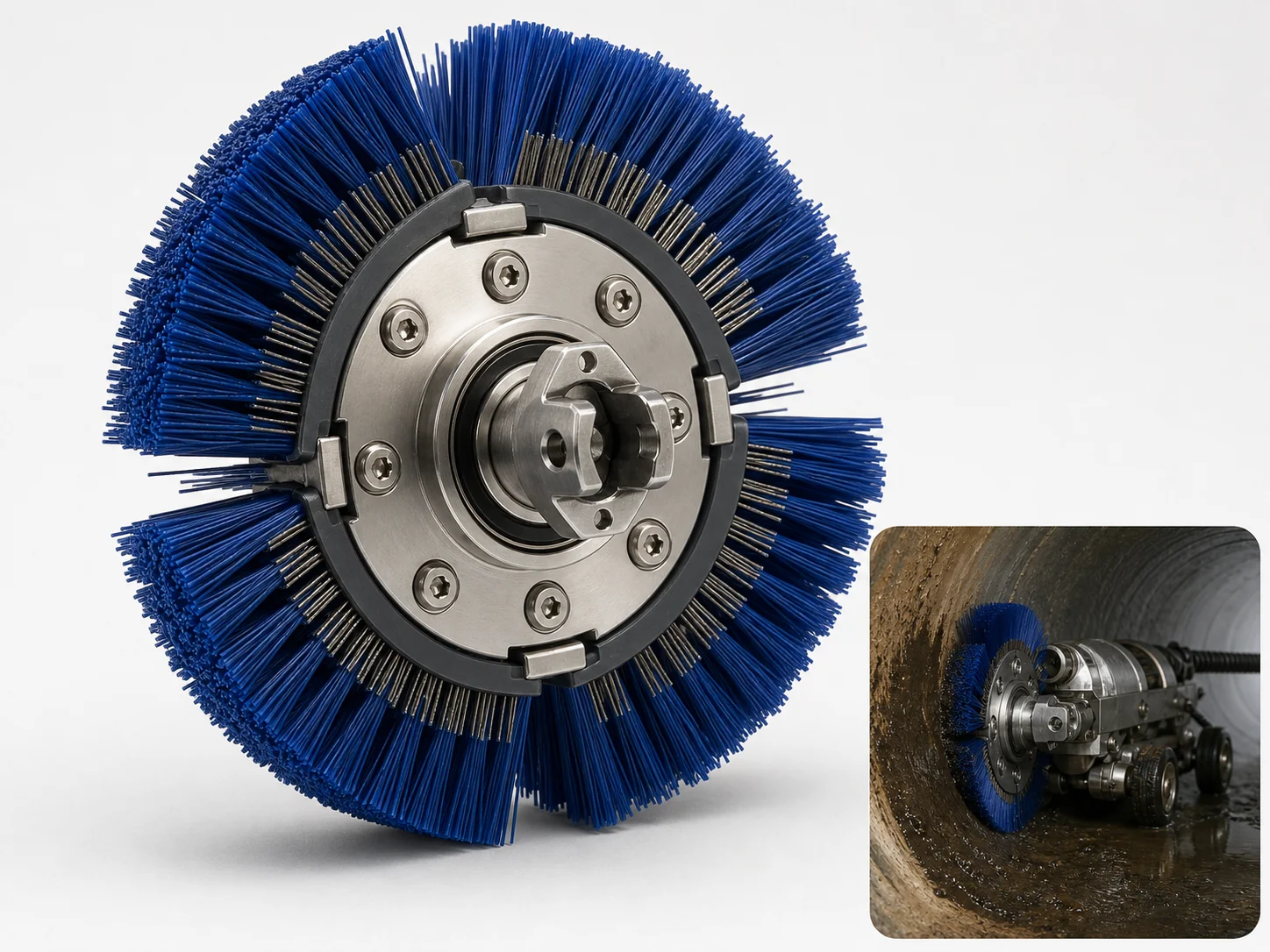
Custom pipe robot brush attachments built to your robot's drive interface and pipe geometry.
Small brush
500 pcs
Minimum order
Held in one hand: tube, bottle, detail and swab brushes — including long-handled ones with a small head.
Production lead time, once the specification is confirmed
- Up to 500 pcsWithin 7 days
- 501–50,000 pcsWithin 14 days
- Over 50,000 pcsWithin 21 days
Peak season can extend these times; the shipping date is confirmed in writing with your quotation. Sampling and shipping are quoted separately.
A robot-mounted rotating brush module for pipe inspection and cleaning crawlers that scrubs grease, sludge, soap film, loose scale, and light corrosion from internal pipe and duct walls without human entry. The attachment is configured around the robot’s mounting interface, drive output, and the pipe’s minimum bore and bend geometry so the filaments stay in controlled contact instead of binding the carrier.
What can this brush do for you?
An Interface That Matches the Robot’s Real Drive Output
Every attachment is built to the pipe robot’s approved rotary drive — keyed shaft, bolt-circle flange, quick-release hub, or custom collet — instead of a generic shank that someone adapts on site. The brush runs with less runout, lower vibration, and no secondary adapters loading the robot’s bearings.
Full-Circumference Contact Through Ovality, Weld Beads, and Bends
The filament working envelope is calculated from the minimum internal diameter, not the nominal pipe size. Radial compliance in the bristle field lets the tips follow oval sections, weld seams, and slight out-of-round without the hub wedging, while the brush length is kept short enough to track through the robot’s tightest bend without unweighting the contact face.
Three Filament Families for Different Deposit Types
Nylon PA filaments carry grease, organic film, and soft sludge. PBT holds stiffness in wet, warm, chemical-laden process lines. AISI 316 stainless steel wire attacks scale, oxide, and mineral encrustation. The material is chosen for the residue and the pipe surface, so contact rate and wear life stay predictable.
Stable Rotation in Wet, Flooded, and Submerged Lines
The hub, core, and filament anchoring are selected for continuous wet operation. Stainless components resist corrosion in sewer and process water, and the filled rotor is balanced for the robot’s normal speed band so the attachment does not add shaft whip or camera vibration to a live inspection run.
Predictable Wear and Quick Replacement
Because the brush is a consumable, the mounting interface and retention are designed for repeated changeouts. Filaments are anchored rather than glued in high-load areas, so wear shows up as gradually reduced tip length, not tufts shedding into the line. A replacement can be pre-balanced and delivered ready to mount.
What is a Pipe Robot Brush Attachment?
A pipe robot brush attachment is a rotating brush module that mounts to the rotary output of a pipe inspection or cleaning robot and scrubs the internal wall as the crawler advances through the line. It is not a hand brush, a drill-mounted brush, or a universal power-tool accessory. It is a robot-scale consumable designed around one carrier machine and one pipe class.
In service, the brush is typically installed at the front or rear of the robot module, rotated by the machine’s own drive motor, and pushed or pulled along the bore. The filament tips contact the crown, invert, and sides of the pipe while the hub stays clear of the wall. The brush works as part of the robot’s cleaning sequence — loosening attached deposits so water flow, vacuum removal, or a follow-up CCTV inspection can complete the job. It can also be used after jetting to remove residual film and soften material before inspection.
Operating considerations are central to the design. The attachment must fit inside the robot’s available envelope, stay within the drive system’s torque and side-load limits, clear the minimum bend radius, and survive the pipe environment — which may be wet, chemically aggressive, or submerged. A brush sized to nominal diameter alone will fail on ovality, debris mounds, or tight bends, so the working envelope is developed around the robot’s actual range of motion, not just the pipe’s printed bore.
The attachment is a wear item. Filament height and diameter determine the productive life, and the brush should be replaced when effective contact diameter drops or the robot starts leaving unbrushed bands on the wall. It is intended for soft to semi-adherent residues; hard tuberculation, cured concrete, root masses, and similar deposits require cutter, milling, or high-pressure tools instead.
Technical Specifications
Values below are the typical design window; each attachment is dimensioned to your robot and pipe.
| Parameter | Typical configuration |
|---|---|
| Working diameter (tip-to-tip) | 150–1,200 mm, set from minimum pipe ID, ovality, and bend clearance |
| Brush length (along pipe axis) | 100–600 mm, sized to maintain wall contact through the tightest bend |
| Mounting interface | Keyed bore, bolt-circle flange, quick-release hub, or custom collet matched to robot output |
| Rotation compatibility | Built for the robot’s approved speed and torque band and rotation direction; no universal shaft assumed |
| Filament material | Nylon PA, PBT, or AISI 316 stainless steel wire; mixed material fills available |
| Filament diameter | PA/PBT: 0.3–1.5 mm; 316 wire: 0.15–0.5 mm, matched to deposit and surface |
| Hub and core | AISI 304/316 stainless steel, corrosion-protected aluminum, or machined polymer as required |
| Filament trim | Full radial fill, segmented strips, or open spiral for debris self-clearing |
| Working environment | Wet, humid, or submerged conditions; continuous exposure typically 0–80 °C for PA/PBT fills unless reviewed for higher temperatures |
| Directional marking | Rotation arrow and part marking as required for one-way drives |
| Brush type | Custom Tube & Pipe Bore Brushes |
| How it is driven | Machine-driven, mounted in the equipment |
| Cleaning target | municipal sewer and stormwater line, industrial process and transfer piping, and box culvert cleaning |
| Surface or part | pipes, bends, walls, bores, concrete, hubs, carriers, and duct walls |
| Residue or debris | scale, sludge, grease, soap film, loose scale, corrosion, oxide, and dust |
| Mounting / connection | Keyed bore, bolt-circle flange, quick-release hub, or custom collet matched to robot output; Built for the robot's approved speed and torque band and rotation direction; no universal shaft assumed |
Where does this brush work best?
- Municipal sewer and stormwater lines — removing grease, sludge, soft scale, and post-jetting film from concrete, clay, HDPE, and lined mains before CCTV inspection or rehabilitation.
- Industrial process and transfer piping — cleaning soap film, product residue, dust, and light oxide from pipes that cannot be opened or entered, using robot crawlers already deployed for inspection.
- Box culverts, penstocks, and large-diameter drains — covering crown and invert surfaces that manual brushing cannot reach safely, including rectangular sections when the robot trajectory allows full contact.
- Ventilation and utility ducts — removing dust, lint, and non-adherent deposits from duct interiors where access is limited and chemical or foam cleaning is not preferred.
- Pre- and post-coating preparation — light surface conditioning before lining or coating, or removal of loose scale and residual film after hydrodemolition or jetting.
How do I choose the right one?
Start with the robot, not the pipe
You can have the right cleaning diameter and still be unable to run the brush if the fixture does not fit the machine. Provide the drive output drawing, shaft or flange dimensions, keyway or bolt pattern, rotation direction, maximum speed, torque limit, and available axial and radial load capacity. The attachment is then built to that interface instead of relying on universal adapters.
Set the working diameter from actual geometry
Measure the minimum internal diameter along the full run — including ovality, weld beads, protruding laterals, and sediment depth. The brush must be large enough to keep filament tips engaged with the wall but small enough to clear the tightest bend without the hub contacting the pipe. Include the robot’s articulation and bend radius in the review, not just the straight-section ID.
Match the filament to the deposit and the surface
| Deposit / operating condition | Recommended filament | What to check |
|---|---|---|
| Grease, soap film, soft sludge, light organic residues | Nylon PA | Good film release and conformability; not for heavy scale or sharp abrasive surfaces |
| Wet, warm, or chemically treated process lines; food or detergent residues | PBT | Low moisture uptake, stable stiffness, better alkaline and chemical tolerance than PA |
| Oxide, mineral scale, light corrosion on metal or concrete | AISI 316 stainless steel wire | Aggressive contact; test on a sample, especially for HDPE, PVC, or lined pipe |
Combination fills are possible when one zone of the pipe carries heavier deposit than another, but they change balance and wear behavior, so they should be specified deliberately.
Account for the pipe environment
State whether the line is wet, submerged, hot, chemically dosed, or pressure-washed. This drives the hub material, filament choice, and anchor details. 316 stainless hardware avoids rust streaking in potable or process lines. PBT often holds dimension better than nylon when residual water is warm or alkaline cleaning chemistry is used.
Decide how the fill should release debris
A dense radial fill produces the most uniform film removal and leaves the smoothest contact pattern. An open spiral or segmented fill clears heavy sludge faster and is less likely to pack with fibrous debris. If the robot cannot reverse flow or the line has low flow, choose the more self-clearing pattern even if film removal is slightly less aggressive.
When to choose a different tool
Do not use a filament brush on cured tuberculation, concrete or mortar deposits, hard mineral scale that a wire brush cannot dent, or root masses. Those require cutter heads, milling attachments, chain flails, or high-pressure jetting. Also avoid this attachment if the robot has no approved rotary output or cannot accept the brush’s side-load and torque; forcing a motor not designed for continuous rotary cleaning shortens robot life and creates unsafe run conditions.
Can I customize this brush?
Pipe robot brush attachments are project-specific because the robot and the pipe decide almost everything. We build each one around your machine, your line geometry, and your deposit type.
We can adjust:
- Mounting and drive interface — keyed bore, flange bolt circle, quick-release hub, drive pin, collet, or an adapter plate matched to the robot output.
- Working diameter and length — tip-to-tip diameter, axial coverage, radial compliance, and hub clearance set from your minimum ID and bend radius.
- Filament system — material (PA, PBT, 316 stainless wire, or mixed fill), filament diameter, straight or crimped construction, trim profile, fill density, and directional tufting.
- Core and hub — stainless steel, corrosion-protected aluminum, or machined polymer; balancing, weight reduction, and retention features to suit the robot payload and speed band.
- Rotation features — one- or two-direction rotation, marked rotation arrow, torque-limiting design if required, and integration with the robot’s existing drive control.
- Marking and packaging — part number laser marking, color coding by diameter or material, protective bristle tubes for storage, and bulk or per-unit packing.
To define a custom attachment, send the robot model and drive drawing, output shaft or flange dimensions, rotation direction, speed and torque limits, pipe minimum ID and bend radius, surface material, deposit description, chemical and temperature conditions, and any payload restrictions. A sample robot mount or a full-scale bend mockup can speed up fit verification.
If your project requires material declarations, dimensional inspection records, balance verification, or third-party test support, we can include those deliverables as part of the qualification package.
When is a pipe robot brush attachment worn out rather than just dirty?
How do I confirm the brush will clear the tightest bend in the line?
Build a full-scale bend mockup or use the robot’s articulation drawings, mount the attachment, and drive it through the worst-case bend. Watch for hub contact with the pipe wall and for filament tips pinching or folding. If the tips bind or the hub rubs, reduce the brush length or diameter, or increase radial compliance in the bristle field.
Can one attachment clean both small and large sections of the same pipe?
Usually not. A fixed-diameter attachment covers a narrow internal diameter range around its set point. A brush sized for a large pipe will not fit a smaller section, and a brush sized for a small pipe will not contact the wall of a larger one. If the line changes diameter significantly, use multiple modules or specify a compliant or adjustable hub design.
What should the operator check before each deployment?
Inspect the hub fasteners, filament wear and breakage, and shaft fit. Verify the rotation direction is correct, remove any debris wrapped around the hub, and confirm the brush spins without excessive vibration at low speed before entering the line. A cracked hub, loose tuft, or unbalanced condition should stop the run until corrected.
How do I know when the brush has reached the end of its service life?
Record the tip-to-tip diameter before the first run and compare it after each campaign. Replace the brush when effective diameter has dropped 10–15%, when the robot starts leaving visible unbrushed bands on the wall, or when filament tips become shredded, brittle, or consistently bent out of contact.
Can this brush remove cured scale or hardened tuberculation?
No. The brush is designed for loose, soft, or semi-adherent deposits such as grease, sludge, soap film, dust, and light oxide. Hard mineral encrustation, cured concrete, or root masses require cutter or milling attachments, chain flails, or high-pressure jetting. Using a wire brush on these deposits may polish the surface without removing the build-up and can overload the robot.
Will higher rotation speed clean faster?
Not necessarily. Speed must stay inside the robot’s approved torque and speed band. Too high a speed can cause filament flutter, poor wall contact, and premature wear. The best setting is the lowest speed that keeps the tips in consistent contact and clears loosened debris effectively. Start low and increase until cleaning quality stabilizes without bounce.
Guides that go deeper on this
Custom Manufacturing RFQ
Describe Your Application
An accurate custom quote starts with the dimensions, working surface, residue, material choice, connection, quantity, and reference files.
Drawing or photo optional — it speeds things up, it does not gate the enquiry.
Custom Brush RFQ
Send Your Brush Project
Upload a drawing, product photo, or sample photo and provide the core dimensions and cleaning conditions.
“We need a brush to remove wet residue from a stainless steel conveyor, about 800mm wide. The current brush wears quickly. We can send photos.”
“We sell drinkware and need a cleaning brush to include with the product. Quantity around 5,000 pieces.”