
Custom Cleaning Brush
60mm PP Chemical Pipe Brush
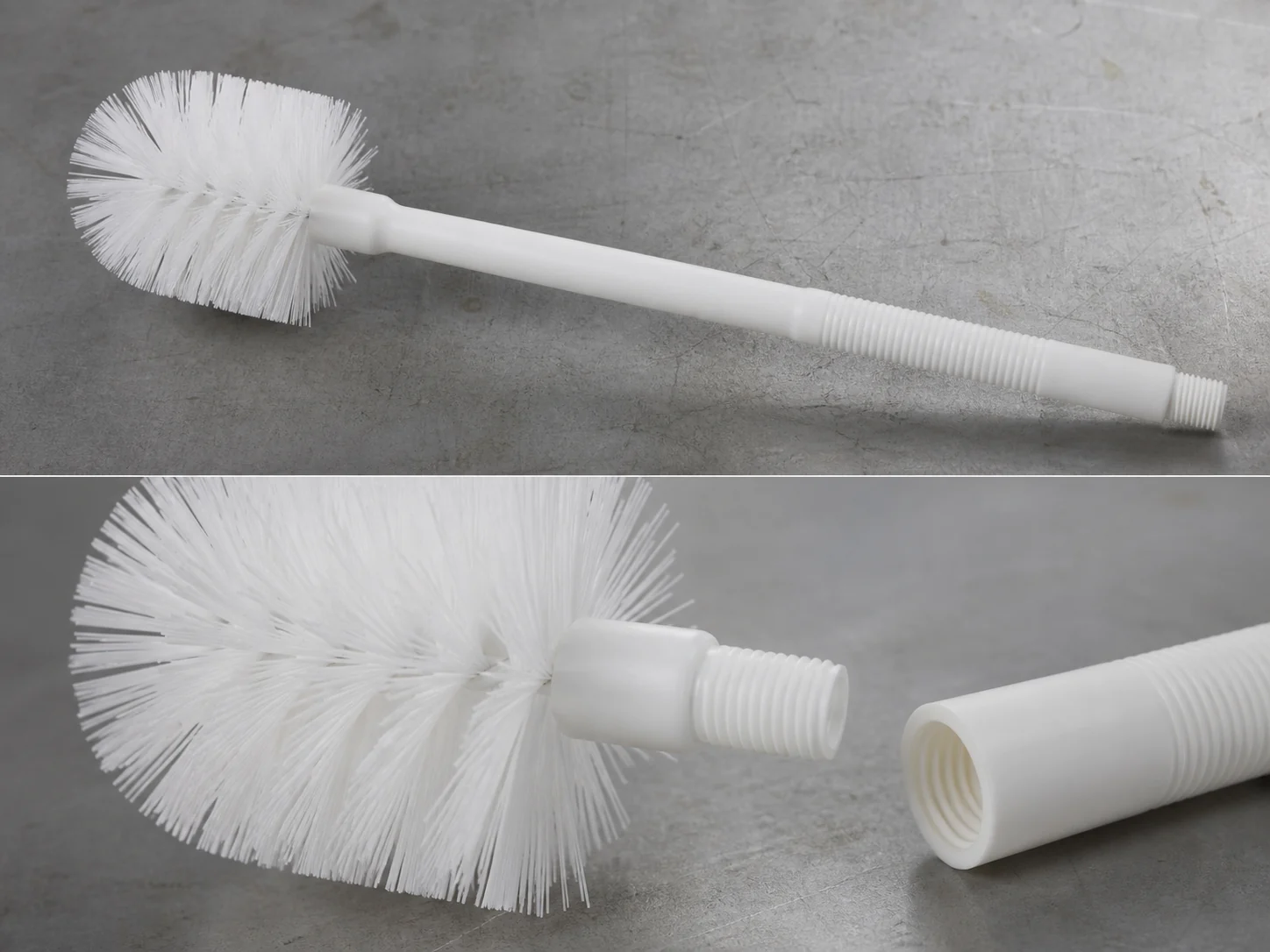
60mm PP chemical pipe brush with chemical-resistant polypropylene bristles, stainless steel twisted-wire core and threaded removable head.
Small brush
500 pcs
Minimum order
Held in one hand: tube, bottle, detail and swab brushes — including long-handled ones with a small head.
Production lead time, once the specification is confirmed
- Up to 500 pcsWithin 7 days
- 501–50,000 pcsWithin 14 days
- Over 50,000 pcsWithin 21 days
Peak season can extend these times; the shipping date is confirmed in writing with your quotation. Sampling and shipping are quoted separately.
A 60 mm diameter polypropylene pipe brush built on a stainless steel twisted-wire core for internal cleaning of chemical process pipes, tube bores, and fittings. The chemical-resistant PP bristles scrub the full circumference without introducing metal contamination, and the threaded removable head lets operators replace the wear part or mount the brush on a compatible extension or rotary drive.
What can this brush do for you?
Clean the full bore in one pass
The round, 60 mm radial fill surrounds the entire inside diameter. A single push-pull or rotating stroke contacts the tube wall all the way around, so soft deposits, oil film, and process residue are loosened evenly instead of leaving clean streaks next to dirty streaks.
Keep metal contamination out of the process line
PP filament does not rust, corrode, or shed metallic particles the way carbon steel or brass fill can. That makes the brush suitable for chemical lines where a loose wire bristle could carry into a pump, valve, or product batch. The stainless steel core adds corrosion resistance where wash chemicals are present.
Swap the head without replacing the whole tool
The threaded removable connection lets you replace a worn 200 mm bristle section while keeping the stem and handle. For planned maintenance, operators can also keep one handle assembly and switch between clean and soiled heads as piping moves through the cleaning station.
Wet or chemical-assisted cleaning without material breakdown
PP bristles tolerate many dilute acids, alkalis, salt solutions, and process fluids better than natural fiber or some nylon grades. The filaments do not absorb water, so they hold their stiffness in a wet bore and dry quickly between uses instead of staying saturated and soft.
Reach into the pipe with control
The 350 mm stainless steel twisted-wire stem works as the reach section and provides enough column strength to push the head forward without folding. An optional 20 mm PP overmold at the grip end keeps the handle controllable with wet or gloved hands.
What is a 60mm PP Chemical Pipe Brush?
A 60mm PP Chemical Pipe Brush is a cylindrical tube-cleaning brush with polypropylene filaments anchored in a stainless steel twisted-wire core. The 60 mm head diameter and 200 mm fill length are sized for internal contact in larger-bore process piping, while the 350 mm stem gives the operator working reach without entering the pipe by hand.
In use, the head is inserted into the pipe or tube and moved in straight push-pull strokes, rotating strokes, or a combination of both depending on the residue and the drive. The twisted-wire construction holds the PP filaments mechanically, and the round fill works through ports, cross holes, and threads as well as plain bore sections. The brush is intended for adhesive but soft deposits — sludge, oil films, light scale, powder, and process buildup — not for cutting hard rust or baked carbon.
Because it is designed for chemical environments, the BOM matters as much as the trim. PP bristles provide the chemical resistance; the stainless wire core resists washdown chemicals and prevents rust transfer into the cleaned surface. If the pipe carries strong oxidizers, high-aromatic solvents, or continuous temperatures above the PP limit, the brush should be specified with an alternative filament or a different cleaning method.
Technical Specifications
The base configuration shown below fits the stock 60 mm PP chemical pipe brush. Dimensions, filament grade, core material, and thread details can be adjusted for the project.
| Parameter | Value / Options |
|---|---|
| Brush head diameter | 60 mm nominal |
| Brush head shape | Round cylindrical, 360° radial fill |
| Brush head length | 200 mm fill length |
| Bristle material | Polypropylene (PP) filament |
| Core / stem | Stainless steel twisted wire, 304 standard; 316 available |
| Stem / handle length | 350 mm twisted-wire section; optional PP overmold at grip end |
| Overall length | Approximately 550 mm including head and stem |
| Grip diameter | 20 mm with PP overmold when equipped |
| Connection | Threaded removable coupling; thread size matched to project |
| Recommended pipe ID for full wall contact | Approximately 55–65 mm; larger IDs can be cleaned with reduced wall pressure |
| Continuous temperature limit (PP bristles) | Up to about 80°C continuous; short exposure to 100°C possible depending on chemicals present |
| Chemical compatibility | Good for many dilute acids, alkalis, salt solutions, and process fluids; not for strong oxidizing acids or high-aromatic solvents |
| Brush type | Custom Tube & Pipe Bore Brushes |
| How it is driven | Hand-guided |
| Cleaning target | chemical transfer and process drain line, cooling water and utility piping, and pipe spool cleaning |
| Surface or part | pipes, tubes, bores, thread, holes, metal, walls, and cross holes |
| Residue or debris | oil film, scale, sludge, carbon, rust, particles, light scale, and powder |
| Mounting / connection | Threaded removable coupling; thread size matched to project |
The most important fit parameters to check before ordering are the actual internal diameter at the narrowest point, the length that must be reached, and the thread size on any extension or drive adapter already in use.
Where does this brush work best?
- Chemical transfer and process drain lines where acid, alkali, or solvent residues need to be loosened without introducing carbon steel or brass particles.
- Cooling water and utility piping carrying soft scale, biofilm, sludge, and oil films that a non-metallic fill can remove without damaging coatings or plastic pipe walls.
- Pipe spools, flanged sections, and short runs where the 550 mm overall reach covers the full interior without an extension rod.
- Threads, cross holes, and ports on larger fittings during maintenance or before reassembly, where the round brush reaches full circumference and PP bristles protect sealing faces from aggressive scratching.
- OEM part-washing stations for tubes and pipes where a rusting brush would leave contamination on the cleaned part.
How do I choose the right one?
Start with the actual internal diameter
Measure the smallest bore the brush must enter, not the nominal pipe size. A 60 mm head works most effectively when the ID is about 55–65 mm: the bristles deflect enough to apply wall pressure but not so much that they fold flat. Below about 50 mm the insertion force rises quickly and bristle life shortens. Above about 70 mm the brush still cleans the wall but leaves the center untouched, so a larger head or a different tool may be required.
Check the chemical and temperature exposure
PP is a good general chemical choice, but it is not universal. Confirm the filament against the actual fluid, concentration, and temperature — including any cleaning chemical, not just the process fluid. If the pipe runs above 80°C continuously, or uses strong oxidizers or aromatic solvents, switch to PBT, nylon, or a metal-core wire brush as the application demands.
Match the connection to the drive method
Decide whether operators will use the brush by hand, on a manual extension rod, or in a rotary tool. Manual use requires a secure grip and comfortable overall length. Powered use requires a threaded or shank connection that stays locked at speed, and the operator must keep rotation low enough that the bristles stay balanced. A quick test at low speed before full-speed use will reveal an out-of-true core or loose thread.
Match the fill to the residue, not just the chemical
PP bristles remove sludge, oil films, powder, light scale, and soft process deposits. They will not cut hard mineral scale, rust, weld spatter, or carbonized buildup. For those jobs choose a stainless steel wire brush, an abrasive nylon brush, or a mechanical descaling method first. Use PP when the priority is chemical resistance, non-contamination, and protection of the pipe surface.
When to consider a different brush
If the bore is under 50 mm, choose a smaller pipe brush or a tube brush built for that diameter. If the pipe is longer than the 550 mm reach and no extension can be added safely, order a longer stem configuration. If the process demands very stiff scrubbing or metal removal, PP is the wrong filament — switch to steel, PBT, or an abrasive tube brush.
Can I customize this brush?
The 60 mm PP Chemical Pipe Brush is configured to the project, not only supplied from stock. To quote a custom build, provide the narrowest pipe ID, the full length to clean, the residue type, the cleaning chemical and temperature, whether the brush will be used manually or powered, and the thread or adapter details. A drawing or sample of the fitting helps confirm the fit before production.
- Head geometry: 55–65 mm diameter variations, 150–300 mm fill length, straight or tapered trim, single-spiral or double-spiral fill, optional end tuft for closed-end bores.
- Filament specification: PP filament diameter, cut length, density, and color; stiffer PBT or nylon can be specified when PP is not suitable.
- Core and stem: 304 or 316 stainless steel, single-wire or double-wire twisted core, custom stem length, or reduced-flex core for long push runs.
- Handle: PP overmold length and grip profile, hanging hole, color coding, or no overmold for direct adapter mounting.
- Connection: thread size and pitch, quick-connect end, plain shank for a drill chuck, or fixed non-removable handle.
- Marking and packaging: custom filament color, pad-printed or laser-marked handle, bulk cartons, individually bagged, or kitted with spare heads.
If your project requires material documentation, inspection reports, or third-party testing for a specific chemical or washdown condition, we can support those requirements during customization.
When is a 60mm PP chemical pipe brush worn out rather than just dirty?
How do I check whether a 60 mm head will clean my pipe properly?
Measure the narrowest internal diameter of the pipe or fitting. If it is between about 55 mm and 65 mm, the bristles will contact the wall around the full circumference. If it is under 50 mm, the head will be hard to insert and the bristles will over-bend. If it is over 70 mm, the brush will clean the wall but leave the center untouched; a larger brush or a slower side-pressure pass may be needed.
Can this brush be used in a drill or rotary machine?
Yes, when the threaded connection matches your adapter and the core runs true. Start below 300 rpm and inspect for wobble before increasing speed. High speed with a long 550 mm assembly can create imbalance, and overheated PP bristles can soften or fly out. Keep rotating use short and wet when possible.
Does PP melt or deform during dry cleaning?
PP softens near 80–100°C, and dry friction on a hot pipe can melt the filament tips. For long dry runs or hot surfaces, use wet cleaning, chemical-assisted cleaning, or switch the filament to PBT or stainless steel wire. The PP brush is best in wet or ambient-temperature chemical cleaning.
What should I inspect before each use?
Check that the threaded connection is tight, the twisted-wire core is straight, and the bristles are evenly distributed. Bend a few filaments; if they snap instead of flexing, the PP has been chemically or thermally embrittled. Replace the head when you see bare spots, significant bristle loss, or a core that no longer holds the fill.
Does this brush remove rust and hard mineral scale?
No. Polypropylene filaments remove soft deposits, oil films, sludge, powder, and light scale. Hard rust, carbonate scale, weld spatter, or baked carbon requires a stainless steel wire brush, an abrasive brush, or a mechanical descaling process. Using PP on hard deposits will wear the bristles quickly without cutting the deposit.
How do I verify the pipe is actually clean after brushing?
Brush the full length, then flush the pipe and inspect with a borescope or wipe the bore with a white cloth. If the cloth shows residue, repeat the brush-and-flush cycle. Brushing loosens deposits; the flush carries them out. If residue remains at a fitting transition or cross hole, the brush trim length or head profile likely needs adjustment to reach that feature.
Guides that go deeper on this
Custom Manufacturing RFQ
Describe Your Application
Please share the brush dimensions, working area, residue type, material direction, quantity, and a drawing or photo for quotation.
Drawing or photo optional — it speeds things up, it does not gate the enquiry.
Custom Brush RFQ
Send Your Brush Project
Upload a drawing, product photo, or sample photo and provide the core dimensions and cleaning conditions.
“We need a brush to remove wet residue from a stainless steel conveyor, about 800mm wide. The current brush wears quickly. We can send photos.”
“We sell drinkware and need a cleaning brush to include with the product. Quantity around 5,000 pieces.”