
Custom Cleaning Brush
25mm PTFE Chemical Tube Brush
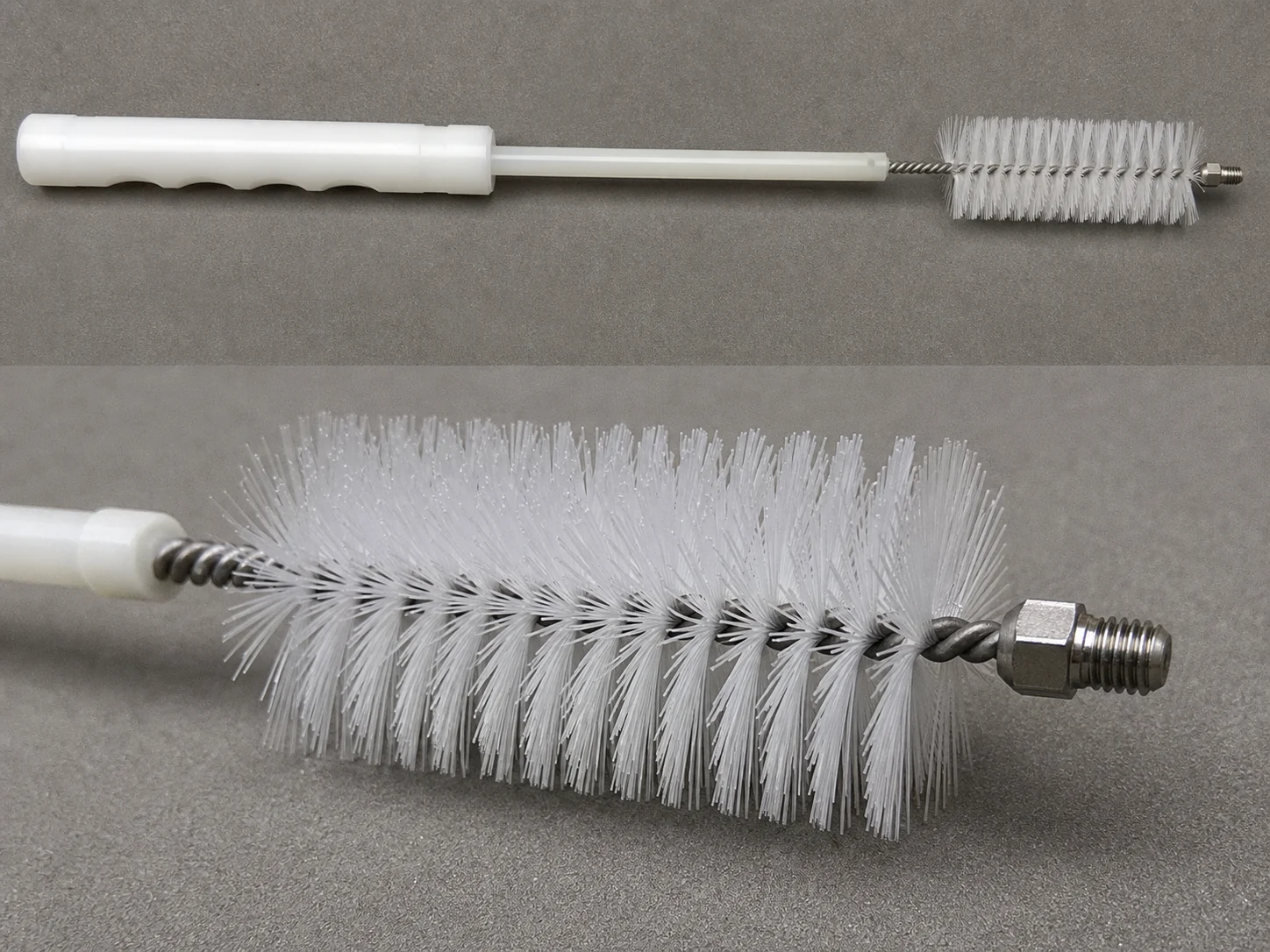
PTFE tube brush with 25 mm head, PVDF handle, threaded removable connection for heat exchanger tubes, ports, and chemical lines. Custom sizing available.
Small brush
500 pcs
Minimum order
Held in one hand: tube, bottle, detail and swab brushes — including long-handled ones with a small head.
Production lead time, once the specification is confirmed
- Up to 500 pcsWithin 7 days
- 501–50,000 pcsWithin 14 days
- Over 50,000 pcsWithin 21 days
Peak season can extend these times; the shipping date is confirmed in writing with your quotation. Sampling and shipping are quoted separately.
A chemically inert tube brush built around a 25 mm round PTFE filament head, with a PVDF handle and threaded removable connection for cleaning heat exchanger tubes, ports, and chemical process lines. The PTFE filament and PVDF handle stay stable in aggressive acids, alkalis, and solvents while wiping away soft deposits without scratching the substrate.
What can this brush do for you?
Stays inert when the cleaning chemistry gets aggressive
PTFE filament does not swell, soften, or embrittle in most acids, bases, and solvents, and the PVDF handle adds a second chemically resistant layer at the grip. The brush keeps its shape and useful life through repeated chemical cleaning cycles that would destroy nylon, polyester, or natural-fiber brushes, so one tool can stay in service instead of being replaced after every campaign.
Covers the full circumference of a 25 mm bore
The round 25 mm head positions PTFE filament tips around the entire sweep, so each push, pull, and rotation brings new filament tips into contact with the tube wall. Operators get even contact around straight tubes, threaded ports, and cross-drilled passages without having to roll a flat brush through the bore.
Removes residue without changing the substrate
PTFE is one of the lowest-friction solid materials available and is non-abrasive by nature. The brush wipes away oil, coolant, loose scale, powder, and soft process films while protecting passivated stainless, coated interiors, and other surfaces where wire or aggressively abrasive brushes would leave scratches or remove surface treatment.
Replace the working end, not the whole tool
The head threads onto the handle rather than being molded or pinned permanently. When the filament finally flattens or loses its shape, a new 25 mm head threads on in seconds and the PVDF handle continues in service. Maintenance stock is limited to heads, and each handle can be paired with several head configurations for different line sizes.
Rinses clean and does not hold chemical residues
PTFE and PVDF absorb almost no liquid, so acids, solvents, or cleaning solutions rinse off instead of soaking into the brush. The brush dries quickly between uses and is less likely to carry one process chemical into the next batch than natural-fiber or hygroscopic filament brushes.
What is a 25mm PTFE Chemical Tube Brush?
A 25mm PTFE Chemical Tube Brush is a hand-guided, round-head tube brush with a 25 mm outside diameter formed by PTFE filament and a 100 mm working head mounted on a threaded PVDF handle approximately 220 mm long. The tool is built for manual insertion, rotation, and retraction through heat exchanger tubes, process ports, blind holes, and cross-drilled passages where chemical exposure is part of the cleaning routine.
In use, the operator guides the head into the bore and applies short push-pull strokes with rotation. The PTFE filament tips flex as they enter and sweep the wall under light-to-moderate interference, lifting off oil, coolant, loose deposits, and soft process films. Because the filament is chemically inert, the brush can be used wet with acid, alkaline, or solvent cleaning solutions, and the PVDF handle stays stable in the same environment. The threaded removable connection allows a worn or damaged head to be replaced without replacing the handle.
The brush is not a substitute for mechanical descaling, wire brushing, or abrasive blasting. PTFE removes soft, loosely attached material and agitates chemical cleaning solutions; it will not cut through hard scale, baked-on carbon, or rust. Applying excessive force or using the brush as a lever can permanently deform the PTFE filament.
Technical Specifications
The table lists the base configuration for the 25mm PTFE Chemical Tube Brush. Dimensions and materials can be adjusted for your tube ID, length, chemical environment, and replacement plan.
| Parameter | Value / Options |
|---|---|
| Head diameter | 25 mm |
| Head shape | Round |
| Head length | 100 mm, configurable to the cleaning zone |
| Filament material | PTFE (polytetrafluoroethylene) |
| Filament diameter | 0.2–0.5 mm, selected for stiffness and access |
| Core / wire | Corrosion-resistant twisted wire core; stainless steel standard, PTFE-coated or polymer core available |
| Handle / base material | PVDF (polyvinylidene fluoride) |
| Handle length | 220 mm |
| Grip diameter | 12 mm |
| Connection | Threaded removable, thread size matched to the head and handle pair |
| Overall length | Approximately 320 mm with the standard 100 mm head |
| Operating temperature | PTFE filament rated to 260 °C continuous; PVDF handle rated to approximately 150 °C continuous. Specify higher temperatures for alternative handle or core materials. |
| Chemical resistance | Inert to most acids, alkalis, and solvents; not suitable for molten alkali metals or elemental fluorine at elevated temperature |
| Color | Natural white PTFE filament; PVDF handle color can be specified |
| Brush type | Custom Tube & Pipe Bore Brushes |
| How it is driven | Hand-guided |
| Cleaning target | shell-and-tube heat exchanger tube, chemical process piping and small-bore line, and threaded port cleaning |
| Surface or part | tubes, ports, bores, passages, thread, metal, blind holes, and substrates |
| Residue or debris | oil, scale, coolant, powder, sludge, soft deposits, rust, and hard scale |
| Mounting / connection | Threaded removable, thread size matched to the head and handle pair |
Where does this brush work best?
- Shell-and-tube heat exchanger tubes during or after chemical cleaning, where the brush agitates acid, caustic, or solvent solutions and wipes away loosened scale, sludge, oil, and process deposits from straight runs near 25 mm ID.
- Chemical process piping and small-bore lines where the cleaning additive would attack nylon or natural fibers; PTFE filament handles the chemistry while the user works the brush through elbows and tapers.
- Threaded ports, blind holes, and cross-drilled passages in valve bodies, manifolds, pump housings, and hydraulic components, where the round head follows the bore axis and reaches into recessed threads without wedging.
- Tapers and curved transition areas where rigid tube brushes leave dead spots; the flexible PTFE filament tips track the changing diameter as the operator changes stroke depth.
- Oil and coolant passages in machined parts where chips, powder, and wet residues must be removed without scratching sealing surfaces or bores.
- Analytical and laboratory lines where residual metal or abrasive particles from the brush are unacceptable and where PTFE’s low extractables and inertness support contamination-sensitive cleaning.
How do I choose the right one?
These checks show whether the 25 mm PTFE head fits the bore and the cleaning job. The same questions guide any customization before ordering.
Check the bore diameter first
Measure the narrowest internal diameter the brush must pass through. A 25 mm head works best in tubes and ports with an ID close to 25 mm, typically about 22–28 mm depending on filament trim and desired contact pressure. If the bore is much smaller, the filament will over-compress, the core may scrape, and the brush will bind. If the bore is much larger, the filament tips will not reach the wall. For those cases, select a smaller or larger head diameter rather than forcing this size.
Match the filament to the residue, not the other way around
PTFE is the right choice when the material to be removed is soft, wet, or only loosely attached: oil, coolant, chemical film, sludge, powder, or loosened scale after chemical soaking. PTFE will not remove hard bonded scale, heavy rust, or carbonized deposits. For those jobs, choose a stainless steel, brass, or abrasive-impregnated filament brush. As a rule: if you can wipe the deposit off with moderate hand pressure, PTFE will do the job; if you need a scraper, it will not.
Confirm the chemical and temperature envelope
PTFE filament and PVDF handle tolerate most acids, alkalis, solvents, and oxidizers, but the working temperature is limited by the PVDF handle at roughly 150 °C continuous. If the process runs hotter than that, specify a metal handle extension or a higher-temperature handle and core combination. Also verify the core material against the chemistry. Stainless steel works in most cases, but very aggressive halide-containing environments may require a PTFE-coated core or polymer core.
Decide how the brush will be held and driven
The base configuration is a hand-held brush with a 220 mm PVDF handle. If operators need longer reach, a longer handle or extension can be specified; just remember that longer reach reduces control unless the handle is supported. If the head will be threaded onto a rotating tool, machine spindle, or automated fixture, provide the thread size, RPM, and duty cycle so the core and connection can be matched to the drive.
Set head length to the cleaning zone
The 100 mm head length is usually enough for localized port and shallow bore cleaning, but a full-length heat exchanger tube may be several meters long. In that case, either specify a longer head or plan for graduated passes from both ends. A longer head increases the swept area per stroke but also increases friction, so match it to the operator’s control and the tube’s straightness.
If the deposit is hard scale, rust, or baked-on carbon, use a wire or abrasive tube brush. If the line is too narrow for a 25 mm head, switch to a smaller brush. If the surface must have zero physical contact, consider chemical circulation, flushing, or swab-based cleaning instead of brushing.
Can I customize this brush?
The 25 mm PTFE Chemical Tube Brush can be rebuilt around your actual tube dimensions, chemical exposure, and cleaning motion. To quote a custom configuration, we need the minimum bore ID, cleaning length, entry access, residue type, cleaning solution chemistry, working temperature, handle preference, and whether the brush is hand-held or machine-driven. A drawing or sample helps remove guesswork.
- Head diameter: other sizes from roughly 6 mm to 60 mm and beyond; the PTFE filament and core are cut to the target bore.
- Head length and shape: round, tapered, or contoured heads; length adjusted to the cleaning zone.
- Filament construction: PTFE filament diameter, trim length, stiffness, crimped or straight, and density; for more aggressive but still non-sparking jobs, other polymer or metal filament options can be evaluated.
- Core: stainless steel twisted wire, PTFE-coated core, or polymer core for metal-free and chemically extreme applications.
- Handle: length, grip diameter, straight, loop, or T-handle form, color, marking, or branded mold; handle material can be PVDF, PEEK, stainless steel, or another compatible polymer.
- Threaded connection: thread size, depth, locking feature, and whether the head must fit an existing handle, extension, or machine spindle.
- Packaging: bulk, individually bagged, kits with multiple head diameters, or project-specific labeling.
If your project requires material declarations, chemical compatibility documentation, inspection reports, or third-party testing, we can support those during the customization process.
What size should a 25mm PTFE chemical tube brush be, and how long does it last?
How do I know if the 25 mm head will fit my tube without damaging the brush?
Insert the dry brush by hand. If the core touches the wall or the filament completely flattens, the head is too large for that bore. If the brush slides through with no resistance and no wall contact, the head is too small. The right fit produces light drag with visible but not fully compressed filament flex.
Can I run this brush with strong acids or solvents?
PTFE and PVDF are resistant to most acids, alkalis, and solvents, but every chemistry has edge cases. Molten alkali metals, elemental fluorine, and some extreme halogenated environments can attack the materials. Also verify the core and thread materials against your solution; a PTFE-coated core may be required in halide-heavy systems. Rinse the brush with compatible solvent after each chemical exposure.
What should I do after brushing a chemical system?
Rinse the head and handle with deionized water or a compatible solvent, then air dry and store the brush hanging by the handle. Do not leave solvent or acid on the filament between uses, and do not rest the head on the ground or against metal that could deform the PTFE tips.
Will this brush remove hard scale or rust from heat exchanger tubes?
No. The PTFE filament is designed for soft, wet, or chemically loosened deposits. Hard scale, rust, and carbonized buildup require a wire or abrasive tube brush, or mechanical cleaning before this brush is used as a finishing or chemical-agitation tool.
How can I tell when the head needs replacement?
Examine the filament tips after each batch. If they are permanently flattened, leaning to one side, or no longer spring back when flexed, replace the head. Also check for exposed core wire, thread damage, or filament shedding. A fresh head should restore wall contact and drag feel.
Does brushing replace flushing or chemical circulation in tube cleaning?
No. Brushing loosens and dislodges deposits, but the loosened material still has to be carried out of the tube by rinsing, flushing, or chemical circulation. Use the brush as one step in the cleaning sequence, not as the final removal step.
Guides that go deeper on this
Custom Manufacturing RFQ
Describe Your Application
To quote this brush accurately, send the size, material, cleaning target, residue, quantity, and any available drawing or sample photo.
Drawing or photo optional — it speeds things up, it does not gate the enquiry.
Custom Brush RFQ
Send Your Brush Project
Upload a drawing, product photo, or sample photo and provide the core dimensions and cleaning conditions.
“We need a brush to remove wet residue from a stainless steel conveyor, about 800mm wide. The current brush wears quickly. We can send photos.”
“We sell drinkware and need a cleaning brush to include with the product. Quantity around 5,000 pieces.”