
Custom Cleaning Brush
Double Head Spring Tube Brush
Clean bores, tubes, ports, threads and internal passages with a flexible double head spring tube brush.
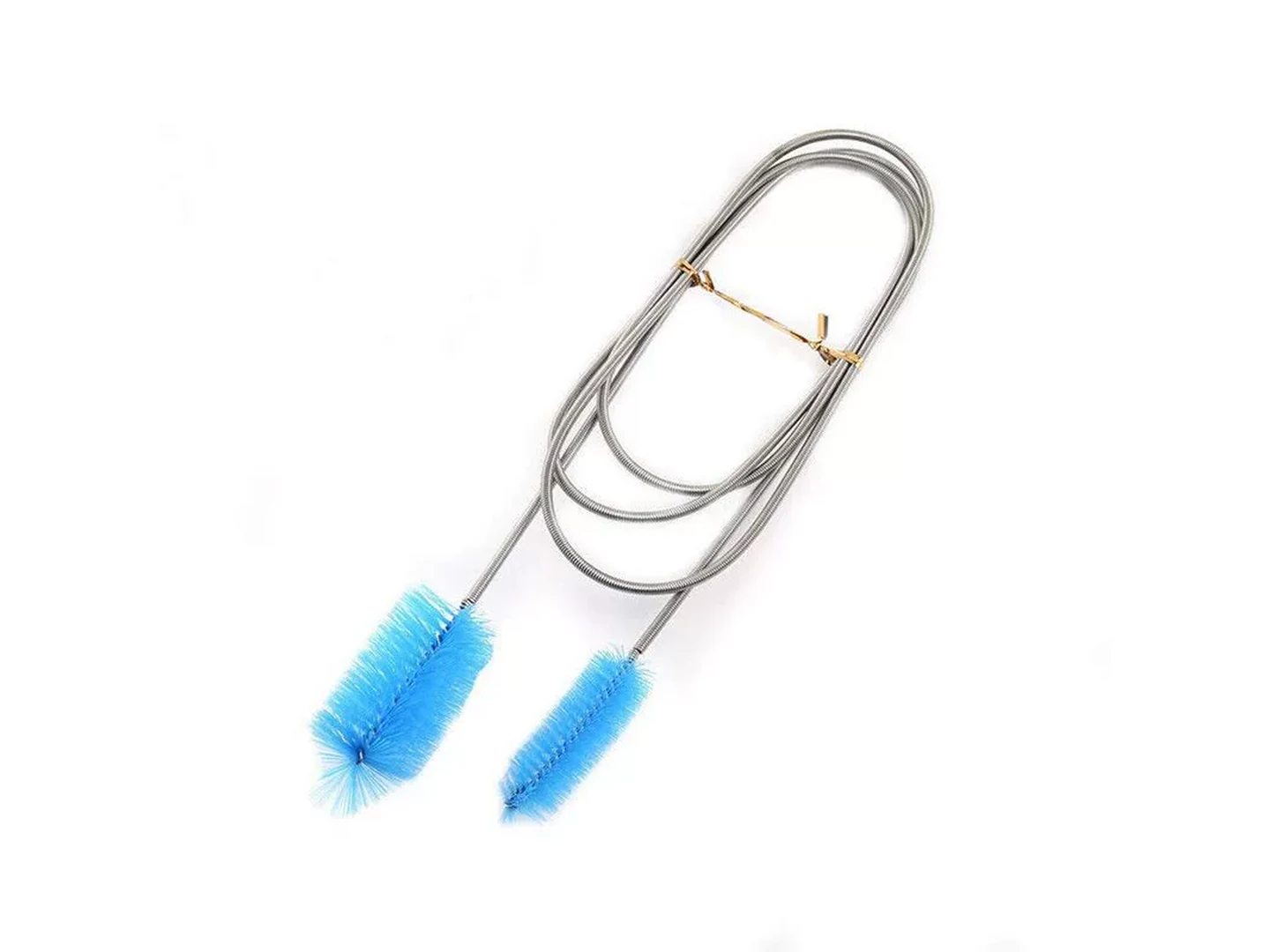
Small brush
500 pcs
Minimum order
Held in one hand: tube, bottle, detail and swab brushes — including long-handled ones with a small head.
Production lead time, once the specification is confirmed
- Up to 500 pcsWithin 7 days
- 501–50,000 pcsWithin 14 days
- Over 50,000 pcsWithin 21 days
Peak season can extend these times; the shipping date is confirmed in writing with your quotation. Sampling and shipping are quoted separately.
Double Head Spring Tube Brush is a flexible, dual-ended cleaning tool with a brush head on each end of a spring wire stem. It cleans bores, tubes, ports, threads, and internal passages when one tool needs to reach two different diameters or work from both ends of a line.
What can this brush do for you?
Two working diameters, one tool
The two brush heads are specified independently, so one end can be sized for a small orifice, thread root, or cross-drilled port while the other fits the main bore. Operators clean stepped passages and reducers without stopping to switch tools.
Spring stem follows the tube path
The twisted-wire spring core bends through elbows and curved sections, then returns to straight. The filament stays in contact through the bend instead of skipping across the outside wall the way a rigid rod can.
Radial contact around the full circumference
Filaments are held in a spiral pattern around the full diameter of each head. A few axial strokes and a partial turn cover the entire inside wall, leaving no flat untouched stripe along the bore.
Filament matched to the deposit and surface
PBT and nylon remove oil, coolant, chips, and soft process residue; brass, stainless steel, and abrasive nylon handle rust, scale, and baked carbon. Each head can use a different filament, so the small end can wipe threads while the large end scrubs the bore wall.
Near-size or oversize contact built into each end
One end can be built near-size for wiping coolant off a finished surface, while the other uses 5-20% polymer oversize for scrubbing a fouled tube. Both contact settings live on the same stem, so the tool matches the job instead of forcing one fit on two different bores.
What is a Double Head Spring Tube Brush?
A Double Head Spring Tube Brush is a hand- or pull-through cleaning tool made by twisting spring wire around a row of filament to form a circular brush section at each end of a flexible stem. The two heads may share one continuous stem or connect through a central loop, ring, threaded coupling, or short handle, depending on how the brush will be worked.
In use, one head enters the near-side opening, port, or thread and is worked with axial strokes plus partial rotation. The brush is then turned end-for-end and the opposite head cleans the main bore, the far-side opening, or a second passage. When a central loop or ring is specified, the brush can also be pulled through a pipe so both ends clean their zones in a single pass.
The brush removes chips, oil, coolant, loose rust, carbon, powder, and process deposits that yield to mechanical contact. It is not a reaming, honing, or high-pressure flushing tool, and it is not intended for welded-on scale or immovable solids; it is the controlled-contact step that opens a passage for further processing or completes the final clean.
Technical Specifications
Every dimension below can be set for the specific bore, thread, and operating condition. The two heads are specified separately.
| Parameter | Value / Options |
|---|---|
| Working head diameter | 3.2-50.8 mm per head |
| Brush section length | 25-127 mm per head |
| Overall length | 150-2000 mm, depending on stem and handle arrangement |
| End configuration | Two brush heads; same or different diameter; each end specified separately |
| Filament diameter | 0.08-0.25 mm, selected for wiping or scrubbing intensity |
| Stem style | Single twisted-wire spring stem, double stem, central loop, ring, threaded coupling, or flexible extension |
| Filament material | PBT, nylon 6/6, polypropylene, polyester, brass, stainless steel, carbon steel, horsehair, abrasive nylon |
| Filament fill | Spiral radial fill; density and trim matched to the passage ID and deposit |
| Recommended contact fit | Near-size for wiping; 5-20% oversize for flexible polymer scrubbing; lower interference for wire fill |
| Stem wire | Galvanized steel, stainless steel, or polymer-coated wire chosen for the process environment |
| Brush type | Custom Tube & Pipe Bore Brushes |
| How it is driven | Hand-driven on rods or a flexible shaft |
| Cleaning target | hydraulic and pneumatic fitting, tubular component, and heat exchanger and condenser tube cleaning |
| Surface or part | tubes, bores, passages, thread, ports, spring, internal passages, and connectors |
| Residue or debris | carbon, scale, coolant, chips, oil, rust, process deposits, and powder |
| Mounting / connection | Threaded Removable / Fixed |
The contact-fit row is a design input: it determines how hard the brush works against the wall. If the application is a wiped pass rather than a scrub pass, say so before the heads are built.
Where does this brush work best?
- Hydraulic and pneumatic fittings, valve ports, and manifold passages where a small thread root at one end and a larger body bore at the other need separate contact sizes.
- Tubular components, reducers, and connector bodies with chips, coolant, oil, or light process deposits left from machining or assembly.
- Heat exchanger and condenser tubes with soft scale or oxidation that can be removed by brass or stainless steel fill without damaging the base metal.
- Compressed air and process piping where dust, powder, or light rust must be displaced from a run and both line openings are accessible.
- Automotive and fluid-system ports, bores, and cross-drilled passages where varnish, carbon, or assembly residue builds up and the operator needs different diameters without another tool.
How do I choose the right one?
Start by measuring the smallest restriction and the main bore as two separate openings. Assign the smaller head to the smallest ID and the larger head to the main tube. Each head is then set to the contact fit of its own passage; do not average the two diameters.
Choose the filament by residue and surface. PBT and nylon are the standard choices for oil, coolant, chips, and soft deposits on steel, aluminum, and most machined surfaces. Polypropylene and polyester are lighter-contact options for coated or vulnerable surfaces. Brass, stainless steel, and abrasive nylon are for rust, scale, and baked carbon, with lower interference to avoid gouging.
Set the brush section length by the deposit zone, not the whole tube. A short 25-50 mm head works a thread or port; a 75-127 mm head covers a long bore. Too much fill length adds drag and increases the chance of folding the filaments at the entrance.
Choose the stem style by how the brush will be moved. A plain twisted-wire spring stem is for hand strokes from one or both ends. A central loop or ring is for pull-through cleaning. A threaded coupling or extension is only worth specifying when the brush will be attached to a rod or low-speed drive; high-speed powered use should be confirmed before ordering.
| Situation | Better choice |
|---|---|
| Light oil, coolant, chips, soft deposit | PBT or nylon head, near-size to 10% oversize |
| Rust, scale, or carbon in steel or iron tube | Brass or stainless steel fill, lower interference |
| Scratch-sensitive or coated surface | Polypropylene, polyester, or horsehair, near-size contact |
| Heavy baked-on deposit | Abrasive nylon or wire fill, 5-20% oversize polymer only where the base material allows |
| Deep blind hole with no opposite access | Single-head tube brush with handle or extension instead of double heads |
| Hard welded-on scale or passivation residue | Chemical stripping or high-pressure flushing before brushing |
Can I customize this brush?
Double head spring tube brushes are built around the passage, not picked from finished stock. Provide the two bore IDs, thread specifications, access from each end, bend radius or tube path, surface material, residue type, cleaning motion, and any cleaning chemical or process temperature. A drawing or sample part gets the geometry right faster.
Configurable elements include:
- Head geometry: each end specified by diameter, brush section length, trim profile, and filament density.
- Filament: PBT, nylon, polypropylene, polyester, brass, stainless steel, carbon steel, horsehair, or abrasive nylon; filament diameter 0.08-0.25 mm or project-specific.
- Stem / interface: single twisted-wire spring, double stem, central loop, ring, threaded coupling, flexible extension, or a short center handle.
- Stem wire: galvanized steel, stainless steel, or coated wire chosen for the process environment.
- Color and marking: filament color for diameter coding, shrink-tube or marking on the stem, or project identification tags.
- Packaging: bulk, individually bagged, tube-brush kits, or project-specific packing for line stocking.
If the end use requires material declarations, inspection support, or third-party testing against a specific process, include that requirement with the drawing and we can support the documentation as part of the customization.
What size fits the opening, and how is a double head spring tube brush cleaned afterwards?
Should this brush be used in a drill or powered spindle?
The spring-wire design is controlled for hand strokes and low-speed rotation. If the brush will be powered, provide the rpm, drive direction, torque, and duty cycle in the request so the stem and fill can be confirmed or redesigned for driven use.
How do I check that each head contacts the full bore?
Pass the brush through the intended ID by hand after receiving it. The head should drag with even resistance around the full circumference. If it spins freely or leaves a single wipe line, the diameter is too small. If it binds or folds over, the head is too large or the bend radius is tighter than the stem can handle.
What is the correct stroke pattern for a tube with open ends?
Work one end at a time. Push the working head into the opening, rotate a quarter to half turn, and withdraw so the loosened debris is pulled out of the tube. Repeat from the opposite end with the other head. Do not push debris toward a closed end or pack it into a cross-drilled port.
How do I clean the brush between jobs so it does not re-deposit what it removed?
Rinse or blow the filaments from the stem toward the filament tips with the working solvent or compressed air, then shake out trapped chips. For oily films, use a degreaser compatible with the filament material and let the brush dry fully before storing. Replace any head that stays matted or bent after cleaning.
Can one brush be used for two different tube IDs if the heads are different diameters?
Yes, that is the purpose of a double head spring tube brush. Keep each head in its intended bore: the small head does not scrub a large bore effectively, and the large head will fold and may scratch a small bore. Color-code or tag the ends if operators cannot tell them apart by eye.
What does the spring stem do that a solid rod cannot?
The spiral wire core bends through elbows and returns to straight, maintaining filament contact on curved walls. It also flexes before the filaments are pushed too hard into the tube, reducing the chance of gouging when the brush meets a step or a tighter passage than expected.
Guides that go deeper on this
Custom Manufacturing RFQ
Describe Your Application
To prepare the correct quotation, provide the dimensions, cleaning task, residue, material, mounting details, quantity, and a drawing or photo.
Drawing or photo optional — it speeds things up, it does not gate the enquiry.
Custom Brush RFQ
Send Your Brush Project
Upload a drawing, product photo, or sample photo and provide the core dimensions and cleaning conditions.
“We need a brush to remove wet residue from a stainless steel conveyor, about 800mm wide. The current brush wears quickly. We can send photos.”
“We sell drinkware and need a cleaning brush to include with the product. Quantity around 5,000 pieces.”