
Custom Cleaning Brush
35mm PBT Test Tube Brush
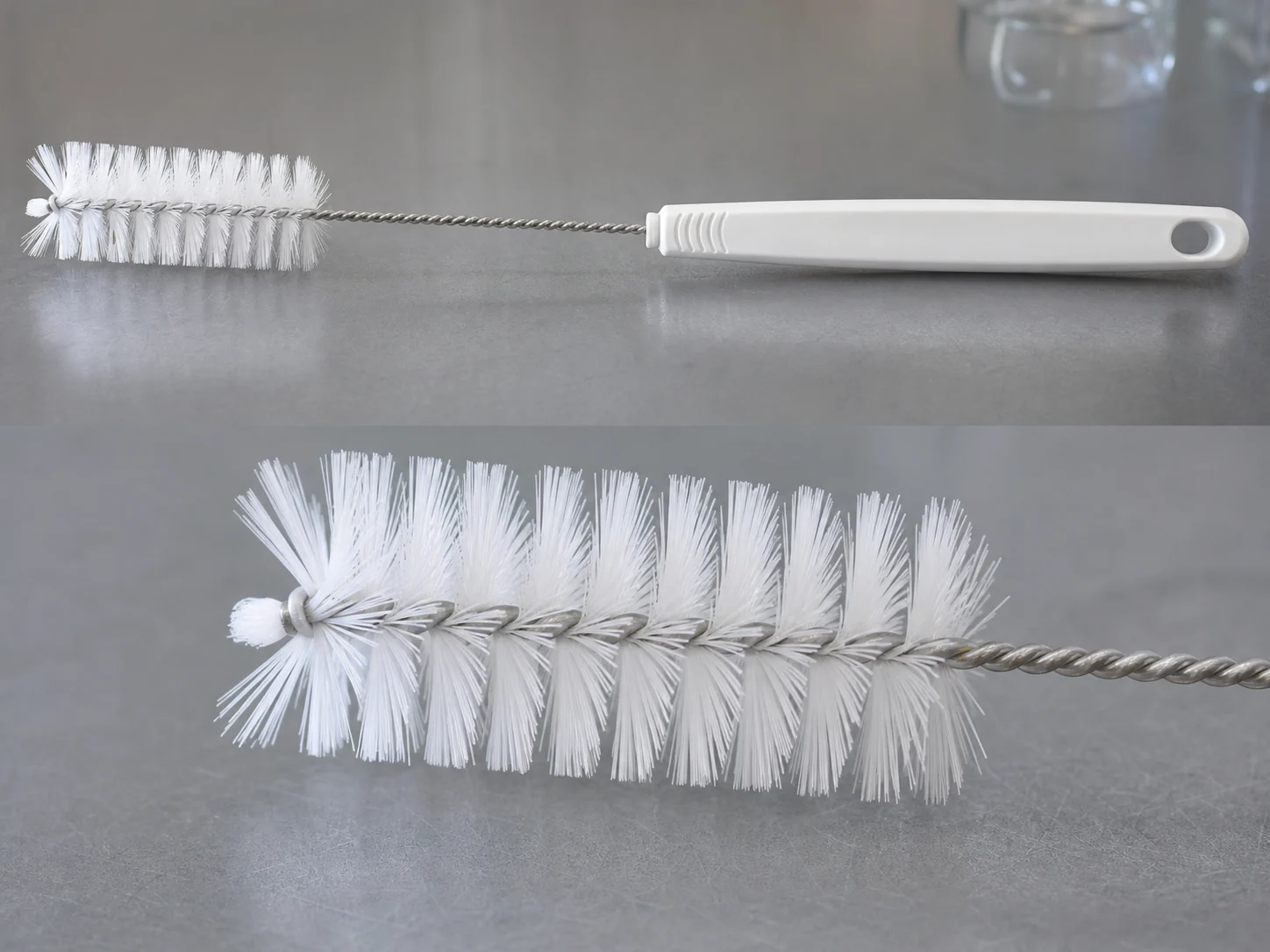
35mm PBT test tube brush with twisted SUS304 core for lab glassware cleaning. Removes reagent films, precipitates, detergent residue.
Small brush
500 pcs
Minimum order
Held in one hand: tube, bottle, detail and swab brushes — including long-handled ones with a small head.
Production lead time, once the specification is confirmed
- Up to 500 pcsWithin 7 days
- 501–50,000 pcsWithin 14 days
- Over 50,000 pcsWithin 21 days
Peak season can extend these times; the shipping date is confirmed in writing with your quotation. Sampling and shipping are quoted separately.
The 35mm PBT Test Tube Brush is a laboratory cleaning tool built around a 35 mm PBT bristle head and a twisted SUS304 stainless steel wire core. It removes reagent films, precipitates, powders, oils, and detergent residue from the inside walls, bottom, and rim of test tubes and similar narrow glassware without shedding fibers or scratching the glass.
What can this brush do for you?
Sized to clean the full bore of common 35 mm test tubes
The 35 mm round bristle head is designed to enter tubes with an inside diameter of roughly 33–40 mm and keep contact with the wall through the entire stroke. That means one rotating pass scrubs the full circumference, including the curved transition into the bottom.
PBT bristles stay stiff after exposure to cleaning chemicals
PBT is selected instead of natural fiber or soft nylon because it keeps its stiffness and spring recovery after contact with most dilute acids, bases, alcohols, detergents, and oils used in laboratory cleaning. The bristles won’t soften or collapse after a few wash cycles.
Twisted core locks bristles in place and returns to straight
The PBT filaments are captured between two twisted SUS304 wires, so they remain anchored during aggressive scrubbing instead of pulling free into the tube. The core flexes under hand pressure but springs back, letting the operator scrub the bottom and rim without permanently bending the tool.
One-piece construction leaves nothing to fall into the glassware
The bristle section and handle are a single fixed assembly. There is no separate ferrule, cap, or threaded joint to loosen during use or accidentally drop into the tube.
Round head reaches the bottom without a second tool
The full-length round bristled section follows the tube wall down to the curved base. You can clean the bore and the bottom transition in one continuous push, twist, and pull, instead of switching to a swab for the base.
What is a 35mm PBT Test Tube Brush?
A 35mm PBT Test Tube Brush is a hand-operated cleaning brush used to scrub the interior of cylindrical laboratory glassware. It consists of a round bristle head made from PBT monofilament fixed into a twisted SUS304 stainless steel wire core, with an extended plain wire handle formed from the same core material.
In use, the brush is inserted through the open end of the tube, then rotated and moved back and forth so the bristles sweep attached residue from the wall, bottom, and rim. The tool is pulled out and the tube is rinsed; the brush itself is rinsed and dried for the next cycle. It is a reusable tool, not a disposable swab.
PBT is used for the bristles because it resists common laboratory chemicals, absorbs very little water, and holds its mechanical spring after repeated flexing. The SUS304 core provides enough stiffness for hand pressure while remaining corrosion-resistant in normal wash and rinse environments. The fixed connection means the brush has no moving or replaceable parts in its standard form.
This brush is intended for routine removal of attached residues from reusable glassware. It is not a substitute for soaking, ultrasonic washing, or sterilization, and it is not intended for heavy abrasive descaling or for tubes with inside diameters significantly below the 33–40 mm range the 35 mm head is designed for.
Technical Specifications
All dimensions are standard for the 35 mm configuration and can be adjusted in custom orders.
| Parameter | Standard Value / Options |
|---|---|
| Head diameter | 35 mm (custom diameters from 10 mm to 50 mm available) |
| Head shape | Round |
| Head length (bristled section) | 90 mm |
| Bristle material | PBT (polybutylene terephthalate) monofilament |
| Bristle stiffness | Medium standard; fine or stiff filament options available |
| Core / handle material | SUS304 stainless steel twisted wire |
| Handle length | 180 mm |
| Grip diameter | 10 mm twisted wire bundle (loop or plastic grip optional) |
| Connection | Fixed, one-piece |
| Recommended tube ID | 33–40 mm for effective wall contact |
| Maximum continuous service temperature | 120°C; short steam exposure up to 121°C should be validated for the process |
| Chemical compatibility | Good with dilute acids, bases, detergents, alcohols, and oils; avoid hot concentrated oxidizing acids and strong chlorinated solvents |
| Brush type | Custom Tube & Pipe Bore Brushes |
| How it is driven | Hand-guided |
| Cleaning target | laboratory test tube and culture tube, and graduated cylinder and narrow round-bottom vessel cleaning |
| Surface or part | tubes, test tubes, rims, walls, glassware, vessels, glass, and cylinders |
| Residue or debris | reagent film, powder, precipitate, oil, fiber, detergent residue, and scale |
| Mounting / connection | Fixed, one-piece |
Where does this brush work best?
- Laboratory test tubes and culture tubes after reagent reactions, biological media, precipitates, or staining solutions.
- Centrifuge tubes and boiling tubes where residue collects at the curved base or under the rim.
- Graduated cylinders and narrow round-bottom vessels with accessible inside diameters in the 33–40 mm range.
- Sample vials and small reaction vessels in QC, R&D, and production laboratories that need repeatable residue removal before reuse.
Typical residues removed include reagent films, dried powders, oils, precipitated solids, and detergent deposits left from previous cleaning.
How do I choose the right one?
Start with the internal diameter of your tube
Measure the narrowest internal dimension of the tube or vessel. The 35 mm head should enter with light friction and still rotate freely. If the tube ID is below about 33 mm, the brush will bind or bend. If it is above about 40 mm, contact pressure drops and wall coverage becomes inconsistent. For other sizes, request a smaller or larger head diameter.
Check the reach you need to scrub the base
The standard configuration provides a 90 mm bristled section plus a 180 mm handle, which covers most test tubes and comparable vessels. For deep centrifuge tubes or long reaction vessels, request a longer handle or an extended bristle section so the operator can reach the bottom while still gripping the handle outside the opening.
Match the bristle stiffness to the residue
Medium-stiff PBT handles reagent films, dried culture media, fine powders, and light precipitates. For heavy crust, hard mineral scale, or baked deposits, a stiffer PBT filament, a larger diameter, or a different material may be needed. Pre-soaking in an appropriate solvent or detergent reduces the force required and extends bristle life.
Confirm chemical and temperature compatibility
PBT tolerates most typical lab washing solutions at room and warm temperatures. If your process uses hot concentrated acids, strong alkalis, chlorinated solvents, or repeated autoclaving, confirm the exact chemical and thermal exposure before finalizing the order.
Consider handling and identification
The fixed twisted-wire handle works by hand and can be formed into a loop for hanging. If the brush is used in a busy washing station or alongside brushes of other sizes, a plastic grip, color-coded handle, or marked length helps operators pick the right tool and reduces cross-contamination between tube sizes.
For tubes with IDs under 30 mm, use a smaller-diameter test tube brush. For single-use or high-contamination-control work, a disposable swab may be more appropriate. For hard scale or baked carbon, use soaking, ultrasonic cleaning, or a more aggressive brush material before or instead of PBT bristles.
Can I customize this brush?
Common customization options
- Head diameter and shape: adjust the 35 mm standard to any diameter between about 10 mm and 50 mm, with round, tapered, or bulb head profiles to match the tube.
- Head length and bristle coverage: change the 90 mm bristled section longer or shorter, or specify partial coverage for cleaning only the bottom or rim zone.
- Bristle material and filament: standard PBT in medium stiffness; alternative filament diameters, stiffness grades, or polymer materials can be evaluated where chemistry requires it.
- Core and handle configuration: SUS304 standard; SUS316 or coated wire available for aggressive wash solutions. Handle length, loop form, plastic grip, and color coding can be specified.
- Color and marking: custom bristle color, colored handle, laser marking, or size coding for visual identification.
- Packaging: bulk cartons, individual polybags, labeled sleeves, or project-specific packing.
To define a custom configuration, provide the tube inside diameter, tube length, residue type, cleaning solution, wash temperature, manual or machine cleaning, and any marking or packaging requirements. A sample tube or a drawing with dimensions speeds up the engineering review. If your project requires material declarations, inspection reports, or third-party testing support, we can assist with those requirements during the order.
Which filament survives the cleaning and still lasts on a 35mm PBT test tube brush?
How can I check whether the 35 mm head fits my tubes before ordering?
Measure the narrowest inside diameter of the tube, usually near the rim. The brush should enter with light friction, rotate freely, and the bristles should visibly contact the wall. If a 35 mm cylinder gauge fits with 2–4 mm clearance, this brush will work. If the ID is below 33 mm, use a smaller head; if above about 45 mm, wall contact will be weak and a larger brush is needed.
Will PBT bristles scratch glass or leave fibers in the tube?
PBT is softer than borosilicate and soda-lime glass and does not scratch these surfaces under normal manual pressure. On soft plastics or coated labware, test on an inconspicuous area first. The twisted-core construction locks the bristles in place, but always inspect the brush before use and remove any loose or damaged filaments.
How should I store the brush between cleaning cycles?
Rinse the brush with clean water or solvent after each use, shake off excess, and store dry in a ventilated holder. Do not leave it soaking in corrosive solutions and do not store it wet in a closed container, which can deform the bristles, promote wire corrosion, and carry contamination into the next tube.
Can I autoclave this brush with the tubes?
SUS304 wire and PBT can generally withstand a standard 121°C steam autoclave for short cycles, but repeated steam exposure may gradually relax bristle tension and discolor the material. Validate one brush in your autoclave protocol before processing a full batch. Whenever possible, wash and air-dry the brush separately rather than autoclaving it with the glassware.
How do I know when to replace the brush?
Replace the brush when bristles appear flattened, folded, broken, or no longer spring back after bending; when the wire core is permanently bent, kinked, or shows corrosion; or when the head diameter has visibly reduced so that contact with the tube wall is weak. A worn brush removes less residue and increases cross-contamination risk.
Does brushing replace soaking or ultrasonic cleaning for stubborn residues?
No. The brush mechanically removes attached residue, but it does not dissolve mineral scale, remove strongly adsorbed films, or sanitize the glassware. Pre-soak or ultrasonic cleaning may be needed for difficult deposits, and sterilization must be performed separately under your lab protocol. Brushing is one step in the cleaning sequence, not the entire sequence.
Guides that go deeper on this
Custom Manufacturing RFQ
Describe Your Application
For a custom quote, we need the key dimensions, surface or part, residue, material preference, quantity, and reference image or drawing.
Drawing or photo optional — it speeds things up, it does not gate the enquiry.
Custom Brush RFQ
Send Your Brush Project
Upload a drawing, product photo, or sample photo and provide the core dimensions and cleaning conditions.
“We need a brush to remove wet residue from a stainless steel conveyor, about 800mm wide. The current brush wears quickly. We can send photos.”
“We sell drinkware and need a cleaning brush to include with the product. Quantity around 5,000 pieces.”