
Custom Cleaning Brush
PBT Tube & Bore Cleaning Brush
Industrial PBT cleaning brushes for tube, pipe, bore and port cleaning. Diameters 3.2–50.8 mm, PBT filament for oil, carbon, scale and process residue.
Small brush
500 pcs
Minimum order
Held in one hand: tube, bottle, detail and swab brushes — including long-handled ones with a small head.
Production lead time, once the specification is confirmed
- Up to 500 pcsWithin 7 days
- 501–50,000 pcsWithin 14 days
- Over 50,000 pcsWithin 21 days
Peak season can extend these times; the shipping date is confirmed in writing with your quotation. Sampling and shipping are quoted separately.
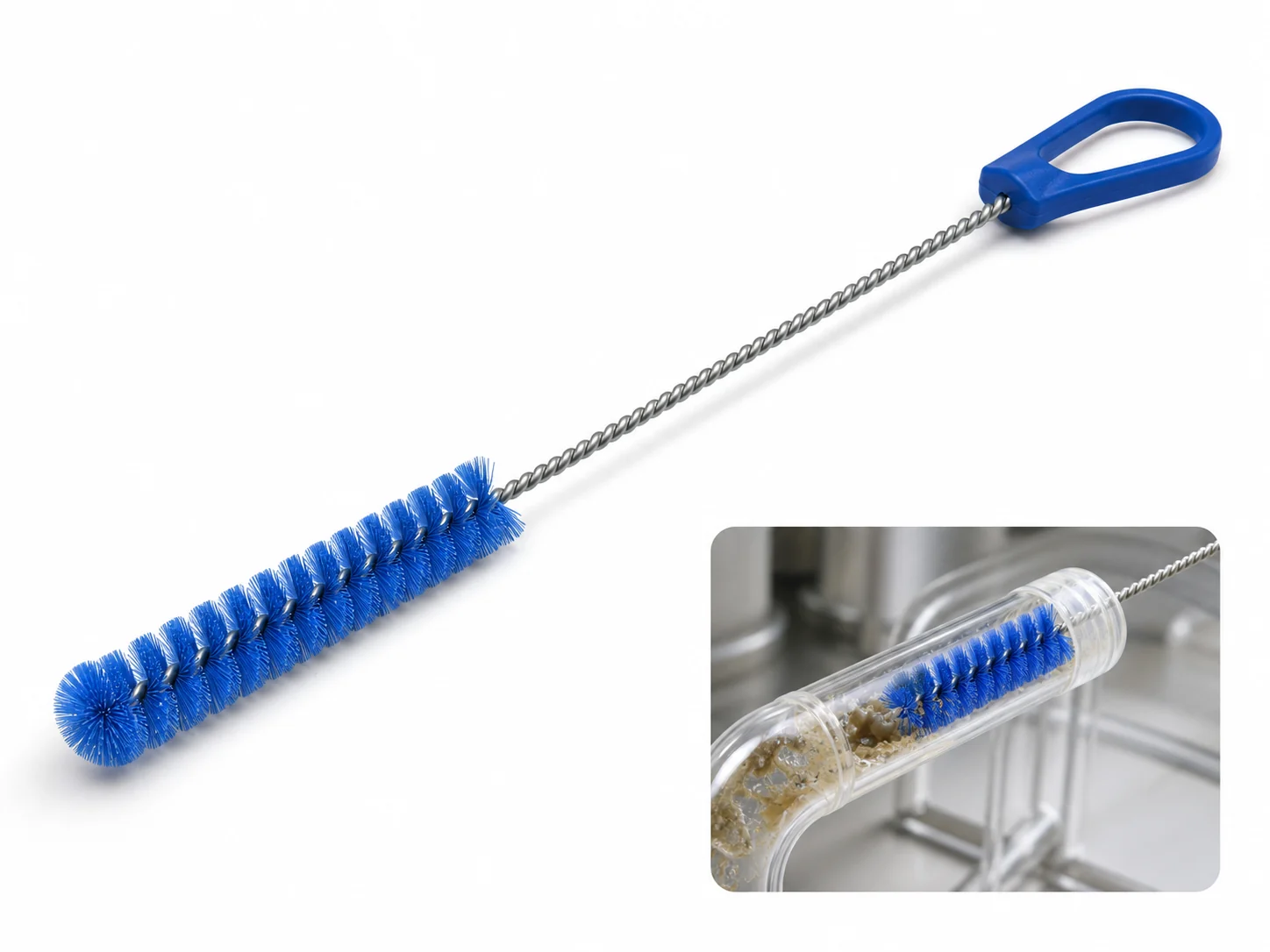
A PBT filament tube, pipe, and bore cleaning brush for wiping and scrubbing oil, carbon, scale, particulate, and process residue from internal passages as small as 3.2 mm in diameter. PBT polyester filament keeps its stiffness and shape in wet, oily, and warm chemical service, making this brush a dependable choice for parts washers, hydraulic lines, coolant circuits, and maintenance applications.
What can this brush do for you?
Reaches narrow ports and deep bores
Brush diameters start at 3.2 mm, so the tool can enter small orifices, oil galleries, valve ports, and sensor passages. With brush section lengths up to 127 mm and overall lengths to 406 mm, the cleaning area can be placed where the residue is instead of stopping at the inlet.
Holds scrubbing pressure when the passage is wet or oily
PBT absorbs very little moisture compared with nylon. The filaments keep their stiffness in water, oil, coolant, and solvent environments, so the brush continues to exert contact pressure over the full stroke length instead of softening and folding back in a wet bore.
Wipes light films or scrubs heavier deposits depending on fit
Near-size contact is used for wiping thin oil films and light debris. Oversizing the PBT fill by 5–20% creates flexed bristle pressure for scrubbing carbon, scale, or dried process residue. The filament recovers its set after repeated flexing, which helps maintain predictable contact over the brush life.
Adapts to manual or powered use
Single-spiral, double-spiral, threaded, loop, ring, and flexible-extension stems cover hand cleaning, drill or rotary-tool drive, lanyard retention, and curved-tube access. The stem style can be matched to the operator’s motion instead of forcing one drive method onto every bore.
Withstands typical process fluids better than nylon
PBT offers good resistance to many oils, fuels, greases, mild acids, alkalis, and common industrial solvents. For wet parts washing, degreasing, and service crews working through different process chemistries, the bristle material is one less variable to manage.
What is a PBT Tube & Bore Cleaning Brush?
A PBT Tube & Bore Cleaning Brush is a filament-type internal cleaning brush in which the working fill is made from polybutylene terephthalate (PBT) polyester rather than nylon, natural fiber, or wire. The filament is typically captured in a twisted-wire stem so that bristles radiate around the brush axis. When the brush is pushed, pulled, or rotated through a tube, pipe, or bore, those bristles drag against the internal wall, loosen attached residue, and carry loosened material out of the passage or into the flushing stream.
The brush section is the bristled working length. The stem supports insertion, drive, and retrieval. In a single-spiral construction, one twisted wire core carries the PBT fill. In a double-spiral construction, two twisted wire cores are wound together to increase fill density and aggressiveness. Threaded ends allow rotary-tool or drill drive. Loop and ring ends provide manual control or retention. A flexible extension lets the brush follow a bend without transferring heavy side load to the operator’s hand.
PBT is selected here because it keeps usable stiffness in wet and warm conditions, resists many process fluids, and offers better temperature performance than standard nylon. It is still a polymer filament, not a metal cutter. Use it when the job needs controlled scrubbing, wiping, and residue transport inside accessible passages. Hard mineral scale, rust, weld spatter, or seized carbon calls for a wire-fill brush instead.
Technical Specifications
| Parameter | Value / Options |
|---|---|
| Filament material | PBT polyester; round profile standard, crimped optional |
| Filament diameter | 0.08–0.25 mm (0.003–0.010 in) |
| Brush diameter | 3.2–50.8 mm (0.126–2.000 in) |
| Brush section length | 25–127 mm (1–5 in) |
| Overall length | 152–406 mm (6–16 in) |
| Stem construction | Single spiral, double spiral, threaded end, loop end, ring end, flexible extension |
| Stem / core material | Galvanized steel, 304 stainless steel, or project-specified alloy or coating |
| Fill density | Light, standard, or dense; selected by bore clearance and residue type |
| Working temperature | PBT filament typically suitable for continuous use up to approximately 130°C (266°F); stem or coating may set a lower limit |
| Chemical compatibility | Good resistance to common oils, fuels, greases, mild acids/alkalis, and industrial solvents; specify process chemistry for confirmation |
| Brush type | Custom Tube & Pipe Bore Brushes |
| How it is driven | Hand-guided |
| Cleaning target | oil gallery, heat exchanger, and valve body cleaning |
| Surface or part | bores, passages, tubes, internal passages, pipes, bends, ports, and valves |
| Residue or debris | carbon, scale, oil, coolant, process residue, light scale, mineral scale, and process film |
| Mounting / connection | Threaded Removable / Fixed |
All dimensions are configurable within the listed ranges. For a specific bore, the brush diameter is normally set after measuring the minimum passage ID and choosing the contact mode required.
Where does this brush work best?
- Oil galleries, coolant passages, and hydraulic tube assemblies where oil, carbon, and sludge collect inside small bores.
- Heat exchanger, condenser, and boiler tube maintenance where light scale, biofilm, or process film needs to be wiped or scrubbed without metal-to-metal scoring.
- Valve bodies, pump housings, manifold ports, and spool bores with internal passages that are difficult to reach with a rag or hand brush.
- Fuel system components, injector bores, and small process tubing where solvent or fuel exposure is part of the cleaning cycle.
- Parts washing and remanufacturing cells where brushes run in aqueous or solvent wash and must stay consistent over repeated cycles.
- Laboratory tubing, glassware, and small-bore process lines where a firm but non-metallic polymer brush is preferred.
How do I choose the right one?
Measure the minimum bore ID first
Brush diameter is based on the smallest passage the brush must enter. For wiping a thin oil film or light residue, specify the brush near the bore ID. For scrubbing carbon, scale, or dried process deposit, oversize the PBT fill by 5–20% so the bristles flex against the wall. Avoid oversizing so far that insertion requires excessive force or the stem twists under load.
Select filament diameter and fill density for the residue
Fine filament, around 0.08–0.10 mm, suits light films, smoother surfaces, and very small passages. Coarser filament, around 0.15–0.25 mm, gives more aggressive contact for carbon and heavier process soils. Dense fill increases contact area and residue pickup but raises insertion drag. Light fill is easier to insert and works better in tight or flexible passages.
Match the stem to the access and drive
Single-spiral stems are the common all-purpose choice for hand or low-speed rotary cleaning. Double-spiral stems pack more filament and are better for heavier deposits. A threaded end allows drill or rotary-tool operation when speed and repeatable rotation matter. Loop or ring ends support manual strokes and tethering. A flexible extension is needed for curved tubes; specify bend radius, internal diameter, and distance from the bend to the cleaning section.
Check stem material against the process fluid
Galvanized steel is cost-effective for oil and general maintenance. Stainless steel is preferable for coolant, water-based wash, humid storage, or corrosion-sensitive systems. If the process includes halogenated cleaners, strong acids, or other aggressive chemistry, provide the chemical description before finalizing the stem and PBT grade.
Quick selection reference
| Cleaning need | Recommended starting point |
|---|---|
| Wipe thin oil film, coolant residue, light dust | Brush diameter near bore ID; 0.08–0.12 mm filament; light to standard fill |
| Scrub oil-carbon, varnish, light scale, process deposit | 5–20% oversize; 0.15–0.25 mm filament; standard to dense fill |
| Curved or flexible tube | Flexible extension; shorter brush section; controlled oversize |
When a PBT brush may not be the right tool
Use stainless or carbon steel wire fill if the deposit is rust, weld spatter, hard mineral scale, or seized carbon that requires metal filament cutting action. Choose brass fill when non-sparking or softer metal contact is required. Use a natural-fiber or softer polymer brush if the internal surface is softer than the PBT filament or is polished and needs very low scratch potential. PBT is the right middle option when the job needs a firm, chemical-resistant polymer scrub without switching to wire.
Can I customize this brush?
PBT cleaning brushes are normally configured around the customer’s bore drawing or sample. To define the part, provide the minimum bore ID, bore depth, bend locations and radii if present, residue type, process fluid, operating temperature, drive method, and expected number of use cycles. A dimensioned drawing, tube sample, or photos of the failed cleaning condition help us set the fill correctly.
- Brush diameter, brush section length, and overall length
- Filament diameter, round or crimped PBT profile, and fill density
- Stem configuration: single spiral, double spiral, threaded, loop, ring, or flexible extension
- Stem/core material and plating or coating where corrosion protection is needed
- End treatment: plain cut, safety loop, ring, hex shank, or adapter for your tooling
- Color marking, laser marking, or identification coding for size or line use
- Packaging: bulk, labeled bundle, kit, or line-side dispensing format
If your project requires material documentation, dimensional inspection data, surface-finish verification, or third-party testing for a specified process standard, we can support that work as part of the custom brush definition.
How do you check that a PBT tube & bore cleaning brush is the right size for the opening?
How can I check that the brush is the correct diameter for my bore?
Measure the brush at several points along the brush section before use, then push it through a known-good section of the tube or a short sample of the same ID. A near-size brush should slide through with light contact drag. A 5–20% oversize PBT brush should require noticeable but not excessive insertion force and should not permanently fold the filament. If the stem twists before the brush enters, the brush is oversized or the bore ID is smaller than measured.
Can this brush be rotated with a drill or rotary tool?
Yes, with a threaded or suitable shank. Rotate in the direction that tightens the spiral stem; for most single- and double-spiral brushes this is clockwise when viewed from the drive end. Do not reverse under load, because reversing can loosen or unwind the twisted stem. For long or curved bores, keep speed moderate and let the brush do the work.
Will one pass remove all the residue?
No. PBT filament loosens and carries residue that is within its mechanical range. Heavy carbon or scale may require multiple strokes, flushing between passes, and possibly a two-step process with solvent or detergent. Check the bore with a borescope or clean swab after brushing before declaring the passage clean.
What should I inspect before reusing the brush?
Examine the brush section for flattened, melted, or broken filaments. Check the stem for bends, corrosion, or untwisting. If the brush runs in a tight-tolerance bore, measure the brush diameter against the original specification. If the brush no longer gives the required contact or the stem shows fatigue, retire it rather than forcing it through expensive parts.
Can this brush follow a curved tube or U-bend?
A flexible extension allows the brush to follow a bend, but it must be specified for the bend radius and internal diameter. If the brush section itself must travel around the bend, the brush section may need to be shorter and the fill density reduced. Provide the bend radius, angle, and ID at the bend so the stem can be configured correctly.
Is PBT safe for food or medical contact?
This listing describes a technical/industrial cleaning brush and does not state food-contact or medical approval. If your process involves food-contact surfaces, potable water, or hygienic equipment, specify those requirements upfront so the correct material grade and supporting documentation can be confirmed for your project.
Guides that go deeper on this
How to Choose PBT Brush for Wet Cleaning
Read this guideGuideHow to Choose the Right PBT Brush for Chemical Exposure
Read this guideGuideHow to Maintain PBT Tube Brush in Production
Read this guideGuideNylon vs PBT Brush: Which Material Fits Your Application?
Read this guideGuidePBT Brush Maintenance in Solvent Environments
Read this guideGuidePBT Brush: Specs for Scratch-Sensitive Parts
Read this guideGuideCustom Brush Sampling and Validation Plan
Read this guideGuideHow to Maintain Chimney and Boiler Tube Brushes in Production
Read this guideGuideTube and Bore Cleaning Brush Design
Read this guideCustom Manufacturing RFQ
Describe Your Application
Please include the main sizes, application, residue, preferred material, interface, quantity, and any drawing or sample available.
Drawing or photo optional — it speeds things up, it does not gate the enquiry.
Custom Brush RFQ
Send Your Brush Project
Upload a drawing, product photo, or sample photo and provide the core dimensions and cleaning conditions.
“We need a brush to remove wet residue from a stainless steel conveyor, about 800mm wide. The current brush wears quickly. We can send photos.”
“We sell drinkware and need a cleaning brush to include with the product. Quantity around 5,000 pieces.”