
Custom Cleaning Brush
30mm PBT Food Tube Brush
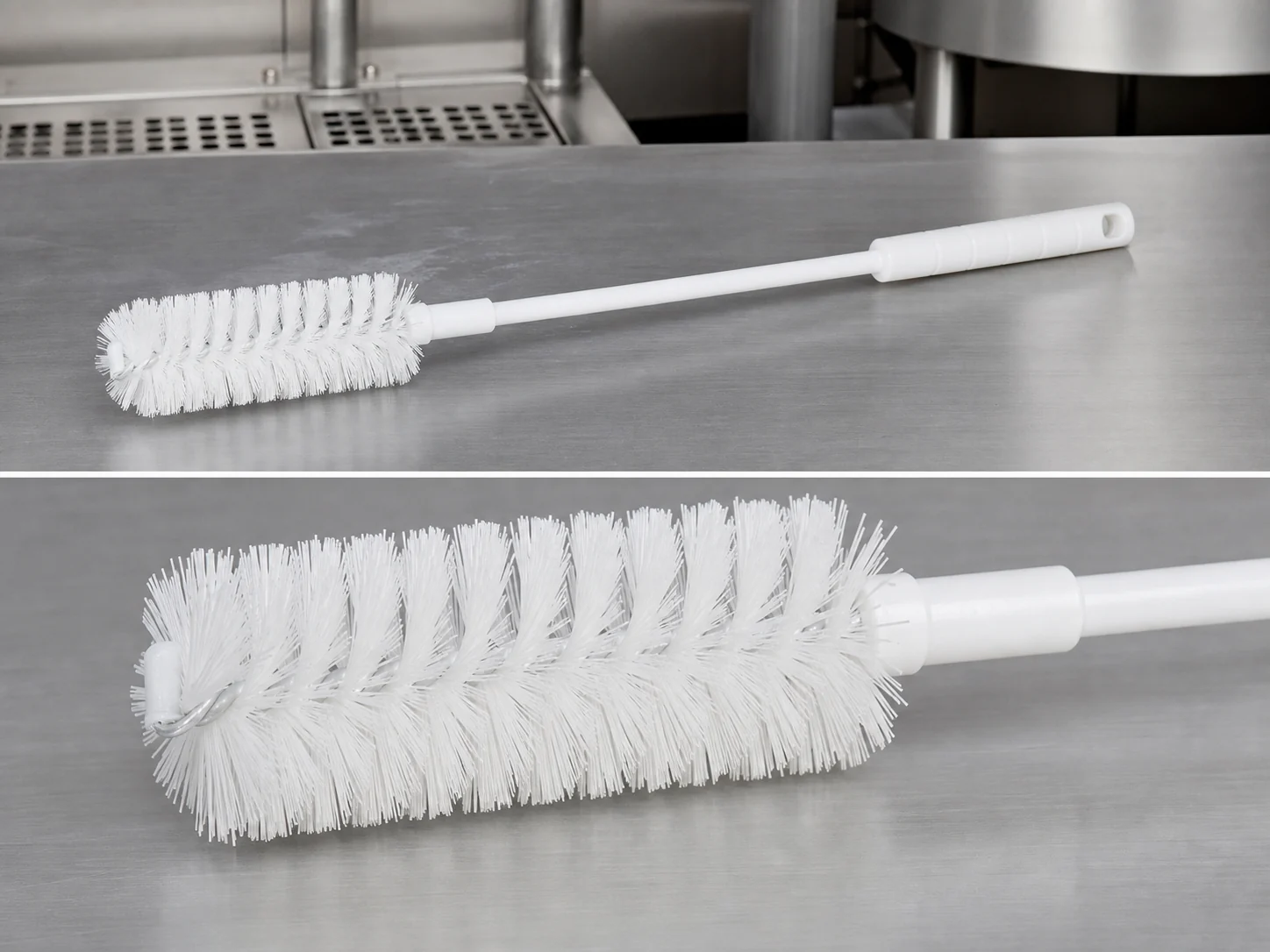
30mm PBT food tube brush with a 30 mm round head, 120 mm brush section and fixed 240 mm PP handle for product tubes, fill nozzles and ports in washdown.
Small brush
500 pcs
Minimum order
Held in one hand: tube, bottle, detail and swab brushes — including long-handled ones with a small head.
Production lead time, once the specification is confirmed
- Up to 500 pcsWithin 7 days
- 501–50,000 pcsWithin 14 days
- Over 50,000 pcsWithin 21 days
Peak season can extend these times; the shipping date is confirmed in writing with your quotation. Sampling and shipping are quoted separately.
Manual washdown brush with a 30 mm round PBT head for cleaning product transfer tubes, fill nozzles, and small ports in food processing equipment. The fixed PP handle and wet-stable PBT bristles remove soft food residues without scratching stainless steel or plastic contact surfaces.
What can this brush do for you?
Reaches the full inside wall of 25–30 mm tubes
The 30 mm round brush head is filled with PBT bristles around the full circumference, so one push-pull stroke or a half turn scrubs the entire bore. That keeps residue from collecting in the top of a fill nozzle or transfer tube, where a flat pad or narrow swab leaves a dead zone.
Stays stiff when the brush is wet
PBT polyester filament absorbs very little water, so the bristles keep their working stiffness during sink washdown instead of going limp like natural fiber. Dough, batter, fat, syrup, and thin product film come off with normal hand pressure, while bristle tips stay soft enough for stainless steel and plastic food-contact surfaces.
Fixed assembly leaves no joint for food soil to hide in
The brush head and polypropylene handle are connected as one fixed unit. There is no threaded ferrule, clamp, or replaceable head joint where crumbs, flour, or washdown water can collect and dry into a second cleaning problem.
Longer working section for short and mid-length passages
The 120 mm bristle-covered head plus the 240 mm handle gives about 360 mm of assembled length, letting an operator clean the full interior of many dispense valves, port housings, and removable process parts while keeping hands out of the cleaning zone.
Handles routine food-area chemistry without damage
PBT and PP are selected for repeated contact with common food-processing detergents, sanitizing rinses, and warm washdown water. The brush is intended for everyday manual washdown, not for exotic solvents or boiling-hot steam exposure.
What is a 30mm PBT Food Tube Brush?
A 30mm PBT Food Tube Brush is a hand-guided cleaning tool built around a 30 mm round head filled with PBT polyester filament. The standard configuration has a 120 mm brush head mounted to a fixed 240 mm polypropylene handle, for an assembled length of about 360 mm. It cleans the inside walls of product tubes, fill nozzles, valve bodies, port housings, and other removable food-equipment parts that an operator can bring to a washdown sink or clean in place with hand access.
In use, the operator inserts the head into the opening and works it with a combination of push-pull and rotating strokes. The bristles flex against the bore wall to loosen soft food soils — crumbs, flour, fat, protein film, syrup, and dough residues — which are then rinsed away. Because PBT stays stiff when wet, the same stroke keeps effective through a full shift, not just the first few seconds.
This is a manual washdown brush for accessible openings and removable parts. It is not a rotary brush for long enclosed pipe runs, not a substitute for CIP of fixed piping, and not a heavy-duty tool for carbonized or mineral deposits. Its value is in frequent cleaning of food-contact passages where a soft but firm filament is the right contact.
Technical Specifications
The dimensions below are the standard configuration. Diameter, working length, handle length, and materials can be adjusted on project-specific orders.
| Parameter | Standard configuration |
|---|---|
| Brush head diameter | 30 mm |
| Head shape | Round |
| Brush head length | 120 mm |
| Bristle material | PBT polyester filament |
| Bristle layout | Full-circumference radial fill |
| Handle material | Polypropylene (PP) |
| Handle length | 240 mm |
| Grip diameter | 14 mm |
| Overall assembled length | approx. 360 mm |
| Connection | Fixed — head and handle supplied as one unit |
| Operating environment | Wet washdown, common food-area detergents; avoid prolonged steam and temperatures above 80°C (176°F) |
| Brush type | Custom Tube & Pipe Bore Brushes |
| How it is driven | Hand-guided |
| Cleaning target | product transfer tube and dispensing spout, fill nozzle, and removable process part cleaning |
| Surface or part | ports, tubes, nozzles, plastic, bores, housings, valves, and passages |
| Residue or debris | crumbs, flour, food soil, product film, food residue, dust, dough, and fat |
| Mounting / connection | Fixed — head and handle supplied as one unit |
Where does this brush work best?
- Product transfer tubes and dispensing spouts with an internal bore near 25–30 mm on filling, metering, and packaging lines.
- Fill nozzles, fill valves, and product ports where dried product film accumulates just inside the opening.
- Removable process parts — filter housings, sight-glass ports, sampling ports, pump suction fittings, and small hopper chutes — taken to a washdown sink for manual cleaning.
- Stainless steel and food-grade plastic surfaces that need residue removal without the scratch risk of wire or abrasive bristles.
- Dry-processing equipment guards, crevices, and rails where flour, crumbs, and fine product dust pack into areas too small for a larger washdown brush.
How do I choose the right one?
Start by confirming the brush fits the opening. The 30 mm head is most effective in tubes and ports with an inside diameter of about 25–30 mm. In a 30 mm bore, bristle tips touch the wall with limited flex; in a 25 mm bore, there is enough interference for a firmer scrub. If the bore is much smaller or larger, select the next brush diameter that matches the ID rather than forcing the 30 mm head.
Match the filament to the residue. PBT is the right choice for soft, fresh food soils and light dried film. If the deposit is baked-on carbon, polymerized oil, heavy mineral scale, or requires carving force, a wire, stainless, or abrasive brush — or a pre-soak step — is a better tool. PBT will wear quickly against hard scale and leave the heaviest material behind.
Confirm the environment. PBT and PP are fine for normal hot-water washdown and common acid/alkali cleaning chemicals. If the brush will see steam sterilization, sustained temperatures above 80°C (176°F), or aggressive solvents, specify a heat-stabilized filament or stainless core through customization.
Check reach and access. The standard assembled length is about 360 mm, which suits short and mid-length straight passages. Deep tubes beyond the handle reach, or passages with bends and diameter transitions, need a longer or flexible tube brush instead of this rigid straight version.
Consider hygiene management. Fixed construction means the whole brush is replaced when the bristles wear. If your plant uses zone color coding, metal detection, or dedicated-brush programs, choose custom colors and marking at the order stage.
Can I customize this brush?
The 30mm PBT Food Tube Brush is available as a standard item and can be adjusted for volume or application-specific requirements. For a custom version, provide the tube or port inside diameter, passage length, residue type, washdown temperature and chemical list, and any handle or identification requirements. A sample part or drawing speeds up the selection.
Common adjustable variables:
- Brush head diameter and overall working length to match a specific bore or port
- Head geometry — straight round, tapered, flared, or double-ended
- Bristle material — PBT, nylon, PP, or other suitable polymer for different temperature or chemical exposure
- Bristle stiffness, filament diameter, and fill density
- Core/stem — plastic for metal-free versions or 304/316 stainless steel where needed
- Handle — length, grip diameter, shape, hanging loop, soft-touch overmold, color
- Connection — fixed, threaded, quick-connect, or replaceable-head system
- Marking and packaging — color coding, pad print, laser marking, bulk carton, or individual bag
For projects that require material declarations, inspection reports, third-party testing, or documentation tied to your plant’s food-safety program, those requirements can be handled during the customization process.
What size should a 30mm PBT food tube brush be, and how long does it last?
What tube diameter range works with a 30 mm brush head?
Use it in tubes, nozzles, and ports with an inside diameter of roughly 25–30 mm. In a 25 mm bore the bristles bend more and give a firmer scrub; in a 30 mm bore the contact is lighter. Much wider openings will leave part of the wall untouched, and much smaller openings may jam the brush.
Can I use this brush in hot water and cleaning chemicals?
Yes for normal manual washdown. PBT bristles and the PP handle tolerate hot water and common food-processing detergents, including mild acids and alkaline cleaners. Avoid prolonged steam exposure or repeated use above about 80°C (176°F). If your cycle runs hotter, ask for a high-temperature filament version.
How can I tell when to replace the brush?
Replace it when bristles look permanently bent or thinned, when tufts loosen under a light pull, when the handle shows cracks or stress marks, or when residue stays trapped at the base of the bristles after normal rinsing. Fixed-connection brushes are replaced as complete units.
Will this brush scratch stainless steel food-contact surfaces?
Under normal hand pressure, PBT filaments are softer than stainless steel and will not scratch the surface. If hard particles such as sand or mineral grit are mixed with the food soil, rinse those away first so they are not driven across the metal by the bristles.
Does this brush sanitize or disinfect what it cleans?
No. The brush removes attached food residue from accessible surfaces. Rinsing and any required sanitizing or disinfection steps still need to be performed according to your plant’s cleaning program. Brushing is one step in the washdown sequence, not the final hygiene step.
What should I do if my tube is longer than the brush can reach?
Use a longer-handle brush, a flexible tube brush that can follow the passage, or clean the part from both ends if access allows. Forcing the fixed handle deeper than its working length reduces control and can bend or break the handle or stem.
Guides that go deeper on this
Custom Manufacturing RFQ
Describe Your Application
Please include the main sizes, application, residue, preferred material, interface, quantity, and any drawing or sample available.
Drawing or photo optional — it speeds things up, it does not gate the enquiry.
Custom Brush RFQ
Send Your Brush Project
Upload a drawing, product photo, or sample photo and provide the core dimensions and cleaning conditions.
“We need a brush to remove wet residue from a stainless steel conveyor, about 800mm wide. The current brush wears quickly. We can send photos.”
“We sell drinkware and need a cleaning brush to include with the product. Quantity around 5,000 pieces.”