
Custom Cleaning Brush
80x500mm PBT Glass Washing Roller Brush
80 mm x 500 mm PBT roller brush for glass washing lines. Scratch-safe cleaning of flat and coated glass. Stainless steel core, quick-change coupling.
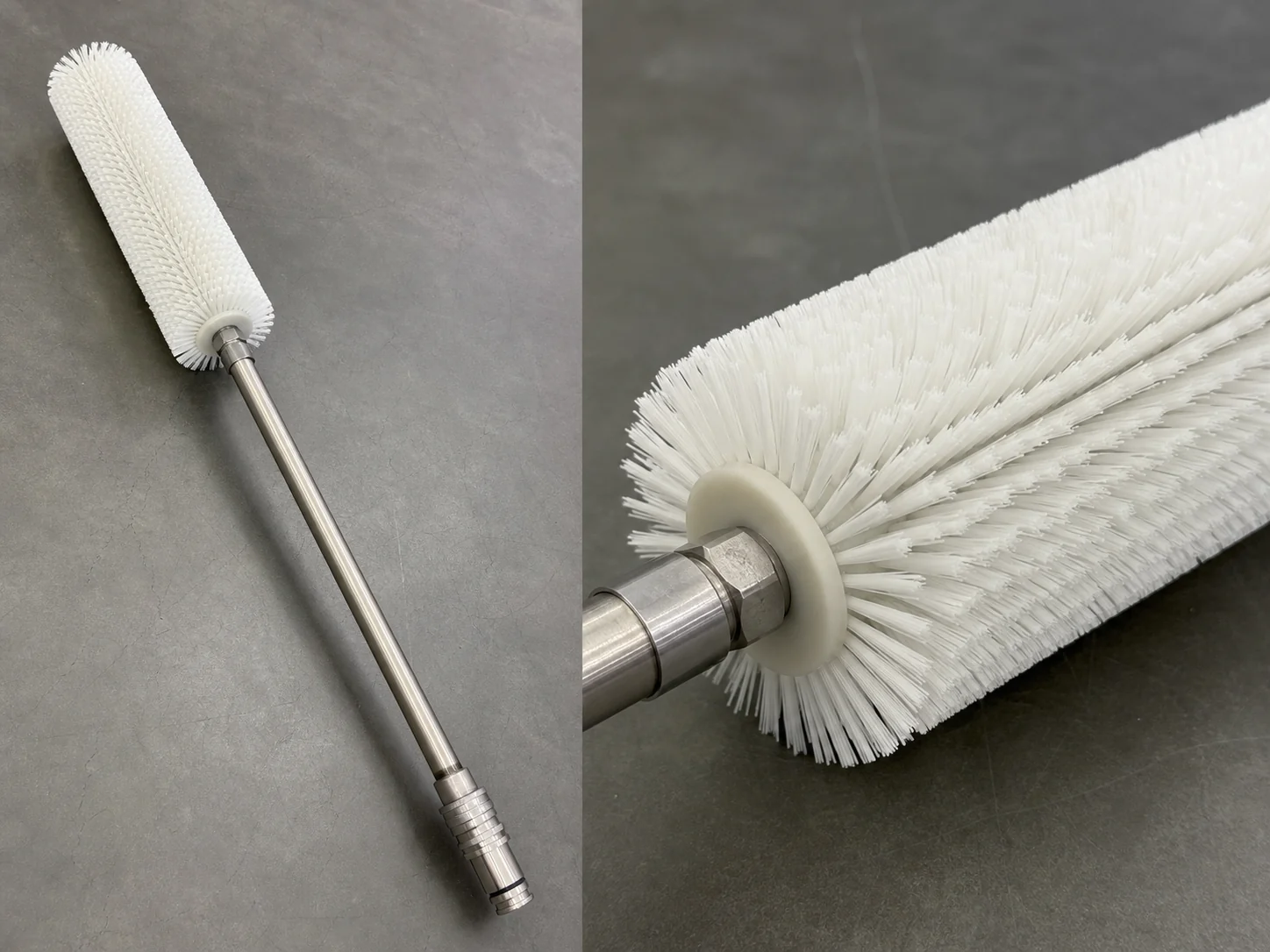
Medium brush
100 pcs
Minimum order
Worked with two hands or on a pole: chimney, gutter and pond-filter brushes, discs, cups and tank brushes.
Production lead time, once the specification is confirmed
- Up to 100 pcsWithin 7 days
- 101–5,000 pcsWithin 14 days
- 5,001–50,000 pcsWithin 21 days
- Over 50,000 pcsConfirmed with your quotation
Peak season can extend these times; the shipping date is confirmed in writing with your quotation. Sampling and shipping are quoted separately.
This 80 mm diameter × 500 mm long PBT roller brush is built for continuous glass washing lines that need even, scratch-free removal of dust, polishing fines, oil film, and wash-water deposits from flat glass, coated panels, and edge contact zones. The brush mounts on a driven shaft through a quick-change coupling, so replacement between production runs takes seconds instead of a line shutdown.
What can this brush do for you?
Consistent contact across the full 500 mm working width
The 500 mm filament face covers common glass pane widths in a single pass, eliminating the alternating wet and dry stripes that shorter brushes leave on washing lines. PBT filaments flex just enough to follow minor surface variations while the 80 mm OD maintains uniform contact pressure from center to edge.
Scratch-safe cleaning on coated and polished glass
PBT filament tips present a smooth, rounded contact surface with no exposed metal. That lets the brush remove dust, fingerprints, and oil film from low-E, reflective, or painted glass without marking the coating. The filament material itself contains no abrasive filler, so the contact remains gentle even at line speed.
Low water absorption keeps the brush consistent
PBT absorbs far less water than nylon or natural fiber, so the filaments do not soften, swell, or lose stiffness after hours in a wet washing bath. Brush pressure stays the same at the beginning and end of a shift, which keeps cleaning performance predictable on continuous lines.
Quick-change coupling minimizes downtime
The brush mounts to the machine shaft through a quick-change coupling that lets an operator swap a worn roller in under a minute without pulling the drive assembly. That reduces line stoppage and makes it practical to change brushes between glass types or coating campaigns.
Reaches edges and seams without chipping
With the correct alignment and line speed, the brush can safely contact glass edges and seams to remove swarf, polishing residue, and wash-water deposits that collect in those zones. The PBT filaments absorb contact energy rather than transferring it to the glass edge, which helps prevent micro-chipping on cut or ground edges.
What is an 80x500mm PBT Glass Washing Roller Brush?
An 80x500mm PBT Glass Washing Roller Brush is a cylindrical industrial brush designed to rotate against flat glass surfaces inside a washing machine. The 80 mm outer diameter and 500 mm filament-covered length define the contact envelope; the brush is not a hand tool but a driven component that mounts on a machine shaft.
The brush body consists of PBT filaments anchored around a central stainless steel core. PBT (polybutylene terephthalate) is chosen for this application because it combines enough stiffness to dislodge fine particles and oil film with enough flexibility to avoid scratching coated or polished glass. The stainless steel core resists corrosion in the wet, detergent-laden environment of a glass washing line and supports the filament pack at operating speed.
During operation, the brush rotates while the glass passes beneath or between brushes. Wash water or detergent solution is applied to the glass, and the rotating filaments loosen dust, polishing residue, fingerprints, oil film, and wash-water deposits so the rinse section can carry them away. The brush works as part of a sequence: pre-wash, brushing, rinsing, and drying. It does not replace rinsing or drying, but it determines how much residue reaches the final inspection station.
The quick-change coupling on the brush is designed to interface with common glass washing machine drive shafts. The exact coupling type—keyway, hex bore, or clamp—must match the shaft on the buyer’s line. Because the brush runs wet and continuously, the core and coupling are made from AISI 304 stainless steel as standard, with options for other grades where the wash chemistry requires it.
Technical Specifications
| Parameter | Value / Options |
|---|---|
| Outer diameter (brush OD) | 80 mm |
| Working length (filament-covered face) | 500 mm |
| Bristle material | PBT (polybutylene terephthalate) |
| Core material | AISI 304 stainless steel (316 available on request) |
| Filament diameter | 0.3 mm, 0.4 mm, or 0.5 mm, selected by residue type and glass sensitivity |
| Trim length (filament free length) | 25–35 mm, depending on core diameter and stiffness target |
| Fill density | Standard, dense, or extra-dense; matched to debris load and line speed |
| Setting pattern | Straight row or spiral, selected for even wear and water distribution |
| Connection | Quick-change coupling (keyway, hex bore, or clamp type specified against machine shaft) |
| Handle / grip | None (machine-mounted roller) |
| Operating environment | Continuous submersion in mild alkaline or neutral glass washing detergent up to 80°C |
| Typical operating speed | 100–300 rpm, depending on glass thickness, line speed, and brush pressure |
| Brush type | Custom Roller and Conveyor Brushes |
| How it is driven | Machine-driven, mounted in the equipment |
| Cleaning target | flat glass washing line, insulated glass unit production, and architectural and automotive glass processing cleaning |
| Surface or part | glass, edges, flat glass, roller, panels, glass edges, seams, and coated panels |
| Residue or debris | oil, dust, oil film, fines, fingerprints, wash-water deposits, glass fines, and polishing compound |
| Mounting / connection | Quick-change coupling (keyway, hex bore, or clamp type specified against machine shaft) |
All dimensions and material choices can be adjusted during project development. The values above represent the standard configuration for an 80 mm OD × 500 mm working-length brush; custom diameters, lengths, and filament specifications are available.
Where does this brush work best?
- Flat glass washing lines feeding tempering, laminating, coating, or screen-printing processes, where dust, glass fines, and oil film must be removed before the next operation.
- Insulated glass unit (IGU) production, cleaning lites before spacer and sealant application to remove fingerprints, dust, and wash-water marks.
- Architectural and automotive glass processing, where coated or polished surfaces require scratch-free brushing on faces, edges, and seams.
- Solar panel and display glass washing, light contact cleaning of sensitive substrates without metal contamination.
- Glass edge processing lines, where the brush contacts cut or ground edges to pull away swarf and polishing compound before inspection or tempering.
How do I choose the right one?
First, confirm the machine interface. The quick-change coupling must match the drive shaft geometry on your washing line. Send the shaft diameter, keyway or spline dimensions, and any existing brush end drawing. A mismatch makes the brush impossible to mount, regardless of filament specification.
Then match the filament stiffness and density to the residue and the glass. Standard PBT filament with a standard fill removes dust, fingerprints, and light oil film from uncoated glass. Dense or extra-dense fill handles higher fines loads from grinding or seaming operations. For coated glass, choose finer filament (0.3 mm) and a softer trim to keep contact gentle; for heavier oil or wash-water film, a stiffer 0.5 mm filament with shorter trim length applies more scrubbing pressure without switching material.
Check the brush length against your line width. The 500 mm working length covers narrow to medium panes in a single roller; wider washing machines may need two or more rollers mounted end-to-end, or a custom longer brush can be built to match the conveyor width.
Consider the wash environment. AISI 304 stainless steel handles most municipal water and mild alkaline detergents. If your line uses acidic cleaners, high chloride water, or operates above 80°C, specify 316 stainless steel and confirm the PBT filament grade is suitable; PBT maintains stiffness up to about 120°C dry, but continuous wet operation above 80°C may shorten filament life.
When a PBT roller is not the best fit: use a nylon roller if the wash chemistry degrades PBT or if the glass requires a softer touch; use an abrasive-impregnated roller for heavy grinding residue or scale; use a softer filament or flap brush for very delicate coated glass; use a wider diameter or multiple brushes if the line needs more contact time.
Can I customize this brush?
Yes. The 80×500 mm dimensions are the standard configuration, but the brush can be adapted to the buyer’s machine and process. To define a custom configuration, provide the machine shaft drawing, glass width and thickness range, line speed, wash water temperature, detergent type, residue description, and any coating specifications on the glass.
We can adjust:
- Dimensions — outer diameter from 40 mm to 150 mm, working length from 100 mm to 3000 mm, and overall length to fit existing guards and drive positions.
- Core and coupling — stainless steel grade (304, 316, or duplex), shaft bore design, keyway, spline, or clamp interface, and end journal arrangement.
- Filament package — PBT filament diameter from 0.15 mm to 0.8 mm, trim length, fill density, straight or spiral setting, and hybrid fills with nylon or abrasive filaments in specific zones.
- End and edge treatment — filament density at the brush ends can be increased or tapered to protect glass edges or seams.
- Color and marking — custom filament colors for batch identification, plus core marking, laser etching, or pad printing on the coupling.
- Packaging — bulk cartons, individual protective sleeves, or custom skid packing for export.
If the project requires material declarations, inspection reports, or third-party testing for specific wash chemistries or glass coatings, we can assist with those requirements during the customization process.
Which filament survives the cleaning and still lasts on a 80x500mm PBT glass washing roller brush?
How do I know when the brush needs replacement?
Measure the brush OD at several points along the working length. When the diameter has worn down by more than 5–8 mm from the original 80 mm, or when filament density has visibly thinned and cleaning streaks appear on the glass, replace the brush. Also inspect for broken or missing filament tufts, especially near the ends, where edge contact causes faster wear.
Can this brush run under hot water or steam?
The brush is designed for continuous wet operation up to 80°C with standard PBT filaments. Short exposure to water up to 90°C is usually acceptable, but steam or temperatures above 100°C will soften PBT and may cause permanent filament deformation. If your process uses hot water or steam, specify a high-temperature filament grade or consider a different material.
Does the quick-change coupling require special tools?
No. The quick-change design allows an operator to slide the brush onto the machine shaft and lock it in place by hand, typically using a spring-loaded pin or a quarter-turn clamp, depending on the coupling type. A small mallet may help seat a tight bore, but no wrenches or disassembly of the drive are required for routine replacement.
What is the difference between PBT and nylon for glass washing?
PBT absorbs much less water than nylon, so it keeps its stiffness and diameter stable after hours in a wet washing machine. PBT also resists many alkaline detergents better than nylon. Nylon may be chosen when the glass is extremely scratch-sensitive or when a particular wash chemistry attacks PBT. For most flat glass washing lines, PBT offers the best balance of stiffness, water resistance, and coating safety.
Can I use this brush on curved or shaped glass?
This roller brush is designed for flat glass surfaces and straight edges. On curved or three-dimensionally shaped glass, the 500 mm straight face cannot follow the contour, and contact pressure will be uneven. For bent automotive glass or curved displays, use a conformable brush or a shaped roller specifically designed for that geometry.
How should I store a spare brush between uses?
Store the brush horizontally, supported along its full length, in a dry area away from direct sunlight and strong UV sources. PBT can become brittle after prolonged UV exposure. If the brush is removed from service wet, allow it to air dry before storage to prevent water trapped in the filament pack from causing corrosion on the core, especially if the coupling has any exposed end face.
Guides that go deeper on this
Abrasive Nylon Grit and Filament Selection
Read this guideGuideBrush Roller Conveyor Mistakes with Dry Dust
Read this guideGuideBrush Speed, Engagement, and Heat
Read this guideGuideConveyor Belt Cleaning Brush Design
Read this guideGuideFloor Scrubber Brush Selection: Disc Brush vs Roller Brush
Read this guideCustom Manufacturing RFQ
Describe Your Application
Please share the brush dimensions, working area, residue type, material direction, quantity, and a drawing or photo for quotation.
Drawing or photo optional — it speeds things up, it does not gate the enquiry.
Custom Brush RFQ
Send Your Brush Project
Upload a drawing, product photo, or sample photo and provide the core dimensions and cleaning conditions.
“We need a brush to remove wet residue from a stainless steel conveyor, about 800mm wide. The current brush wears quickly. We can send photos.”
“We sell drinkware and need a cleaning brush to include with the product. Quantity around 5,000 pieces.”