
Application
Outdoor Grill & Sports Equipment Cleaning
For Outdoor Grill & Sports Equipment Cleaning, the brush must reach the working area, disturb or collect carbonized grease/carbonized residue/food residue/soot, and release it without creating unacceptable surface damage or process interference. Choose the brush structure from the available access, contact direction, and cleaning process.
At a glance
- Cleaning target
- Carbonized Grease/Carbonized Residue/Food Residue/Soot
- Working environment
- Outdoor / High-Temperature Equipment Area
- Cleaning method
- Dry Brushing / Wet Brushing / Steam Cleaning
- Requirements to check
- Use FDA 21 CFR- or EU 10/2011-Compliant Materials for Food-Contact Areas; Wire-Shedding Control
Carbonized grease on a grill grate and dried mud on a bicycle are opposite jobs, so this group is defined by which surfaces tolerate a scraper and which accept soft fill only.
What makes Outdoor Grill & Sports Equipment Cleaning different from other facility, floor and outdoor cleaning?
The main difficulty is removing brake dust, road film, grease, mud, carbon, and loose particles from paint, wheels, tires, chains, vents, grills, and vehicle details without damaging the surface, loading the brush, or carrying contamination back into the process.
The work happens in outdoor and high-temperature equipment area against carbonized grease, carbonized residue, food residue and soot.
The part people get wrong: the residue tells you the filament, but the access opening tells you the construction. Get them in that order and the shortlist is short.
What are the most common cleaning targets in Outdoor Grill & Sports Equipment Cleaning?
5 targets, each with its own opening, residue and contact requirement.
| Part or area | Residue type | Cleaning requirement |
|---|---|---|
| Barbecue-Grill Grate | Carbonized grease, food residue, soot, ash | The brush must reach between bars or slots and clean both faces of each member. |
| Bicycle and Outdoor-Gear | Chain grease, road grit, mud, dried spray | The brush must concentrate contact on a small feature without touching the surrounding surface. |
| Sports-Shoe | Mud, grass stain, dust, dried soil | The head must reach the working face and apply even contact without marking the surface. |
| Golf Equipment | Soil, grass clippings, sand, groove packing | |
| Camping and Patio Equipment | Dust, pollen, mildew film, weathering soil |
The dimensional envelope those targets impose on the brush:
| Parameter | Typical range |
|---|---|
| Grill duty | Use a manual grill-cleaning brush matched to the grate material and cleaning temperature; verified product forms include nylon-bristle and bristle-free/coil designs |
| Sports-equipment duty | Use a separate cleaning brush specified for the actual equipment surface; no common bristle material or size is assigned across all sports equipment |
| Selection input | Surface material, coating, soil type, access, and whether the surface is hot or cool |
| Separation rule | Do not carry grill-wire or grill-brush stiffness over to painted, polymer, rubber, or coated sports-equipment surfaces |
Which brush types work for each cleaning target?
Long-handle grill brush, scraper brush, handheld detail brush, ball-cleaning brush, or rotating equipment brush.
| Cleaning target | Recommended brush type | Why it fits |
|---|---|---|
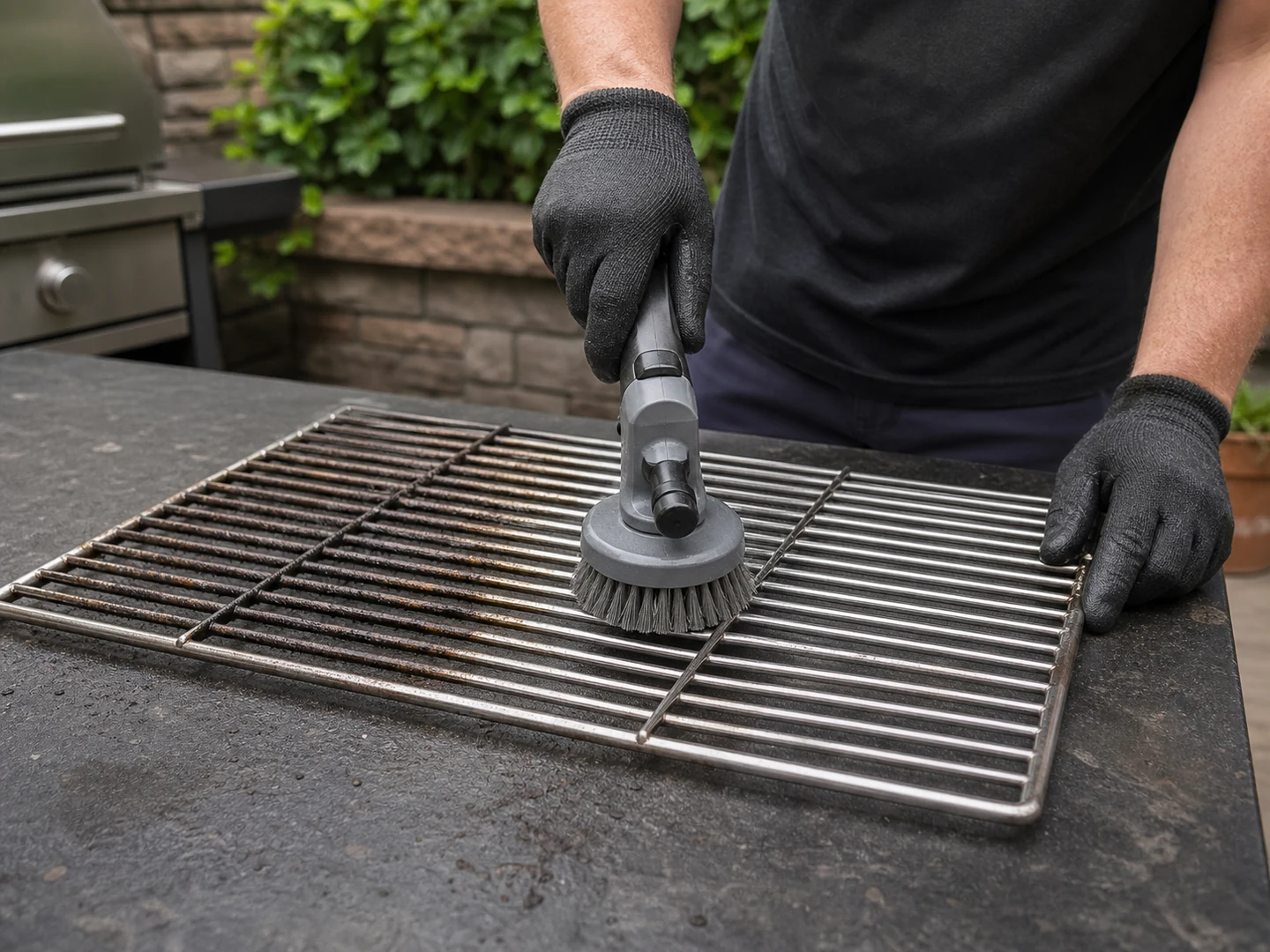
| Barbecue-Grill Grate | Handheld Detail Brushes | A grate is spaced round or square bar, so a narrow head follows each bar and reaches the underside where the carbon actually builds. |
| Bicycle and Outdoor-Gear | Cassettes, chainrings and derailleur cages are small features surrounded by finished parts, so the head is kept narrow enough to work one of them at a time. | |
| Sports-Shoe | Shoe uppers mix mesh, leather and printed panels, so a hand-guided head lets the user change pressure as they cross from one to the next. | |
| Golf Equipment | Club heads, grips and bag pockets each want a different pressure, so a hand-guided head covers all of them without a separate tool for each. | |
| Camping and Patio Equipment | Camping and patio gear is bulky, folded and put away dirty, so a hand-guided head is what reaches into hinges and fabric channels before it is packed. |
The layouts this application is normally built in:
- Driven brush — use when brake dust, road film, grease, mud, carbon, and loose particles needs repeatable scrubbing or controlled relative movement
- Passive or free-running brush — use for loose contamination and lower process complexity on paint, wheels, tires, chains, vents, grills, and vehicle details
- Localized hand, strip, or tube brush — use where only an edge, gap, port, or maintenance point needs contact
In practical brush terms: reach first, then residue. A brush that fits but is too soft can be stiffened; a brush that does not fit is simply the wrong tool.
What filament materials work best for Outdoor Grill & Sports Equipment Cleaning?
Consider stainless or brass wire for robust uncoated grates; choose nylon, PBT, polypropylene, natural fiber, or sponge for painted, polymer, rubber, and appearance-sensitive surfaces.
| If the condition is… | Filament to start with | Why |
|---|---|---|
| Sensitive or coated surface | Nylon PA | balanced flex life and abrasion resistance |
| Wet, washdown, or detergent service | Polypropylene PP | acid, alkali, water, and detergent resistance |
| Bonded residue or aggressive cleaning | PBT | stable wet stiffness and low moisture uptake |
The constraints this application puts on the filament:
| Constraint | Value for this application |
|---|---|
| Filament hardness | Hard |
| Maximum service temperature | 260°C |
| Chemical exposure | Alkaline Cleaner pH 10–14; Steam Cleaning; Hot Water |
| Cleaning method | Dry Brushing, Wet Brushing, Steam Cleaning |
How do I choose the right brush for my outdoor grill & sports equipment equipment?
Sort the surfaces into those that tolerate a scraper and those that do not; each group takes a different fill even in the same handle.
Work through it in this order:
- Identify the target part and measure the access opening or clearance
- Describe the residue: what it is, how thick it sits, and how strongly it holds
- Choose the construction that can physically reach that target
- Set the filament from surface risk, working temperature and cleaning chemistry
- Fix filament diameter, free trim length and density for the contact pressure you need
- Run one cycle and check the result before committing to a production quantity
Before you commit to a quantity, list the surfaces the brush will touch and mark which tolerate a scraper and which need soft fill only.
When is an outdoor grill and sports equipment brush the wrong tool?
A hot grate and a scraper do more for carbonized grease than bristles, and loose-wire grill brushes carry a documented ingestion risk. Bicycles and gear are better degreased and rinsed first, with the brush kept for the drivetrain and cleats.
What common mistakes should I avoid in Outdoor Grill & Sports Equipment Cleaning?
- Grouping grill, bicycle and shoe cleaning into one brush, when those surfaces tolerate completely different fill
- Changing brush material while leaving excessive engagement, poor alignment, or no discharge path unchanged
- Copying a worn brush without recording motion, direction, mounting, and the original working diameter
When a brush is running but not cleaning, start here rather than adding pressure:
| Symptom | What to change |
|---|---|
| Residue remains | Increase relative motion or discharge, then change filament diameter or density; do not add pressure before checking loading by brake dust, road film, grease, mud, carbon, and loose particles. |
| Surface marks or scratches | Reduce engagement, use finer or softer fill, and remove trapped abrasive particles from contact with paint, wheels, tires, chains, vents, grills, and vehicle details. |
| Rapid wear or uneven cleaning | Check alignment, runout, support, motion, temperature, chemical attack, and whether the brush covers the complete working path. |
| Brush loads or redeposits residue | Open the fill pattern or add wash, vacuum, air, scraping, or a collection path so removed brake dust, road film, grease, mud, carbon, and loose particles leaves the contact zone. |
Guides that go deeper on this
We have not written a guide specific to this one yet. The material that covers selection, filament, dimensions, maintenance and sourcing is collected in the technical resources library.
No catalogue item for this yet
Every brush here is made to order, and this one has no catalogue entry so far. Send the working surface, the residue, the access opening and the quantity, and it is quoted through the same specification route as the rest of the range.
Custom Manufacturing RFQ
Discuss This Application
Share the working surface, residue, dimensions, material direction, interface, quantity and drawing or sample photo.
Custom Brush RFQ
Request a Custom Cleaning Brush Quote
Upload a drawing, product photo, or sample photo and provide the core dimensions and cleaning conditions.
“We need a brush to remove wet residue from a stainless steel conveyor, about 800mm wide. The current brush wears quickly. We can send photos.”
“We sell drinkware and need a cleaning brush to include with the product. Quantity around 5,000 pieces.”