
Custom Cleaning Brush
Brass Precision Parts Brush
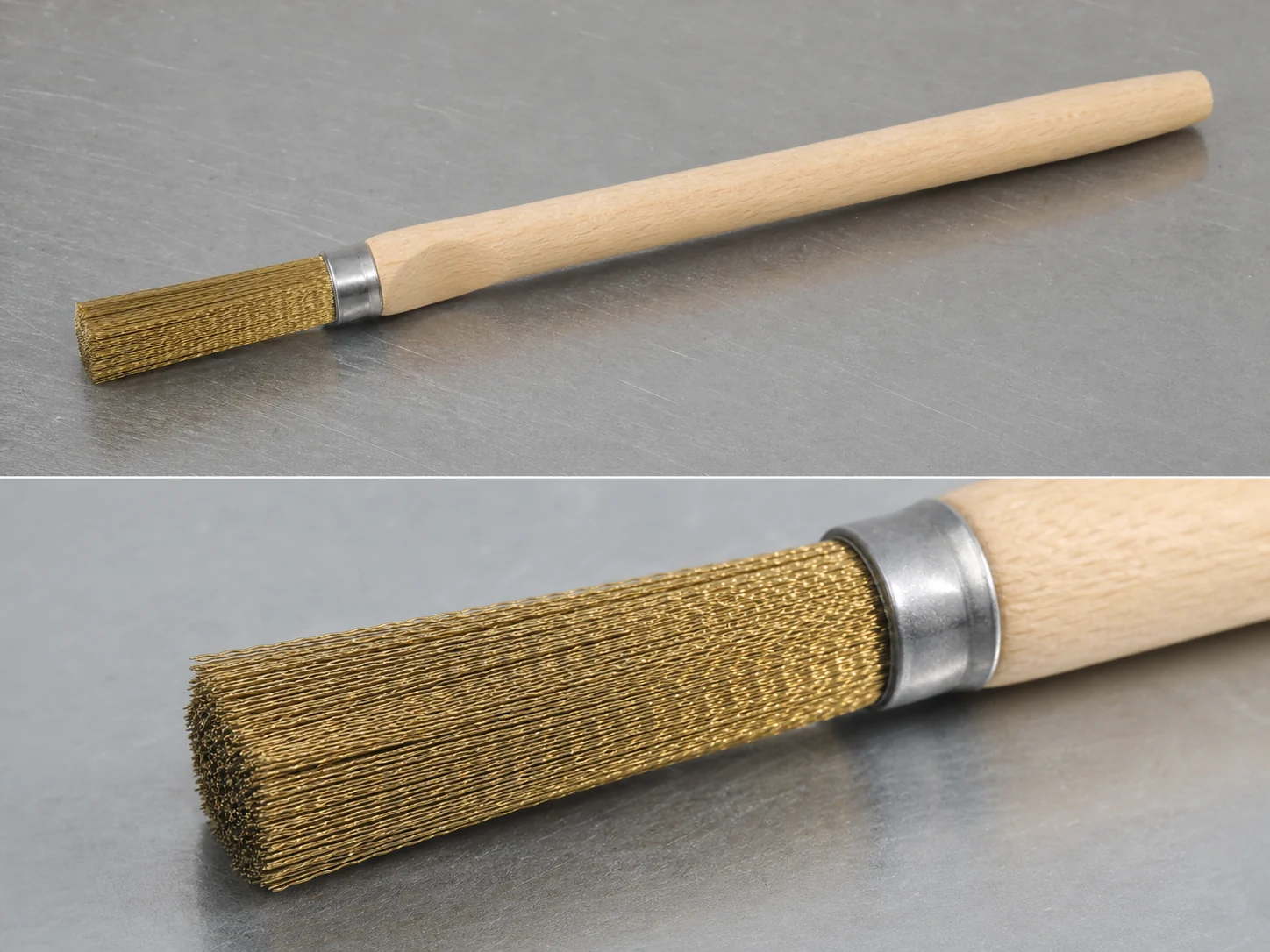
Solid brass precision parts brush with an 18 x 80 mm rectangular head for removing chips, oil, and light residue from machined parts, guides, and tooling.
Small brush
500 pcs
Minimum order
Held in one hand: tube, bottle, detail and swab brushes — including long-handled ones with a small head.
Production lead time, once the specification is confirmed
- Up to 500 pcsWithin 7 days
- 501–50,000 pcsWithin 14 days
- Over 50,000 pcsWithin 21 days
Peak season can extend these times; the shipping date is confirmed in writing with your quotation. Sampling and shipping are quoted separately.
A compact, fine-wire brass hand brush for controlled removal of chips, oil, dust, and light process residue from machined parts, guides, tooling, and tight machine recesses. The rectangular 18 mm × 80 mm head and solid brass fill clean into corners without scratching hardened ferrous surfaces.
What can this brush do for you?
Reaches packed chips in slots and corners
The 18 mm × 80 mm rectangular head fits into T-slots, keyways, shallow pockets, and corner seams where a large bench brush only moves debris around. Short brass tufts maintain contact at the bottom of the recess, so chips and dried coolant lift out on the stroke instead of sliding to the back of the slot.
Cleans ferrous surfaces without leaving visible scratch tracks
Solid brass wire is softer than hardened steel, cast iron, and tool steel. The wire tips wear before the base metal does, which makes the brush practical on guideways, fixture locating surfaces, and other ground or polished ferrous parts where carbon-steel wire would leave marks. Operators can use more contact pressure without converting the cleaning step into a damage source.
Adds a margin of safety around oil and solvent environments
Brass is non-ferrous and does not produce the impact sparks typical of carbon-steel wire against hard steel. For hand cleaning around machine sumps, cutting-fluid residues, and solvent-wiped enclosures, brass wire is the safer material choice — with normal machine isolation, ventilation, and site safety controls still in force.
Keeps wires from clogging during the wiping stroke
The open wire fill cuts through the oil film, grabs the chip or loose particle, and releases it with a shake or solvent rinse. Unlike cloths or foam pads, the brush does not build a swarf-loaded surface that can drag chips across the part on the next pass.
Fixed head gives stable control for detail work
The brush head is fixed to the handle, so there is no pivot or flex point between the hand and the wire. This stability lets the operator make short, precisely placed strokes along thread flanks, mold details, and machined edges — important when the surrounding surface finish has no tolerance for accidental contact.
What is a Brass Precision Parts Brush?
A Brass Precision Parts Brush is a small hand-guided cleaning tool with a dense block of solid brass wire fill and a short handle, built for close work on machined parts, tooling, machine housings, and other ferrous surfaces where chips, oil, dust, and light residue accumulate. The head is rectangular and trimmed straight, and the handle is fixed in line with the brush so the operator always knows where the working edge is.
In use, the operator works with short push-pull and corner strokes over the contaminated areas, dry or with a small amount of mineral spirits, kerosene, or neutral parts-cleaning solvent. The brass fill is solid wire rather than brass-plated steel, so worn or broken wire ends do not introduce rust-prone steel slivers into the work area. Handle material is selected for the shop environment: aluminum for rigidity and light weight, or plastic where chemical resistance or a non-conductive grip is preferred.
This is a controlled cleaning tool, not a descaling or heavy stock-removal brush. It removes chips, oil, dust, loose process residue, and light corrosion. Deposits that require chipping, aggressive abrasion, or chemical stripping are outside its working range and should be handled by a stainless, carbon, abrasive, or chemical process before a final brass pass if the base metal allows.
Technical Specifications
Standard configuration is shown below. Dimensions, wire diameter, fill pattern, and handle can be adjusted to the customer’s part geometry and cleaning procedure.
| Parameter | Standard Configuration / Options |
|---|---|
| Overall length | 200 mm standard (120 mm handle + 80 mm head); custom 150–350 mm available |
| Head length | 80 mm |
| Head width | 18 mm |
| Head shape | Rectangular block with straight trim; angled, trapezoidal, or contour trim on request |
| Bristle material | Solid brass wire — CuZn alloy such as 65/35 or 70/30 depending on wire source; not plated steel |
| Wire diameter | 0.10–0.15 mm standard; finer 0.08 mm or coarser 0.20–0.25 mm available |
| Bristle trim length | 10–14 mm standard, selected for recess depth and contact stiffness |
| Fill density | Dense block fill; row spacing and tuft pattern adjustable |
| Handle length | 120 mm |
| Grip diameter | 18 mm |
| Handle / base material | Aluminum or plastic (PP / PA / other project-compatible polymer) |
| Connection | Fixed — insert-molded, riveted, or bonded depending on handle material |
| Cleaning environment | Dry or with mineral spirits, kerosene, and neutral degreasers; handle compatibility to be confirmed for acidic or alkaline cleaners |
| Replacement format | Standard fixed-head unit; replaceable refill strip can be designed for high-volume programs |
| Brush type | Custom Handheld Detail Brushes |
| How it is driven | Hand-guided |
| Cleaning target | machine tool maintenance, tooling and setup surface, and stamping detail cleaning |
| Surface or part | tooling, aluminum, recesses, corners, holes, housings, edges, and fixtures |
| Residue or debris | chips, oil, dust, carbon, process residue, light process residue, coolant, and mold |
| Mounting / connection | Fixed — insert-molded, riveted, or bonded depending on handle material |
Where does this brush work best?
- Machine tool maintenance: guideways, T-slots, vise bases, chip trays, and enclosure seams where machining chips and coolant collect during production.
- Tooling and setup surfaces: collet seats, tool holder bodies, turret pockets, fixture keys, and jig locating edges before assembly or after storage.
- Die, mold, and stamping details: ejector pin holes, vent grooves, shallow parting-line channels, and other hardened tool-steel details.
- Gears, splines, and threads: gear root fillets, thread flanks, keyways, and tapped holes on ferrous components where chips pack into the profile.
- Cast iron and steel housings: engine, gearbox, and pump maintenance where oily carbon, old gasket remnants, and loose debris need light mechanical removal without scratching the casting.
For aluminum, copper, brass, plated, or coated parts, do not default to brass before testing — softer non-ferrous surfaces can gall or pick up a visible brass transfer mark. Those parts usually need nylon, Tampico, or fine stainless alternatives.
How do I choose the right one?
Confirm the base metal before selecting the wire
Brass wire works on hardened steel, cast iron, tool steel, and most ferrous machine alloys. For aluminum, copper alloys, plated surfaces, or coated parts, switch to nylon, Tampico, or a fine stainless fill — brass can gall the surface or leave a yellow transfer mark. On ground, lapped, or otherwise critical surfaces, always run a trial on a non-functional area or test coupon first.
Match wire diameter to the residue
Use 0.10 mm or finer brass wire for light oil film, dust, and delicate surfaces. Move to 0.15 mm or coarser wire when sticky cutting oil, packed chips, or light carbon needs more mechanical action. If the deposit is hard scale, rust scale, or cured carbonized material, this brush is not the first tool; use chemical, ultrasonic, stainless, or abrasive cleaning first, then a final brass pass only if the surface permits it.
Verify the head fits the smallest access feature
Measure the narrowest slot, hole, or recess before ordering. The standard 18 mm width fits many machine-table slots and common tool holders, but a narrower head, reduced trim length, or angled profile may be needed for special fixtures. The 80 mm head length covers reasonable flat areas; for longer guide rails or large housings, consider a wider fill or larger brush format instead of trying to cover everything with one small head.
Choose the handle for the environment and use
Aluminum handles offer rigidity and low weight, but some alkaline or acidic cleaning agents attack aluminum. Plastic handles are usually better for solvent-rich or wet service and provide electrical isolation. Use a 120 mm handle for close work; choose longer handles only when the recess is deep, and expect reduced control as length increases.
| Your condition | Recommended configuration |
|---|---|
| Steel/iron parts with oil and chips | 0.15 mm brass, aluminum handle, dry or solvent-dampened |
| Ground or polished ferrous surfaces, light film | 0.10 mm or finer brass, dense fill, trial first |
| Aluminum, copper, plated, or coated parts | Nylon / Tampico / fine stainless — not brass |
| Narrow slot or shaped recess | Custom reduced width and contour trim |
| Heavy rust, baked-on carbon, or mill scale | Chemical / ultrasonic / stainless or abrasive brush first |
Can I customize this brush?
Yes. For production use, we start from the part geometry and the cleaning procedure rather than from a catalog dimension. To define the correct configuration, please provide: base material and hardness, surface finish, narrowest opening and recess depth, residue type, cleaning chemical or solvent, preferred handle form, and expected usage volume. A CAD drawing, photo, or physical sample speeds up the evaluation.
Adjustable areas include:
- Head geometry: width below or above 18 mm, length, rectangular, trapezoidal, angled, or contoured trim; single or double-faced fill.
- Brass wire fill: wire diameter from fine 0.08 mm to coarse 0.25 mm or more, straight or crimped wire, trim length, fill density, and tuft pattern.
- Handle: aluminum or plastic, length, diameter, ergonomic shape, textured grip, hanging hole, or non-conductive requirement.
- Connection and serviceability: fixed insert-molded, riveted, or bonded; reinforced head for heavy industrial use; replaceable refill strip or block for repeat-order programs.
- Color and marking: custom handle color, molded or pad-printed logo, laser marking, and identification coding.
- Packaging: bulk shipper, individual polybag, box, or project-specific labeling.
For maintenance programs that need material documentation or batch traceability, we can support project-specific material declarations, inspection records, and third-party testing during the customization process.
Which filament survives the cleaning and still lasts on a brass precision parts brush?
Can I use this brush on stainless steel parts?
Generally yes for austenitic and martensitic stainless machine parts when the surface is not a mirror polish or critical sealing face. Brass is softer than stainless and will not cut the base. However, on long continuous strokes the brass can leave a dull golden transfer film; use a compatible solvent wipe afterward. For food-contact or high-purity stainless surfaces, test before use and select a nylon or fine stainless alternative if any transfer appears.
Is this brush made from solid brass wire or brass-plated steel?
Solid brass wire. There is no steel core under a brass coating, so as the wire tips wear down or break in service, the remaining pieces do not rust, and they do not introduce ferrous slivers into the work area. This is also why the brush is not magnetic; a magnet can be used as a quick incoming check.
Will it remove heavy rust or baked-on carbon?
No. Brass wire removes chips, oil, dust, light corrosion, and some loose process residue. Hard rust scale, cured carbon, and sintered deposit layers require chemical treatment, ultrasonic cleaning, or a stainless, carbon, or abrasive brush. Forcing brass against hard scale wears the wire quickly without producing a clean surface, and it can smear the deposit rather than remove it.
Can I use the brush with a parts-cleaning solvent and keep reusing it?
Yes, but match all materials to the solvent. Brass wire tolerates common mineral spirits, kerosene, and neutral degreasers. Plastic handles can soften or crack in chlorinated or aggressive solvents, and aluminum handles can be attacked by strongly alkaline or acidic cleaners. Rinse the head in the same compatible solvent after use, dry it, and store with the bristles protected from crushing.
How do I know when the brush should be replaced?
Inspect the wire tips for a polished or mushroomed appearance, and look for matted, flattened tufts that no longer spring back. Also check the head-to-handle connection for movement and the handle for cracks. Replace the brush when it no longer picks up chips after a normal stroke, when wire ends are missing, or when the connection feels loose.
Can I brush bearing seats and precision bores?
Avoid brass brushes on actual bearing running surfaces, spindle tapers, and precision bores unless your maintenance procedure specifically allows mechanical brushing. Even soft brass alters the surface contact pattern and can leave transfer. Use a clean lint-free wipe, swab, or ultrasonic cleaning for those surfaces; reserve the brass brush for surrounding housings, threads, and chip pockets on ferrous structure.
Guides that go deeper on this
Custom Manufacturing RFQ
Describe Your Application
Send the key measurements, cleaning requirement, residue, material direction, mounting method, quantity, and drawing or photo.
Drawing or photo optional — it speeds things up, it does not gate the enquiry.
Custom Brush RFQ
Send Your Brush Project
Upload a drawing, product photo, or sample photo and provide the core dimensions and cleaning conditions.
“We need a brush to remove wet residue from a stainless steel conveyor, about 800mm wide. The current brush wears quickly. We can send photos.”
“We sell drinkware and need a cleaning brush to include with the product. Quantity around 5,000 pieces.”